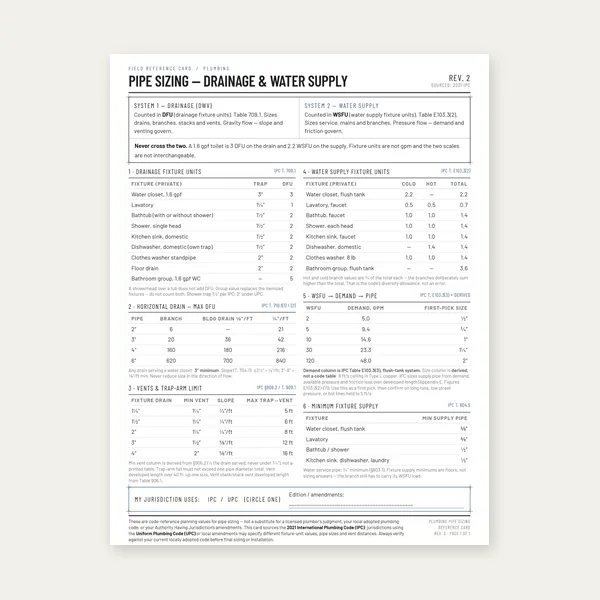
Plumbing Pipe Sizing Card
One page. DFU, drain and vent sizing, WSFU and supply, 2021 IPC.
$3.99
BuyQuiet sealed motor in the water versus a cheaper motor above the pit you can actually service — a product choice, not a GPM formula
Once the sump pump sizing calculator has given you a GPM at a head and an HP class, you still have to pick a machine. Submersible: motor in the water, quieter, sealed, usually more money, harder to service. Pedestal: motor on a column above the pit, cheaper, impeller in the water, you can replace a switch without pulling a sealed can. This page is that choice. It is the same kind of decision as process choice in welding — the numbers do not pick the architecture.
How to get the GPM/HP numbers: sizing guide. Short-cycling and check valves: troubleshooting. Plumbing index: plumbing calculators hub.
A potable well pump is a different worksheet from this basement crock: Well Pump Sizing Calculator (TDH, HP class, pressure tank — not a sump pump).
Size GPM and head first.Then pick submersible or pedestal. Starting point only.
Open Calculator →A submersible sump pump is a sealed motor and impeller sitting in the pit. Oil-filled or air-filled, it dumps heat into the water around it. A pedestal pump stands a motor on a pipe column above the lid (or above the high-water line). A long shaft drops to an impeller at the bottom. The motor stays dry.
Both are sized the same way: inflow, head, basin, cycle time. The calculator does not ask which style you want because the curve does not care. Retail listings care a lot, because one is quieter in a finished basement and the other is the pump you can work on in a crawlspace without a puller.
| Submersible | Pedestal | |
|---|---|---|
| Motor | In the water, sealed | Above the pit, dry |
| Noise | Usually quieter | Motor noise in the room |
| Service | Pull the whole unit | Switch and motor are up top |
| Price (typical 1/3–1/2 HP) | Higher | Lower |
| Pit lid / finish | Easier to cover flush | Column through the lid |
| Debris / silt | Sealed can can overheat if it runs dry | Impeller still in the muck; motor stays dry |
This is the same angle as MIG vs TIG vs stick: pick the process that matches the job constraints after the weld size (here: GPM at head) is known. Do not buy a pedestal because it is $40 cheaper if the bedroom is on the other side of the joists. Do not buy a sealed submersible for a pit you cannot pull without cutting the discharge if you are the one who will service it at 2 a.m.
Finished basement. You can hear a pedestal motor through a bedroom floor. A submersible runs under water; the pit lid and a little foam gasket do more for sleep than any HP upgrade.
You want a sealed lid. Radon, kids, pets, and a pit that is not an open well in the rec room. Pedestal columns punch through the cover. Submersibles sit under a flat lid with a cord grommet and a discharge stub.
The pit is deep enough that a pedestal column would be awkward or custom. Most residential submersibles are happy in an 18–24 in liner with a standard cover.
Tradeoffs you actually pay: when the switch fails, you are fishing a sealed pump out of a pit of groundwater, usually with a jammed check valve and a discharge you did not put a union on. Cast-iron submersibles last. They also weigh enough that “I will just lift it out” is a lie at 11 p.m. Put a union and a check you can reach from the lid.
Unfinished utility area, crawl, or a pit you will service yourself. The motor is in the air. The switch is in the air. You can replace a float without breaking the discharge union if the column is designed for it. That is the whole product.
Budget. A decent 1/3 HP pedestal is still the cheapest way to put a real pump on a curve, not a hardware-aisle utility pump in a 5-gallon bucket.
Debris-prone pits where you expect to pull the impeller often. You are not cracking a sealed housing. You are lifting a shaft. Silt still destroys impellers on both styles; you just get to the pedestal impeller without a gym session.
Tradeoffs: noise, a column through the lid, and a shaft bearing that lives in a wet pit. Pedestals are not the pretty choice for a finished family room. They are the honest choice for a mechanical room you already hate.
GPM at head is settled. Style is next. Then the pit itself vetoes you:
If the calculator says you are past a 3/4 HP residential band, neither a fancy submersible nor a cheap pedestal in that class will save you. That is dual-pump, less head, or a different pump family.
A sealed cast-iron submersible in clean water often outlasts a cheap pedestal. A sealed pump that overheats dry, or a pedestal with a replaceable switch, can flip that. Buy for service reality, then read the curve at your head.
Often yes if the diameter and cover work. You will cap or replace the lid. Do not assume the old pedestal float geometry matches the new pump. Reset tether / vertical float and re-check cycle time in the calculator.
No. Ejectors handle solids and usually sit in a sealed basin with a vent. A groundwater sump is a different pit and a different discharge. Do not use an open sump as a toilet pump.
One page. DFU, drain and vent sizing, WSFU and supply, 2021 IPC.
$3.99
Buy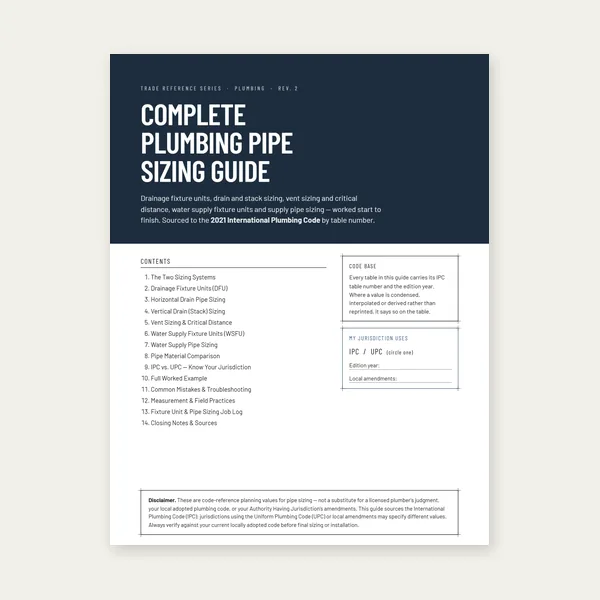
18 pages. DWV and supply sizing, plus one job worked end to end.
$12.99
Buy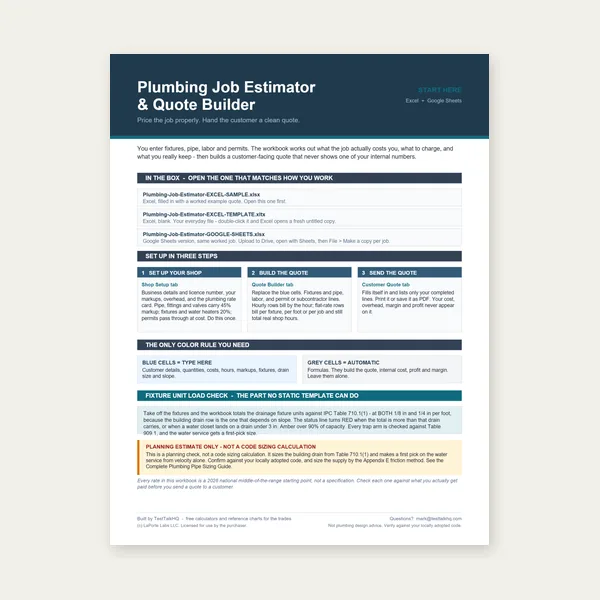
Quote plumbing work and total fixture units against the drain size.
Excel or Google Sheets. Best on a computer.
$29.00
Buy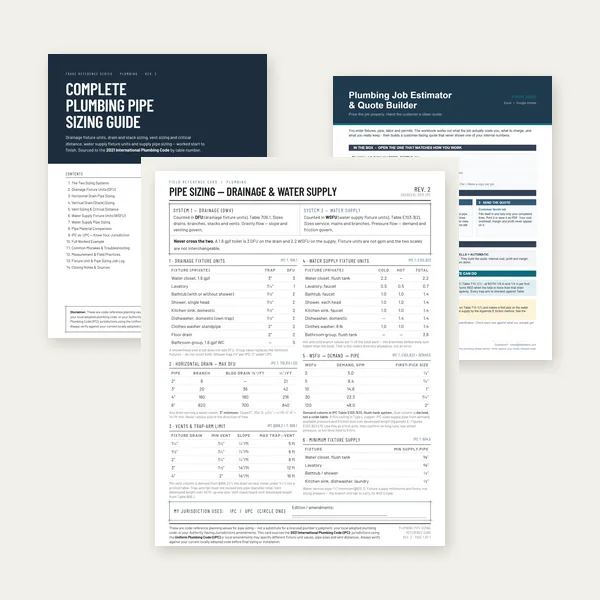
Card, 18-page guide and the estimator workbook. All six files.
Excel or Google Sheets. Best on a computer.
$34.99
$45.98 if bought separately — save $10.99
BuyCheckout opens in a new tab.
Horsepower gets you a pump. Discharge pipe, a check valve, and a basin that actually holds a cycle are why a “right-size” pump still short-cycles or floods.

Discharge is usually 1-1/4 or 1-1/2 in PVC. Leaky joints at the check valve are how a pump short-cycles after you “fixed” it.
View on Amazon →
Check valves, unions, and the discharge adapter still come apart with a wrench. Sizing math does not replace a seized swing check.
View on Amazon →
A cocked basin liner and a discharge that sags back toward the pit both fake an undersized pump. Level the pit before you blame GPM.
View on Amazon →
Unsupported discharge adds equivalent feet of head and lets the check valve slam. Strap the riser; do not let it cantilever off the pump.
View on Amazon →
A pump that “cannot keep up” is often a discharge full of silt, a crushed corrugated line, or an iced outlet. Clear the pipe before you upsize HP.
View on Amazon →
Diameter, inflow GPM, and total head. Required GPM, HP class, and estimated cycle time.
Open Sump Pump Sizing Calculator →As an Amazon Associate, TestTalkHQ earns from qualifying purchases.