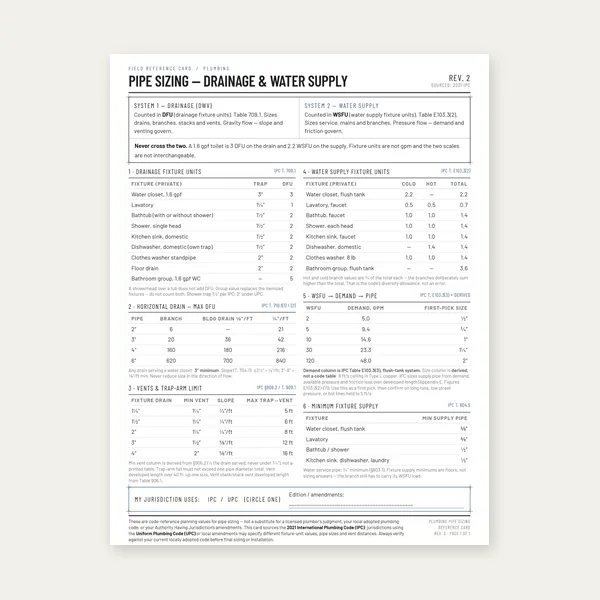
Plumbing Pipe Sizing Card
$3.99
BuySigns of an undersized heater — and what to check before you assume you need a bigger tank
Running out of hot water feels like a gallons problem. Sometimes it is. Often it is sediment, a thermostat that got knocked down, a mixing valve that is mis-set, or a dip tube that snapped off and is dumping cold inlet water straight out the hot side. Upsizing a tank that is full of scale just gives you a more expensive tank that is full of scale. Use the sizing calculator to see whether the FHR was ever in the right zip code, then work this list before you order steel.
How tank size and FHR relate: sizing guide. If the honest answer is “we need more simultaneous flow, not more storage”: tank vs tankless.
Basement groundwater is a different worksheet: Sump Pump Sizing Calculator (basin, inflow GPM, total head — starting point, not a named-model pump curve).
Check whether the FHR was ever enough.Household, bathrooms, peak hour, fuel. Starting point only.
Open Calculator →True undersize has a pattern: the tank runs out in the same peak hour, every peak hour, and it has done so since the household grew or the fixtures changed. The second shower in a back-to-back morning goes lukewarm. The dishwasher sanitizes on cold. Someone started taking showers during laundry day and the house lost the argument.
Compare that to a recovery problem. Recovery problems show up as a long wait after the tank is empty. An undersized tank empties in the first hour. A tank with a dying element, a dirty burner, or a heat exchanger buried in sediment also empties, then takes forever to come back. Both feel like “we need a bigger tank.” Only one of them is a gallon-count problem.
Hard water drops minerals on the bottom of the tank. On electric heaters those minerals bury the lower element. The element then cooks in its own jacket of scale, trips out, or heats a tiny pocket of water while the rest of the tank stays stratified and short. On gas heaters the pile of sediment becomes a thermal blanket between the burner and the water. Recovery collapses. You hear popcorn in the tank. You wait an hour for a shower that used to take twenty minutes.
Flush the tank through the drain valve (if the valve is not already clogged with the same sediment). A few gallons of white grit is your answer. A tank that has not been flushed in eight years in a 20-grain water town is not a candidate for a bigger tank until it has been flushed, and maybe not even then — the glass lining may already be done.
Anode rods belong in the same visit. A spent anode does not steal first-hour rating on day one, but a rotten tank leaks, and a rotten tank gets replaced with whatever the big-box shelf is holding, which is how households accidentally downsize. Check the anode when you flush.
Electric heaters have two thermostats hiding behind those little access plates: upper and lower. If the upper is set to 120°F and the lower was knocked to 90°F during a previous element swap, you have half a tank. The shower dies early, recovery looks fine on paper, and the carton still says 50 gallons. Reset both to the same temperature, typically 120°F unless a mixing valve is installed and you are storing hotter on purpose.
Gas heaters have a single control valve. “Hot” on the dial is not a calibrated 140°F. Use a thermometer at a nearby tap after a long unused period. If you are measuring 110°F at the tap with no mixing valve, the tank is not delivering the first-hour volume you think it is, because every gallon is closer to lukewarm already.
Thermostatic mixing valves (tempering valves) at the heater let you store 140°F and deliver 120°F. That increases usable stored energy and can raise effective first-hour delivery. It is also how you keep Legionella risk down in stored water without scalding kids at the tap. A mixing valve set too cold, or failed half-closed, will make a correctly sized tank feel small. Check the output temperature at the valve, not just the tank dial.
Cold water is supposed to enter through a dip tube that dumps at the bottom of the tank. Hot water leaves from the top. If the plastic dip tube cracks or drops off (a known failure mode on some early-2000s tubes), cold inlet water short-circuits to the hot outlet. You get a burst of hot, then cold, while the tank is still full of hot water you cannot reach. That is not undersize. That is a $20 tube.
Electric: a failed lower element leaves you with only the upper element heating the top third of the tank. First-hour rating collapses. Upper-element-only operation is also how a tank “recovers” in the sense that the top gets hot fast, then dies in a six-minute shower.
Gas: a dirty burner, blocked flue, or failed thermocouple/igniter that causes short cycling will trash recovery. Yellow lazy flame, soot, or a heater that ticks on and off is not a gallons problem.
Recirculation loops that run 24/7 steal recovery all day. The tank never starts the peak hour full. Disable the loop on a timer or add a crossover pump strategy before you blame the carton size.
If those checks pass and the DOE peak hour is still larger than the EnergyGuide FHR (or the estimated FHR from tank + input), then yes: the heater is undersized. The fix might be a larger tank, a fuel switch that buys recovery, or tankless if the real problem is simultaneous GPM. That last fork is tank vs tankless, not “always buy 80 gallons.”
You need more first-hour rating if that shower happens in the same peak hour as the others, and you need more GPM if it runs at the same time. A bathroom added for guests who shower at night may not move the morning peak at all. Put the new pattern into the calculator instead of adding 10 gallons by folklore.
A healthy 50-gallon electric at 4,500 W needs on the order of an hour to recover a large draw; gas is quicker. If you are waiting two or three hours for a lukewarm tank after one shower, look at sediment and elements before you look at a bigger jacket.
Turning it up without a mixing valve increases scald risk. With a mixing valve, storing hotter can increase usable first-hour volume. It is a legitimate tool. It is not a substitute for an FHR that was never in the ballpark, and it will not fix a broken dip tube.
$3.99
Buy
$12.99
Buy
$29.00
Buy
$39.00
BuyCheckout opens here — you stay on this page.
Sizing gets you a tank or a tankless spec. Sediment, anodes, mixing valves, and T&P valves are why a “big enough” heater still runs out of hot water.
A spent anode does not shrink the tank, but it lets the steel rust from the inside. Check it before you assume you need more gallons.
View on Amazon →
Store hotter, deliver 120°F at the tap. A mixing valve changes how much usable hot water you actually get from the same tank.
View on Amazon →
Anode, drain valve, and dielectric unions still come apart with a wrench. Sizing math does not replace a drain-and-flush.
View on Amazon →
Safety first. A weeping T&P is not a first-hour-rating problem. A drip on every recovery is often a missing or waterlogged expansion tank: expansion tank troubleshooting. Replace a valve that weeps at rest; do not cap it.
View on Amazon →
Closed municipal systems need somewhere for heated water to go. Expansion tanks are not first-hour rating, but they save the T&P from dripping all winter.
View on Amazon →
Household size, bathrooms, peak scenario, gas or electric. Tank gallons and FHR starting point.
Open Water Heater Sizing Calculator →As an Amazon Associate, TestTalkHQ earns from qualifying purchases.