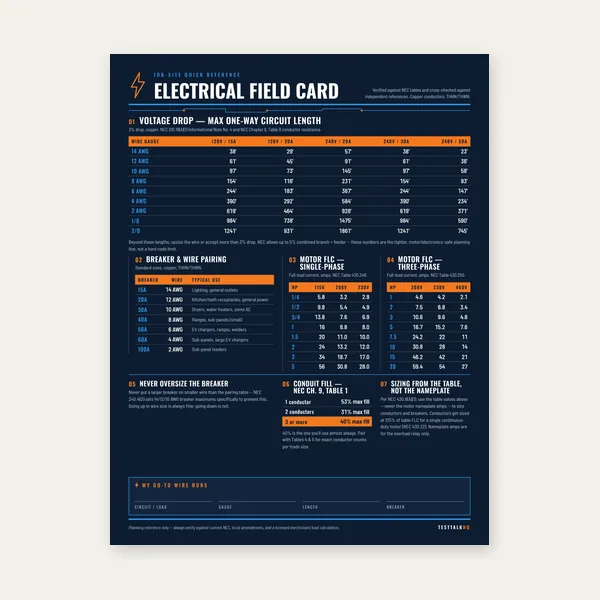
Electrical Reference Card
One page. Voltage drop lengths, breaker and wire pairing, motor FLC.
$3.99
BuyEnter your load, voltage, and power factor to calculate required transformer kVA, select the next standard size, and get NEC 450.3 overcurrent protection values.
Size single-phase and three-phase dry-type transformers from load current or kW. See the Transformer Sizing Guide for kVA formulas, NEC 450.3 rules, and installation requirements.

| Standard sizes (kVA) |
|---|
| 3 | 6 | 9 | 15 | 30 | 45 | 75 | 112.5 | 150 | 225 | 300 | 500 | 750 | 1000 | 1500 | 2000 | 2500 |
| Standard sizes (kVA) |
|---|
| 1 | 1.5 | 2 | 3 | 5 | 7.5 | 10 | 15 | 25 | 37.5 | 50 | 75 | 100 | 167 | 250 | 333 | 500 |
Transformers are sized in kVA — apparent power — not kW. The transformer's windings and core must handle the full current regardless of how much of it is doing useful work. A load drawing 80 kW at 0.80 power factor demands 100 kVA of transformer capacity. Size from kVA every time. If you only know watts and power factor, divide kW by PF to get kVA before selecting a transformer size.
Never select a transformer rated exactly at your calculated kVA. Running a transformer at 100% of rated capacity means running it at the top of its thermal design limit continuously, with no headroom for load growth or demand spikes. The engineering target is 70-80% loading at peak demand. Round up to the next standard size above your calculated requirement, then add a growth factor of 20-25% for any facility where loads will increase.
The available fault current at the transformer secondary determines the minimum interrupting rating required for every breaker, disconnect, and fuse downstream. Most standard molded case breakers are rated 10 kA or 22 kA — if your transformer's available fault current exceeds that, you need high-interrupting-capacity breakers or current-limiting fuses. Lower transformer impedance (%Z) produces higher fault current. Verify device ratings before selecting a low-impedance transformer for voltage regulation improvement.
NEC 450.21 draws a hard line at 112.5 kVA for dry-type transformer installation in occupied buildings. Units at or below 112.5 kVA can be installed in general areas with proper clearances. Units above 112.5 kVA require a dedicated transformer room with at least one-hour fire resistance. This threshold frequently influences transformer selection — when the next standard size above your calculated load is 150 kVA, seriously evaluate whether 112.5 kVA with conservative loading works, because the difference in installation requirements is significant.
One page. Voltage drop lengths, breaker and wire pairing, motor FLC.
$3.99
Buy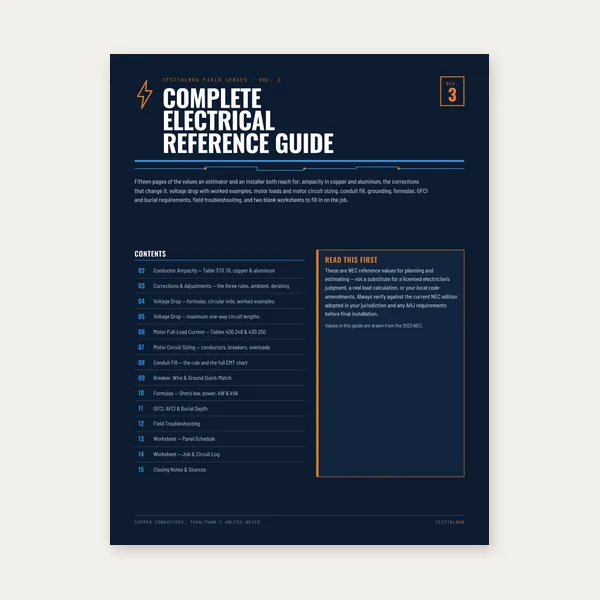
15 pages. Ampacity, corrections, voltage drop, motor circuits, conduit fill.
$12.99
Buy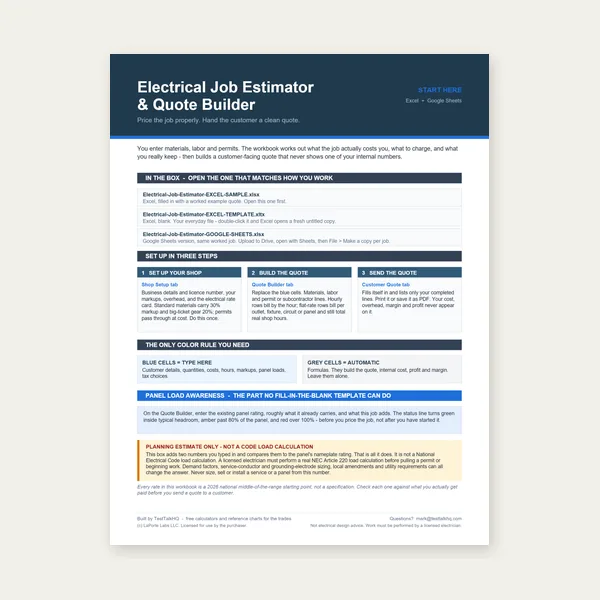
Quote electrical work and flag panel headroom before you price it.
Excel or Google Sheets. Best on a computer.
$29.00
Buy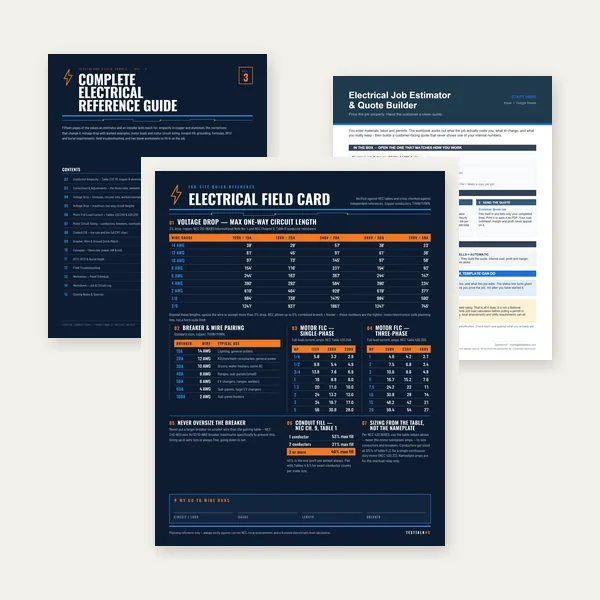
Card, 15-page guide and the estimator workbook. All six files.
Excel or Google Sheets. Best on a computer.
$34.99
$45.98 if bought separately — save $10.99
BuyCheckout opens in a new tab.
Measure primary and secondary current, verify voltage, and confirm de-energization before transformer work.


As an Amazon Associate, TestTalkHQ earns from qualifying purchases. Prices and availability subject to change.