Commercial load calculator

NEC 220 Part III occupancy VA/sq ft — retail, office, restaurant. Not a dwelling 220.82 calc.

Enter square footage, occupancy type, and equipment loads to get total demand load, service amperage, and feeder requirements for retail, office, restaurant, and light commercial tenant spaces.

Embed this calculator Free · no API key · keep the attribution link

Copy the snippet below to embed this calculator on your site. The attribution link must stay intact and dofollow (no rel="nofollow"). Browse all embeddable calculators

<div class="ttq-embed" style="max-width:100%;margin:0 auto;">
  <iframe src="https://testtalkhq.com/embed/commercial-load-calculator/?theme=light&utm_source=embed" width="100%" height="980" frameborder="0" loading="lazy" scrolling="no" title="Commercial Load Calculator — TestTalkHQ" style="border:0;max-width:100%;width:100%;"></iframe>
  <p style="font:400 13px/1.4 system-ui,sans-serif;text-align:center;margin:6px 0 0;">Powered by the <a href="https://testtalkhq.com/commercial-load-calculator/?utm_source=embed&utm_medium=referral&utm_campaign=calculator_embed&utm_content=commercial-load-calculator" target="_blank" rel="noopener">Online Commercial Load</a> from <a href="https://testtalkhq.com/?utm_source=embed&utm_medium=referral&utm_campaign=calculator_embed&utm_content=commercial-load-calculator" target="_blank" rel="noopener">TestTalkHQ</a></p>
</div>

Any trade

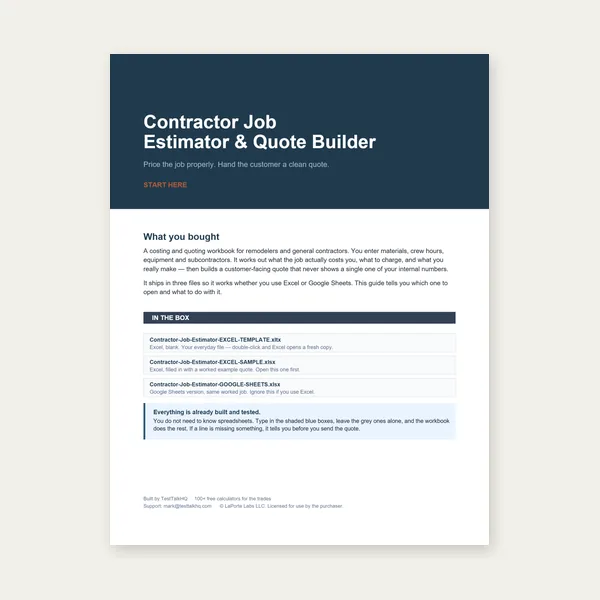
Contractor Job Estimator

Contractor Job Estimator

Price remodels and GC work, then send a quote with no internal numbers.

Excel or Google Sheets. Best on a computer.

$29.00

Buy

See all products

Checkout opens in a new tab.

Recommended electrical tools

Field picks for commercial load calculations — test circuits, measure demand current, and verify service sizing before energizing tenant equipment.

Clamp
Klein CL800 clamp meter

Klein CL800 Clamp Meter

  • Measure feeder current without breaking circuits
  • Helps validate derating assumptions
  • Auto-ranging AC/DC
View on Amazon →
Tester
Klein NCVT-6 voltage tester

Klein NCVT-6 Voltage Tester

  • Fast hot/dead checks at boxes and panels
  • Audible and visual indication
  • Everyday electrical safety tool
View on Amazon →
Strip
Klein Tools 11063W wire stripper

Klein Tools 11063W Wire Stripper / Cutter

  • Strips 10–18 AWG solid and stranded
  • Clean terminations after pulls
  • Built-in cutter and loop holes
View on Amazon →
Bend
Klein Tools 56401 1/2 inch EMT conduit bender

Klein Tools 56401 1/2" EMT Conduit Bender

  • Built for 1/2" EMT — common branch runs
  • Degree markings cast into the head
  • Size the raceway first, then bend with confidence
View on Amazon →

What this calculator does

This calculator sizes a sub-panel (feeder panel) for a detached garage, workshop, barn, or addition fed from your main service. It applies NEC Article 220 demand calculations with a 125% continuous load factor to recommend panel amperage, feeder wire gauge, and main breaker size.

NEC rule to knowSub-panel feeders are sized to 125% of continuous loads plus 100% of non-continuous loads per NEC 215.2. The calculator applies this automatically.

What each input means

  • Voltage — Most shops use 240V single-phase from a residential service.
  • Distance — Runs over 100 feet often need wire upsized one size for voltage drop.
  • Wire material — Copper carries more current per gauge; aluminum is acceptable for feeders when properly terminated.
  • Loads — Check equipment you plan to run; include everything that might operate at the same time.

Frequently asked questions

Do I need a permit to add a sub-panel?
Yes in almost every jurisdiction. Sub-panel work is inspected electrical work.
Can I put a sub-panel in a detached garage?
Yes. You need a disconnect at the structure (main breaker in the sub-panel) and a grounding electrode system — typically two ground rods.
What's the difference between a sub-panel and a main panel?
A main panel connects to the utility. A sub-panel is fed from the main panel via a feeder and has its own main breaker.

Related electrical calculators

What this calculator does

This calculator applies NEC Article 220 Part III demand calculations for tenant spaces, retail, office, restaurant, and light commercial buildings. It accounts for NEC demand factors so you can size service entrances and feeders below total connected load when the code allows.

Use it before specifying a service entrance, transformer, or main distribution panel for any commercial project. Getting demand wrong means either an undersized service that trips constantly or an oversized installation that costs more than necessary.

NEC Article 220 — key sections220.12 (lighting loads by occupancy), 220.14 (receptacle loads), 220.50 (motor loads), 220.51 (fixed electric space heating), 220.56 (kitchen equipment demand), 220.57 (EV charging), 220.60 (noncoincident loads — use larger of AC or heat, not both).

NEC lighting unit loads by occupancy

NEC Table 220.12 assigns a minimum volt-ampere per square foot for general lighting by occupancy type. These are minimums — actual lighting loads may be higher depending on fixture selection.

OccupancyVA/sq ftNotes
Office3.5 VAGeneral office, cubicles, conference rooms
Retail store3.0 VAPlus show window at 200 VA/lin ft
Restaurant2.0 VADining area — kitchen equipment calculated separately
Warehouse0.25 VAStorage only — increase for active pick areas
Medical / healthcare2.0 VAExam rooms and labs often require more
School3.0 VAClassrooms and corridors

Demand factors explained

  • Receptacle loads (NEC 220.44) — first 10 kVA at 100%, remainder at 50% for general-use receptacles.
  • Kitchen equipment (NEC 220.56) — 65% to 100% depending on number of pieces of equipment.
  • Noncoincident loads (NEC 220.60) — use only the larger of heating and cooling when they cannot operate simultaneously.
  • Motor loads (NEC 220.50) — 125% of the largest motor plus 100% of other motors (simplified in this tool).
  • EV charging (NEC 220.57) — continuous load at 125%.
Common mistakeAdding both HVAC and electric heat to the total. NEC 220.60 says use only the larger load when the two cannot operate simultaneously.

How to use results on the job

The recommended service amperage is the minimum per NEC Article 220. Standard commercial service sizes are 100A, 200A, 400A, 600A, 800A, 1200A, 1600A, and 2000A. Always specify the next standard size up from your calculated demand.

For 120/208V 3-phase service, demand amps = VA ÷ (208 × 1.732). For 277/480V service: VA ÷ (480 × 1.732).

Frequently asked questions

Does this calculation replace an engineer's stamp?
No. For permitted commercial work, most jurisdictions require a licensed engineer or electrical contractor to sign the load calculation. This calculator gives you working numbers for planning.
What's the difference between connected load and demand load?
Connected load is every circuit at full rated capacity. Demand load is connected load after NEC demand factors. Service and feeders are sized to demand load.
How do I handle mixed-use space?
Calculate each occupancy area separately using its own VA/sq ft factor, then sum the results. This tool uses one occupancy type per run.

Related electrical calculators