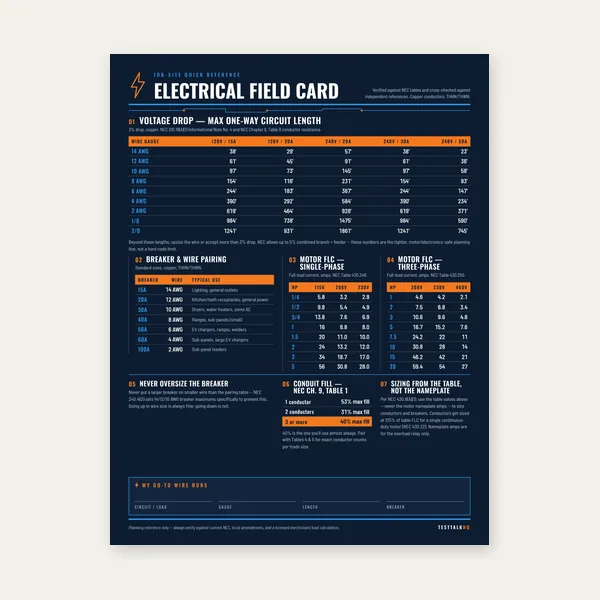
Electrical Reference Card
One page. Voltage drop lengths, breaker and wire pairing, motor FLC.
$3.99
BuyCopper or aluminum wire · Single-phase, three-phase, or DC · NEC-oriented limits
One page. Voltage drop lengths, breaker and wire pairing, motor FLC.
$3.99
Buy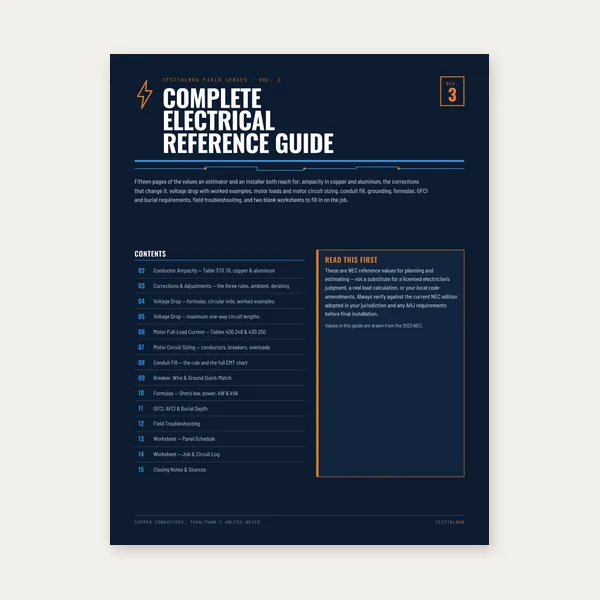
15 pages. Ampacity, corrections, voltage drop, motor circuits, conduit fill.
$12.99
Buy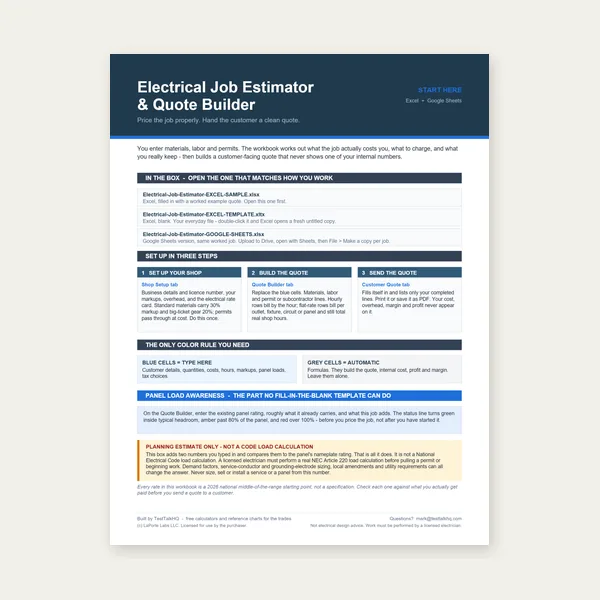
Quote electrical work and flag panel headroom before you price it.
Excel or Google Sheets. Best on a computer.
$29.00
Buy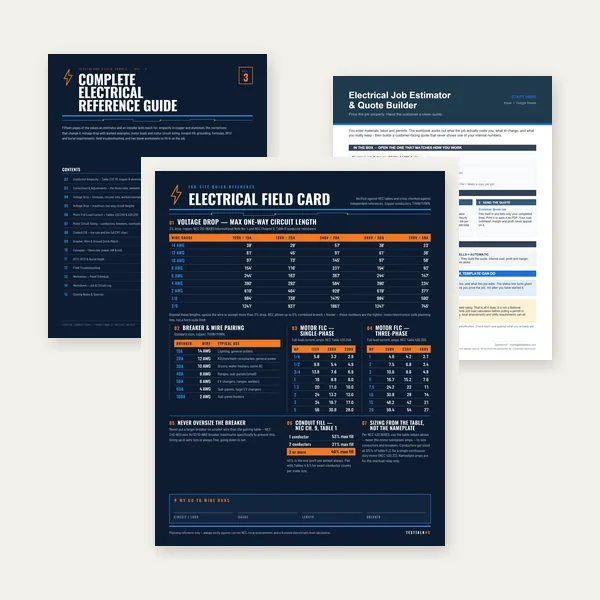
Card, 15-page guide and the estimator workbook. All six files.
Excel or Google Sheets. Best on a computer.
$34.99
$45.98 if bought separately — save $10.99
BuyCheckout opens in a new tab.
Gear for measuring voltage and current, tracing circuits, and making safe terminations—paired with voltage-drop planning (affiliate links).
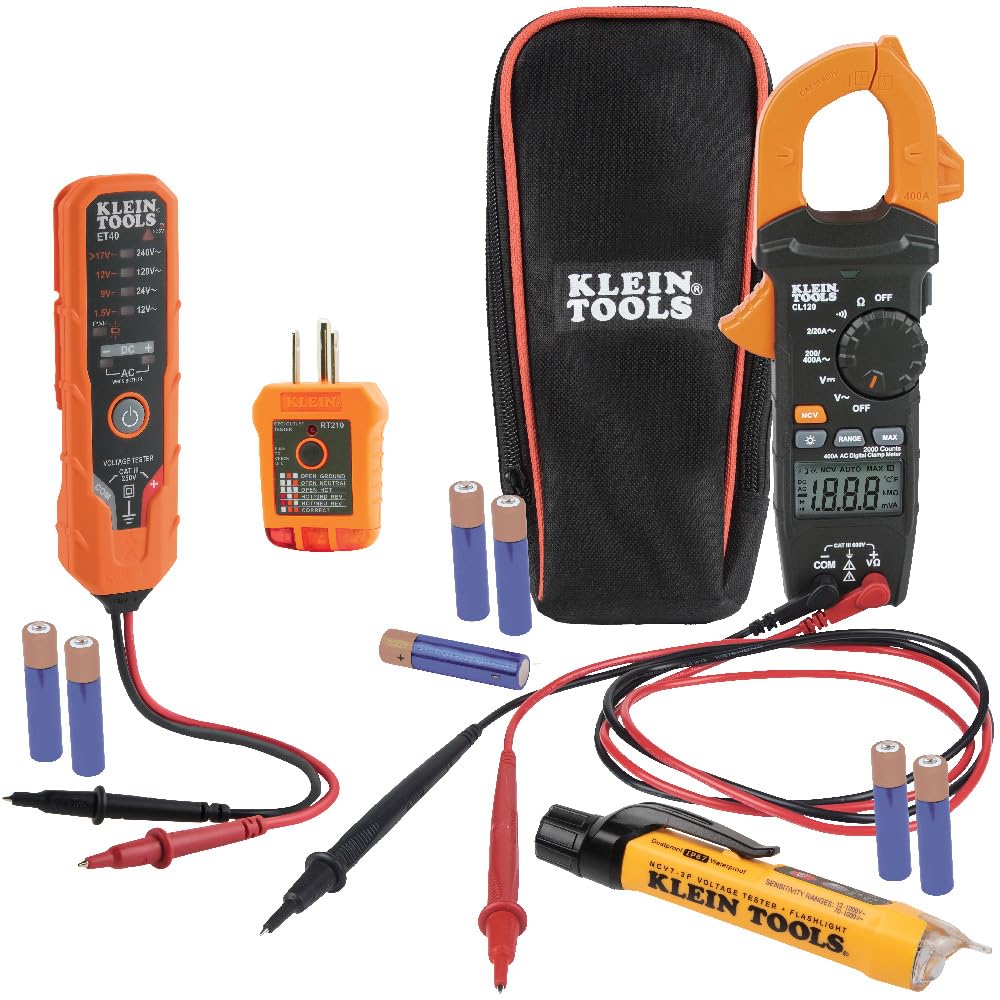
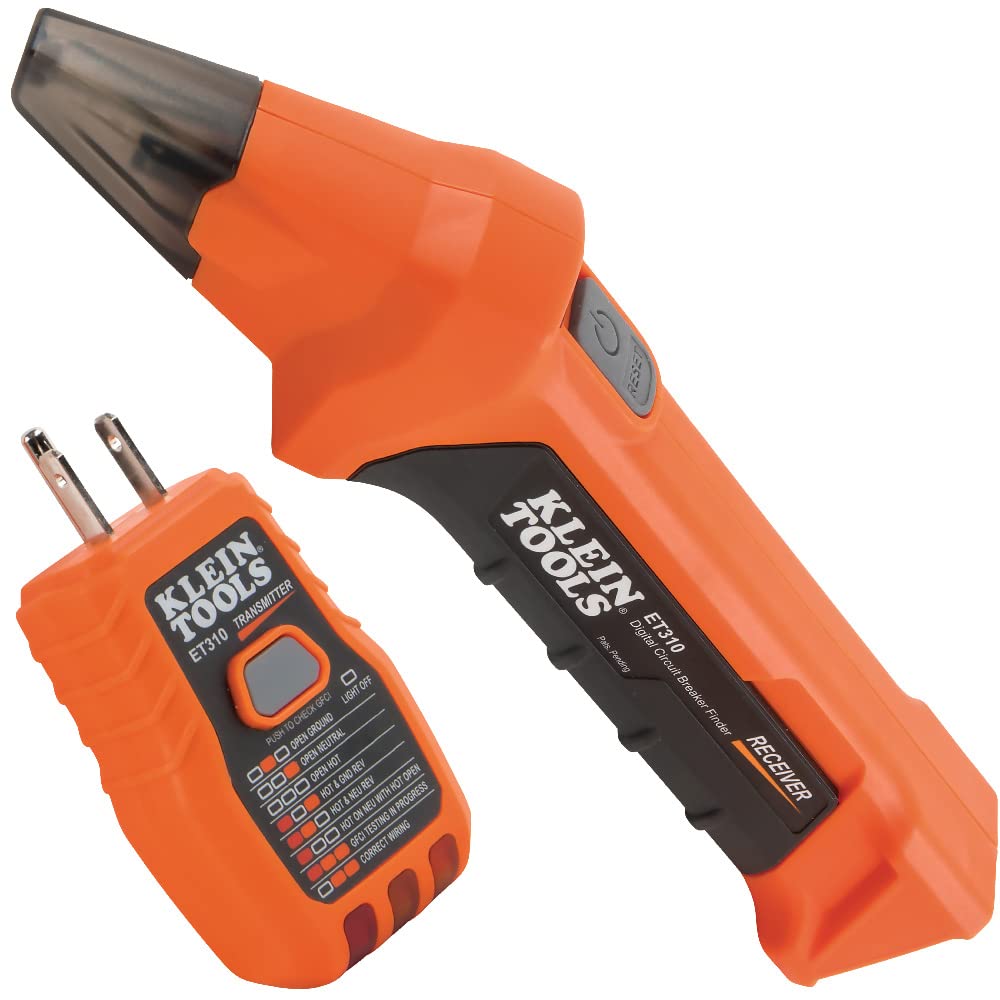
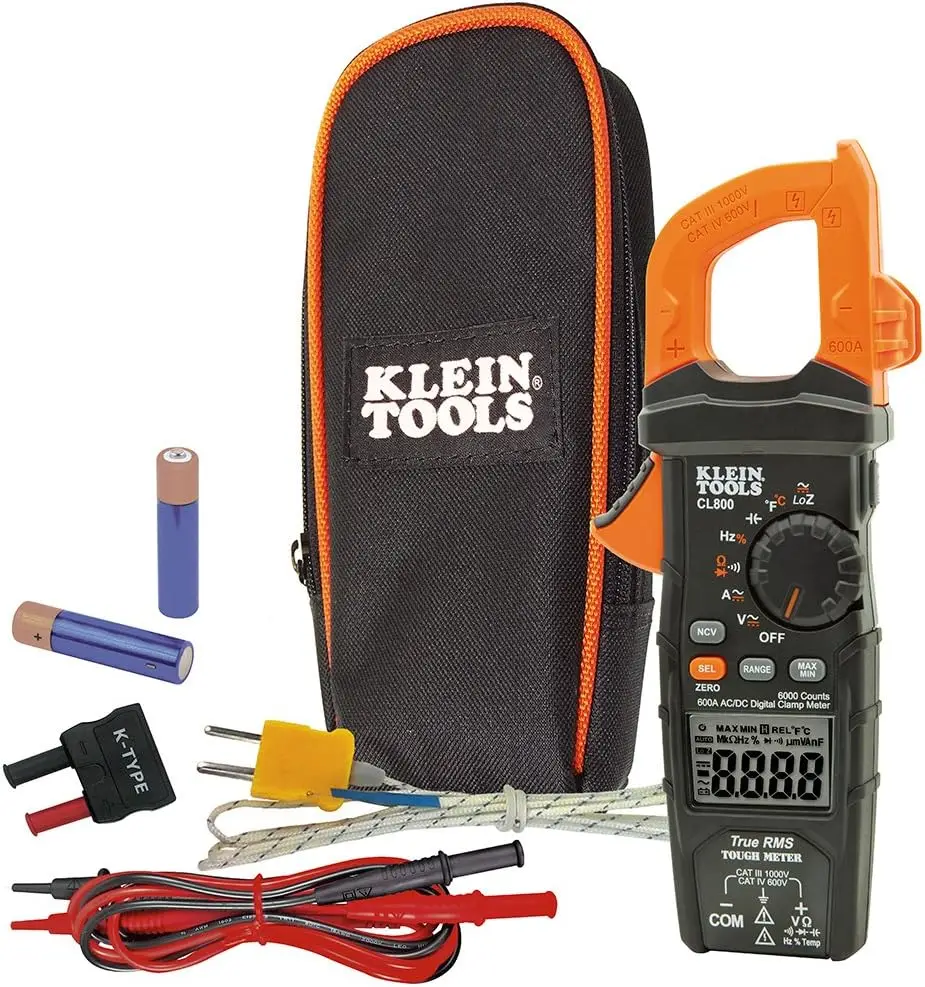

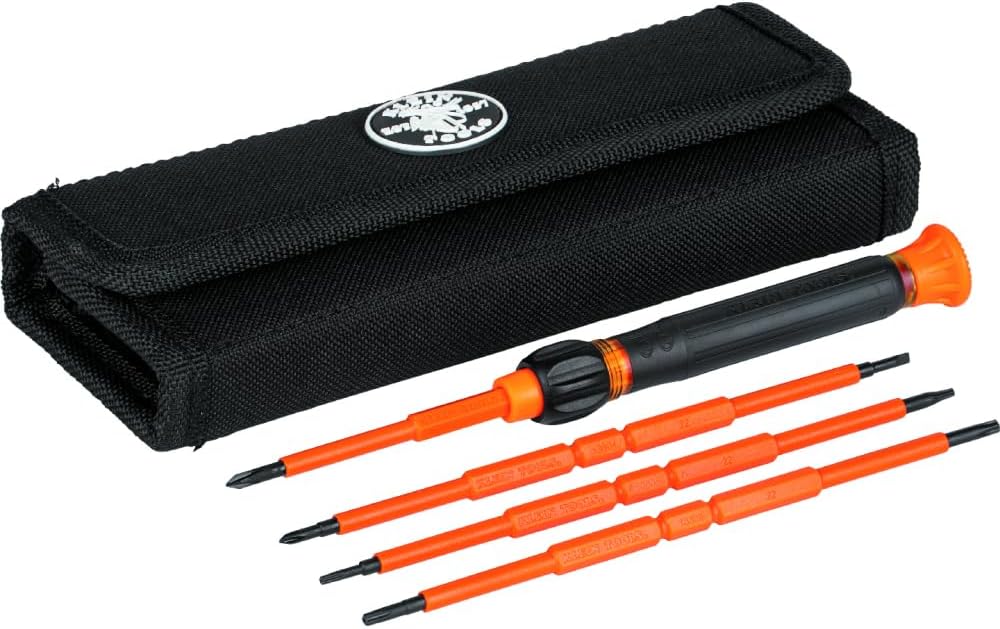
As an Amazon Associate, TestTalkHQ earns from qualifying purchases. Prices and availability subject to change.
Want voltage drop, wire and breaker sizing, and motor FLC on one card you can keep in the van?
View on Etsy →Approximate percent drop for a 20 A load on 120 V single-phase copper at common branch-circuit gauges. Curves use NEC Table 9 resistance at 75°C (no ambient or bundling adjustment). Longer runs and smaller wire climb fastest — upsizing one AWG often cuts drop nearly in half.
Voltage drop is easy to overlook until equipment misbehaves. Enter source voltage, phase type, conductor type and size, load current, and one-way length—then compare percent drop to your target (commonly 3% branch / 5% combined).
Conductors resist current flow; that lost energy shows up as voltage missing at the load. Motors, electronics, and heating loads all behave worse when supply voltage sags—especially on long feeders or small wire.
Want voltage drop, wire and breaker sizing, and motor FLC on one card you can keep in the van?
View on Etsy →What is an acceptable voltage drop for a branch circuit?
The NEC recommends keeping branch circuit voltage drop to 3% or less. For feeder plus branch combined, 5% is the commonly cited overall ceiling.
Does voltage drop change breaker sizing?
No—breaker size follows load and conductor ampacity rules. You may upsize wire for drop while keeping the same breaker when ampacity still complies.
What formula does this tool use?
For single-phase and DC: VD = 2 × L × I × R. For three-phase: VD = 1.732 × L × I × R (with R in ohms per foot, length in feet). See also our how-to article.
Explore more tools at TestTalkHQ.com, including welding, fabrication, and shop calculators.
Excessive voltage drop is not just a numbers exercise on paper — it shows up as real equipment problems on the job. When supply voltage sags at the load, motors draw more current to maintain torque, run hotter, and wear out insulation faster. Lights dim under load. Sensitive electronics and control circuits can malfunction or reset when voltage dips below their minimum operating range.
The NEC recommends keeping voltage drop to 3% or less on branch circuits and 5% total when you combine feeder and branch runs. Those are planning guidelines, not hard breaker-sizing rules, but they reflect what electricians see in the field every day. Planning for drop upfront avoids callbacks for nuisance trips, weak motor starts, and flickering lighting on long homeruns.
Every conductor has resistance per foot. Smaller wire (higher AWG number) has more resistance, so more voltage is lost over the same distance at the same current. Larger wire (lower AWG number) cuts resistance — often dramatically — which is why upsizing one conductor size is the first fix when drop runs high on a long circuit.
As a rough rule of thumb, doubling the cross-sectional area of the wire roughly halves the resistance, which roughly halves the voltage drop for the same length and load. That is why a 100-foot run that fails at 12 AWG may pass comfortably at 10 AWG or 8 AWG. Always verify ampacity separately; upsizing for drop does not automatically mean you can increase breaker size.
Low-voltage DC systems — solar battery banks, RV wiring, marine circuits, and off-grid installs — are especially sensitive to voltage drop because the same absolute volt loss is a much larger percentage of the total. A 1-volt drop on a 120V branch circuit is less than 1%. On a 12V system, that same 1-volt loss is over 8%, which can prevent inverters from starting, leave batteries undercharged at the far end of a run, or cause lights to look dim. For vehicle and accessory copper (winch, lights, amp) use the dedicated 12V DC wire gauge calculator and the 12V accessory sizing guide rather than treating this NEC-oriented tool as a chassis-wiring spec.
Design low-voltage runs with short paths, generous wire size, and solid terminations. Use this calculator with your actual source voltage (12V, 24V, 48V) and treat the 3% / 5% targets as even more critical than on utility-fed AC circuits. Many installers target 2% or less on critical DC homeruns.
Wire sizing has two independent requirements that both must pass. Ampacity is the thermal rating — can the conductor safely carry the load current without overheating insulation? That comes from NEC Table 310.16 (with derating for ambient temperature, bundling, and other factors). Voltage drop is a performance check — will enough voltage reach the load over the run length?
A wire can be ampacity-compliant yet still fail voltage drop on a long feeder. Conversely, upsizing for drop does not replace ampacity or breaker coordination rules. Always check both before you order wire or pull a homerun. Pair this tool with our wire ampacity derating calculator and voltage drop guide for a complete branch circuit plan.