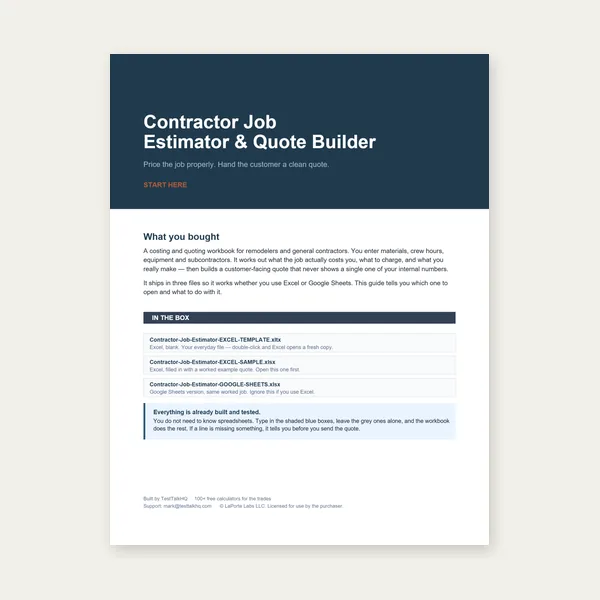
Contractor Job Estimator
Price remodels and GC work, then send a quote with no internal numbers.
Excel or Google Sheets. Best on a computer.
$29.00
BuyUneven risers, squeaks, thin throat, and code failures
Most stair callbacks are not mysterious. The first riser grew when hardwood went down, a joint is rubbing, or the well never had enough run for a legal tread.
Re-check the layout with the Stair Stringer Calculator using finished-floor rise. Marking order: layout guide.
Confirm the layout numbers firstIf rise or run is illegal, no amount of shimming fixes the inspection.
Open Calculator →IRC allows 3/8" from the tallest to the shortest riser in a flight. People trip on less. The usual causes are not “the square slipped.” They are finish-floor math and a bottom cut that was never dropped.
First riser tall after hardwood goes down. You laid out to subfloor, then added 3/4" finish. Every other rise is still 7.2"; the first is 7.95" and you fail both comfort and, often, code. Fix: drop the bottom of the stringer by the finish thickness before you hang it, or plane/shim only if you are still in dry-fit. After drywall and treads, the honest fix is recut or a landing rebuild.
Last riser short. Upper landing finish is thinner than the treads, or the header is not where the story pole said. Measure finished-to-finished again. Do not add a fat nosing or a tapered last tread to hide it — that is a second defect.
Random variation in the middle. You laid out three stringers separately, or the circular saw ran past the line and you “cleaned up” with a chisel. Use one pattern. If the treads are already on, a story pole against each riser face tells you which ones to shim (thin, glued plywood under the tread back) versus which ones to pull and recut.
Layout walkthrough: stair stringer layout guide. Re-run the calculator with the measured finished rise, not the plan rise.
A stair squeak is two pieces rubbing. Find which pair before you blow construction adhesive into every gap.
Open stringers squeak more because the triangular bearing is small. Housed stringers squeak in the dado if the groove is oversize. Type choice: open vs closed.
The calculator's FAIL flag is the typical IRC residential pair: unit rise over 7.75" or unit run under 10". Those are the two that kill a final more often than headroom, because people squeeze a stair into a closet-width well.
Rise too tall. Not enough risers for the floor-to-floor. Add a riser (which shortens each tread's run) or lower the total rise (rarely possible). If adding a riser drops unit run under 10", the well is too short for a straight legal flight. The honest answers are a longer well, an intermediate landing, or winder geometry (not this calculator).
Run too short. Plenty of height, not enough going. Fewer risers would lengthen each tread but would push rise over 7.75". Same fork: you cannot have both in that box. Do not “gain run” by shrinking nosing below the code range or by measuring run along the stringer instead of horizontally.
3/8" variation. Legal unit sizes, illegal spread. This is a build defect, not a layout-math defect. Story pole every riser. Pull treads until the faces agree.
Headroom. 6' 8" plumb off the nosing line. A legal rise/run can still clip a header. The calculator does not model this. Hold a story pole plus a 6' 8" stick on the nosing line before you order drywall.
Open-stringer splits start at an overcut crotch or at a remaining throat under ~3.5". The calculator reports throat for 2x12 / 2x10 / 2x8. If it is already thin on paper, a 7-1/4" saw that blows 3/8" past the line will finish the job.
Fixes before hang: recut from a wider board, flatten the pitch (more run), or switch to housed stringers so you are not notching triangles. Sistering a second 2x onto a split stringer works if you still have access; it does not un-fail a 7.9" riser.
Flight feels bouncy. Missing center stringer on a 36"+ width, or stringers toenailed instead of hung. Add a center cut stringer or a housed wall stringer. Glue and screw treads. A steel landing beam is a different tool: the steel beam calculator if the header is steel, not a 2x12.
Re-check the numbers against finished floorsThen decide whether this is a layout fail or a fastening fail.
Open Stair Stringer Calculator →Not if the flight was already at the 3/8" variation limit. A 1/2" shim is an inspection fail and a trip. Recut or rebuild that step.
Wood dried and the joint opened. Glue blocks still work. Talc is a winter-only mask.
They measure nosing to nosing horizontally, not along the pitch and not including a bullnose that was never there. Re-measure with a level and a tape on the going, then compare to the calculator's unit run.
Still counts in the 3/8" rule. Drop the stringer for the tile thickness so the first finished rise matches the rest.
Price remodels and GC work, then send a quote with no internal numbers.
Excel or Google Sheets. Best on a computer.
$29.00
BuyCheckout opens in a new tab.
A framing square and stair gauges do the layout. The saw only follows the line. Pair this calculator with a square you trust and a story pole before you notch a 2x12.
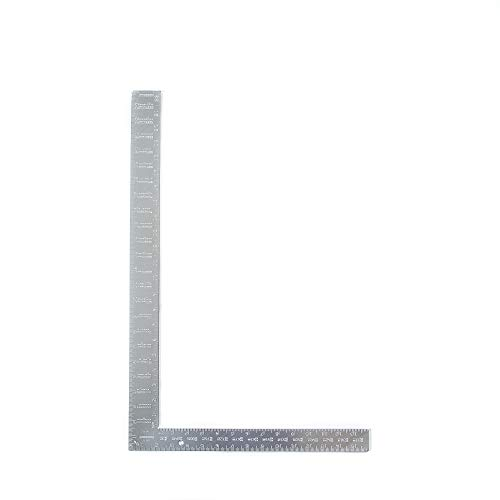
Fast 90 and 45 checks on the first and last plumb cuts. Not a substitute for a rafter square on the full rise/run walk, but it squares the drop and the landing cut.
View on Amazon →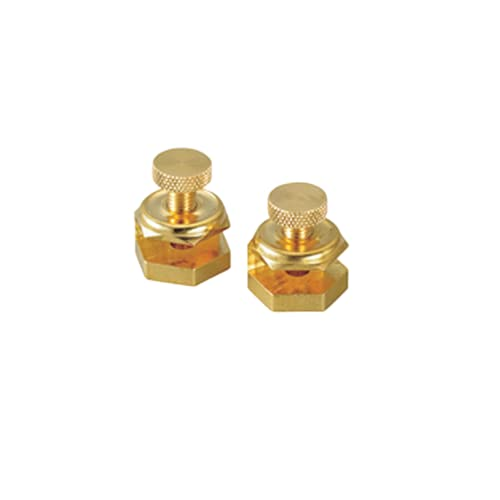
Clamp these on the body and tongue of a framing square at unit rise and unit run. Walk the square down the 2x12 without losing the numbers.
View on Amazon →
The layout tool this calculator is written for. Unit rise on the tongue, unit run on the body, then step it down the stringer. Aluminum stays readable in shop light.
View on Amazon →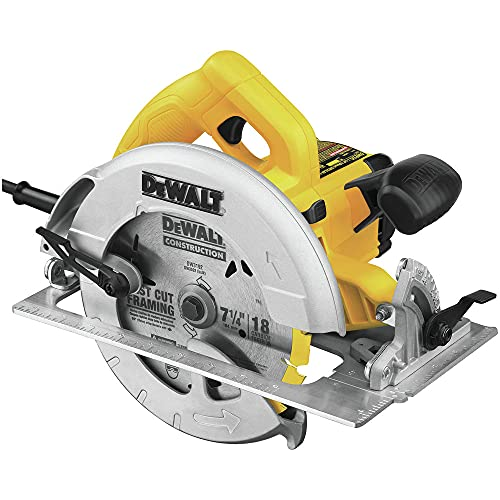
Cut to the line, not through the crotch. Stop the circular saw short of the inside corner and finish with a handsaw so you do not weaken the remaining throat.
View on Amazon →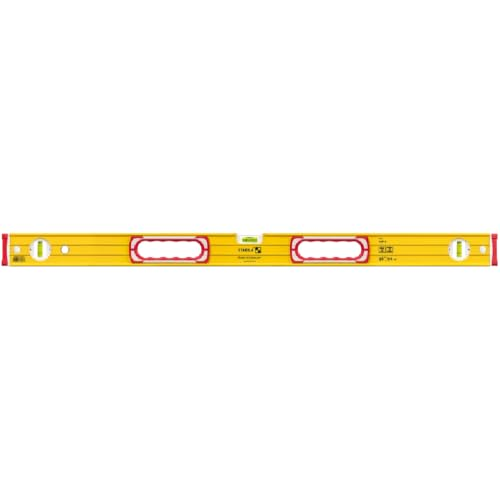
Check the first riser plumb and the first tread level before you commit the rest of the flight. A long level also proves the landing and the stringer seats.
View on Amazon →
Story pole, square walk, and the overcut rule. Use the calculator for numbers, then this guide before the first kerf.
Read the Layout Guide →As an Amazon Associate, TestTalkHQ earns from qualifying purchases.