Welding Reference Card
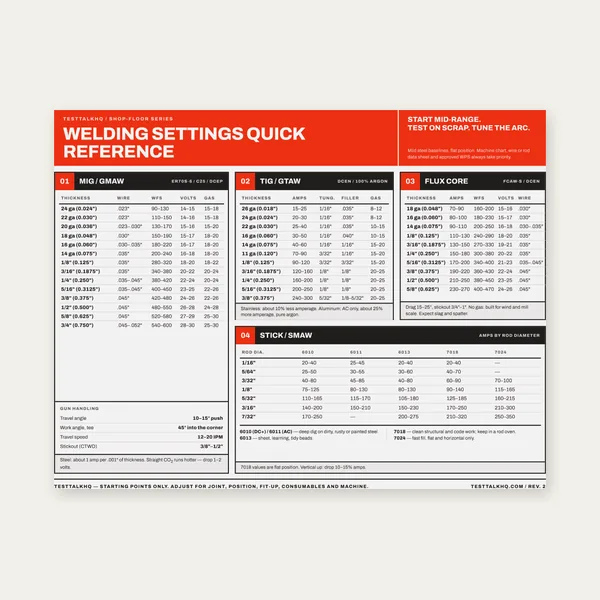
One page. MIG, TIG, stick and flux core settings by thickness.
$3.99
BuyLoad capacity and pass/fail check per AWS D1.1 and AISC
One page. MIG, TIG, stick and flux core settings by thickness.
$3.99
Buy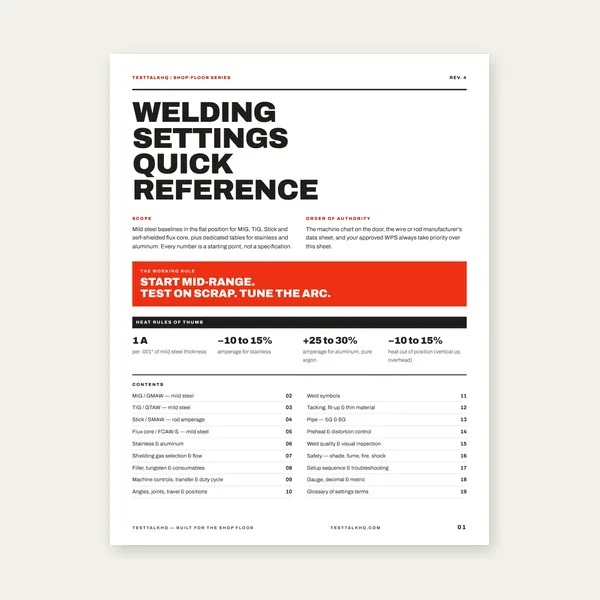
19 pages. Four processes, stainless and aluminum, symbols and inspection.
$12.99
Buy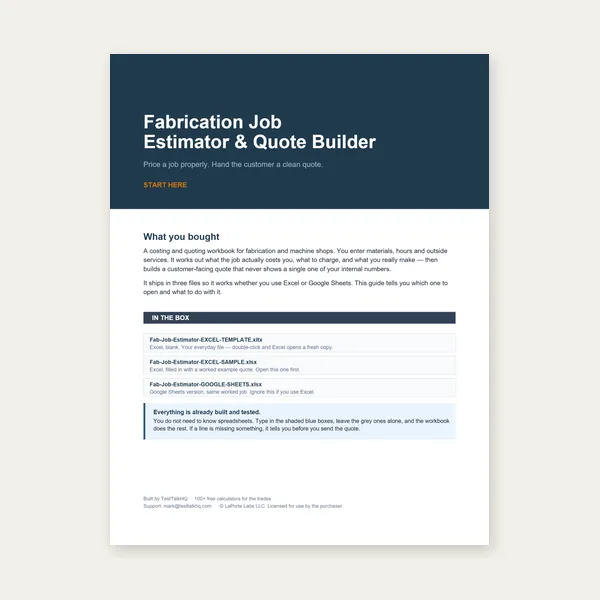
Price the job, then hand over a quote with no internal numbers.
Excel or Google Sheets. Best on a computer.
$29.00
Buy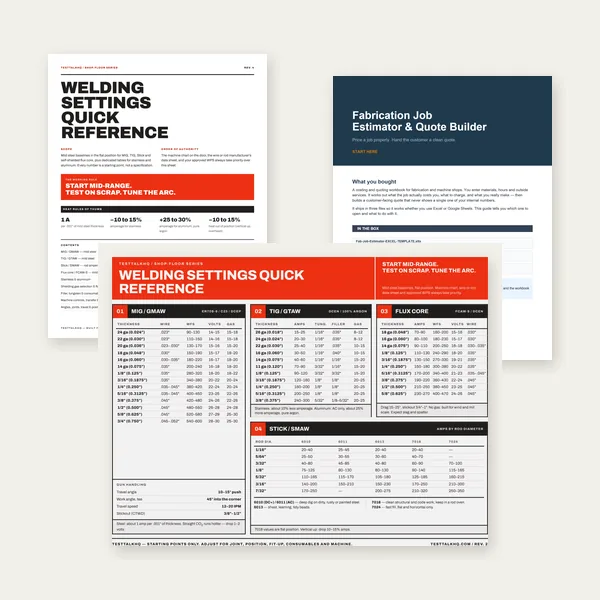
Card, 19-page guide and the estimator workbook. All six files.
Excel or Google Sheets. Best on a computer.
$34.99
$45.98 if bought separately — save $10.99
BuyCheckout opens here — you stay on this page.
Select imperial or metric units, then enter weld leg size a and weld length L. Choose one or two weld lines, orientation (transverse or parallel), and electrode class. Optionally enter applied load F for a demand/capacity pass/fail check. Open Advanced to enter base metal thickness for AWS D1.1 minimum fillet size and adjust base metal yield strength Fy for the shear rupture check.
Effective throat: For an equal-leg fillet, effective throat t = 0.707 × a. This is the critical dimension for shear strength on the failure plane through the weld throat.
Allowable stress on weld metal: AWS D1.1 / AISC use allowable shear stress on the throat Fw = 0.30 × FEXX, where FEXX is the electrode classification strength (60, 70, 80 ksi, etc.).
Capacity: P = Fw × t × L × (number of welds). This is nominal weld metal strength in shear on the effective throat area.
Base metal shear rupture: Simplified LRFD check φRn = 0.75 × 0.6 × Fy × tbm × L × n. Governing strength is the lesser of weld metal capacity and base metal rupture when both apply.
Demand/capacity: When load F is entered, D/C = F / Pgoverning. PASS when D/C ≤ 1.0.
Table 5.7 sets minimum fillet weld size from thicker connected part (base metal thickness):
Maximum fillet size is also limited by part thickness — do not exceed AWS maximums when detailing.