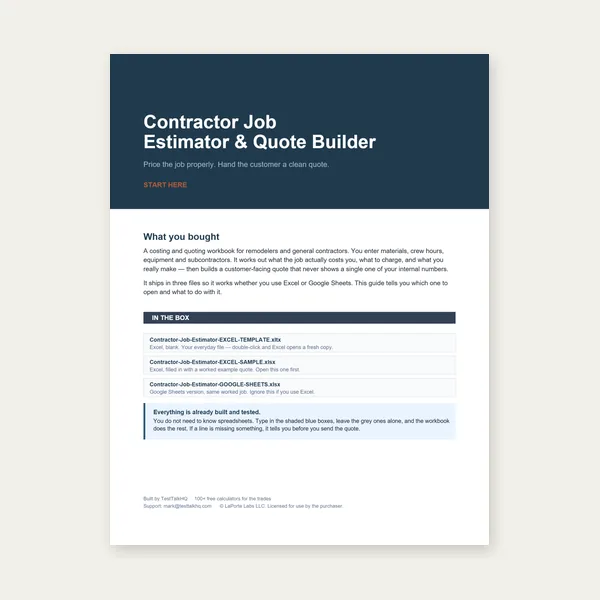
Contractor Job Estimator
Price remodels and GC work, then send a quote with no internal numbers.
Excel or Google Sheets. Best on a computer.
$29.00
BuyChain multiple press-brake bends into one complete flat blank — PDF, DXF, CSV, and JSON
Enter thickness, inside radius, and K-factor, then add each leg and bend in sequence. The unfolder computes bend allowance and bend deduction per bend, sums the flat-blank length, and draws the side profile and to-scale flat pattern with dashed bend lines. Export a printable PDF with a reference square, a DXF outline, a CSV breakdown, or a JSON save file. Size one bend first with the single-bend calculators.

How to use: Set units, thickness, inside radius, and K-factor. Pick a dimensioning convention — outside / mold-line (dimensions to the sharp corner, as a drawing shows) or inside / flat-leg (flat length between tangent lines). Add legs and bends in order, then export the flat-pattern PDF (print at 100%, verify the reference square), DXF, CSV, or Save JSON to resume later. Size a single bend first with the Bend Allowance Calculator or Bend Deduction Calculator, and see the flat-pattern guide.
Price remodels and GC work, then send a quote with no internal numbers.
Excel or Google Sheets. Best on a computer.
$29.00
BuyCheckout opens in a new tab.
Verify bend angles, transfer flat-pattern marks, and cut the blank — products from the TestTalkHQ affiliate catalog.
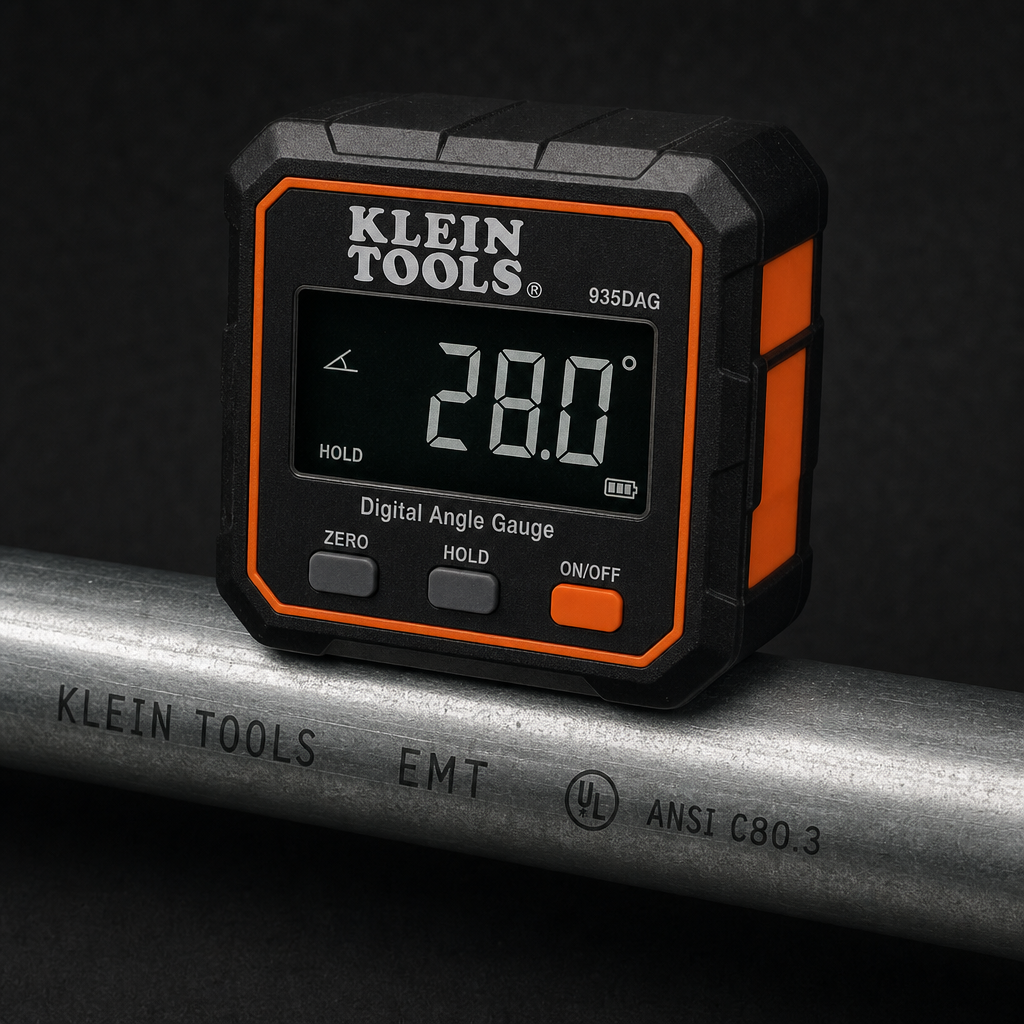
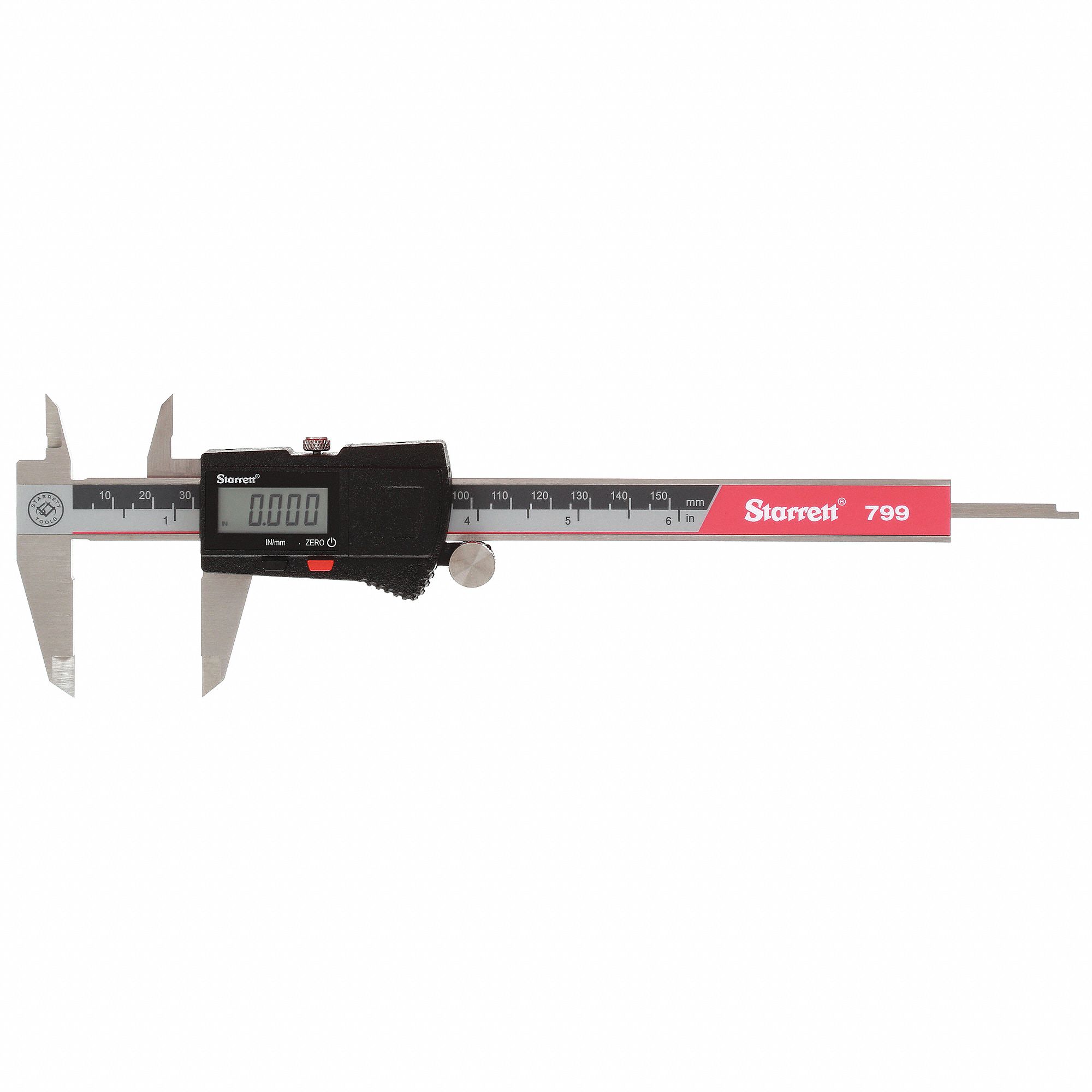
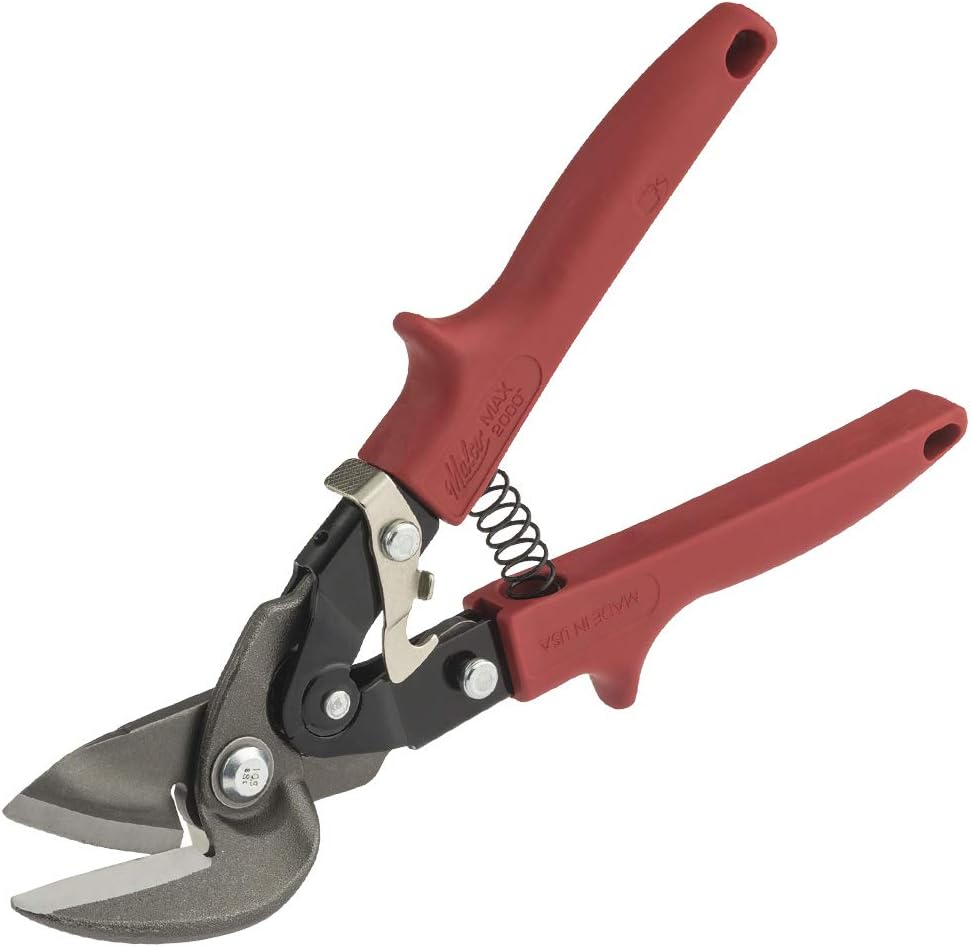
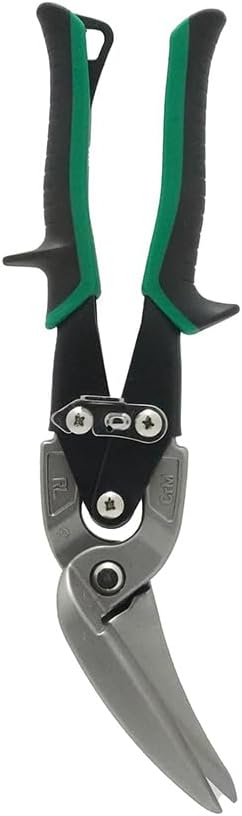
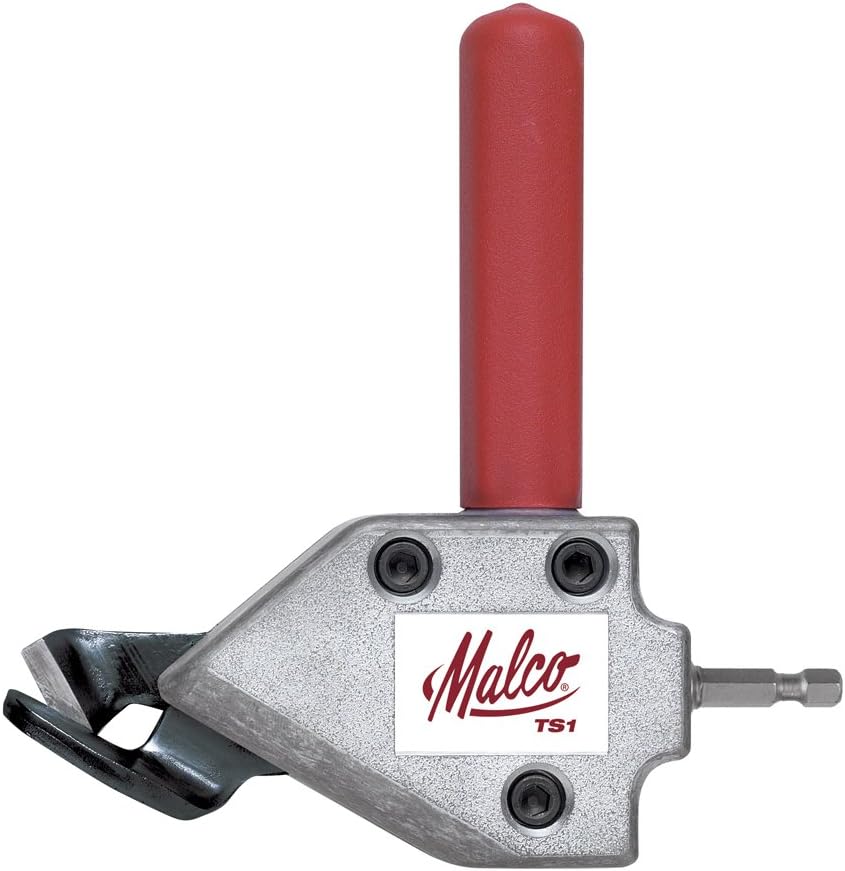
As an Amazon Associate, TestTalkHQ earns from qualifying purchases.
Real press-brake parts — U-channels, hat sections, boxes, brackets — are a chain of flat legs separated by bends. This unfolder models that chain directly: each leg is a flat face and each bend folds the next leg by a bend angle. The tool walks the sequence, adds the bend allowance (neutral-axis arc) at every bend, and reports the total flat-blank length so you cut the blank once and form it correctly. Add or remove bends up to 30 per part.
Outside / mold-line (BD) mode reads dimensions to the sharp outside corner where two faces would meet — the way drawings are usually dimensioned. Flat length = sum of outside legs − sum of bend deductions. Inside / flat-leg (BA) mode reads the flat length between bend tangent lines. Flat length = sum of flat legs + sum of bend allowances. Both converge to the same blank (the tool cross-checks them), but you must dimension the whole part in a single convention — mixing outside and inside dims on one part is the fastest way to a wrong blank.
Bend allowance is the arc length of the neutral axis through a bend: BA = (π/180) · A · (R + K·T). Outside set-back is OSSB = (R + T) · tan(A/2), and bend deduction is BD = 2·OSSB − BA (the familiar 2(R+T) − BA at 90°). The K-factor locates the neutral axis inside the material; 0.44 is a reasonable starting point for many mild-steel processes, but always verify it against a test bend on your actual material and press. Open Show the math / derivation to see every term.
The PDF prints the flat pattern to scale (1:1 when it fits the page, otherwise fit-to-page with a clear note) plus a 1 in / 50 mm reference square — print at 100% and measure the square before trusting it as a template. The DXF is a minimal R12 line-only export with an OUTLINE rectangle and dashed BEND centerlines for maximum CAD/CAM compatibility. CSV gives the per-feature breakdown for spreadsheets, and Save/Load JSON stores the entire part (units, mode, material, legs, and bends) so you can reopen and edit it later.