You’re bidding a fabrication job that requires 200 feet of MIG welds on 1/4″ steel, and you need to know: how many pounds of wire will this consume, and what will it cost? Guess too high and you price yourself out of the job. Guess too low and you eat the material cost when reality hits. The difference between estimating 15 pounds of wire at $45 versus the actual 22 pounds you’ll use is $21—not catastrophic on one job, but multiply that across 50 jobs per year and you’ve lost over $1,000 to poor consumption estimates.
Welding consumable costs are easy to underestimate because they’re incremental—each weld uses a little wire, each pass burns a little electrode—but they add up to 15-25% of total welding costs on most jobs. If you’re not tracking wire and electrode consumption accurately, you’re either losing money on jobs or pricing yourself out of competitive bids. Professional shops track deposition rates, transfer efficiency, and stub loss because these numbers directly impact profitability.
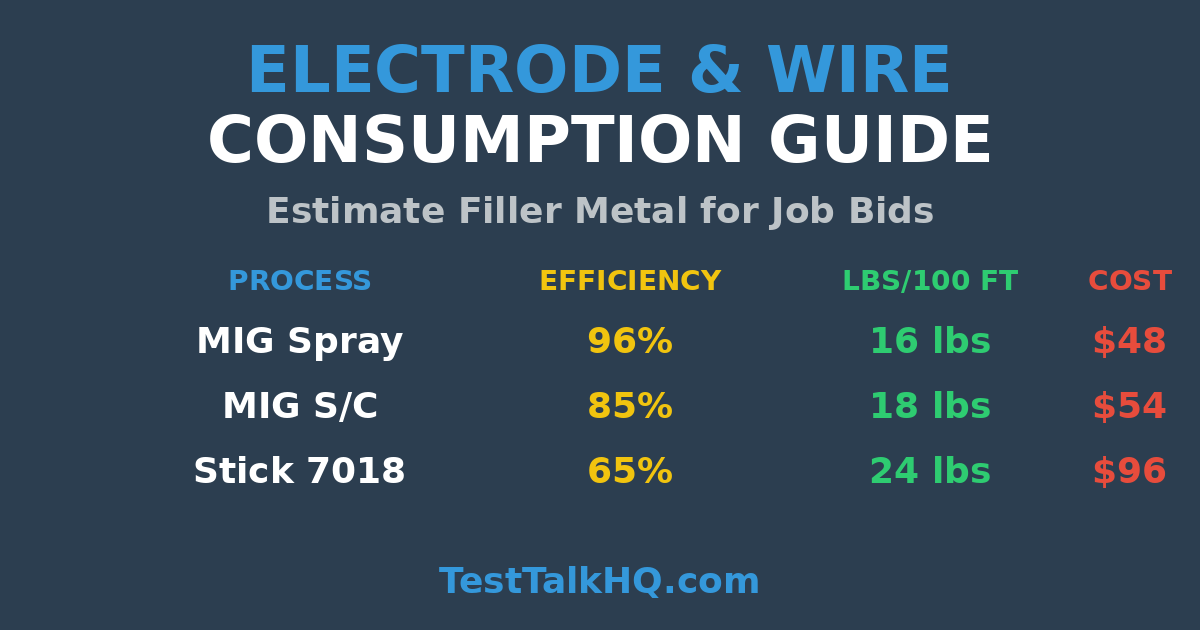
This guide shows you how to calculate wire and electrode consumption for MIG, TIG, and Stick welding using deposition rate formulas, explains transfer efficiency percentages by process (MIG spray = 98%, short-circuit MIG = 85%, Stick = 60-65%), and gives you real-world consumption rates for different materials and joint types. You’ll learn how to estimate filler metal for job bids, when bulk buying saves money, and the five most common estimation mistakes that cause shops to lose money on material costs.
Use our free Electrode & Wire Consumption Calculator to estimate filler metal requirements for any welding project.
Jump to what you need
Why Consumption Tracking Matters for Profitability
Welding consumables—wire, electrodes, filler rod, and gas—typically represent 15-25% of total welding costs on fabrication jobs. For a $10,000 welding project, that’s $1,500-2,500 in consumable expenses. If you underestimate consumables by 20%, you’ve just lost $300-500 in profit on that single job.
The Cost of Poor Consumption Estimates
Real-world example: Structural steel fabrication job
Estimated consumables: 30 lbs of .035″ MIG wire @ $3/lb = $90
Actual consumption: 42 lbs (40% more due to overwelding and spatter)
Actual cost: $126
Lost profit: $36 on consumables alone
Add gas consumption (underestimated by 25%), grinding discs, and extra labor from re-dos, and this job just lost $75-100 in profit. Across 50 jobs per year, poor estimates cost $3,750-5,000 annually.
What Affects Consumable Consumption
Wire and electrode consumption depends on:
- Joint type: Fillet welds use less filler than groove welds
- Material thickness: Thicker material requires larger welds, more filler
- Welding process: MIG spray = 98% efficiency, Stick = 60-65% efficiency
- Welder skill: Experienced welders waste less through spatter and overwelding
- Travel speed: Slower = more filler deposited per inch
- Multiple passes: Each pass adds filler metal
Professional shops track actual consumption rates per job type and use that data to refine estimates. This turns guesswork into reliable cost projections.
Consumable Costs as Percentage of Total Job Cost
| Job Type | Consumables % of Total | Tracking Priority |
|---|---|---|
| Light fabrication (sheet metal) | 10-15% | Medium |
| Structural steel (heavy) | 15-20% | High |
| Pipe welding | 20-30% | Critical |
| Automotive/custom | 12-18% | Medium |
| Production welding | 18-25% | High |
The higher the consumable percentage, the more critical accurate tracking becomes for maintaining profit margins.
MIG Wire Consumption: Formulas and Rates
MIG (GMAW) wire consumption depends on deposition rate, travel speed, and transfer efficiency. Here’s how to calculate it:
Basic MIG Wire Consumption Formula
Wire Consumption (lbs/ft of weld) = Deposition Rate (lbs/hr) ÷ (Travel Speed (in/min) × 60 ÷ 12)
Or simplified:
Wire lbs/ft = (Deposition Rate × 12) ÷ (Travel Speed × 60)
Deposition Rates by Wire Size and Process
| Wire Size | Amperage | Transfer Mode | Deposition Rate (lbs/hr) |
|---|---|---|---|
| .030″ | 150A | Short-circuit | 3.5-4.5 |
| .035″ | 180A | Short-circuit | 5.0-6.0 |
| .035″ | 250A | Spray transfer | 8.0-10.0 |
| .045″ | 200A | Short-circuit | 7.0-8.5 |
| .045″ | 300A | Spray transfer | 12.0-15.0 |
| 1/16″ | 400A | Spray transfer | 18.0-22.0 |
Worked Example: MIG Wire Consumption Calculation
Scenario: Welding 1/4″ steel fillet weld, 100 feet total length
Parameters:
- Wire: .035″ ER70S-6
- Amperage: 180A (short-circuit)
- Deposition rate: 5.5 lbs/hr
- Travel speed: 10 inches/min
- Transfer efficiency: 85% (short-circuit MIG)
Step 1: Calculate wire deposited per foot
Wire lbs/ft = (5.5 × 12) ÷ (10 × 60)
Wire lbs/ft = 66 ÷ 600
Wire lbs/ft = 0.11 lbs per foot of weld
Step 2: Account for transfer efficiency
Actual wire consumed = 0.11 ÷ 0.85 (85% efficiency)
Actual wire consumed = 0.129 lbs per foot
Step 3: Calculate total for 100 feet
Total wire = 0.129 × 100 = 12.9 lbs
Round up to 15 lbs (account for setup, test welds, spatter)
Cost at $3/lb: 15 lbs × $3 = $45 for wire
Quick Reference: MIG Wire Consumption Rates
For estimating without detailed calculations, use these average consumption rates for single-pass fillet welds on steel:
| Weld Size | Material Thickness | Lbs per 100 ft |
|---|---|---|
| 1/8″ fillet | 18-16 gauge | 3-5 lbs |
| 3/16″ fillet | 14 gauge – 1/8″ | 8-12 lbs |
| 1/4″ fillet | 1/8″ – 3/16″ | 15-20 lbs |
| 5/16″ fillet | 3/16″ – 1/4″ | 25-32 lbs |
| 3/8″ fillet | 1/4″ – 3/8″ | 38-48 lbs |
These rates include typical spatter and setup waste (10-15% over theoretical deposition).
Use our MIG Welding Calculator to get wire consumption estimates for your specific settings.

Stick Electrode Consumption: Coverage and Stub Loss
Stick welding (SMAW) has lower transfer efficiency than MIG due to flux coating consumption and stub loss. You can’t use the last 1-2 inches of electrode because it gets too hot to hold, so that portion is wasted.
Stick Electrode Transfer Efficiency
Transfer efficiency for Stick welding varies by electrode type:
- E6010, E6011 (cellulosic): 58-62% efficiency
- E7018 (low-hydrogen): 62-68% efficiency
- E6013 (general purpose): 60-65% efficiency
- E308, E309 (stainless): 60-64% efficiency
This means that for every pound of electrode you buy, only 60-65% becomes deposited weld metal. The rest is lost to flux slag, spatter, fumes, and stub waste.
Stick Electrode Stub Loss
Stub loss is the unusable portion of electrode left in the holder:
| Electrode Length | Stub Length | Usable % |
|---|---|---|
| 14″ (standard) | 1.5-2″ | 85-90% |
| 18″ (long) | 2″ | 88-90% |
| 9″ (short/tight spaces) | 1.5″ | 83-85% |
Longer electrodes reduce stub waste percentage, but they’re harder to use in tight spaces. Most fabricators use 14″ standard electrodes as a compromise.
Stick Electrode Coverage Rates
Coverage rates tell you how many feet of weld one pound of electrodes will produce:
| Electrode Type | Weld Size | Feet per Pound |
|---|---|---|
| E7018 1/8″ | 3/16″ fillet | 12-15 ft |
| E7018 5/32″ | 1/4″ fillet | 8-10 ft |
| E7018 3/16″ | 5/16″ fillet | 5-7 ft |
| E6010 1/8″ | 3/16″ fillet | 10-13 ft |
| E6010 5/32″ | 1/4″ fillet | 7-9 ft |
Worked Example: Stick Electrode Consumption
Scenario: Welding 80 feet of 1/4″ fillet welds on structural steel pipe
Parameters:
- Electrode: E7018, 5/32″
- Coverage rate: 9 feet per pound
Calculation:
Electrode needed = 80 feet ÷ 9 feet/lb
Electrode needed = 8.9 lbs
Round up to 10 lbs (account for learning curve, re-dos)
E7018 5/32″ comes in:
- 5 lb box = $18-25 (need 2 boxes = 10 lbs)
- 10 lb box = $32-42 (perfect, one box)
- 50 lb box = $140-180 (overkill unless you use a lot)
Cost: $32-42 for electrodes
TIG Filler Rod Consumption Rates
TIG welding filler rod consumption is harder to estimate than MIG wire because it depends heavily on welder technique. Some welders add filler constantly (high consumption), others dab sparingly (low consumption).
TIG Filler Rod Transfer Efficiency
TIG has the highest transfer efficiency of all processes:
- Transfer efficiency: 95-98%
- Why so high: No flux coating, minimal spatter, direct deposition
- Waste: Mostly stub ends (last 2-3 inches too short to hold)
TIG Filler Rod Consumption by Material
| Material | Joint Type | Rod per Foot |
|---|---|---|
| Steel, 16 gauge | Butt weld | 6-8 inches rod/ft |
| Steel, 1/8″ | Fillet weld | 10-14 inches rod/ft |
| Aluminum, 1/8″ | Butt weld | 12-16 inches rod/ft |
| Stainless, 1/8″ | Fillet weld | 10-14 inches rod/ft |
| Steel pipe, Sch 40 | Root pass | 8-12 inches rod/ft |
TIG Filler Rod Packaging and Costs
TIG rod typically comes in:
- 1 lb tubes: ~36 rods of 36″ length (1/16″ diameter)
- 1 lb tubes: ~18 rods of 36″ length (3/32″ diameter)
- 5 lb boxes: Best value for regular users
- 10 lb boxes: Production use
Cost per pound:
- ER70S-2 (steel): $6-10/lb
- ER4043 (aluminum): $12-18/lb
- ER308L (stainless): $15-25/lb
Worked Example: TIG Rod Consumption
Scenario: TIG welding 50 feet of 1/8″ fillet welds on stainless steel
Parameters:
- Rod: ER308L, 3/32″
- Consumption: 12 inches rod per foot of weld
- Rod length: 36 inches
Step 1: Calculate total rod length needed
Total rod = 50 ft × 12 inches/ft = 600 inches of rod
Step 2: Account for stub waste (6% loss on 36″ rods)
Actual rod needed = 600 ÷ 0.94 = 638 inches
Step 3: Calculate number of rods
Rods needed = 638 ÷ 36 = 17.7 rods (round to 18)
Step 4: Convert to pounds
18 rods of 3/32″ ER308L = ~1 lb
Need: 1 lb tube of ER308L
Cost: $15-25 for filler rod
Flux-Core Wire Consumption
Flux-cored wire (FCAW) consumption differs from solid MIG wire because the flux core adds weight without contributing to deposited metal.
Flux-Core Transfer Efficiency
- Self-shielded flux-core: 75-82% efficiency
- Gas-shielded flux-core: 82-88% efficiency
- Metal-cored wire: 92-96% efficiency
Lower efficiency than solid wire means you need more pounds of flux-core to deposit the same amount of weld metal.
Flux-Core Consumption Rates
| Wire Type | Weld Size | Lbs per 100 ft |
|---|---|---|
| E71T-1 .045″ | 1/4″ fillet | 18-24 lbs |
| E71T-1 .052″ | 5/16″ fillet | 30-38 lbs |
| E71T-8 .045″ | 1/4″ fillet | 20-26 lbs |
Flux-core uses 15-25% more wire than solid MIG wire for the same weld size due to lower transfer efficiency.
Deposition Rate vs. Consumption Rate
These terms are often confused, but they’re different:
Deposition Rate
Definition: Pounds of weld metal deposited per hour of arc-on time
What it measures: How fast you’re actually laying down metal while welding
Example: MIG at 200A with .035″ wire = 6 lbs/hr deposition rate
Why it matters: Determines productivity and welding speed
Consumption Rate
Definition: Pounds of wire/electrode consumed per hour of arc-on time
What it measures: How much filler material you’re using (including waste)
Example: Same MIG at 200A consumes 7.1 lbs/hr of wire (85% efficiency)
Why it matters: Determines material costs
The Relationship
Consumption Rate = Deposition Rate ÷ Transfer Efficiency
Example calculation:
- Deposition rate: 6 lbs/hr
- Transfer efficiency: 85% (short-circuit MIG)
- Consumption rate: 6 ÷ 0.85 = 7.06 lbs/hr
You’re depositing 6 lbs of metal but consuming 7.06 lbs of wire. The 1.06 lbs difference is spatter, fumes, and spatter loss.
Transfer Efficiency by Welding Process
Transfer efficiency is the percentage of filler metal that actually becomes part of the weld (versus being lost to spatter, slag, fumes, or stubs):
| Welding Process | Transfer Efficiency | Material Loss |
|---|---|---|
| MIG – Spray transfer | 96-98% | 2-4% |
| MIG – Pulse spray | 93-96% | 4-7% |
| MIG – Short-circuit | 82-88% | 12-18% |
| TIG (GTAW) | 95-98% | 2-5% |
| Stick – E7018 | 62-68% | 32-38% |
| Stick – E6010 | 58-62% | 38-42% |
| Flux-core (gas-shielded) | 82-88% | 12-18% |
| Flux-core (self-shielded) | 75-82% | 18-25% |
| Metal-cored wire | 92-96% | 4-8% |
Why Efficiency Varies
High efficiency processes (spray, TIG):
- Smooth metal transfer
- Minimal spatter
- No flux coating to burn off
- Controlled arc
Low efficiency processes (Stick, flux-core):
- Flux coating burns away (30-40% of electrode weight)
- Stub loss (1-2″ unusable)
- Slag formation
- Higher spatter (especially self-shielded flux-core)
Impact on costs: To deposit 10 lbs of weld metal:
- Spray MIG: Buy 10.2 lbs wire ($31 @ $3/lb)
- Short-circuit MIG: Buy 11.8 lbs wire ($35 @ $3/lb)
- Stick E7018: Buy 15.6 lbs electrodes ($62 @ $4/lb)
Process selection affects material costs significantly on large jobs.
How to Estimate Consumables for Job Bids
Accurate consumable estimates separate profitable shops from those that lose money on jobs. Here’s a step-by-step process:
Step 1: Calculate Total Weld Length
Measure or estimate total linear feet of welds required. Break down by weld type:
Example structural steel job:
- 1/4″ fillet welds: 180 feet
- 5/16″ fillet welds: 60 feet
- 3/8″ groove welds: 25 feet
Step 2: Determine Weld Size and Passes
Estimate how many passes each weld requires:
- Single-pass fillet: 1 pass
- Multi-pass fillet: 2-3 passes
- Groove weld (1/4″ material): 2-4 passes depending on joint prep
Step 3: Calculate Wire/Electrode per Weld Type
Use consumption rates from earlier sections or your shop’s historical data:
1/4″ fillet welds (MIG, single pass):
180 feet × 0.18 lbs/ft = 32.4 lbs wire
5/16″ fillet welds (MIG, two-pass):
60 feet × 2 passes × 0.14 lbs/ft = 16.8 lbs wire
3/8″ groove welds (Stick, 3 passes):
25 feet × 3 passes ÷ 8 ft/lb = 9.4 lbs electrodes
Step 4: Add Safety Margin
Add 15-25% to account for:
- Test welds and setup
- Rejected welds (re-dos)
- Overwelding (welds larger than spec)
- Spatter and waste
MIG wire total: (32.4 + 16.8) × 1.20 = 59.0 lbs
Stick electrodes: 9.4 × 1.15 = 10.8 lbs
Step 5: Calculate Costs
MIG wire: 59 lbs @ $3/lb = $177
Stick electrodes: 11 lbs @ $4/lb = $44
Total consumables (wire/electrodes): $221
Don’t forget to add gas costs using our Welding Gas Cost Calculator.
Step 6: Track Actual vs. Estimated
After job completion, compare actual consumption to estimates. Use this data to refine future bids.
Use our Weld Cost Calculator to estimate complete job costs including consumables, labor, and overhead.
Bulk Buying Strategies and Cost Savings
Buying wire and electrodes in bulk can save 20-40% on material costs, but you need enough volume to justify the upfront investment.
Wire Spool Size and Cost per Pound
| Spool Size | Cost Range | Cost per Pound | Best For |
|---|---|---|---|
| 2 lb spool | $8-12 | $4.00-6.00/lb | Hobbyists, occasional use |
| 10 lb spool | $28-38 | $2.80-3.80/lb | Small shops, regular use |
| 33 lb spool | $80-110 | $2.42-3.33/lb | Production shops |
| 44 lb drum | $100-140 | $2.27-3.18/lb | High-volume production |
Savings example: Using 300 lbs of wire per year
- Buying 2 lb spools: $1,500-1,800 annually
- Buying 33 lb spools: $726-999 annually
- Savings: $501-801 per year (33-44%)
Electrode Package Size and Cost
| Package Size | Cost Range (E7018) | Cost per Pound |
|---|---|---|
| 1 lb package | $6-9 | $6.00-9.00/lb |
| 5 lb box | $18-28 | $3.60-5.60/lb |
| 10 lb box | $32-48 | $3.20-4.80/lb |
| 50 lb box | $140-200 | $2.80-4.00/lb |
When to Buy Bulk
Buy bulk if:
- You use 50+ lbs per month consistently
- You have storage space (33 lb spools are large)
- You weld the same material type regularly (don’t need variety)
- Upfront cash flow allows larger purchases
Stick with smaller packages if:
- You use less than 20 lbs per month
- You need variety (different wire types for different jobs)
- Storage is limited
- Wire/electrodes might expire before use (moisture in electrodes)
Bulk Buying Pitfalls
Pitfall #1: Moisture contamination in electrodes
Low-hydrogen electrodes (E7018, E8018) absorb moisture from air. If you don’t use a 50 lb box within 6-12 months, you’ll need to re-dry them in a rod oven (120-150°C for 1-2 hours) or they’ll cause porosity.
Pitfall #2: Wire oxidation
MIG wire can oxidize on large spools if stored in humid environments. Store spools indoors in climate-controlled space.
Pitfall #3: Buying the wrong wire
Ordering 44 lbs of .030″ wire when you realize halfway through you need .035″ ties up cash and storage space.
Tracking Consumption in Your Shop
Professional shops track consumable usage to refine job estimates and identify waste. Here are practical tracking methods:
Method 1: Weigh Before and After
How it works: Weigh wire spool or electrode package before starting a job, weigh again when job is complete.
Accuracy: Very high (within 0.1 lbs)
Effort: Low (30 seconds per job)
Cost: $20-50 for digital scale
Best for: Jobs that use significant wire (5+ lbs), tracking actual vs. estimated consumption
Method 2: Track Spools Per Job Type
How it works: Record how many spools (or partial spools) each job type consumes over time. Average the data.
Example: “Trailer fitch plate welding uses 0.8 spools (8 lbs) on average”
Accuracy: Medium (±15%)
Effort: Low
Cost: Free (just note-taking)
Best for: Repetitive production jobs
Method 3: Inventory Management Software
How it works: Software tracks wire/electrode purchases, assigns costs to jobs, calculates variance.
Accuracy: Very high
Effort: Medium (setup takes time, daily use is simple)
Cost: $50-200/month for shop management software
Best for: Shops doing 20+ jobs per month, need detailed cost tracking
Method 4: Visual Inspection and Experience
How it works: Experienced welders estimate consumption based on visual inspection of completed welds.
Accuracy: Low to medium (±25%)
Effort: Minimal
Cost: Free
Best for: Small shops, rough estimates, experienced welders
Weakness: Doesn’t catch systematic overwelding or inefficiency
Common Estimation Mistakes
Mistake #1: Forgetting About Transfer Efficiency
The problem: Calculating deposition rate but not accounting for spatter, slag, and waste.
Example: Job requires 20 lbs of deposited metal. Welder estimates 20 lbs of wire needed. But at 85% efficiency (short-circuit MIG), they actually need 23.5 lbs.
Result: Running out of wire mid-job, or eating $10-15 in material costs.
The fix: Always divide required deposition by transfer efficiency to get actual wire consumption.
Mistake #2: Not Adding Safety Margin
The problem: Bidding exact calculated amounts with no buffer for test welds, rejected welds, or overwelding.
Example: Calculation says 30 lbs wire. Job actually uses 36 lbs (20% more) due to setup, practice welds, and one rejected joint that had to be cut out and re-done.
The fix: Add 15-25% safety margin on all consumable estimates. Track actual usage to refine margin over time.
Mistake #3: Underestimating Multi-Pass Welds
The problem: Estimating based on single-pass when job actually requires 2-3 passes.
Example: 5/16″ fillet weld estimated as single pass (0.28 lbs/ft). Actually requires two passes (0.56 lbs/ft). Consumable cost doubles.
The fix: Review weld specs carefully. If weld size exceeds single-pass capability (typically 5/16″ for MIG), account for multiple passes.
Mistake #4: Using Wrong Deposition Rates
The problem: Using spray transfer deposition rates when actually welding in short-circuit mode (50% lower deposition).
Example: Chart says .035″ at 250A deposits 9 lbs/hr (spray). But welder runs 180A short-circuit (5.5 lbs/hr). Estimate is off by 40%.
The fix: Match deposition rates to actual welding process and amperage used.
Mistake #5: Ignoring Welder Skill Level
The problem: Estimating based on experienced welder rates when job will be done by apprentice who overwields and makes more mistakes.
Example: Experienced welder uses 40 lbs wire on a job. Apprentice uses 55 lbs (37% more) due to slower travel, overwelding, and re-dos.
The fix: Adjust estimates based on who’s actually doing the welding. Add 20-30% for apprentices, 10-15% for journeymen, 5-10% for master welders.
Frequently Asked Questions
How much does a pound of MIG wire cost?
MIG wire costs $2.50-6.00 per pound depending on spool size and wire type. Small 2 lb spools cost $4-6/lb, common 10 lb spools cost $3-4/lb, and bulk 33 lb spools cost $2.50-3.50/lb. Stainless and aluminum wire cost 50-100% more than mild steel wire. Buy larger spools to save 30-40% on cost per pound if you use 50+ lbs monthly.
How do you calculate wire consumption for MIG welding?
Calculate MIG wire consumption using: Wire (lbs/ft) = (Deposition Rate lbs/hr × 12) ÷ (Travel Speed in/min × 60). Then divide by transfer efficiency (85% for short-circuit, 96% for spray). Example: 5.5 lbs/hr deposition at 10 in/min travel = 0.11 lbs/ft theoretical, 0.13 lbs/ft actual after accounting for 85% efficiency. Use our Wire Consumption Calculator for instant results.
What is transfer efficiency in welding?
Transfer efficiency is the percentage of filler metal that actually becomes part of the weld versus being lost to spatter, slag, fumes, or stubs. MIG spray transfer = 96-98% efficient, short-circuit MIG = 82-88%, Stick welding = 60-68%, and TIG = 95-98%. Lower efficiency means you need more wire/electrode to deposit the same amount of weld metal, increasing material costs.
How many feet of weld does a pound of stick electrode produce?
One pound of stick electrode produces 5-15 feet of weld depending on electrode size and weld size. E7018 1/8″ produces 12-15 feet of 3/16″ fillet per pound. E7018 5/32″ produces 8-10 feet of 1/4″ fillet per pound. E7018 3/16″ produces 5-7 feet of 5/16″ fillet per pound. Larger electrodes deposit more metal but produce fewer feet per pound.
Is it cheaper to buy wire in bulk?
Yes, buying 33 lb spools saves 30-40% compared to 2 lb spools. A 2 lb spool costs $4-6/lb ($8-12 total) while a 33 lb spool costs $2.50-3.50/lb ($80-115 total). Annual savings: if you use 300 lbs/year, buying 2 lb spools costs $1,200-1,800 versus $750-1,050 for 33 lb spools—a savings of $450-750/year. Only buy bulk if you use 50+ lbs monthly and have storage space.
What’s the difference between deposition rate and consumption rate?
Deposition rate is pounds of weld metal deposited per hour (how fast you’re welding). Consumption rate is pounds of wire/electrode used per hour (how much you’re buying). The difference is transfer efficiency: if you deposit 6 lbs/hr but efficiency is 85%, you consume 7.1 lbs/hr. Consumption rate = Deposition rate ÷ Transfer efficiency. Always estimate costs using consumption rate, not deposition rate.
How much wire does a typical fabrication job use?
Typical fabrication jobs use 0.15-0.30 lbs of MIG wire per foot of 1/4″ fillet weld. A small project with 100 feet of welds uses 15-30 lbs wire ($45-90). A medium project with 500 feet uses 75-150 lbs ($225-450). Large structural jobs with 2,000 feet use 300-600 lbs ($900-1,800). Add 15-25% safety margin for test welds, setup, and waste.
Do you need to account for spatter in wire consumption?
Yes, spatter reduces transfer efficiency and increases wire consumption. Short-circuit MIG has 12-18% spatter/waste (85% efficiency), meaning 15-18% of wire doesn’t become weld metal. Spray transfer has minimal spatter (2-4% loss, 96% efficiency). To account for spatter, divide deposition amount by transfer efficiency: 10 lbs deposited ÷ 0.85 efficiency = 11.8 lbs wire consumed.
How long does a 10 lb spool of MIG wire last?
A 10 lb spool lasts 50-100 feet of 1/4″ fillet welds, or 6-10 hours of intermittent fabrication work, or 2-4 hours of continuous production welding. Actual duration depends on weld size, material thickness, and how much you’re welding. For hobbyists welding weekends, a 10 lb spool can last 3-6 months. For small shops, 1-2 weeks. For production, 1-2 days.
Can you estimate electrode consumption without complex formulas?
Yes, use rule-of-thumb coverage rates: E7018 1/8″ produces about 12-15 feet of 3/16″ fillet per pound. E7018 5/32″ produces about 8-10 feet of 1/4″ fillet per pound. For quick estimates, divide total weld length by coverage rate, add 20% safety margin. Example: 100 feet of 1/4″ fillet ÷ 9 ft/lb = 11 lbs needed, plus 20% = 13.2 lbs, round to 15 lbs (three 5 lb boxes).
Conclusion: Track Consumption to Protect Profits
Welding consumables represent 15-25% of job costs, and poor estimates directly cut into profit margins. The difference between estimating wire consumption at 30 lbs versus the actual 42 lbs you use is $36 in lost profit—multiply that across 50 jobs per year and you’ve lost $1,800 to inaccurate estimates. Professional shops track actual consumption rates per job type and use that data to refine future bids, turning guesswork into reliable cost projections.
Key takeaways for accurate consumption estimates:
- Always account for transfer efficiency—divide deposition by efficiency percentage to get actual wire consumption
- Add 15-25% safety margin for test welds, setup, and re-dos
- Buy bulk (33 lb spools, 50 lb electrode boxes) if you use 50+ lbs monthly to save 30-40%
- Track actual vs. estimated consumption on jobs to refine your estimates over time
- Remember: MIG spray = 96% efficient, short-circuit MIG = 85%, Stick = 65%, TIG = 97%
Related calculators and tools:
- Electrode & Wire Consumption Calculator – Estimate filler metal requirements
- Weld Cost Calculator – Calculate total job costs including consumables
- MIG Welding Calculator – Get wire consumption for MIG settings
- TIG Welding Calculator – Calculate TIG filler rod usage
- Welding Gas Cost Calculator – Estimate shielding gas expenses
- Welder Power Cost Calculator – Calculate electricity costs
- Wire Gauge Calculator – Size electrical wire for welders
Have questions about wire or electrode consumption? Drop a comment below or reach out—we’re here to help!
When calculated pounds still miss the job — efficiency, waste, mixed processes, arc-on factor, or multi-pass volume — use Electrode & Wire Consumption Troubleshooting. Choosing weight vs length vs volume: Estimating Methods — Which to Use.
Welding
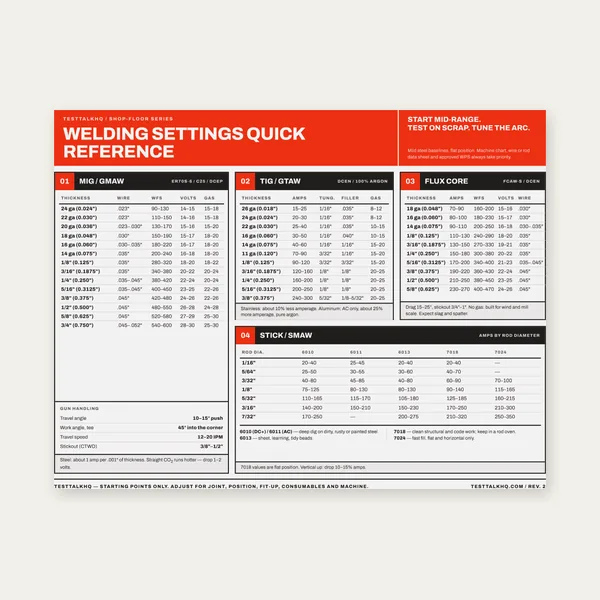
Welding Reference Card
One page. MIG, TIG, stick and flux core settings by thickness.
$3.99
Buy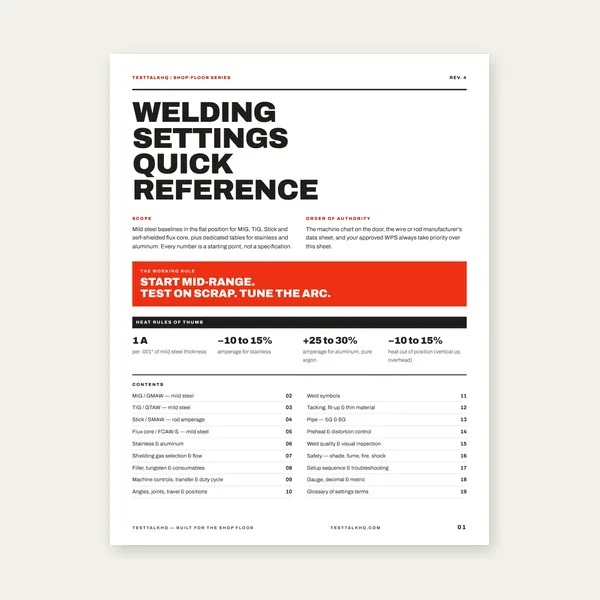
Complete Welding Settings Guide
19 pages. Four processes, stainless and aluminum, symbols and inspection.
$12.99
Buy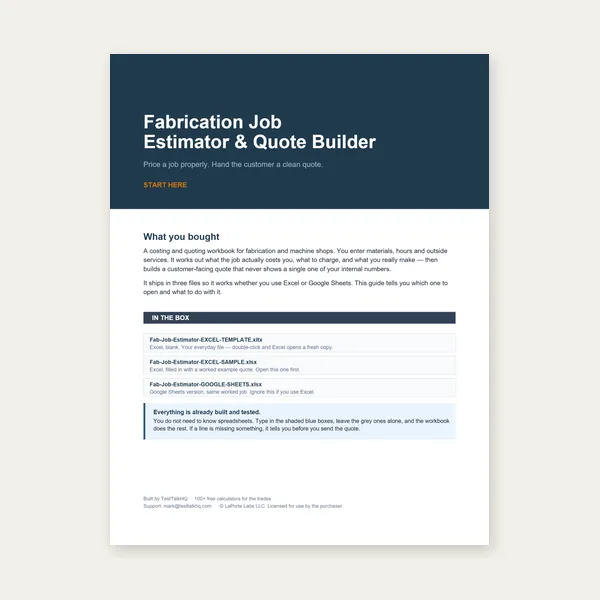
Welding Job Estimator
Price the job, then hand over a quote with no internal numbers.
Excel or Google Sheets. Best on a computer.
$29.00
Buy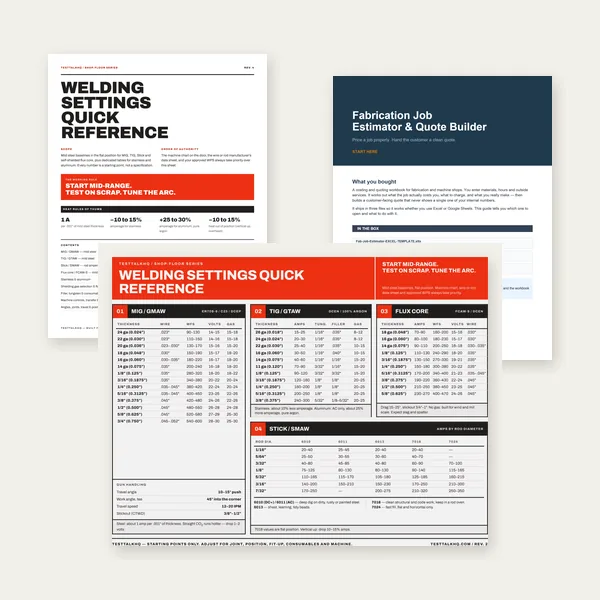
Welding Complete Bundle
Card, 19-page guide and the estimator workbook. All six files.
Excel or Google Sheets. Best on a computer.
$34.99
$45.98 if bought separately — save $10.99
BuyCheckout opens in a new tab.