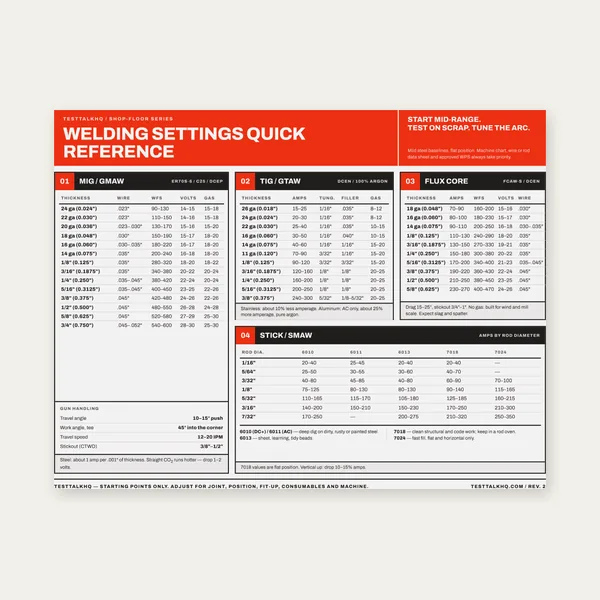
Welding Reference Card
One page. MIG, TIG, stick and flux core settings by thickness.
$3.99
BuySize local exhaust hoods, welding booths, and dilution airflow for cleaner shop air
One page. MIG, TIG, stick and flux core settings by thickness.
$3.99
Buy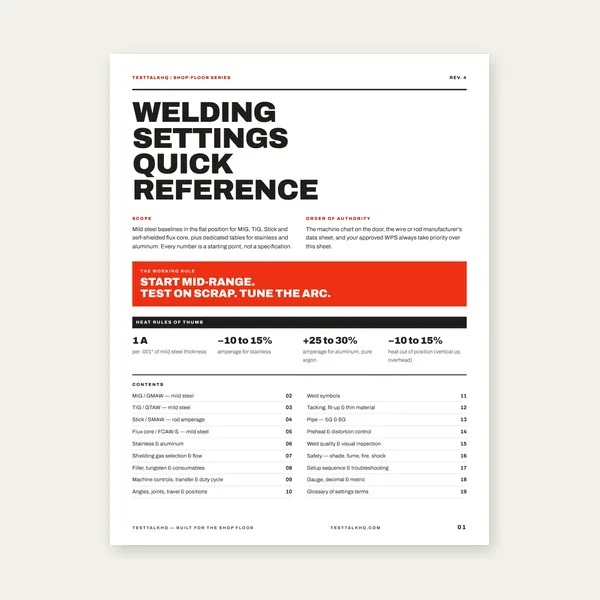
19 pages. Four processes, stainless and aluminum, symbols and inspection.
$12.99
Buy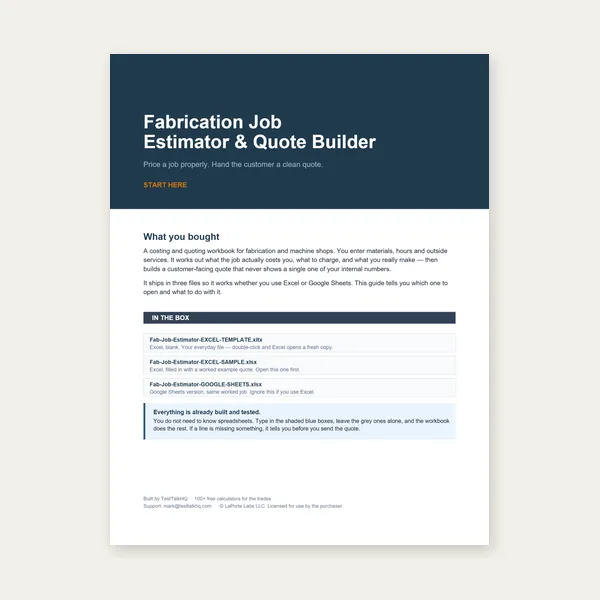
Price the job, then hand over a quote with no internal numbers.
Excel or Google Sheets. Best on a computer.
$29.00
Buy
Card, 19-page guide and the estimator workbook. All six files.
Excel or Google Sheets. Best on a computer.
$34.99
$45.98 if bought separately — save $10.99
BuyCheckout opens in a new tab.
Capture fumes at the source and protect the breathing zone

As an Amazon Associate, TestTalkHQ earns from qualifying purchases.
Welding and cutting generate metal fumes, gases, and particulates that accumulate in the breathing zone without adequate ventilation. MIG and flux-core processes typically produce more fume mass than TIG; plasma cutting adds significant particulate and gas loads. OSHA, ACGIH, and NIOSH exposure limits apply to manganese, hex chrome, zinc oxide, and other components depending on base metal and filler. Engineering controls — especially local exhaust — are the first line of defense before relying on respirators alone.
Local exhaust captures fumes at the source with a hood positioned near the arc. Target capture velocity of 100 fpm or more at the hood face for manual welding. General dilution ventilation replaces room air but does not reliably protect the welder breathing zone — it supplements source capture rather than replacing it. For production shops, dedicated welding booths with filtered exhaust are common; hobby shops often use portable fume extractors on flexible arms.
This calculator uses practical shop baselines: TIG at 75 CFM per station (lower fume generation), MIG at 125 CFM, flux-core at 175 CFM, stick at 200 CFM, and plasma at 300 CFM. Actual requirements vary with wire diameter, amperage, confined spaces, and alloy. Stainless and galvanized work may need higher capture rates and filtration rated for fine particulate. Always verify with an industrial hygienist when exposure limits are approached.
Position the hood opening as close to the arc as practical without interfering with the weld — typically within one duct diameter. Keep flexible hose runs as short and straight as possible to maintain static pressure. Size main duct for transport velocity around 2000–4500 fpm depending on particulate loading. Clean filters and inspect airflow regularly; a clogged filter drops effective CFM and defeats the installation.