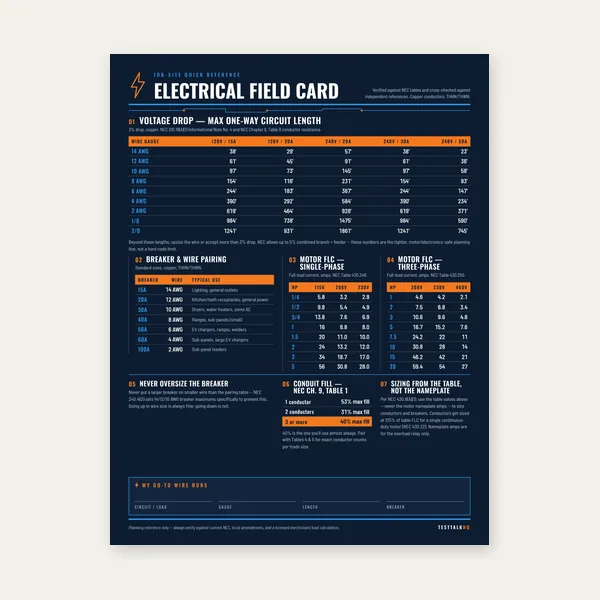
Electrical Reference Card
One page. Voltage drop lengths, breaker and wire pairing, motor FLC.
$3.99
BuyCalculate total resistance, branch current, and voltage drop for up to six loads — with the series and parallel formulas shown step by step. Pair with our Ohm's Law calculator when you know total R and need circuit current.

Rtotal = R1 + R2 + R3 + …I is the same in all branchesVdrop,i = I × RiVsource = V1 + V2 + …1/Rtotal = 1/R1 + 1/R2 + …V is the same across all branchesIbranch,i = V / RiItotal = I1 + I2 + …I = V / RV = I × RP = V × ITwo equal resistors in parallel: Rtotal = R / 2Branch circuits = parallel loadsOld holiday lights = series stringsControl interlocks often seriesMeasure R before energizing unknown loadsOne page. Voltage drop lengths, breaker and wire pairing, motor FLC.
$3.99
Buy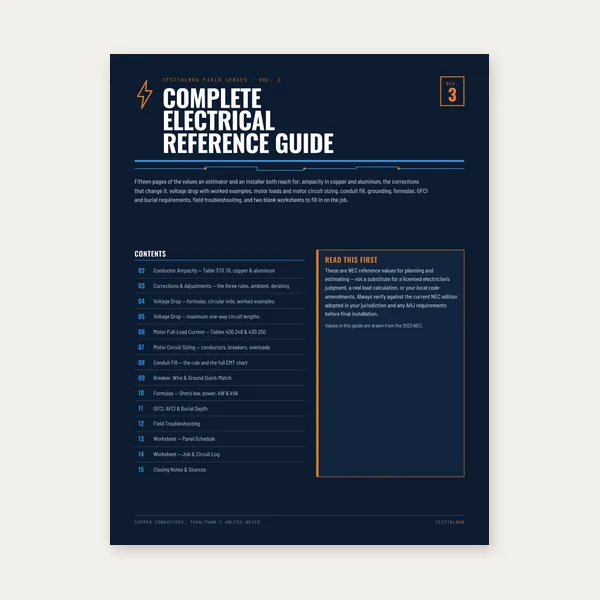
15 pages. Ampacity, corrections, voltage drop, motor circuits, conduit fill.
$12.99
Buy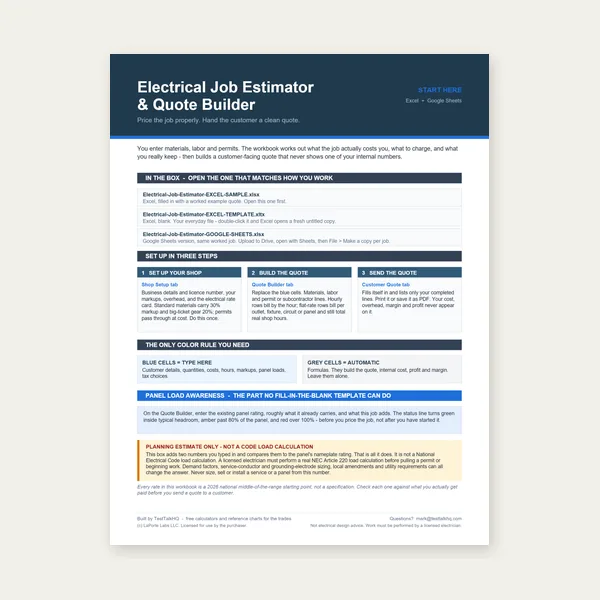
Quote electrical work and flag panel headroom before you price it.
Excel or Google Sheets. Best on a computer.
$29.00
Buy
Card, 15-page guide and the estimator workbook. All six files.
Excel or Google Sheets. Best on a computer.
$34.99
$45.98 if bought separately — save $10.99
BuyCheckout opens in a new tab.
Measure resistance and voltage on real circuits before trusting calculated values — especially on parallel branch wiring.



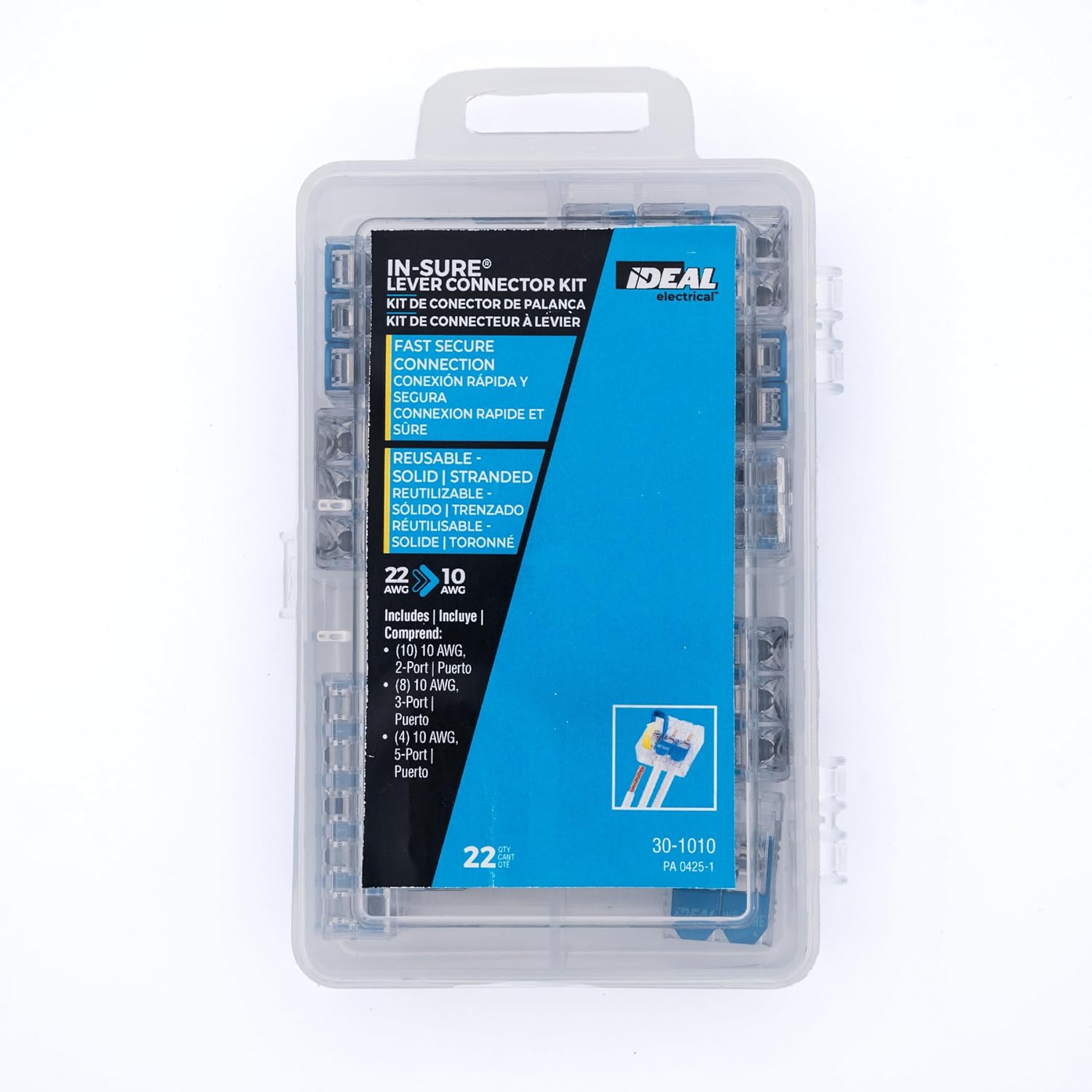

As an Amazon Associate, TestTalkHQ earns from qualifying purchases. Prices and availability may change.
In a series circuit, current has only one path. Resistance values add directly, so each extra load increases total opposition to current flow. Voltage divides across the loads — the largest resistor drops the most voltage. In a parallel circuit, each branch sees the full source voltage. Total resistance is always less than the smallest branch resistor because multiple paths share the current. The reciprocal formula 1/Rtotal = 1/R1 + 1/R2 + … is the standard way to combine parallel branches before applying Ohm's Law for total current.
Parallel wiring is how standard 120V branch circuits work: every receptacle and light on the circuit connects across hot and neutral, so each device gets full voltage even when neighbors are on or off. Series wiring appears in simple control circuits (safety interlocks, limit switches in series), some LED holiday strings, and certain sensor loops where one open point should stop the whole chain. Recognizing the configuration tells you whether a single open device kills the whole string (series) or only affects itself (parallel).
If a series string goes dark, one open element broke the only current path — measure resistance section by section or use voltage-drop testing to find the dead segment. On parallel branch circuits, one tripped breaker or open splice may not affect other branches, but total load current still sums at the panel. Calculating Rtotal helps estimate standby current for multiple parallel loads and validates whether a supply or conductor can handle the combined draw once you apply I = V / R.