
Ohm’s Law and Power Formulas Explained — Volts, Amps, Watts, and Ohms | TestTalkHQ
:root{–orange:#e8611a;–orange-dark:#c4500f;–dark:#111111;–dark2:#1a1a1a;–dark3:#222222;–dark4:#2c2c2c;–gray:#888888;–border:#333333;–text:#e8e8e8;–text-dim:#aaaaaa;–green:#2ecc71;–yellow:#f1c40f;–red:#e74c3c;–blue:#3498db;}
*{box-sizing:border-box;margin:0;padding:0;}
body{background:var(–dark);color:var(–text);font-family:’Barlow’,sans-serif;font-size:16px;line-height:1.7;}
.hero{background:var(–dark2);border-bottom:3px solid var(–orange);padding:48px 24px 40px;text-align:center;position:relative;overflow:hidden;}
.hero::before{content:”;position:absolute;top:0;left:0;right:0;bottom:0;background:repeating-linear-gradient(45deg,transparent,transparent 20px,rgba(232,97,26,0.03) 20px,rgba(232,97,26,0.03) 40px);}
.hero-badge{display:inline-block;background:var(–orange);color:white;font-family:’Barlow Condensed’,sans-serif;font-weight:700;font-size:11px;letter-spacing:2px;text-transform:uppercase;padding:4px 14px;border-radius:2px;margin-bottom:14px;position:relative;}
.hero h1{font-family:’Barlow Condensed’,sans-serif;font-weight:900;font-size:clamp(26px,5vw,52px);text-transform:uppercase;letter-spacing:0.5px;color:white;line-height:1.1;max-width:800px;margin:0 auto 14px;position:relative;}
.hero h1 span{color:var(–orange);}
.hero-meta{display:flex;justify-content:center;gap:24px;flex-wrap:wrap;font-size:13px;color:var(–text-dim);position:relative;}
.hero-meta span{display:flex;align-items:center;gap:6px;}
.article-wrap{max-width:800px;margin:0 auto;padding:40px 20px 60px;}
h2{font-family:’Barlow Condensed’,sans-serif;font-size:28px;font-weight:700;text-transform:uppercase;color:white;border-left:4px solid var(–orange);padding-left:14px;margin:40px 0 16px;}
h3{font-family:’Barlow Condensed’,sans-serif;font-size:20px;font-weight:700;text-transform:uppercase;color:var(–orange);margin:28px 0 12px;}
p{color:var(–text-dim);margin-bottom:18px;font-size:15.5px;line-height:1.8;}
p strong{color:var(–text);}
ul,ol{margin:10px 0 18px 22px;color:var(–text-dim);font-size:15.5px;line-height:1.8;}
li{margin-bottom:10px;}
li strong{color:var(–text);}
a{color:var(–orange);text-decoration:none;}
a:hover{text-decoration:underline;}
.lead{font-size:17px;color:var(–text);line-height:1.8;margin-bottom:24px;padding:20px 22px;background:var(–dark2);border-left:4px solid var(–orange);border-radius:4px;}
.pro-tip{background:rgba(232,97,26,0.08);border:1px solid rgba(232,97,26,0.25);border-left:4px solid var(–orange);border-radius:4px;padding:18px 22px;margin:24px 0;font-size:14.5px;color:var(–text-dim);line-height:1.7;}
.pro-tip strong{color:var(–orange);display:block;margin-bottom:6px;font-size:12px;text-transform:uppercase;letter-spacing:1px;}
.warning-box{background:rgba(231,76,60,0.08);border:1px solid rgba(231,76,60,0.25);border-left:4px solid var(–red);border-radius:4px;padding:18px 22px;margin:24px 0;font-size:14.5px;color:var(–text-dim);line-height:1.7;}
.warning-box strong{color:var(–red);display:block;margin-bottom:6px;font-size:12px;text-transform:uppercase;letter-spacing:1px;}
.info-box{background:rgba(52,152,219,0.07);border:1px solid rgba(52,152,219,0.2);border-left:4px solid var(–blue);border-radius:4px;padding:18px 22px;margin:24px 0;font-size:14.5px;color:var(–text-dim);line-height:1.7;}
.info-box strong{color:var(–blue);display:block;margin-bottom:6px;font-size:12px;text-transform:uppercase;letter-spacing:1px;}
.diagram{background:var(–dark2);border:1px solid var(–border);border-radius:8px;overflow:hidden;margin:28px 0;}
.diagram-title{background:var(–dark4);padding:10px 16px;font-family:’Barlow Condensed’,sans-serif;font-size:13px;font-weight:700;text-transform:uppercase;letter-spacing:1px;color:var(–orange);border-bottom:1px solid var(–border);}
.diagram svg{display:block;width:100%;height:auto;}
.data-table{background:var(–dark2);border:1px solid var(–border);border-radius:8px;overflow:hidden;margin:28px 0;}
.data-table-title{background:var(–dark4);padding:10px 16px;font-family:’Barlow Condensed’,sans-serif;font-size:13px;font-weight:700;text-transform:uppercase;letter-spacing:1px;color:var(–orange);border-bottom:1px solid var(–border);}
.data-table-wrap{overflow-x:auto;}
table{width:100%;border-collapse:collapse;font-size:13.5px;}
thead tr{background:var(–dark4);}
thead th{padding:10px 14px;text-align:left;font-size:11px;font-weight:700;text-transform:uppercase;letter-spacing:1px;color:var(–text-dim);border-bottom:1px solid var(–border);}
tbody tr:nth-child(even){background:rgba(255,255,255,0.02);}
tbody tr:hover{background:rgba(232,97,26,0.05);}
tbody td{padding:9px 14px;border-bottom:1px solid rgba(255,255,255,0.04);color:var(–text-dim);}
tbody td:first-child{color:var(–text);font-weight:500;}
.pass{color:var(–green) !important;font-weight:600;}
.warn{color:var(–yellow) !important;font-weight:600;}
.fail{color:var(–red) !important;font-weight:600;}
.products-section{background:var(–dark2);border:1px solid var(–border);border-radius:8px;padding:28px;margin:36px 0;}
.products-section h3{font-family:’Barlow Condensed’,sans-serif;font-size:20px;font-weight:700;text-transform:uppercase;color:white;margin:0 0 6px;padding-left:0;border:none;}
.products-subtitle{font-size:13px;color:var(–text-dim);margin-bottom:22px;}
.product-grid{display:grid;grid-template-columns:repeat(auto-fit,minmax(200px,1fr));gap:16px;}
.product-card{background:var(–dark3);border:1px solid var(–border);border-radius:6px;padding:16px;position:relative;transition:border-color 0.2s;}
.product-card:hover{border-color:var(–orange);}
.product-card.featured{border-color:var(–orange);}
.product-badge{position:absolute;top:10px;right:10px;background:var(–orange);color:white;padding:3px 8px;border-radius:10px;font-size:9px;font-weight:700;text-transform:uppercase;}
.product-badge.best{background:var(–green);}
.product-card img{width:100%;height:140px;object-fit:contain;background:var(–dark4);padding:8px;border-radius:4px;margin-bottom:12px;}
.product-card h4{color:white;font-size:13px;font-weight:600;margin-bottom:10px;line-height:1.4;min-height:38px;}
.product-features{list-style:none;margin:0 0 14px 0;padding:0;}
.product-features li{font-size:12px;color:var(–text-dim);padding:3px 0;border-bottom:1px solid rgba(255,255,255,0.04);}
.product-features li:last-child{border-bottom:none;}
.product-features li::before{content:”2713 “;color:var(–green);font-weight:bold;}
.product-btn{display:block;padding:10px;background:var(–orange);color:white;text-align:center;border-radius:4px;font-family:’Barlow Condensed’,sans-serif;font-size:14px;font-weight:700;text-transform:uppercase;transition:background 0.2s;}
.product-btn:hover{background:var(–orange-dark);text-decoration:none;}
.products-disclaimer{font-size:11px;color:var(–gray);font-style:italic;text-align:center;margin-top:14px;}
.calc-cta{background:var(–dark2);border:2px solid var(–orange);border-radius:8px;padding:24px 28px;margin:36px 0;text-align:center;}
.calc-cta h3{font-family:’Barlow Condensed’,sans-serif;font-size:22px;font-weight:700;text-transform:uppercase;color:white;margin:0 0 8px;}
.calc-cta p{color:var(–text-dim);font-size:14px;margin-bottom:16px;}
.calc-cta a.cta-btn{display:inline-block;background:var(–orange);color:white;padding:13px 28px;border-radius:6px;font-family:’Barlow Condensed’,sans-serif;font-size:18px;font-weight:700;text-transform:uppercase;letter-spacing:0.5px;transition:background 0.2s;}
.calc-cta a.cta-btn:hover{background:var(–orange-dark);text-decoration:none;}
.faq-section{margin:40px 0;}
.faq-item{background:var(–dark2);border:1px solid var(–border);border-radius:6px;margin-bottom:12px;overflow:hidden;}
.faq-q{padding:16px 20px;font-size:15px;font-weight:600;color:white;cursor:pointer;border-left:3px solid var(–orange);}
.faq-a{padding:0 20px 16px 20px;font-size:14px;color:var(–text-dim);line-height:1.75;border-left:3px solid transparent;}
.section-divider{display:flex;align-items:center;gap:10px;margin:36px 0;}
.section-divider span{font-size:10px;font-weight:700;text-transform:uppercase;letter-spacing:2px;color:var(–text-dim);white-space:nowrap;}
.section-divider::before,.section-divider::after{content:”;flex:1;height:1px;background:var(–border);}
.footer-note{text-align:center;font-size:12px;color:var(–gray);padding-top:20px;border-top:1px solid var(–border);margin-top:40px;}
@media(max-width:600px){.product-grid{grid-template-columns:1fr;}.hero-meta{gap:12px;}}
TestTalkHQ.com — Electrical
Ohm’s Law and Power Formulas Explained
Volts, Amps, Watts, and Ohms
📅 March 2026
⏱ 8 min read
🔌 Electrical / Fundamentals
Someone asks how many amps a 1,500-watt space heater pulls on a 120V circuit and you do the math in your head. Or you’re sizing a circuit and need to know if the load fits the breaker. Ohm’s Law and the power formulas are the four equations behind every one of those calculations — and knowing how to move between voltage, current, resistance, and power is the core skill everything else in electrical work is built on.
Ohm’s Law — The Foundation
Ohm’s Law describes the relationship between three fundamental electrical quantities: voltage (V), current (I), and resistance (R). The law states that the current through a conductor is directly proportional to the voltage across it and inversely proportional to its resistance.
In plain language: push more voltage through the same resistance and you get more current. Put more resistance in the path for the same voltage and current drops. It’s the most fundamental relationship in all of electrical theory, and it holds true in every passive circuit you’ll encounter.
⚡ Ohm’s Law — All Three Forms of the Formula
V
I
R
FIND VOLTAGE
V = I × R
Cover V in the triangle
Example: 15A × 8Ω = 120V
What voltage does this load see?
What is the voltage drop across a resistor?
FIND CURRENT
I = V / R
Cover I in the triangle
Example: 120V / 8Ω = 15A
How many amps does this load pull?
Will this trip the breaker?
R = V / I — Cover R in the triangle to find resistance: R = Voltage ÷ Current
The triangle is a memory tool: cover the variable you want to find, and the remaining two tell you the operation. Cover V and you see I × R. Cover I and you see V / R. Cover R and you see V / I. The math is always division or multiplication.
The Power Formula — Adding Watts to the Picture
Ohm’s Law covers voltage, current, and resistance. Power (measured in watts) is a fourth quantity that describes how much energy is being converted per second. Power connects to the other three through the power formula and its derivatives.
The basic power formula is P = V × I — power equals voltage times current. Combined with Ohm’s Law, this gives you a complete family of 12 formulas that let you solve for any one of the four quantities (V, I, R, P) if you know any two others.
📐 The Complete Formula Wheel — Solve for Any Variable from Any Two Known Values
VOLTAGE (V)
V = I × R
V = P / I
V = √(P × R)
Know any 2 other values
→ solve for V
CURRENT (I)
I = V / R
I = P / V
I = √(P / R)
Know any 2 other values
→ solve for I
RESISTANCE (R)
R = V / I
R = V² / P
R = P / I²
Know any 2 other values
→ solve for R
POWER (P)
P = V × I
P = I² × R
P = V² / R
Know any 2 other values
→ solve for P
The practical reality is that most field calculations use only a handful of these. P = V × I tells you wattage from voltage and amps. I = P / V tells you current draw from a rated wattage. V = I × R is Ohm’s Law in its most direct form. The square root and squared versions come up in power dissipation calculations for resistive loads, fuses, and heater elements.
Skip the Algebra — Use the Calculator
Our free Ohm’s Law and power calculator solves for any variable from any two known values. Enter what you know — get voltage, current, resistance, or power instantly.
Related: Series and Parallel Circuit Calculator and Series and Parallel Circuits Guide — combine resistors before applying Ohm’s Law.
Real-World Applications — Where You Use This Every Day
These formulas aren’t textbook exercises — they come up constantly in practical electrical work. Here are the scenarios every tradesperson and serious DIYer runs into:
Circuit Load Calculation
A 20A, 120V circuit can supply a maximum of P = 120V × 20A = 2,400 watts. NEC 210.19 recommends loading a branch circuit to no more than 80% of its rating for continuous loads, giving you 1,920 watts of usable capacity. If you’re adding a 1,500W space heater to a circuit that already has 600W of lighting, you’re at 2,100W total — over the 80% continuous load limit on a 20A circuit.
Current Draw from Appliance Wattage
The spec sheet says a welder draws 4,800 watts at 240V. What breaker does it need? I = P / V = 4,800 / 240 = 20 amps. At 80% continuous load rule, you’d want at least a 25A breaker — meaning a 30A circuit is the right call.
Resistance from Voltage and Current
You measure 12V across a resistive heating element and 3A flowing through it. What’s the element’s resistance? R = V / I = 12 / 3 = 4 ohms. Useful for diagnosing heating elements, checking motor windings, and validating fuse sizing.
🔧 Common Field Calculations — Quick Reference
SCENARIO
FORMULA USED
RESULT
How many amps does a 1,500W heater pull at 120V?
I = P / V = 1500 / 120
12.5A
Max watts on a 20A / 120V circuit (80% rule)?
P = 120 × 20 × 0.80
1,920W
What breaker for a 3,600W, 240V water heater?
I = 3600 / 240 = 15A ÷ 0.80
20A breaker
Power consumed by a 10Ω resistor at 5A?
P = I² × R = 25 × 10
250W
Resistance of a motor winding: 240V / 8A?
R = V / I = 240 / 8
30Ω
Voltage across a 15Ω load drawing 8A?
V = I × R = 8 × 15
120V
The 80% Continuous Load Rule and Why It Exists
NEC 210.19(A) and 210.20(A) require that branch circuit conductors and overcurrent devices be sized at 125% of the continuous load — or equivalently, that continuous loads not exceed 80% of the breaker and wire rating. A load is “continuous” if it runs for three hours or more at a stretch.
The reason this rule exists is thermal. Breakers are rated for their interrupting capacity at full rated current for short durations — but running a breaker at 100% of its rated current continuously generates heat that degrades the breaker mechanism over time. The 80% rule keeps breakers in their safe thermal operating range under continuous load conditions.
ℹ 80% Rule — Practical Breaker Sizing
To size a breaker for a continuous load: divide the load watts by the voltage to get amps, then divide by 0.80 (or multiply by 1.25) to get the minimum breaker size. A 2,400W continuous load at 120V draws 20A, requiring a 20A / 0.80 = 25A minimum breaker — meaning you’d specify a 30A breaker (next standard size up). Our calculator handles this automatically.
Watts vs. VA vs. kWh — Clearing Up the Confusion
Three different units come up in electrical work and they’re often used interchangeably when they shouldn’t be:
- Watts (W) — Real Power. The actual power consumed by a load and converted to work (heat, light, motion). This is what your electric meter measures and what you pay for. Resistive loads (heaters, incandescent bulbs) are essentially 100% watts — all the power they consume does real work.
- Volt-Amperes (VA) — Apparent Power. The product of RMS voltage and RMS current in an AC circuit. For purely resistive loads, VA = Watts. For reactive loads (motors, transformers, switching power supplies), VA is higher than Watts because some power is stored and returned by inductance or capacitance rather than being consumed. UPS systems and transformers are rated in VA, not watts.
- Kilowatt-Hours (kWh) — Energy Consumed. Power times time. A 1,000W load running for one hour consumes 1 kWh. This is the unit on your electric bill. To estimate monthly cost: multiply device wattage × hours per day × 30 days × your cost per kWh.
💡 Pro Tip — Measure Before You Size
Nameplate wattage and actual wattage are often different — especially for motors, which draw significantly more current on startup than at running load, and for devices rated at maximum capacity that rarely operate at full load. A clamp meter on the actual conductor gives you the real current. A plug-in power meter on a 120V device gives you real watts, VA, and power factor. Sizing circuits from real measurements instead of nameplate ratings often reveals headroom you didn’t know you had — or load you didn’t know you were carrying.
Tools for Measuring Voltage, Current, and Power
🔧 Measure First. Calculate Second. Size Right.
Put real numbers into the formulas — not guesses
Top Pick
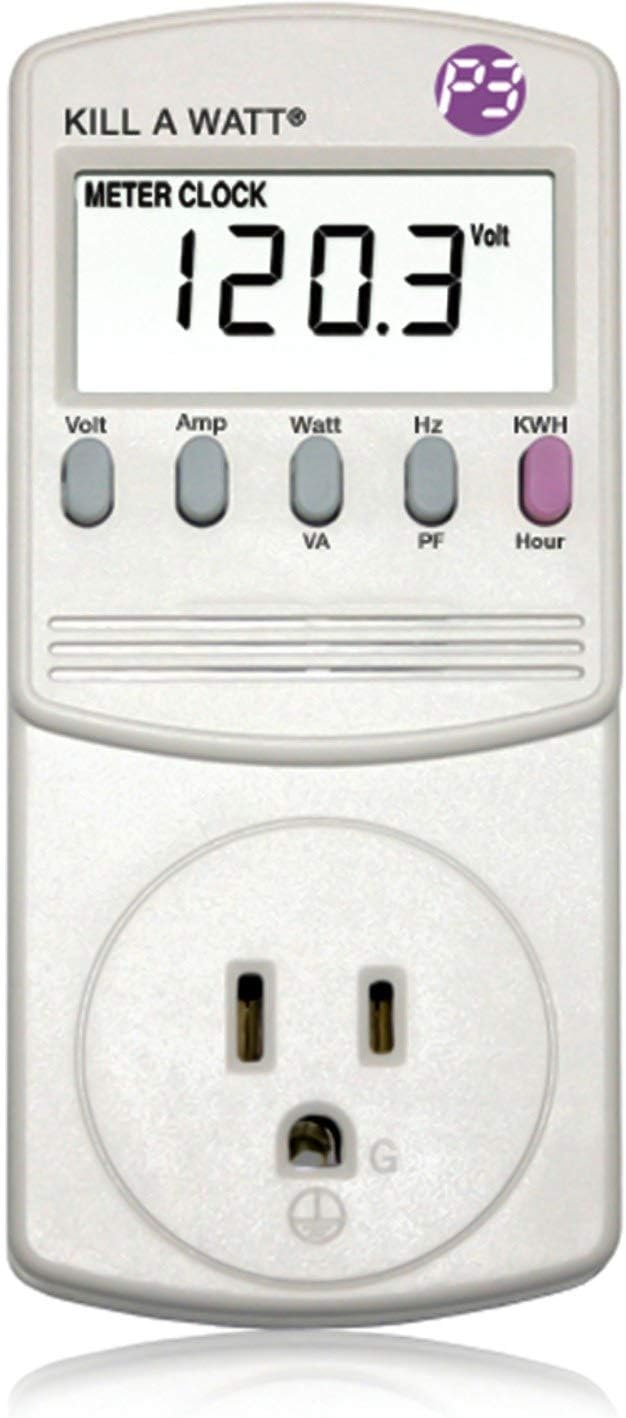
P3 P4400 Kill A Watt Electricity Monitor
- Real watts, VA, amps, volts — plug-in display
- Tracks kWh over time for cost estimation
- Shows power factor on reactive loads
- No clamp meter needed for 120V devices
View on Amazon →
Pro Meter
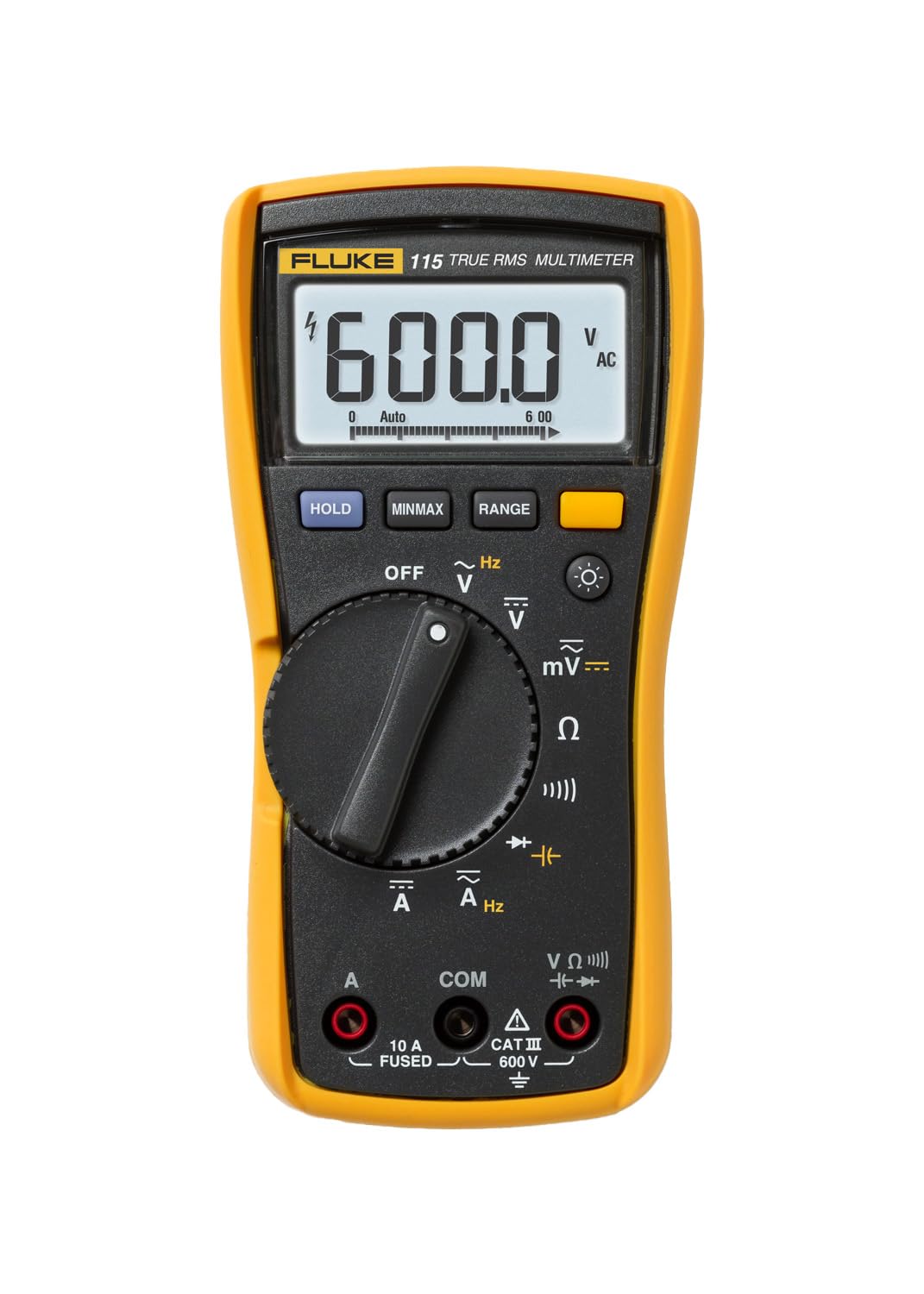
Fluke 115 Digital Multimeter
- Measure V, I, R — all three Ohm’s Law variables
- True RMS for accurate AC readings
- CAT III 600V — rated for field work
- Fluke reliability — the industry standard
View on Amazon →
Safety First

Klein Tools NCVT-6 Non-Contact Voltage Tester
- Verify circuits are de-energized before working
- No contact required — through wire insulation
- Audible and visual alert
- Works on 12–1000V AC circuits
As an Amazon Associate, TestTalkHQ earns from qualifying purchases.
Ohm’s Law in Series and Parallel Circuits
Ohm’s Law applies to the whole circuit and to each individual component. The behavior of voltage and current changes depending on how components are connected:
- Series circuits: Current is the same through every component. Voltage divides across components in proportion to their resistance. Total resistance is the sum of all individual resistances: Rₑ = R₁ + R₂ + R₃… This is why adding more devices in series (like old-style Christmas lights) drops the voltage across each one.
- Parallel circuits: Voltage is the same across every branch. Current divides between branches in inverse proportion to resistance — lower resistance draws more current. Total resistance is always lower than any individual branch. This is how household circuits work — all outlets on a branch circuit see the same 120V, but each device draws its own current independently.
⚠ Why Parallel Loads Increase Total Current
Every device you add to a parallel circuit (a standard household circuit) increases the total current drawn from the source. Adding a 1,500W heater to a circuit that’s already loaded adds another 12.5A on top of existing current. This is why overloaded circuits trip breakers — each device looks independent but they all share the same breaker. Ohm’s Law applied to the whole circuit tells you when you’re approaching the limit.
FAQ
How many amps does a 1,500-watt heater pull at 120V?
Using I = P / V: 1,500W / 120V = 12.5 amps. This is a continuous load, so per NEC 210.20(A), it should be on a circuit rated for at least 12.5 / 0.80 = 15.6 amps minimum — meaning a 20A circuit is the correct choice. A standard 15A circuit would be undersized for this heater running continuously.
What is the difference between watts and volt-amperes (VA)?
Watts measure real power — the energy actually consumed and converted to work. Volt-amperes (VA) measure apparent power — the product of RMS voltage and RMS current. For purely resistive loads like heaters and incandescent bulbs, watts and VA are equal. For reactive loads like motors, transformers, and switching power supplies, VA is higher than watts because some power is stored and returned by the reactive components rather than consumed. The ratio of watts to VA is the power factor.
How do I calculate the monthly cost to run an appliance?
Multiply the wattage by hours used per day to get watt-hours, divide by 1,000 to get kWh, multiply by 30 for monthly kWh, then multiply by your rate per kWh (typically $0.12 to $0.18 in the US). Example: a 200W device running 8 hours/day = 1.6 kWh/day, 48 kWh/month. At $0.15/kWh that’s $7.20/month. Our calculator handles this with a built-in cost estimator.
Why does adding more devices trip the breaker?
Household outlets are wired in parallel — every device gets full voltage (120V) but draws its own current. Each device’s current adds to the total current on the circuit. Total current = P₁/V + P₂/V + P₃/V for all devices. When that total exceeds the breaker rating, the breaker trips. The breaker sees the sum of all currents on the circuit simultaneously, not each device independently.
Does Ohm’s Law apply to AC circuits?
Ohm’s Law in its basic form (V = IR) applies directly to resistive AC loads — heaters, incandescent bulbs, resistors. For reactive components like inductors and capacitors in AC circuits, impedance (Z) replaces resistance (R), and the formula becomes V = I × Z. Impedance accounts for the phase shift between voltage and current that reactance introduces. For most practical field calculations involving resistive loads and general circuit sizing, standard Ohm’s Law and the power formula are sufficient.
What is power factor and when does it matter?
Power factor (PF) is the ratio of real power (watts) to apparent power (VA). A power factor of 1.0 means all the current is doing real work. A PF of 0.8 means only 80% of the current is doing work — the rest is reactive current that stresses the wiring without showing up on your power bill. Motors, ballasts, and switching power supplies typically have power factors between 0.7 and 0.95. Power factor matters for sizing conductors and generators, because those must handle apparent power (VA), not just real power (watts).
Solve Any Electrical Calculation Instantly
Our free Ohm’s Law and power calculator solves for voltage, current, resistance, or power from any two known values. Includes the 80% continuous load rule and kWh cost estimator.
Related: Series and Parallel Circuit Calculator and Series and Parallel Circuits Guide — combine resistors before applying Ohm’s Law.
Ohm’s Law Troubleshooting · ⚡ Open Ohm’s Law Calculator →
Based on fundamental electrical theory and NEC 210.19, 210.20. Always verify circuit sizing with current NEC edition and local jurisdiction requirements. TestTalkHQ.com — free tools for tradespeople.