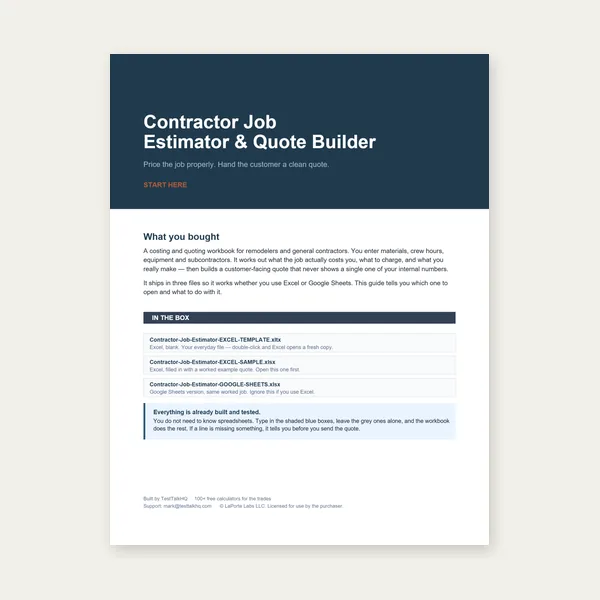
Contractor Job Estimator
Price remodels and GC work, then send a quote with no internal numbers.
Excel or Google Sheets. Best on a computer.
$29.00
BuyX-in-12 convention, why it changes materials and drainage, and how to apply the area multiplier when you order covering
Pitch is the language of the roof ticket. Get the convention right, convert it once, then multiply plan area by the slope factor instead of ordering from the survey footprint. Use the roof pitch / slope calculator for the conversion; this guide is how to tape it and what to do with the number.
Measurement mistakes: troubleshooting. Walkable vs steep: comparison. Framing length: rafter calculator. Hub: roofing calculators.
Need the conversion now?Rise, degrees, or percent in — X-in-12, multiplier, and true roof area out.
Open Calculator →When a roof is “6-in-12,” it rises 6 inches for every 12 inches of horizontal run. The 12 is not a magic rafter length. It is a fixed denominator so every crew on the job is talking the same triangle. Write it 6-in-12 or 6/12. Do not write 6° unless you actually measured degrees.
The run is level. If you stand a square on a sloped deck and read the body without leveling the tongue, you are measuring something else. That is the most common bad 6-in-12 on a ticket.
On an open attic or during tear-off, the clean method is a 12-inch level (or the 12" tongue of a rafter square) held truly horizontal against the underside of a rafter or on the deck, then a tape or the square body reading the rise. Magnetic angle gauges sit on a rafter and print degrees — convert those degrees; do not copy them onto a ticket as 26-in-12.
From the ground you can shoot a laser at the eave and ridge and back into rise/run, but you are measuring the outer envelope, not every plane. Dormers, porch roofs, and additions often run a different pitch than the main house. Measure each plane you are covering.
Need common-rafter length from span and pitch instead of this conversion? That is framing geometry on the rafter length calculator — a different tool, listed on the roofing hub because pitch locks both.
Percent slope is rise divided by run, times 100. A 6-in-12 is 50% slope. Degrees are the angle of that triangle from horizontal: about 26.57°. A civil site plan that says “4%” is a nearly flat drainage slope (about 0.5-in-12), not a 4-in-12 roof. A gauge that says 18.4° is 4-in-12, not 18%.
If you paste degrees into a percent field, every downstream takeoff is wrong. The calculator refuses to treat 26.57% as 6-in-12 on purpose. Details and the usual mix-ups: pitch measurement mistakes.
Roof covering is sold by actual surface, not by the rectangle on the survey. For one rectangular plane:
At 6-in-12 the factor is 1.118. Two thousand square feet of footprint is about 2,236 sq ft of roof — 22.4 extra squares of covering before waste, hips, or starter. That is why the shingle and metal calculators ask for pitch (or already-sloped area). Convert here, then paste true area there, or type the same X/12 into those tools.
Ice-barrier coverage also stretches along the slope. IRC R905.1.2 measures 24 inches inside the wall line horizontally, then you convert that distance along the roof. Pitch is an input to the ice & water calculator, not a footnote.
Hips, valleys, and dormers add surface the rectangle formula does not invent. Estimating waste and hip extra is a different article: roofing estimating mistakes. This guide is the pitch conversion you do before that pad.
Manufacturer application instructions publish minimum (and sometimes maximum) roof pitches. Typical planning bands, always confirmed on the TDS:
Drainage: steeper planes shed faster, which is why gutter sizing uses a SMACNA pitch factor and why low-slope roofs hold snow and ice longer. Snow load uses a different slope factor (Cs) on the roof snow load calculator — do not reuse the area multiplier as a structural snow reduction.
Lock the pitch, then take off materials.Multiplier first, squares or panels second.
Open Calculator →No. 4-in-12 is about 18.4° and 33.3% slope. 4° is about 0.84-in-12.
Use it when you need common-rafter length, plumb cut, or birdsmouth. Use this conversion when you need X-in-12 / degrees / percent and the area multiplier. They share pitch; they do not share output.
No. It only tilts the rectangle. Waste, starter, hips, and valleys are added after true area — on the shingle or metal worksheet, not here.
Price remodels and GC work, then send a quote with no internal numbers.
Excel or Google Sheets. Best on a computer.
$29.00
BuyCheckout opens in a new tab.
A conversion is only as good as the rise you taped. A rafter square, a magnetic angle gauge, and fall protection are how 6-in-12 leaves the truck as a real number — and how steep work stays legal.

Aluminum rafter square for the 12-inch run method: hold the 12" tongue level, read rise on the body. Same X-in-12 the calculator converts.
View on Amazon →
Magnetic digital angle gauge when you already have degrees from a rafter or a laser. Convert that angle here — do not treat it as percent slope.
View on Amazon →
Guardian Safe-Tie bucket kit. OSHA treats slopes greater than 4-in-12 as steep roofs. Walkability is a decision, not a vibe — see the comparison article.
View on Amazon →
Snap the 12-inch run on a dry deck when you cannot hold a square against a rafter. Layout mistakes are how percent and degrees get swapped.
View on Amazon →
Johnson square gauges lock a repeatable rise on a rafter square so every plane is measured from the same reference — not a mixed 6-in-12 and 26° ticket.
View on Amazon →
Rise, degrees, or percent in — X-in-12, multiplier, and true roof area out.
Open Pitch Calculator →As an Amazon Associate, TestTalkHQ earns from qualifying purchases.