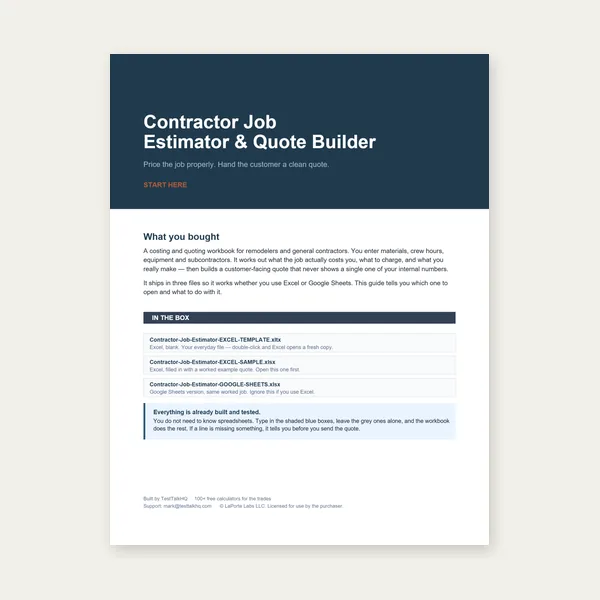
Contractor Job Estimator
Price remodels and GC work, then send a quote with no internal numbers.
Excel or Google Sheets. Best on a computer.
$29.00
BuyThe 4-in-12 OSHA split, fall protection, manufacturer minimum pitches, and why labor is not the same number on both sides
Roofers already make this call on the truck: can you walk it with standard precautions, or is it a steep roof that changes harness, jacks, and the covering you are allowed to nail? OSHA draws the line above 4-in-12. Manufacturers draw others. Convert the pitch first on the pitch calculator, then use this comparison to pick the work method — not to skip a competent-person plan.
How pitch is measured: guide. Measurement mistakes: troubleshooting. Hub: roofing calculators.
What is your pitch in all three units?4-in-12 is 18.4° and 33.3% slope — the steep-roof line, not a vibe.
Open Calculator →29 CFR 1926.500 defines a steep roof as a roof with a slope greater than 4 in 12 (approximately 18.4 degrees). Four-in-12 and flatter is low-slope in that definition. That is not “no fall protection.” It is a different set of options and a different expectation on residential jobs. The competent person still runs the site. This article is the trade decision point that matches that split, not a substitute for 1926.501.
4-in-12 converts to 18.43° and 33.33% slope. If your gauge says 18°, you are on the line. If it says 22°, you are already steep (about 4.8-in-12). Convert instead of arguing from memory.
Pitches at 4-in-12 and under are the roofs most crews will walk with rubber-soled shoes, controlled access, and the job’s written plan. You can usually carry a bundle, snap lines, and work without roof jacks on a dry architectural shingle. That convenience is why 4-in-12 and 5-in-12 dominate production housing.
The covering catch: walkable does not mean every shingle is legal there. Many asphalt lines want 4-in-12 as the standard minimum and only allow 2-in-12 to 4-in-12 with ice barrier or double underlayment. A 3-in-12 ranch is walkable and still a special underlayment job. Ice dams love that band — run the ice & water calculator and the attic ventilation calculator instead of assuming walkability solved moisture.
Above 4-in-12 you are on a steep roof under OSHA’s definition. Conventional fall protection, slide guards where they still apply, or a documented alternative is the default conversation. Roof jacks, toe boards, and scaffolding show up. Walking a 8-in-12 in sneakers is how people leave the industry.
At 7-in-12 (about 30.3°) most crews stop treating it as a “walk and nail” production roof. At 12-in-12 (45°) you are in special staging. The pitch calculator flags that band so the takeoff and the labor hour are not copied from last week’s 4-in-12 ranch.
Walkability and product approval are related but not identical:
Choosing metal vs asphalt on a 3-in-12 is a real product decision, not a brand preference: metal vs asphalt shingles.
Production rates assume a walkable 4-in-12 to 6-in-12. Steep work adds staging time, slower nailing, more handling trips, and usually a higher burdened hourly. Using the 4-in-12 hour on an 8-in-12 bid is how the crew works Saturday for free. The area multiplier (1.202 at 8-in-12) also grows the squares; you pay for both more material and slower placement.
Snow and ice change the walk even on 4-in-12. A low-slope roof that is walkable in July is not automatically walkable in January. Structural snow is a separate calc: roof snow load.
Convert first, then decide the method.4-in-12 vs 8-in-12 is not a rounding error.
Open Calculator →OSHA’s steep-roof definition is greater than 4 in 12, so 4-in-12 itself is low-slope in that text. It is still a roof. Follow the site fall-protection plan.
Plenty of crews do, with the right shoes and a plan. OSHA still classifies greater-than-4-in-12 as steep. Treat 6-in-12 as steep-method work, not as a 3-in-12 ranch.
Walkability does not. Pitch does. Steeper roofs have a larger multiplier, so more covering, plus slower labor. Convert on the calculator, then take off squares or panels.
Price remodels and GC work, then send a quote with no internal numbers.
Excel or Google Sheets. Best on a computer.
$29.00
BuyCheckout opens in a new tab.
A conversion is only as good as the rise you taped. A rafter square, a magnetic angle gauge, and fall protection are how 6-in-12 leaves the truck as a real number — and how steep work stays legal.
Aluminum rafter square for the 12-inch run method: hold the 12" tongue level, read rise on the body. Same X-in-12 the calculator converts.
View on Amazon →
Magnetic digital angle gauge when you already have degrees from a rafter or a laser. Convert that angle here — do not treat it as percent slope.
View on Amazon →
Guardian Safe-Tie bucket kit. OSHA treats slopes greater than 4-in-12 as steep roofs. Walkability is a decision, not a vibe — see the comparison article.
View on Amazon →
Snap the 12-inch run on a dry deck when you cannot hold a square against a rafter. Layout mistakes are how percent and degrees get swapped.
View on Amazon →
Johnson square gauges lock a repeatable rise on a rafter square so every plane is measured from the same reference — not a mixed 6-in-12 and 26° ticket.
View on Amazon →
Rise, degrees, or percent in — X-in-12, multiplier, and true roof area out.
Open Pitch Calculator →As an Amazon Associate, TestTalkHQ earns from qualifying purchases.