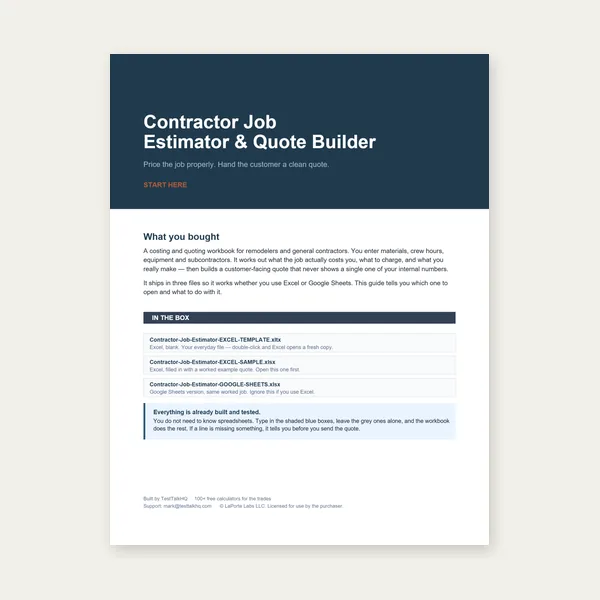
Contractor Job Estimator
Price remodels and GC work, then send a quote with no internal numbers.
Excel or Google Sheets. Best on a computer.
$29.00
BuyWrong reference, percent vs degrees, skipped hips and valleys, and ordering from footprint instead of true roof area
Most bad material orders that “used the right pitch” used the wrong kind of pitch, or applied it to the wrong area. This page is the measurement and conversion mistakes — not the waste-factor list on roofing estimating mistakes. Convert on the pitch calculator after you tape it correctly.
How to measure: guide. Walkable vs steep: comparison. Hub: roofing calculators.
Check the conversion.If 26.57° became 26-in-12 on the ticket, the order is already wrong.
Open Calculator →Pitch is rise over horizontal run. A square sitting on a sloped shingle without a level tongue reads a smaller triangle than the roof. A square on a plumb fascia without transferring to level run reads the fascia bevel, not 6-in-12. An angle gauge on a warped rafter prints that rafter, not the plane.
Fix: level a 12-inch run, then read rise. Or take degrees from a gauge that is sitting on a known-good rafter or a straightedge on the deck, then convert. If two rafters disagree by more than a quarter inch of rise, you do not have one pitch — you have settlement or a mixed addition.
This is the unit swap that quietly blows every calculator downstream. 6-in-12 is 50% slope and 26.57°. If a civil drawing says 4% and you type 4 into an X/12 field, you just described a 4-in-12 roof (18.4°, 33% slope) instead of a nearly flat 0.5-in-12 drainage grade.
If a Klein-style gauge says 26.6° and someone writes 26.6% on the takeoff, the multiplier drops from 1.118 to about 1.035. On a 2,000 sq ft footprint that is roughly 166 sq ft of covering you never ordered — almost two squares — before waste.
The multiplier tilts a rectangle. A hip roof is not a rectangle. Each hip and valley is extra cut surface, and the planes that meet there are often the same pitch counted twice in a sloppy footprint. Using length × width of the building, times one multiplier, under-counts hips and double-counts nothing you can use.
Do the conversion per plane, or take true area from a measured takeoff, then add hip/valley waste on the material worksheet. The estimating article covers the waste pad; this mistake is using one footprint×multiplier for a cut-up roof and calling it done.
Survey and appraisal square footage is plan area. Shingles, panels, and ice barrier are sold for the sloped surface. Skipping the multiplier on a 6-in-12 is an 11.8% short before waste. On 8-in-12 it is 20.2%. Crews then “fix” it by inflating waste, which hides the real error and wrecks the next job’s waste factor.
Feed true area into the shingle calculator and metal panel calculator, or type the same X/12 those tools already accept. Ice-barrier run also grows with pitch on the ice & water calculator.
Porch roofs, Florida rooms, and additions are often 3-in-12 off a 6-in-12 main. Using one pitch on the whole ticket over-orders the porch (or under-orders the main) and can put asphalt on a plane below its minimum. Measure each plane. Convert each plane. Walkability and fall protection can change at the break — walkable vs non-walkable.
Convert the number you actually taped.Do not reuse last job’s 6-in-12 because the neighborhood “looks the same.”
Open Calculator →As-builts lie. Additions, truss substitutions, and reroofs change pitch. Spot-check at least one rafter or deck on each distinct plane.
No. Estimating mistakes is waste, starter, and hip pads after you have true area. This page is getting pitch and area right before that pad.
If it is a digital angle gauge, it almost certainly means 18° (about 4-in-12), not 18% slope (about 2.2-in-12). Convert both ways on the calculator and see which matches a 12-inch-run tape.
Price remodels and GC work, then send a quote with no internal numbers.
Excel or Google Sheets. Best on a computer.
$29.00
BuyCheckout opens in a new tab.
A conversion is only as good as the rise you taped. A rafter square, a magnetic angle gauge, and fall protection are how 6-in-12 leaves the truck as a real number — and how steep work stays legal.

Aluminum rafter square for the 12-inch run method: hold the 12" tongue level, read rise on the body. Same X-in-12 the calculator converts.
View on Amazon →
Magnetic digital angle gauge when you already have degrees from a rafter or a laser. Convert that angle here — do not treat it as percent slope.
View on Amazon →
Guardian Safe-Tie bucket kit. OSHA treats slopes greater than 4-in-12 as steep roofs. Walkability is a decision, not a vibe — see the comparison article.
View on Amazon →
Snap the 12-inch run on a dry deck when you cannot hold a square against a rafter. Layout mistakes are how percent and degrees get swapped.
View on Amazon →
Johnson square gauges lock a repeatable rise on a rafter square so every plane is measured from the same reference — not a mixed 6-in-12 and 26° ticket.
View on Amazon →
Rise, degrees, or percent in — X-in-12, multiplier, and true roof area out.
Open Pitch Calculator →As an Amazon Associate, TestTalkHQ earns from qualifying purchases.