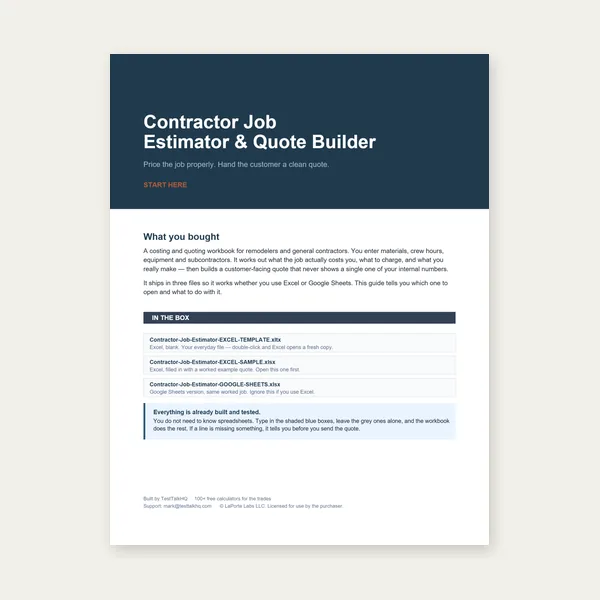
Contractor Job Estimator
Price remodels and GC work, then send a quote with no internal numbers.
Excel or Google Sheets. Best on a computer.
$29.00
Buy4-nail vs 6-nail patterns, nail length by decking thickness, exposure, and how to turn roof area into a coil order
The nail calculator does the arithmetic. This page is the why: which nailing pattern the wind zone and the wrapper actually want, which length punches through 7/16 OSB vs 5/8 plywood vs plank, and how squares become a box count without double-counting waste.
Failures: troubleshooting. Nails vs staples: comparison. Squares: shingle calculator. Hub: roofing calculators.
Need a coil count?Squares or sq ft, 3-tab vs architectural, 4- vs 6-nail, waste, length by decking.
Open Calculator →Most asphalt shingles are manufactured and tested with a 4-nail field pattern: one nail ~1 in from each end and two in between, in the nailing strip / common-bond area printed on the shingle. That is the everyday pattern on inland, moderate-wind roofs when the manufacturer allows it.
6-nail adds two fasteners in that same strip. It is the high-wind / steep-slope / special-listing pattern. IRC Chapter 9 points you at the manufacturer for fastening; the wrapper and the ICC-ES / Miami-Dade / Florida Product Approval report tell you when 6 nails (or a specific nail type) are required for the wind speed and exposure of the site.
IRC R905.2.5 is blunt: the fastener must penetrate through the roof sheathing, or penetrate at least 3/4 in into wood plank decking. ASTM F1667 is the nail standard the IRC points at. Length is therefore a function of the stack (shingle + underlayment + deck), not of wind zone.
| Decking | Typical nail length | Why |
|---|---|---|
| 7/16 in OSB | 1 in | Must exit the panel. 1 in is the usual minimum after shingle + underlayment. |
| 1/2 in plywood / OSB | 1-1/4 in | 1-1/4 in typically punches through the 1/2 in stack. |
| 5/8 in plywood | 1-1/4 in | Still through-penetration on a standard architectural shingle; confirm on scrap if the laminate is extra-thick. |
| 3/4 in+ wood plank | 1-1/4 in min | Must embed 3/4 in into the wood, not merely peek through a thin panel. |
Wind zone does not change this table. Wind zone changes how many nails and sometimes the listing (hand-nail vs coil, shank type). Overlaying a second layer of shingles is a different length problem (often 1-1/2 in or 1-3/4 in) and is not what this calculator sizes.
That is also why a standalone “nail length chart page” would mostly reprint these four rows. The calculator already returns the length for the decking you picked.
Shingle exposure (the reveal) is a manufacturer number — commonly 5 in on 3-tab, 5-5/8 in on many laminates. Exposure sets how many courses cover a given eave-to-ridge run. It does not change nails per shingle. Nails per shingle times shingles per square is what the calculator uses.
On the piece, nails go in the nailing strip / common-bond area:
Hand-nailing still exists on flashings, starter, and awkward cuts. The coil nailer is the field tool; depth-of-drive is a daily adjustment as temperature and air pressure change. Overdriven nails that cut the mat are a blow-off start — see troubleshooting.
Use roof surface, not living area. The shingle bundle calculator converts footprint × pitch into squares with the same 100 sq ft square. This nail tool uses that surface:
Starter, hip/ridge cap, and valley metal are extra fasteners. Cap shingles are usually 2 nails each (or as the cap wrapper says). Do not pretend the field formula covers the ridge.
IRC language is “corrosion-resistant.” In practice:
Wrong metal is a delayed leak, not a day-one blow-off. That is why it has its own section in troubleshooting. Staples are a different fastener class entirely: nails vs staples.
Ready to count coils?Same squares as the shingle takeoff, then 4- vs 6-nail.
Open Nail Calculator →No. Length is penetration through the deck (or 3/4 in into plank). 6-nail changes how many fasteners sit in the nailing strip, not how long they are.
Because most 3-tab and standard architectural lines still pack 3 bundles per square. Nail count follows pieces per square, which is not the same as bundles per square. That is the whole point of this tool.
Some editions still allow staples meeting ASTM F1667 in limited cases. Many manufacturers, Florida Product Approval listings, and insurers have moved nails-only. Full picture: nails vs staples.
Price remodels and GC work, then send a quote with no internal numbers.
Excel or Google Sheets. Best on a computer.
$29.00
BuyCheckout opens in a new tab.
Live TestTalkHQ affiliate SKUs for driving and cleaning up roofing nails. Coil-nail cartons were not on the CSV at ship time — these are the fastener-adjacent tools that were.
3/4 in to 1-3/4 in coil nails. Depth-of-drive is how you keep nails in the sealant strip without overdriving.
View on Amazon →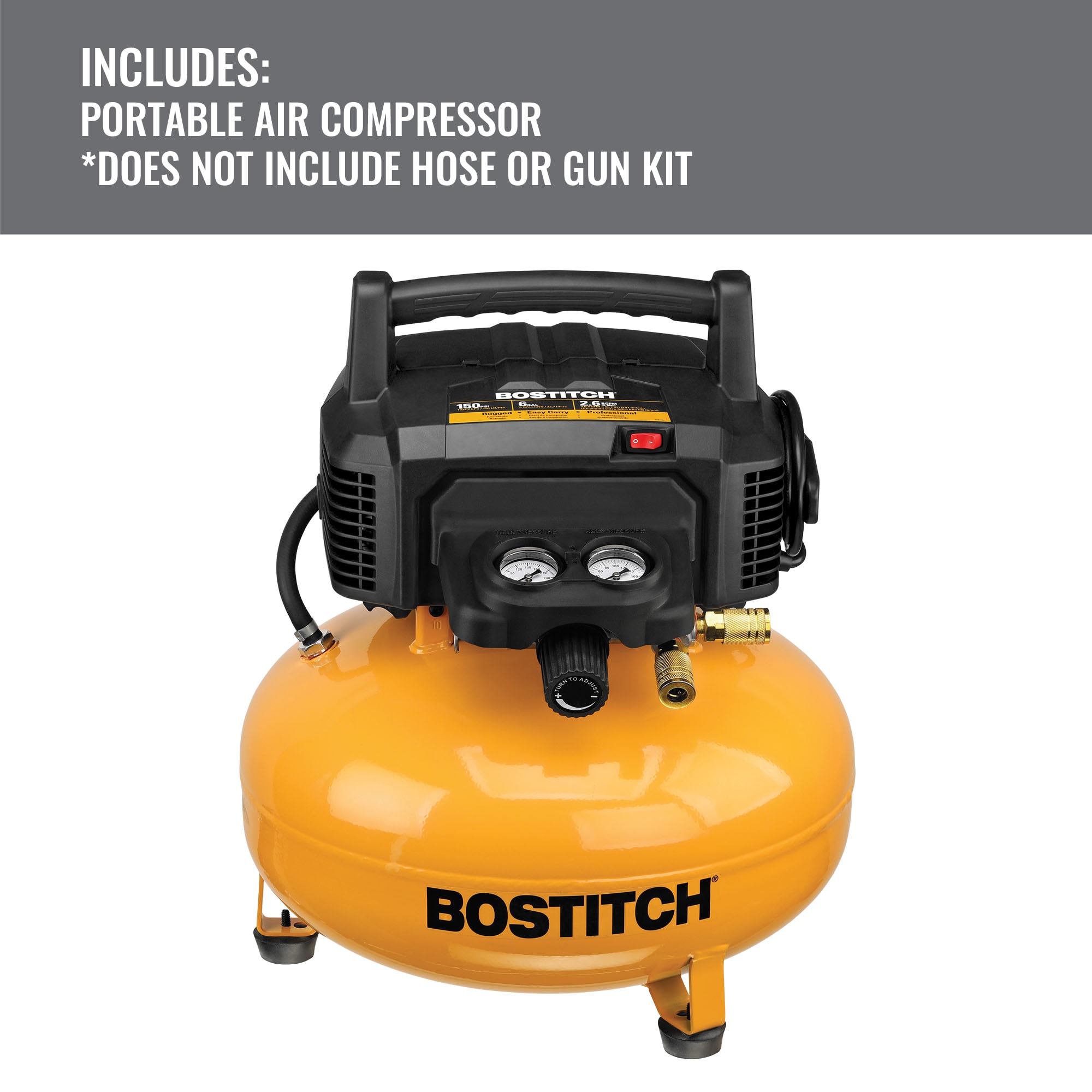
150 PSI / 2.6 CFM pancake that runs a coil roofing nailer on the roof.
View on Amazon →
Pick up loose roofing nails in the yard after the last course.
View on Amazon →As an Amazon Associate, TestTalkHQ earns from qualifying purchases. URLs from testtalkhq-affiliate-links.csv.