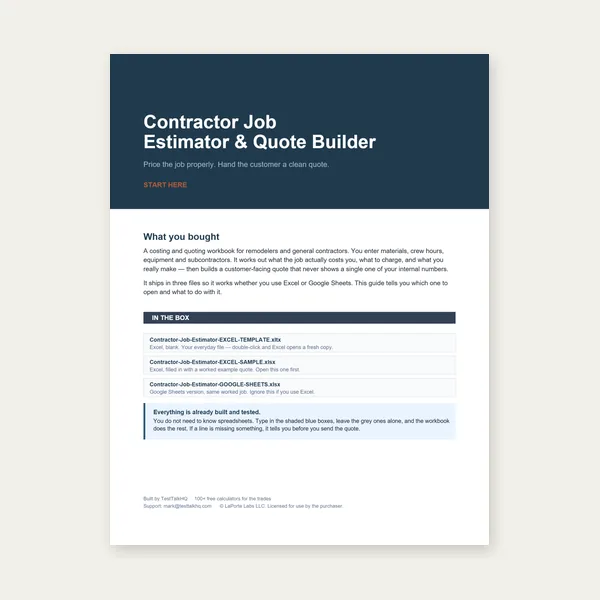
Contractor Job Estimator
Price remodels and GC work, then send a quote with no internal numbers.
Excel or Google Sheets. Best on a computer.
$29.00
BuyHow to turn ridge and hip linear footage into hip-and-ridge bundles — and why coverage depends on brand exposure
The ridge cap calculator does the arithmetic. This page is the method: how ridge/hip caps differ from field shingles, why GAF Seal-A-Ridge and TimberTex print different feet per bundle, and how to apply the result on the roof.
Problems: troubleshooting. Cut 3-tab vs pre-scored: comparison. Field squares: shingle bundle calculator. Hub: roofing tools.
Need a bundle count?Ridge + hip lineal with editable coverage and waste.
Open Calculator →Field asphalt shingles are sold and estimated by the square — 100 square feet of roof surface. That is what the roofing square & shingle bundle calculator covers.
Ridge and hip caps are a different SKU. Manufacturers sell purpose-made hip-and-ridge (ridge cap) products by the bundle, with coverage printed in linear feet at a stated exposure. You measure the ridge runs and hip runs, convert to feet with waste, then divide by that printed coverage. Mixing the two takeoffs is how crews run short of caps on day three with a full pallet of field bundles still on the truck.
The same product usually covers both ridges and hips. A simple gable has ridge only. A hip roof adds four (or more) hip runs that need the same cap material along the angled edges.
Run the same numbers in the calculator to confirm. Yards do not sell 0.36 of a hip-and-ridge bundle.
Coverage is exposure-driven. Shorter exposure means more pieces (and more linear feet) from the same piece count; longer exposure covers more per piece but fewer total feet per bundle.
Industry-wide, hip-and-ridge bundles generally land somewhere around 20–33 linear feet per bundle depending on brand and exposure. The calculator’s coverage field is editable so any brand works — the default of 25 is a Seal-A-Ridge starting point, not a law of physics.
Manufacturer instructions win over generic advice. In broad practice for asphalt hip-and-ridge:
Ready to count bundles?Editable coverage, waste, ridge + hip.
Open Ridge Cap Calculator →Sometimes on 3-tab roofs. On architectural/laminated field shingles, hand-cut strips crack and underperform purpose-made caps. Full decision: cut vs architectural ridge cap.
The waste percentage is meant to cover starters, cutoffs, and damaged pieces. If your manufacturer requires a full starter course that eats measurable length, bump waste or add a foot or two explicitly.
Separate takeoffs: drip edge and underlayment. Caps go on after the field and edge details are right.
Price remodels and GC work, then send a quote with no internal numbers.
Excel or Google Sheets. Best on a computer.
$29.00
BuyCheckout opens in a new tab.
Linear footage and bundles are only the order. On the ridge you still need a coil nailer, chalk line, hook knife for cuts and starters, and a tear-off shovel if you are stripping the old caps first.

Coil nailer for field and cap fastening. Cap nails still need correct placement per the manufacturer — the gun just keeps the pace up on long ridge runs.
View on Amazon →
Snap a centerline on the ridge before the first cap course. Extra-bold 1 mm line, 100 ft, five-gear rewind.
View on Amazon →
Hook blade for trimming caps, cutting starters, and scoring 3-tab strips if you are hand-cutting ridge pieces on a budget job.
View on Amazon →
Serrated tear-off shovel for stripping old ridge and hip caps before the new linear footage goes down.
View on Amazon →As an Amazon Associate, TestTalkHQ earns from qualifying purchases.