
The movement difference in numbers, what it costs, and the three times something else is the better answer
“Quartersawn moves less” is true, and it is not specific enough to spend money on. How much less depends entirely on the species, it ranges from about a third less to two thirds less, and in some woods the premium buys you something closer to a rounding error. Here is the comparison in published numbers, followed by the three situations where the answer is not quartersawn at all.
The difference, in numbers
Every species in Wood Handbook Table 13–5 carries two coefficients. Which one governs the width of your board is decided by how it was sawn: tangential for flatsawn, radial for quartersawn. So the saving quartersawing buys is exactly the radial coefficient divided by the tangential one.
| Species | Flatsawn width (CT) | Quartersawn width (CR) | Quartersawn moves | Saving |
|---|---|---|---|---|
| Pine, eastern white | 0.00212 | 0.00071 | 33 percent as far | 67 percent less |
| Maple, soft (silver) | 0.00252 | 0.00102 | 40 percent | 60 percent less |
| Oak, red (commercial) | 0.00369 | 0.00158 | 43 percent | 57 percent less |
| Beech, American | 0.00431 | 0.00190 | 44 percent | 56 percent less |
| Maple, hard (sugar) | 0.00353 | 0.00165 | 47 percent | 53 percent less |
| Cedar, western red | 0.00234 | 0.00111 | 47 percent | 53 percent less |
| Oak, white (commercial) | 0.00365 | 0.00180 | 49 percent | 51 percent less |
| Cherry, black | 0.00248 | 0.00126 | 51 percent | 49 percent less |
| Teak | 0.00186 | 0.00101 | 54 percent | 46 percent less |
| Hickory, pecan | 0.00315 | 0.00169 | 54 percent | 46 percent less |
| Douglas-fir (Coast) | 0.00267 | 0.00165 | 62 percent | 38 percent less |
| Walnut, black | 0.00274 | 0.00190 | 69 percent | 31 percent less |
Read the bottom two rows first, because they are the ones that change a decision. Black walnut quartersawn moves 69 percent as far as flatsawn — a 31 percent saving for whatever the quartersawn premium is in walnut, which is not small. Coast Douglas-fir saves 38 percent. Meanwhile eastern white pine saves 67 and red oak 57.
What it looks like on a real board
Ratios are abstract. Here is the same job in both cuts: an 8 in wide board, taken through a four-point moisture content change, which is roughly a normal conditioned-house year.
| Species | Flatsawn movement | Quartersawn movement | Difference |
|---|---|---|---|
| Oak, red (commercial) | 0.118 in (about 1/8) | 0.051 in (about 3/64) | 0.067 in |
| Maple, hard (sugar) | 0.113 in | 0.053 in | 0.060 in |
| Cherry, black | 0.079 in | 0.040 in | 0.039 in |
| Walnut, black | 0.088 in | 0.061 in | 0.027 in |
| Douglas-fir (Coast) | 0.085 in | 0.053 in | 0.032 in |
| Pine, eastern white | 0.068 in | 0.023 in | 0.045 in |
On an 8 in board, quartersawing red oak buys you about 1/16 in over a normal year. In walnut it buys about 1/32 in. Whether either of those is worth the money depends entirely on the detail the board sits in — and that is the real decision, not the cut.
The rest of the comparison
Movement is one column of a larger table. Here is the rest of it.
| Factor | Flatsawn | Quartersawn |
|---|---|---|
| Width movement | Tangential — the larger coefficient | Radial — 31 to 67 percent less, by species |
| Thickness movement | Radial — the smaller one | Tangential — so it moves more in thickness |
| Cupping | Built-in tendency; worse the higher the T/R ratio | Essentially none from ring orientation |
| Yield from the log | High — the log is sawn straight through | Low — more cuts, more waste, narrower boards |
| Typical width available | Whatever the log gives | Narrower, because width is limited by the radius |
| Appearance | Cathedral and flame figure | Straight vertical grain; ray fleck in oak and sycamore |
| Price | The baseline | A premium that varies by species and market |
| Wear in a floor | Earlywood exposed in bands | Edge grain wears more evenly |
Two of those deserve a second look because they catch people out.
The thickness swaps. Quartersawn stock is less stable in thickness than flatsawn, not more, because the coefficients simply exchange faces. On a 3/4 in board nobody notices. On a 1‑1/2 in tenon shoulder, a tread housing, or anything fitted into a dado at a tight tolerance, it is real: quartersawn red oak’s thickness moves at 0.00369 where flatsawn moves at 0.00158.
Quartersawn stock is narrower. A log’s quartersawn yield is limited by its radius, so quartersawn boards tend to come narrower. That is partly self-correcting — movement is proportional to width, so a narrower board moves less anyway — but it is a planning constraint for anyone who wanted wide stock in the first place.
Any trade

Contractor Job Estimator
Price remodels and GC work, then send a quote with no internal numbers.
Excel or Google Sheets. Best on a computer.
$29.00
BuyCheckout opens in a new tab.
Telling them apart, and building for it
The whole decision below turns on one observation — the angle the growth rings make to the face of the board — and on actually getting the clearance you planned into the work. Neither needs much. A moisture meter would top this list and we have no verified affiliate link for one, so that slot is empty rather than filled with a guess.
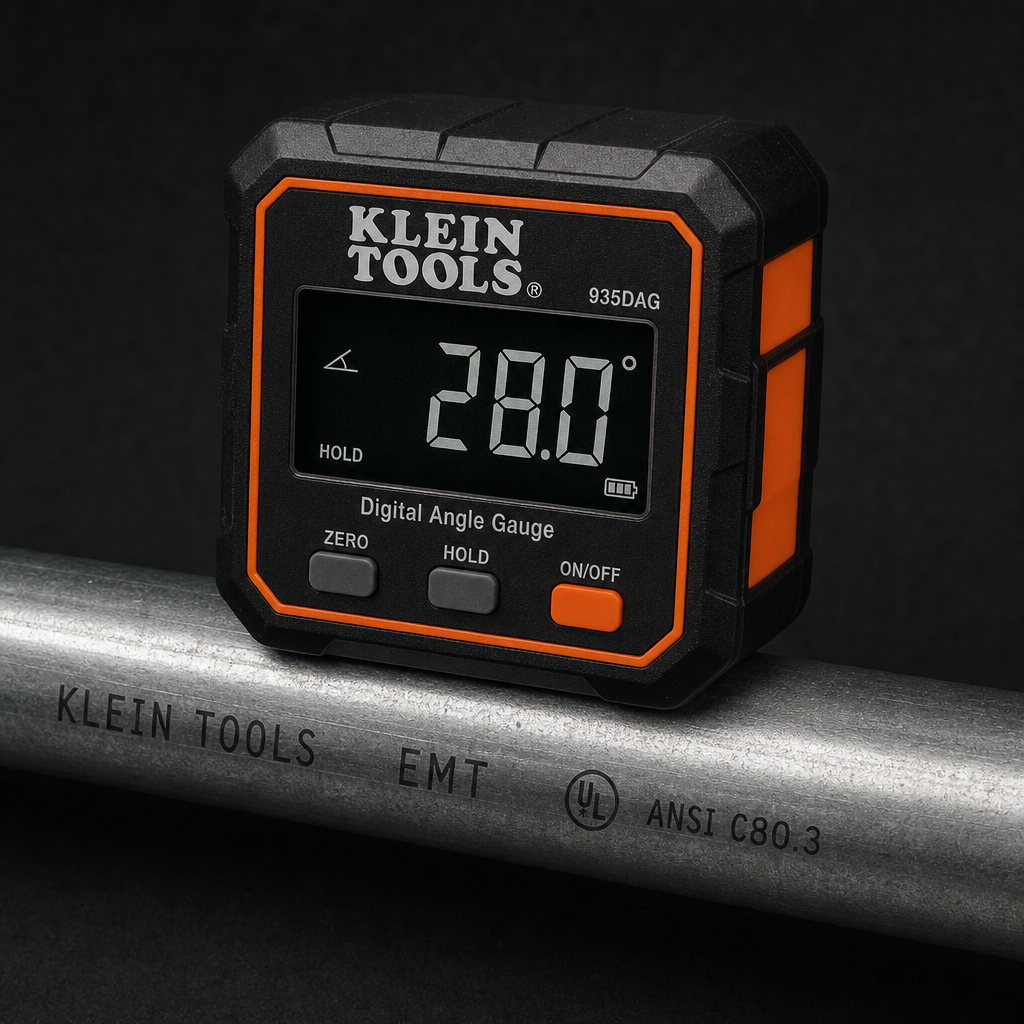
Klein Tools 935DGGP Digital Angle Gauge
- Quartersawn, riftsawn and flatsawn are an angle, not an opinion
- Over about 60 degrees to the face is true quartersawn
- Worth having when you are paying a premium for the grade
Stabila Type 196 48" Box Beam Level
- The flatness quartersawn buys is a thing you can measure
- Straightedge across the width before and after a season
- Also the reference for sorting a mixed delivery
Swanson TA122 Rafter Square 16×24
- Quartersawn halves the movement; it does not remove it
- Sets an even perimeter clearance at both ends of the run
- Squares the first course so the gap stays even all the way across
Franklin Sensors ProSensor M210 Stud Finder
- Letting flatsawn stock float beats paying for quartersawn in most cases
- Floating needs one fixed point, which means knowing the framing
- Reads the whole stud width rather than hunting for an edge

Bosch GLL30 Self‑Leveling Cross‑Line Laser
- Quartersawn still accumulates movement over 40 ft of floor
- Snaps a starting line that keeps clearance at the far wall
- Self-levelling cross lines, so one setup does the whole room
As an Amazon Associate, TestTalkHQ earns from qualifying purchases. Prices and availability can change.
When quartersawn is the right answer
Four cases, and they share a shape: the board is wide, it is restrained, the species has a high ratio, or the detail has no tolerance.
- Wide stock that must stay flat. A 12 in flatsawn red oak board over a four-point swing moves 0.177 in and has a 2.34 ratio pulling it into a cup. Quartersawn takes the movement to 0.076 in and removes the cupping tendency entirely. This is the strongest case there is.
- High-ratio species in visible work. Red oak, beech, hard maple and silver maple all sit above 2.1. These are the species where quartersawing buys the most on both counts.
- Flooring in a swinging climate. Halving the per-board movement halves the total across the run, which halves the perimeter clearance required. On a wide-plank floor where the clearance is hard to hide, that can be the difference between a detail that works and one that does not.
- Where the ray fleck is the point. Quartersawn white oak’s medullary ray figure is a design decision in its own right, and the stability comes free with it.
When something else beats it
Three alternatives, each of which is cheaper than quartersawing and sometimes better.
1. Make the board narrower. Movement is directly proportional to width, so halving the width halves the movement — exactly the same arithmetic as quartersawing red oak, at no premium at all. Two 4 in flatsawn boards with a joint between them move the same total as one 8 in board, but each individual movement is half the size and the joint can absorb it. This is why strip flooring exists, why frame-and-panel exists, and why a 2‑1/4 in oak strip floor is a solved problem while a 10 in plank floor is an engineering exercise.
2. Let it float. If the detail allows the board to change width freely, the movement costs nothing and the cut is irrelevant. A tabletop on slotted fasteners, a panel loose in its groove, a shelf fixed at one end: all of these make the flatsawn-or-quartersawn question academic. Paying a premium for quartersawn stock and then gluing it down hard is spending money to make a failure slightly slower.
3. Change species. The species axis is often a bigger lever than the cut axis, and it is worth laying the two side by side before assuming otherwise. Flatsawn black cherry at 0.00248 moves a third less than flatsawn red oak at 0.00369 — so simply choosing cherry gets you most of the way to what quartersawing the oak would have bought, and a flatsawn cherry board is usually easier to find wide. Or take teak: flatsawn, at 0.00186, it moves a shade more than quartersawn hard maple does at 0.00165, but it moves less than half as far as flatsawn hard maple at 0.00353. Changing species bought more there than quartersawing would have. Pick the species first, then ask about the cut.
| Option for an 8 in board, four-point change | Movement | Relative cost |
|---|---|---|
| Flatsawn red oak | 0.118 in | Baseline |
| Quartersawn red oak | 0.051 in | Quartersawn premium |
| Two 4 in flatsawn red oak boards | 0.059 in each | Nothing — a joint |
| Flatsawn black cherry | 0.079 in | Species premium |
| Flatsawn red oak, floating detail | 0.118 in, absorbed | Nothing — a fastener choice |
A decision procedure
- Work out the movement you actually have for the flatsawn case: width times tangential coefficient times the moisture content swing the piece will see.
- Ask what the detail can absorb. If it can take the whole flatsawn movement, stop — the cut does not matter and you have saved the premium.
- If it cannot, try narrower first. Halving the width is free and halves the movement.
- Then try floating. A fastener change is cheaper than a lumber grade change.
- Then look up the T/R ratio. If it is above about 2, quartersawing buys more than half the movement and removes the cupping tendency, and it is probably worth it. If it is near 1.5, quartersawing buys under a third and you should be looking at a different species instead.
- Check the thickness. If the piece is fitted at a tight tolerance in its thickness, remember that quartersawing makes that direction worse.
And run both cases through the calculator before deciding. The difference between the two cuts is a number, not an argument, and it takes about a minute to have it in front of you.
Frequently asked questions
How much more stable is quartersawn wood? Across its width, between about 31 and 67 percent more stable depending entirely on species, because the saving is the ratio of the radial coefficient to the tangential one. Eastern white pine quartersawn moves 33 percent as far as flatsawn, commercial red oak 43 percent, Coast Douglas-fir 62 percent and black walnut 69 percent. In thickness the relationship reverses, because the two coefficients exchange faces, so quartersawn stock is less stable in thickness than flatsawn.
Is quartersawn worth the extra cost? It depends on the detail rather than on the wood. If the piece can move freely — a floating tabletop, a panel in a groove, a shelf fixed at one end — the movement costs nothing and the premium buys appearance and flatness rather than function. If the piece is wide and restrained, in a species with a tangential-to-radial ratio above about 2, quartersawing removes more than half the movement and the cupping tendency with it, and that is the case where it earns the money. Making the board narrower or letting it float are both cheaper and should be considered first.
Does quartersawn wood still move? Yes. It moves across its width at the radial coefficient instead of the tangential one, which is less but never zero. Quartersawn red oak in an 8 in board over a four-point moisture content change still moves about 0.051 in, so a long floor run still accumulates a meaningful total and still needs its expansion clearance. Quartersawn is a reduction in movement, not an elimination of it.
What is riftsawn and where does it fit? Riftsawn boards have growth rings at roughly 45 degrees to the face, between flatsawn and quartersawn. The movement falls between the radial and tangential figures, and the face shows straight grain with no ray fleck, which is why it is specified where the fleck of quartersawn oak would be unwanted. Yield from the log is the lowest of the three, so it is usually the most expensive. Treating it as quartersawn for width movement is the conservative assumption.
Why is quartersawn lumber narrower? Because the width of a quartersawn board is limited by the radius of the log rather than its diameter, and because producing truly radial faces means more cuts and more waste. That is also most of why it costs more. For movement purposes it partly cancels out, since movement is proportional to width and a narrower board moves less to begin with.
Does quartersawn wood cup? Not from ring orientation, which is its main advantage. A quartersawn board’s two faces have the same orientation relative to the rings, so there is no built-in difference in how far they shrink. It can still cup from a moisture gradient — one face wetter than the other will still pull it — so a quartersawn deck board wet on top and dry underneath is not immune.
Which species benefit most from quartersawing? Those with the highest tangential-to-radial ratios. Eastern white pine at 2.99, commercial red oak at 2.34, American beech at 2.27, hard maple at 2.14 and silver maple at 2.47 all save more than half their width movement. The species that benefit least are the ones that already move evenly: black walnut at 1.44 and Coast Douglas-fir at 1.62, where the saving is under 40 percent.
Can I just use narrower boards instead? Often, yes, and it is free. Movement is directly proportional to width, so two 4 in boards move half as much each as one 8 in board, and the joint between them absorbs the difference. That is the same reduction quartersawing red oak achieves, at no premium. It is why strip flooring and frame-and-panel construction exist, and it is the first alternative to consider before paying for a grade change.