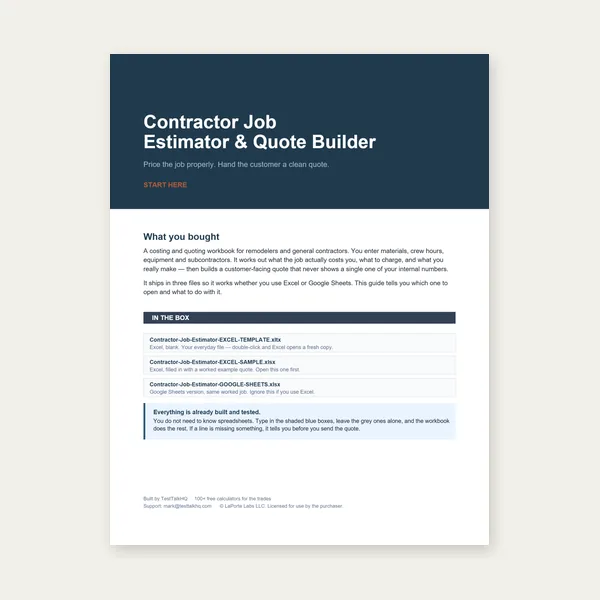
Contractor Job Estimator
Price remodels and GC work, then send a quote with no internal numbers.
Excel or Google Sheets. Best on a computer.
$29.00
BuyRequired fall-arrest clearance in feet — free fall + deceleration + harness stretch + safety factor vs available clearance below the anchor
Enter free-fall distance, deceleration (shock pack or SRL), harness stretch / D-ring shift, safety margin, and measured clearance to the next obstruction. Get a pass/fail with a full breakdown. Method: fall clearance guide. Field failures: troubleshooting. Connector choice: SRL vs shock lanyard. Related safety: PPE by process, arc-flash boundary, noise exposure, hot work checklist. Hub: shop safety tools.
Measure available clearance from the anchor point down to the next lower level or equipment. Enter free-fall and deceleration from your connector label (or use the 6-ft lanyard / SRL presets). Add harness stretch and a safety-factor margin. Calculate. Read required clearance, pass/fail, and the component breakdown.
Full component notes and OSHA 1926.502 context: guide. Low anchors and ignored stretch: troubleshooting.
Price remodels and GC work, then send a quote with no internal numbers.
Excel or Google Sheets. Best on a computer.
$29.00
BuyCheckout opens in a new tab.
Harness, connector, and anchor picks for clearance-limited fab shops and rooftop work. Affiliate links from the live TestTalkHQ Geniuslink set only.
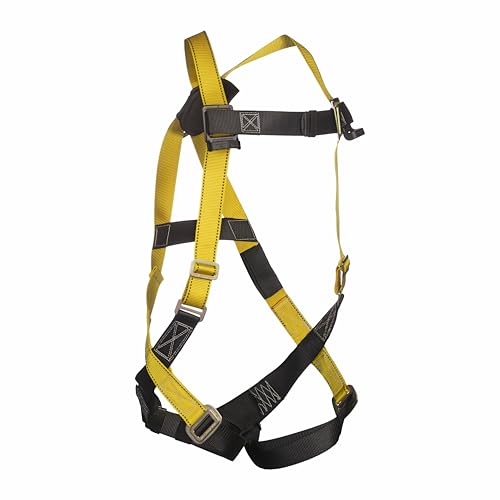
Full-body harness for construction and shop fall arrest — D-ring geometry you still add as stretch/shift in the clearance stack.
View on Amazon →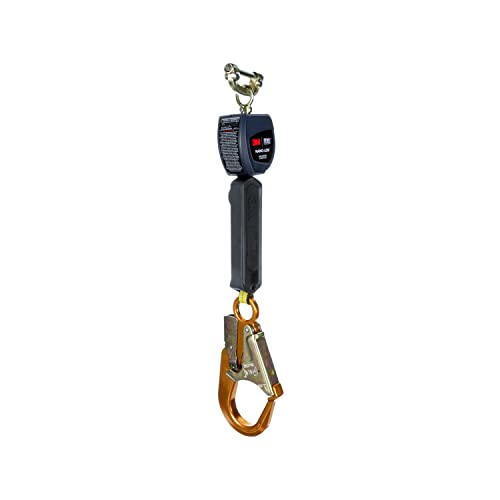
Personal SRL that keeps free fall short when the anchor and working surface allow it — use manufacturer deceleration and free-fall numbers in the calculator.
View on Amazon →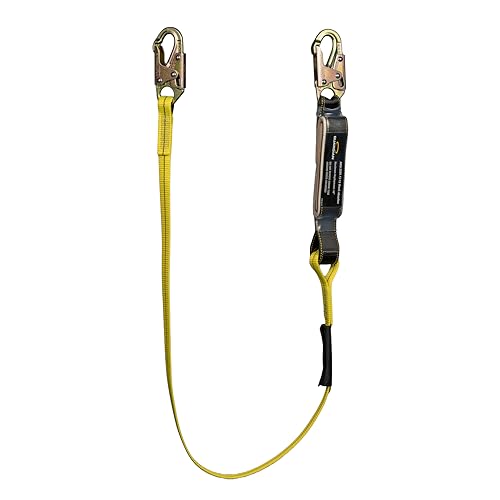
Classic 6-ft shock lanyard preset in the widget (free fall ~6 ft, pack deployment ~3.5 ft). Confirm your model’s label before you trust the stack.
View on Amazon →
Reusable roof anchor for temporary fall-arrest tie-off. Anchor height and location drive free-fall distance — measure before you clip.
View on Amazon →As an Amazon Associate, TestTalkHQ earns from qualifying purchases. Product links are from the live TestTalkHQ affiliate CSV / Geniuslink set only.
The required clearance is a planning stack: how far you fall before the system engages, how far the energy absorber pays out, how much the harness and D-ring shift under load, plus a deliberate margin. Available clearance is a field measurement from the working surface to the strike hazard below — not from the anchor to the floor unless that is truly the path.
It is not a rescue plan, a swing-fall analysis, or permission to ignore manufacturer free-fall limits. It does not size anchorage strength (OSHA 1926.502(d)(15) criteria still apply). Pair fall arrest with the rest of shop risk controls: PPE by process, hot work, and energy isolation via LOTO when equipment can move under you.
Clearance is a sum of job-specific distances, not a single code table reprint. The widget, guide, and manufacturer labels already give you the reference you need.
No. OSHA 1926.502 sets system performance and criteria; your clearance comes from the equipment and geometry you actually use. Training expectations sit in OSHA 1926.503.
Whenever available clearance is tight. See SRL vs shock-absorbing lanyard.
It is a planning margin in this tool, not a single OSHA “magic number.” Do not delete margin to force a pass. If the stack only works at zero margin, change the system.