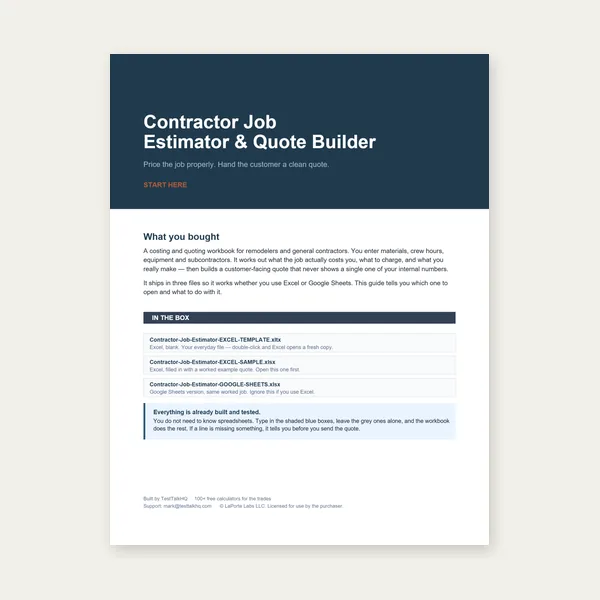
Contractor Job Estimator
$29.00
BuyASCE 7-16 balanced roof snow load from mapped ground snow — pf = 0.7 Ce Ct Is pg, then slope factor Cs. Planning estimate, not a stamp.
This is structural load, not a shingle takeoff. Look up pg for the site, then convert it. Rafters and beams that have to carry this: joist span calculator and deck beam span calculator. Pitch from framing: rafter length calculator. How to find pg: guide. Sag vs creep: troubleshooting. Why ground ≠ roof: comparison. Roofing index: roofing calculators hub.
Ground snow load from your jurisdiction, then exposure, thermal condition, occupancy, pitch, and surface. ASCE 7-16: pf = 0.7 Ce Ct Is pg, then ps = Cs pf. Not a whole-roof square count and not a span table.
There is no universal default. Get pg from the local building department (IRC Table R301.2 climatic criteria), the permit, or the free ASCE 7 Hazard Tool for the adopted edition. Case-study mountain zones need a site-specific value. Do not paste a city-average rumor. This field is empty on purpose.
Same X/12 as the rafter calculator. Slope angle α = arctan(X/12). Steeper roofs shed: Cs stays 1.0 until a thermal/surface breakpoint, then falls to 0 at 70° (ASCE 7-16 Figure 7.4-1).
Assumed suburban roughness B (typical house). Partially exposed is the usual residential default. Fully exposed = no shelter from terrain, taller structures, or trees. Sheltered = tight in among winter-obstructing conifers. Open/coastal (C/D) can be slightly lower when fully exposed; this tool does not undercut B.
Heated = ordinary occupied house. Cold ventilated = kept just above freezing, or a cold roof with R > 25 between the vented space and the heat. Unheated / open-air = barn, carport, unconditioned garage. Freezer buildings (1.3) and greenhouse reductions (0.85) are out of this dropdown on purpose.
Risk Category II (Is = 1.00) is a typical house. Do not drop to RC I to shave load. ASCE 7-22 removed Is from pf and uses separate strength-level maps per risk category — do not mix a 7-22 Hazard Tool pg with this 7-16 formula.
Default is not slippery: shingles, and any roof that cannot freely slide at the eave (gutters, snow guards, dormers). Unobstructed slippery is a warm or cold metal roof that can actually dump snow — do not pick it to lower the number on a shingle roof.
ASCE 7-16 §7.3 / Eq. 7.3-1: pf = 0.7 Ce Ct Is pg. Eq. 7.4-1: ps = Cs pf, applied on the horizontal projection. Cs from Figure 7.4-1 (linearized between α0 and 70°). §7.3.4 minimum pm for slope \u2264 15°. Ce from Table 7.3-1 roughness B; Ct from Table 7.3-2; Is from Table 1.5-2. Not included: drifting, unbalanced, sliding, rain-on-snow, partial loading. ASCE 7-22 uses risk-category maps and drops Is from pf — do not mix editions. IRC Table R301.2 is where most houses get pg. How to look it up: guide. Sag and cracking: troubleshooting. Why pg \u2260 ps: comparison. Span tables that still assume 40 psf live: joist span, deck beam span.
Look up ground snow load pg for the site. Enter it. Leave exposure on partially exposed and thermal on heated unless the roof is actually sheltered or unheated. Keep Risk Category II for a house. Type pitch as X/12. The tool builds the flat-roof load, applies the slope factor, then (on low slopes) checks the code minimum.
This is a load in psf, not a span. Take it as context to the joist span calculator and deck beam span calculator — those IRC tables are 40 psf live, not this snow number. Where to find pg: guide. Sag vs creep: troubleshooting. Why you must not use pg as the roof load: comparison.
The headline is the balanced design snow load on the roof, in pounds per square foot on the horizontal projection. It is not the ground snow load, not a rafter size, and not permission to skip an engineer in snow country.
ASCE 7-16 service-level pg with Is. Ce from Table 7.3-1 roughness B only. Ct is one of 1.0 / 1.1 / 1.2. Cs is the linearized Figure 7.4-1 curve (not a scanned graph). One pitch, one exposure, one thermal condition. No drifting, no unbalanced gable, no sliding from an upper roof, no rain-on-snow surcharge, no parapets, no sawtooth. ASCE 7-22 maps are a different pg and a different equation.
Shingle squares belong in the roofing square calculator. Ice-barrier width belongs in the ice & water shield coverage calculator. Attic NFA belongs in the attic ventilation calculator. Common rafter length belongs in the rafter calculator.
Need a span, not a psf?Joist and beam tables are a different job. This number is an input to that conversation, not the span itself.
Open Joist Span Calculator →$29.00
BuyCheckout opens here — you stay on this page.
The calculator returns a balanced roof snow load in psf. A roof rake is how you take snow off an existing deck from the ground. CSV rows 400–412 were nailers, vents, gutters, and ice barrier — not snow-removal tools — so these two SKUs are new.
21 ft extendable aluminum rake with wheels and oxford slide. Size the balanced roof snow load first; this is how you take snow off the deck from the ground — not a substitute for an engineer.
View on Amazon →
24 in blade with shingle-saver rollers so the edge never rides the asphalt. Relieving weight is not the same as designing for it — run the snow-load number before you argue with a sagging ridge.
View on Amazon →
Look up pg, then Ce, Ct, Is, and pitch. Flat-roof pf, slope factor Cs, governing psf. Planning estimate only.
Open Roof Snow Load Calculator →
IRC joist tables assume 40 psf live. A roof or covered deck in snow country is a different load path — size the snow first.
Open Joist Span Calculator →
Table R507.5(1) is 40/10. Tables R507.5(2)–(4) are snow rows this tool does not replace. Convert pg to roof snow, then talk to the table or an engineer.
Open Deck Beam Span Calculator →As an Amazon Associate, TestTalkHQ earns from qualifying purchases.