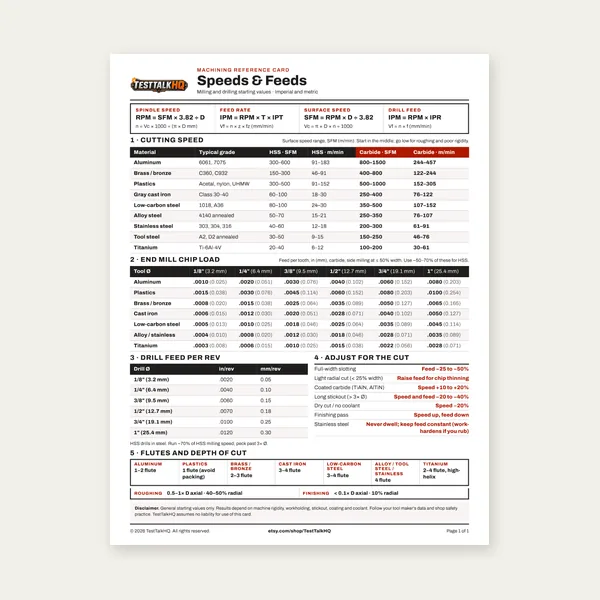
Machining Speeds & Feeds Card
One page. Speeds, chip load and drill feed, imperial and metric.
$3.99
BuyDriven RPM, speed ratio, and open-belt length for shop drives
Use forward mode for driven RPM from known pulleys, or reverse mode to size a pulley for a target output speed. Optional center distance estimates open-belt length with the standard shop formula.

Diameters in inches. Use pitch diameter when the sheave catalog lists it; otherwise measured OD is the shop approximation.
Typical single-phase motors: ~1725 or ~3450 RPM. Use the nameplate, not the marketing sticker.
Planning aid using diameter-ratio belt-drive formulas. Real pitch diameter, belt stretch, slip, and multi-groove derates change results. Verify with a tachometer after install. Not a substitute for the sheave/belt manufacturer chart or machine OEM limits.
One page. Speeds, chip load and drill feed, imperial and metric.
$3.99
Buy
27 pages. Milling, drilling, tapping, turning and CNC routing.
$12.99
Buy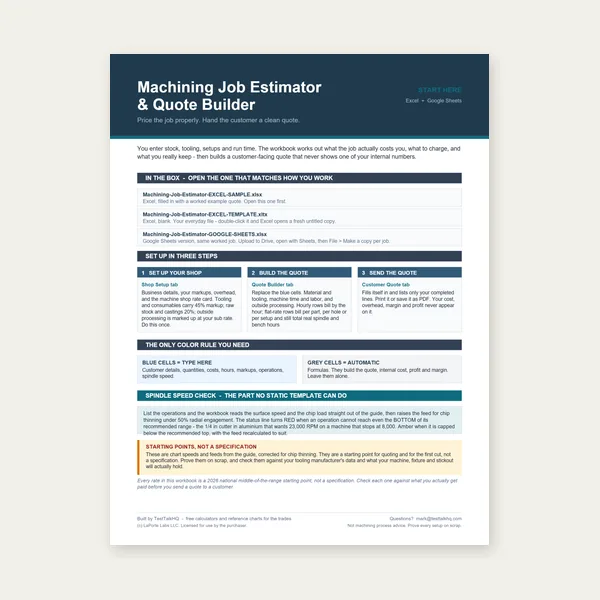
Quote shop work and check operations against your spindle's top speed.
Excel or Google Sheets. Best on a computer.
$29.00
Buy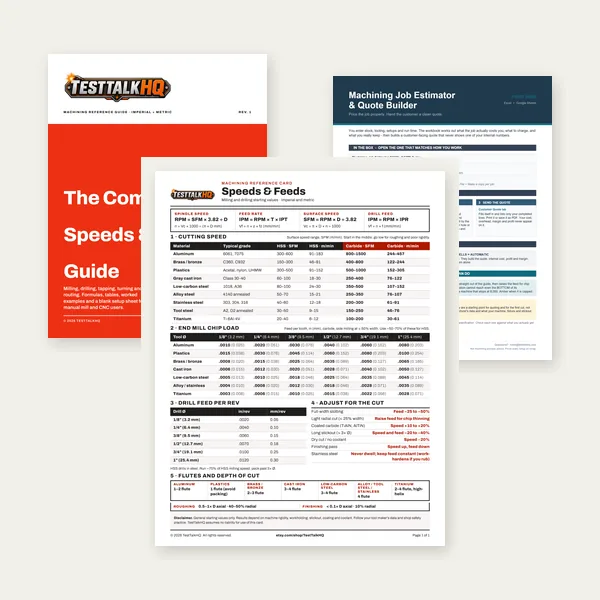
Card, 27-page guide and the estimator workbook. All six files.
Excel or Google Sheets. Best on a computer.
$34.99
$45.98 if bought separately — save $10.99
BuyCheckout opens here — you stay on this page.
Dedicated V-belts, sheave sets, belt tension gauges, and laser tachometers are not in the current TestTalkHQ affiliate CSV — so they are not invented here. These are real catalog items you can use while sizing and checking a belt drive.
Measure driver and driven pulley outside diameters before you trust a stamped size. Pitch diameter may differ from OD on V-groove sheaves — confirm what the catalog calls out.
View on Amazon →Check pulley face runout and shaft end-play after a swap. A few thousandths of wobble will walk a belt off the groove and chew the sidewall.
View on Amazon →Confirm sheave faces are coplanar and shafts are parallel before you tension. Misalignment is the #1 cause of squeal that “needs more tension.”
View on Amazon →Probe V-groove wear and belt bottoming. If the belt rides on the groove floor instead of the flanks, ratio and belt life both go wrong.
View on Amazon →Torque taper-lock bushings and set screws to the sheave maker’s spec. Under-torque walks; over-torque cracks cast iron hubs.
View on Amazon →Common belt-driven shop compressor — the exact use case for a pulley swap when you need more CFM headroom or quieter lower RPM.
View on Amazon →As an Amazon Associate, TestTalkHQ earns from qualifying purchases.
Enter driver (motor) pulley diameter, driven pulley diameter, and motor RPM. The tool returns driven RPM, speed ratio (driven÷driver), and — if you enter shaft center distance — an open-belt length estimate. Reverse mode solves for the missing pulley when you already know the target spindle or compressor RPM.
Ratio math is diameter-based: N₂ = N₁ × (D₁ / D₂). A larger driven pulley slows the output and multiplies torque; a smaller driven pulley speeds it up. That is how belt-driven air compressors, lathes, and drill presses hit shop speeds from a fixed 1725 or 3450 RPM motor. Read the full walkthrough in the Pulley and Belt Ratio Guide.
If the belt squeals, walks, or the RPM is wrong after a swap, go to Pulley and Belt Problems and Solutions. Choosing V-belt vs flat vs timing? See V-Belt vs Flat Belt vs Timing Belt. Common size lookups live on the Pulley / Sheave Size Chart.