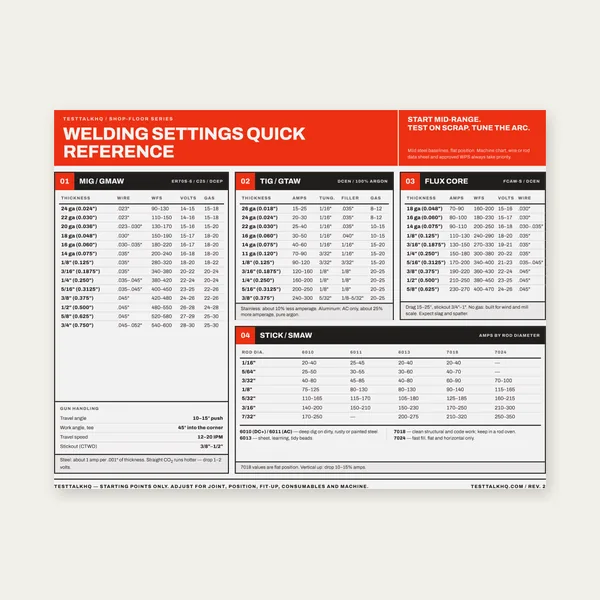
Welding Reference Card
One page. MIG, TIG, stick and flux core settings by thickness.
$3.99
BuyFeet of wire and how long a spool lasts
Enter wire diameter, material density, spool weight, and wire feed speed to get length on the spool, arc-on hours, and an optional deposited weld-feet estimate.
Also try our Weld Deposition Rate Calculator and MIG Welding Calculator.

One page. MIG, TIG, stick and flux core settings by thickness.
$3.99
Buy
19 pages. Four processes, stainless and aluminum, symbols and inspection.
$12.99
Buy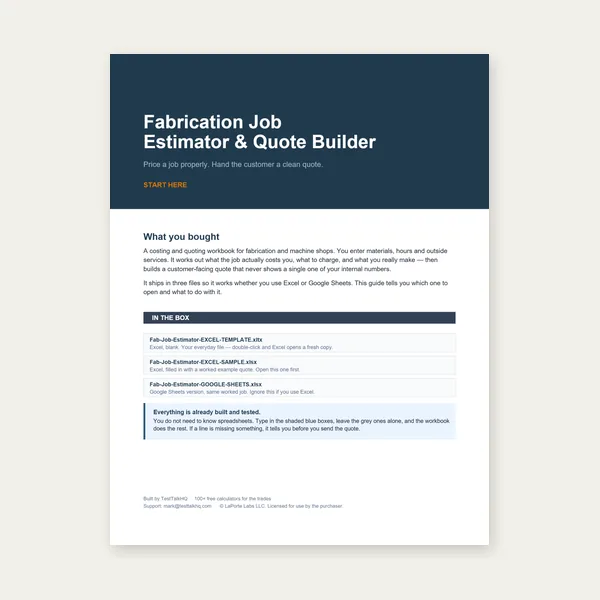
Price the job, then hand over a quote with no internal numbers.
Excel or Google Sheets. Best on a computer.
$29.00
Buy
Card, 19-page guide and the estimator workbook. All six files.
Excel or Google Sheets. Best on a computer.
$34.99
$45.98 if bought separately — save $10.99
BuyCheckout opens in a new tab.
Spools and machines matched to deposition and runtime workflows
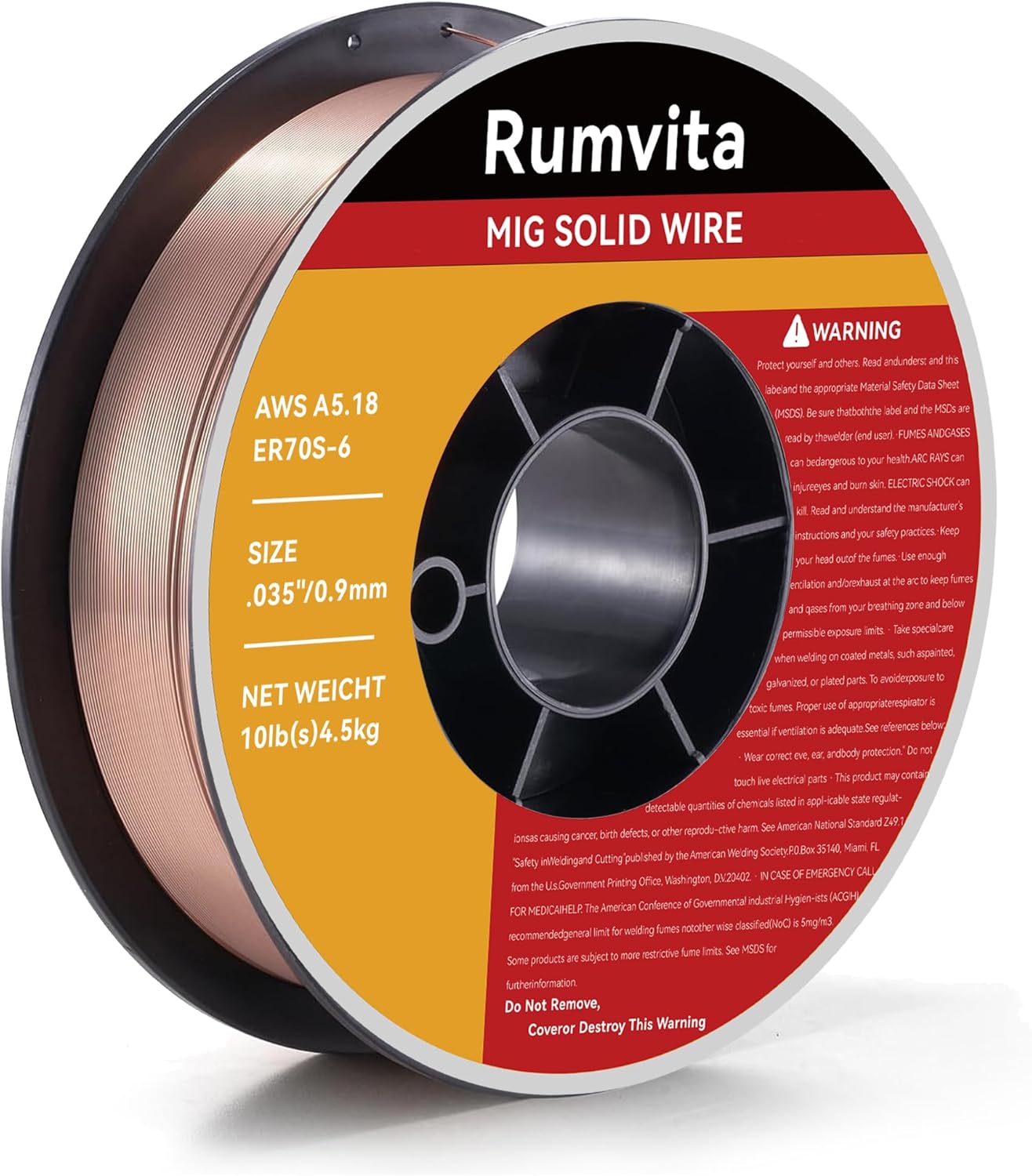
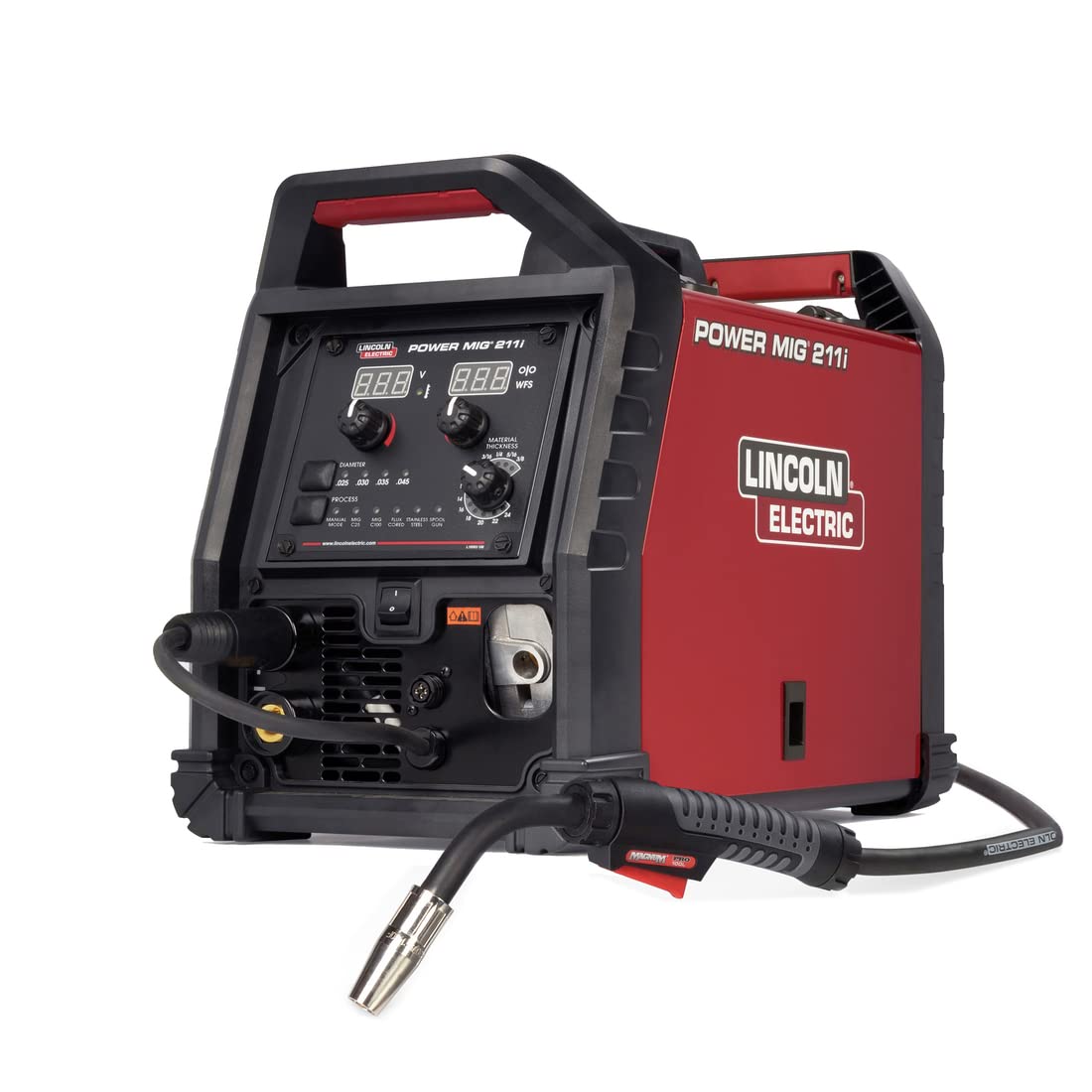

As an Amazon Associate, TestTalkHQ earns from qualifying purchases.
Wire length comes from mass and cross-section. With density ρ (lb/in³) and radius r (in):
Length (in) = Weight ÷ (ρ × π × r²)
Arc-on minutes = Length (in) ÷ WFS (IPM)
Steel ≈ 0.283 lb/in³, stainless ≈ 0.290, aluminum ≈ 0.098. Flux-core packs less deposited metal per pound of spool because slag and fill reduce deposition efficiency — use the 85% option for FCAW.
Lower density means more length for the same mass at a given diameter.
It can lower effective WFS or cause birdnesting, but the theoretical feet on the spool stay the same.