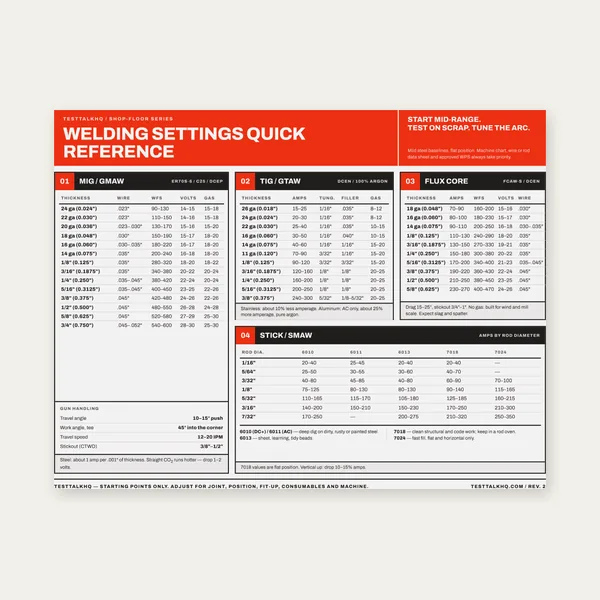
Welding Reference Card
One page. MIG, TIG, stick and flux core settings by thickness.
$3.99
BuyCalculate welding productivity in pounds per hour — optimize your shop efficiency
One page. MIG, TIG, stick and flux core settings by thickness.
$3.99
Buy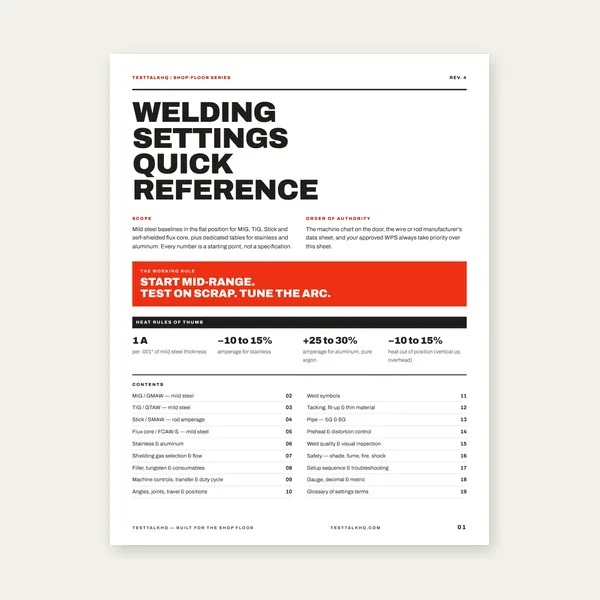
19 pages. Four processes, stainless and aluminum, symbols and inspection.
$12.99
Buy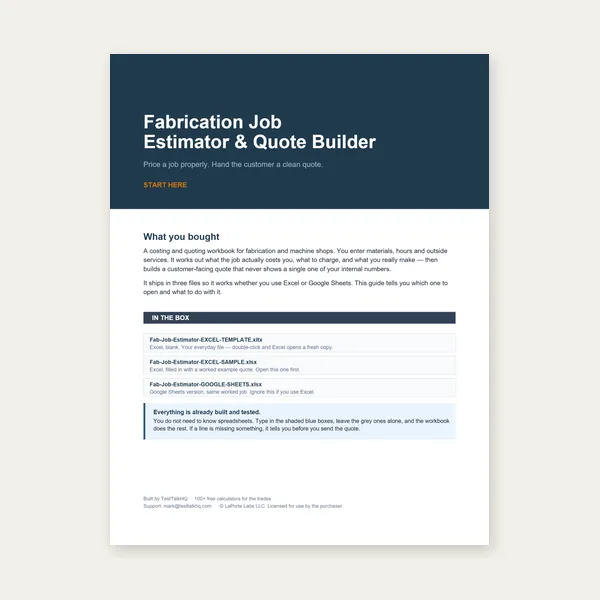
Price the job, then hand over a quote with no internal numbers.
Excel or Google Sheets. Best on a computer.
$29.00
Buy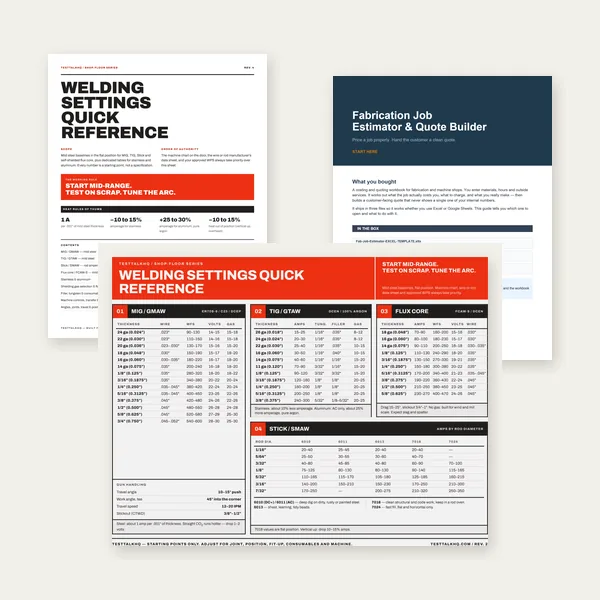
Card, 19-page guide and the estimator workbook. All six files.
Excel or Google Sheets. Best on a computer.
$34.99
$45.98 if bought separately — save $10.99
BuyCheckout opens in a new tab.
Wire, machines that display feed rate clearly, and shop tools to verify material usage.
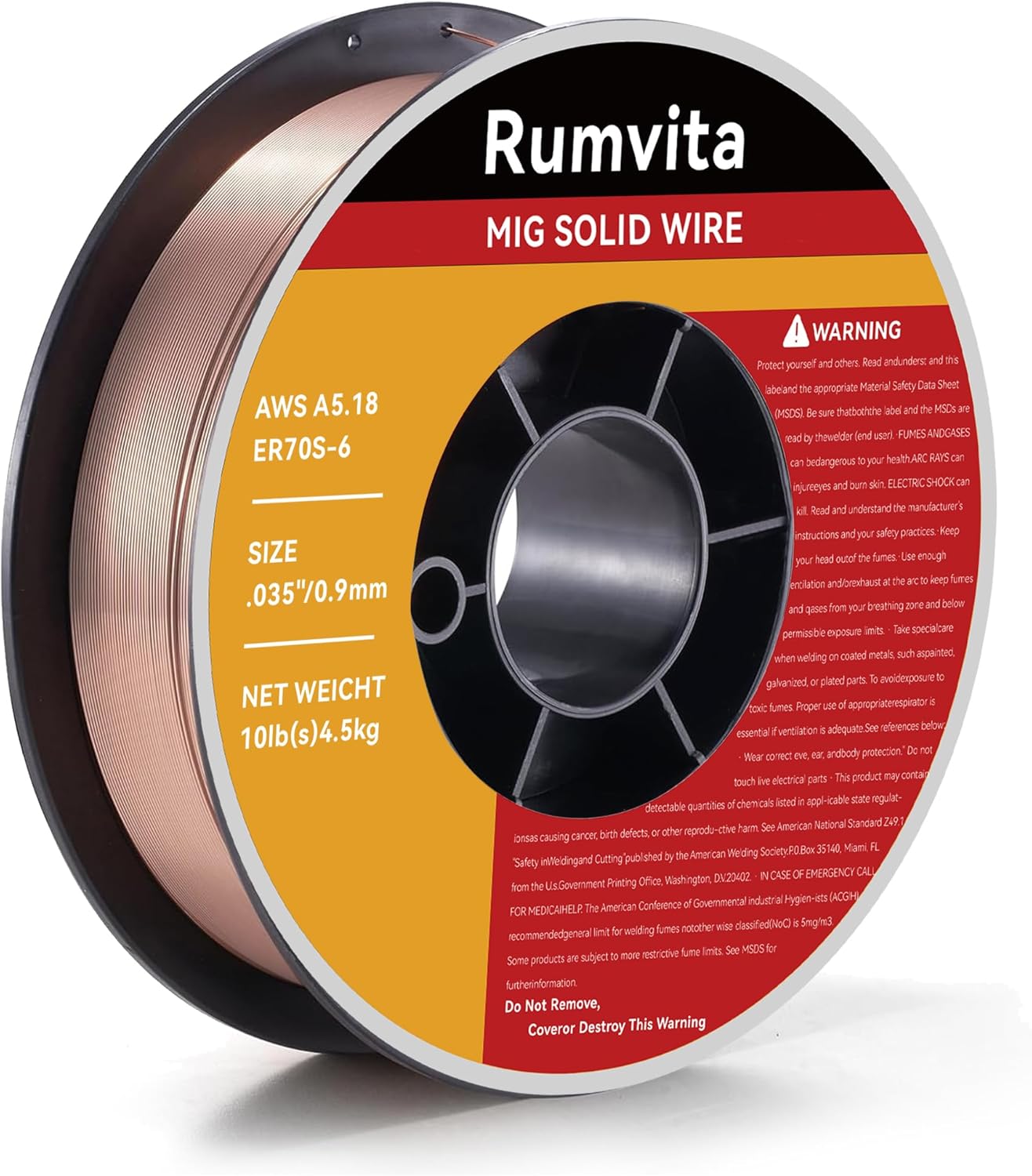
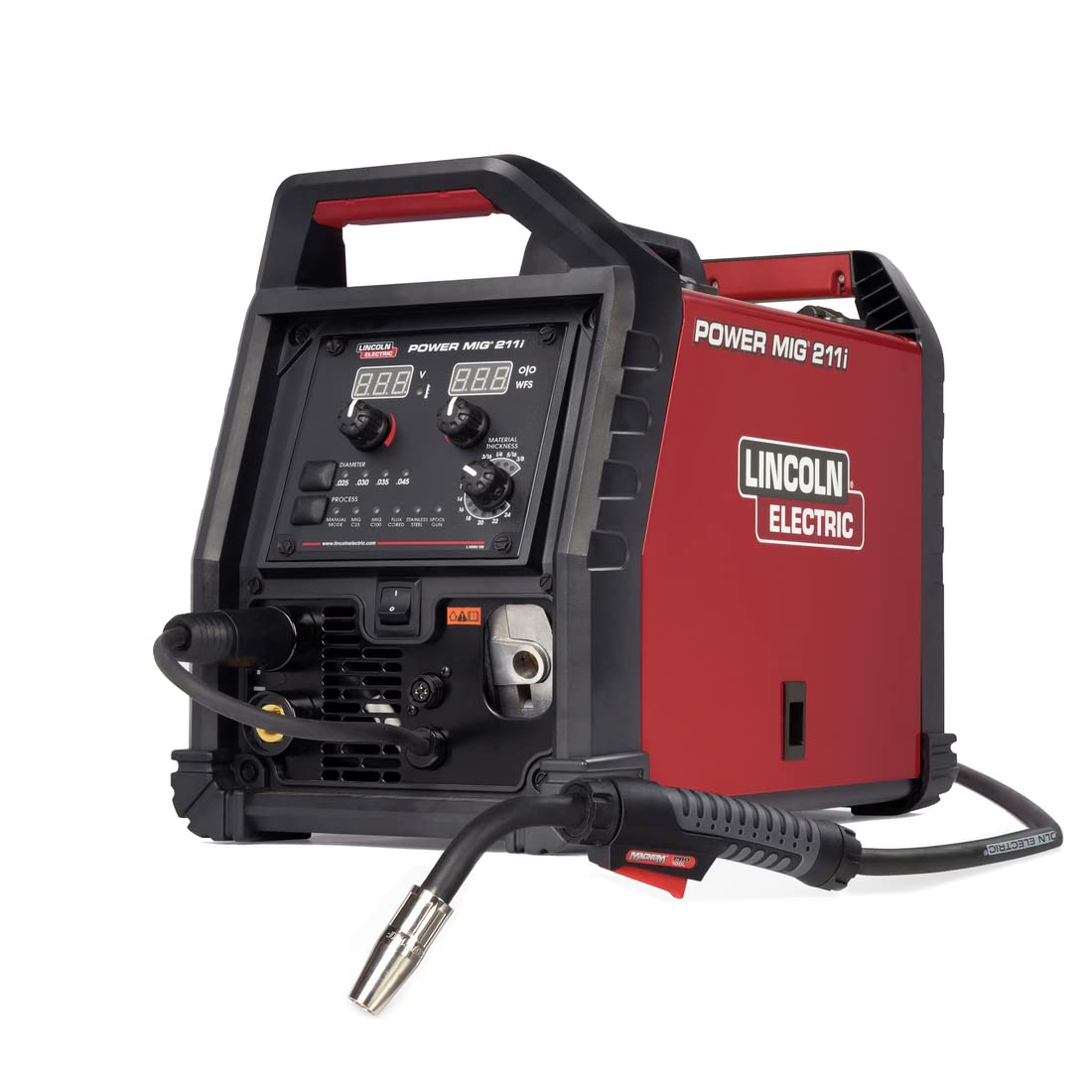
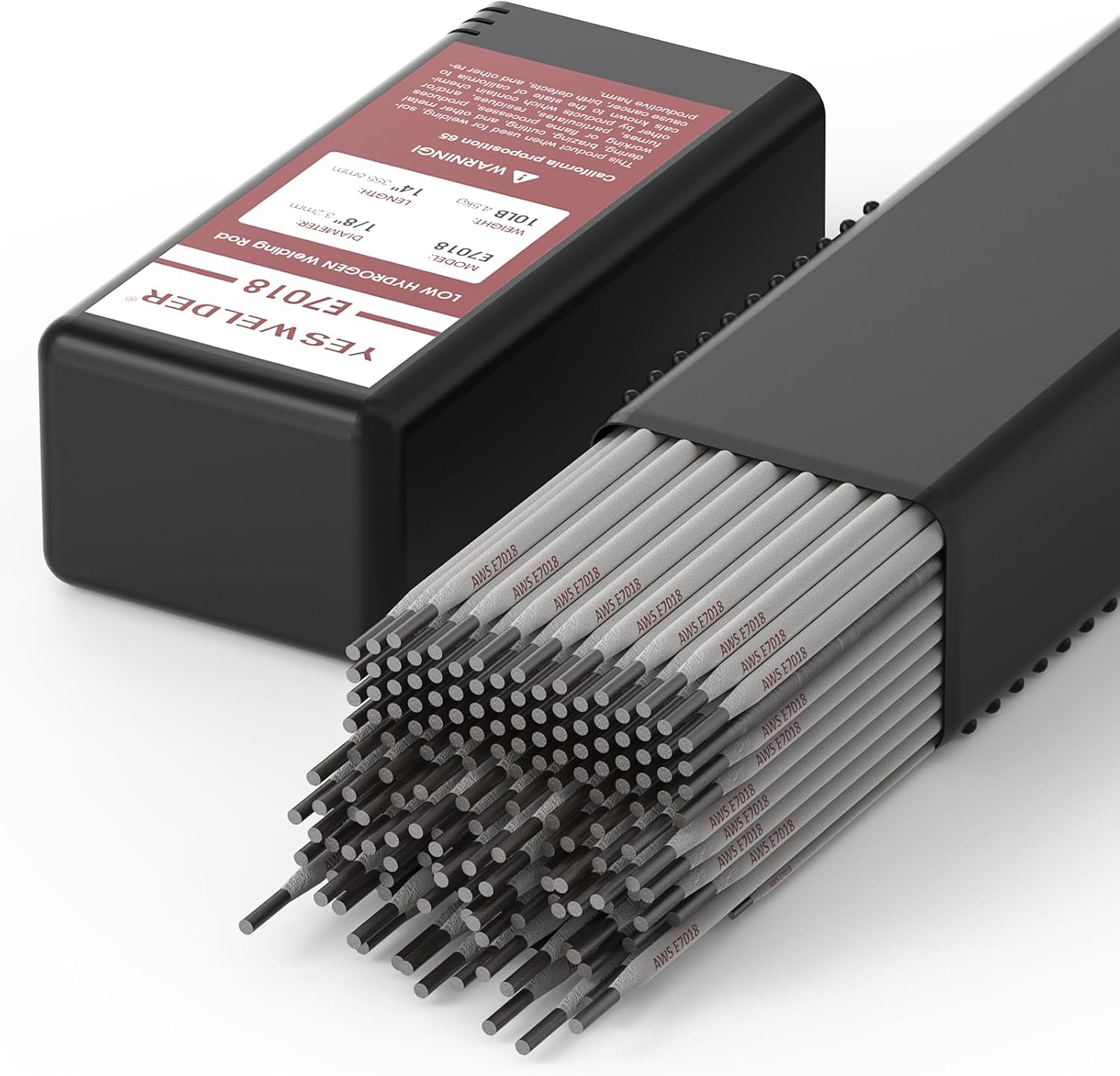
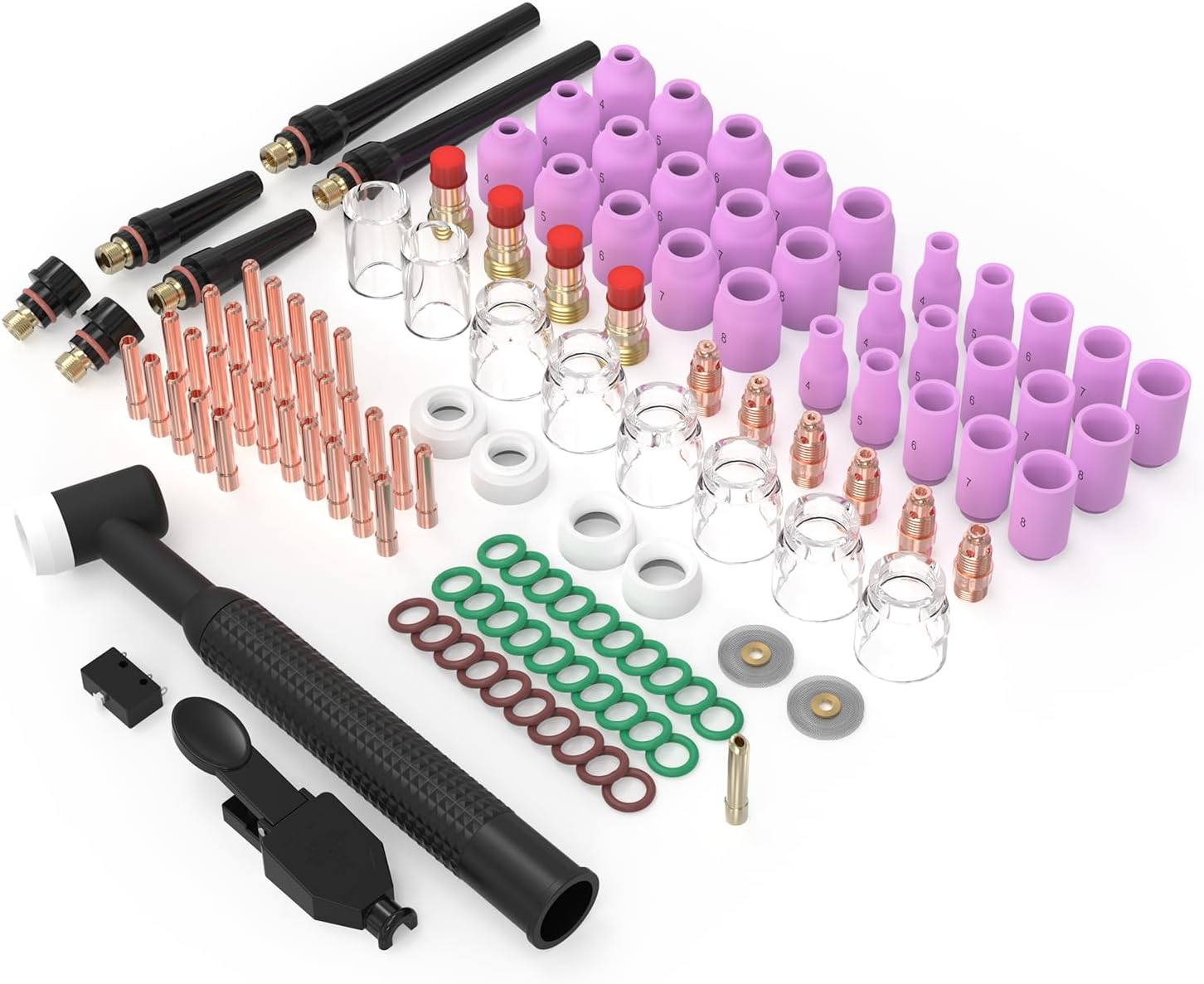

As an Amazon Associate, TestTalkHQ earns from qualifying purchases.
Weld deposition rate measures how much filler metal becomes actual weld metal per hour, typically expressed in pounds per hour (lbs/hr). This metric is crucial for job estimating, cost analysis, process comparison, and maximizing shop productivity.
Understanding your deposition rate helps you:
The difference is your electrode efficiency—the percentage of wire that actually becomes weld metal. The rest is lost to spatter, slag, and fumes.
Deposition Rate (lbs/hr) = Wire Feed Speed × Electrode Area × Material Density × Efficiency × 60
1. Wire Feed Speed (WFS)
Measured in inches per minute (IPM). Most MIG welders display this on the machine.
2. Electrode Area
Cross-sectional area of your wire: π × (diameter/2)²
3. Material Density
4. Electrode Efficiency
Setup:
Calculation:
Arc-on time is the percentage of time actually welding versus positioning parts, changing spools, grinding, setup, breaks, and waiting for materials.
⚠️ Critical Reality Check: The industry average for manual welding is around 25% arc-on time. That means in an 8-hour shift, only 2 hours is actual welding.
If your deposition rate is 8.95 lbs/hr:
At 25% arc-on time:
At 35% arc-on time:
| Process | Deposition Rate | Best For |
|---|---|---|
| SMAW (Stick) | 1–5 lbs/hr | Field repairs, outdoors, dirty metal |
| GMAW (MIG) | 3–12 lbs/hr | Shop fabrication, production |
| FCAW (Flux-Core) | 4–15 lbs/hr | Structural steel, outdoor welding |
| SAW (Submerged Arc) | 15–50+ lbs/hr | Heavy plate, long seams, automation |
| GTAW (TIG) | 1–4 lbs/hr | Critical welds, thin material, stainless |
Larger diameter wire significantly increases deposition rate. Moving from 0.035" to 0.045" increases rate by approximately 60% (all else equal).
Higher feed speeds increase deposition proportionally but require matching amperage.
Faster travel = less deposition per inch. Slower travel = more deposition but risks excessive heat input and distortion.
Goal: Increase from 25% to 35% arc-on time = 40% more production with the same labor cost.
Moving from 0.035" to 0.045" wire can increase deposition by 60%. Material must be thick enough (typically 3/16" minimum).
Project Requirements:
Calculation:
For production MIG with 0.045" wire, 8–12 lbs/hr is typical. High-deposition systems with larger wire can reach 15–25+ lbs/hr.
Wire diameter has a squared relationship with deposition rate. Moving from 0.035" to 0.045" wire increases cross-sectional area by 64%, which directly increases deposition rate by the same percentage.
Arc-on time is almost always the culprit. Most shops only achieve 20–30% arc-on time due to handling, setup, breaks, electrode changes, and grinding.
Industry average is 20–30% for typical job shop fabrication. With good organization, 35–40% is achievable. Robotic systems can hit 60–80%.
Understanding and optimizing weld deposition rate is one of the most effective ways to improve shop profitability. Use this calculator to bid jobs accurately, compare processes, set performance targets, and track improvement over time.
💡 Key Takeaway: A 10% improvement in arc-on time (from 25% to 35%) is equivalent to adding an extra welder to your shop—without the additional labor cost, benefits, or training time. Focus on maximizing productive welding time before investing in new equipment.