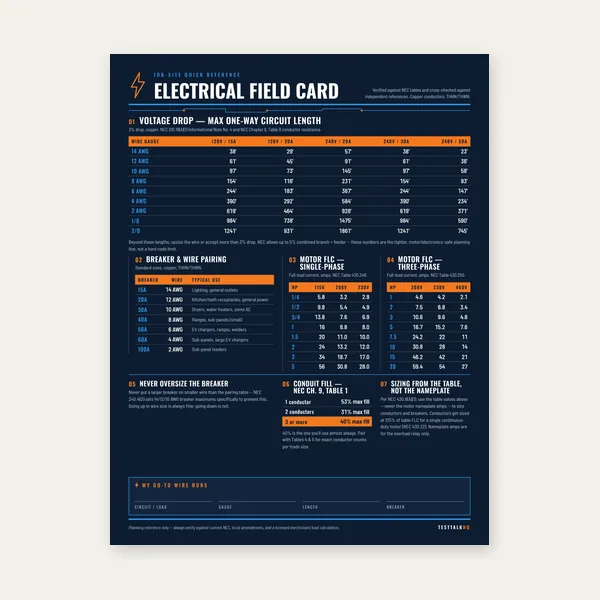
Electrical Reference Card
One page. Voltage drop lengths, breaker and wire pairing, motor FLC.
$3.99
BuyNEC Table 250.66 — GEC from largest ungrounded service conductor
Enter the largest ungrounded service-entrance conductor (or equivalent area for parallel sets), choose copper or aluminum, and pick the electrode type for 250.66(A)–(C) caps. See the Grounding Electrode Conductor Sizing Guide for GEC vs EGC and connection rules.

| Largest ungrounded copper | Largest ungrounded aluminum / Cu-clad Al | Copper GEC | Aluminum GEC |
|---|---|---|---|
| 2 AWG or smaller | 1/0 AWG or smaller | 8 AWG | 6 AWG |
| 1 or 1/0 AWG | 2/0 or 3/0 AWG | 6 AWG | 4 AWG |
| 2/0 or 3/0 AWG | 4/0 AWG or 250 kcmil | 4 AWG | 2 AWG |
| Over 3/0 through 350 kcmil | Over 250 through 500 kcmil | 2 AWG | 1/0 AWG |
| Over 350 through 600 kcmil | Over 500 through 900 kcmil | 1/0 AWG | 3/0 AWG |
| Over 600 through 1100 kcmil | Over 900 through 1750 kcmil | 2/0 AWG | 4/0 AWG |
| Over 1100 kcmil | Over 1750 kcmil | 3/0 AWG | 250 kcmil |
250.66(A): rod/pipe/plate — 6 AWG Cu / 4 AWG Al maximum required. 250.66(B): concrete-encased — 4 AWG Cu maximum required. 250.66(C): ground ring — not larger than the ring conductor.
One page. Voltage drop lengths, breaker and wire pairing, motor FLC.
$3.99
Buy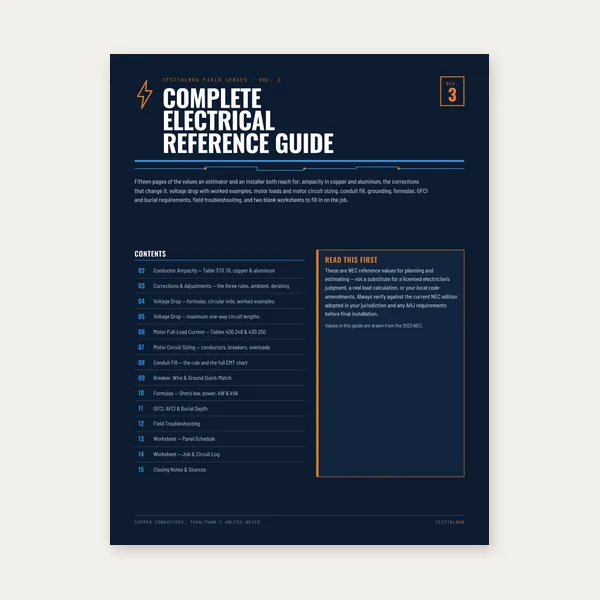
15 pages. Ampacity, corrections, voltage drop, motor circuits, conduit fill.
$12.99
Buy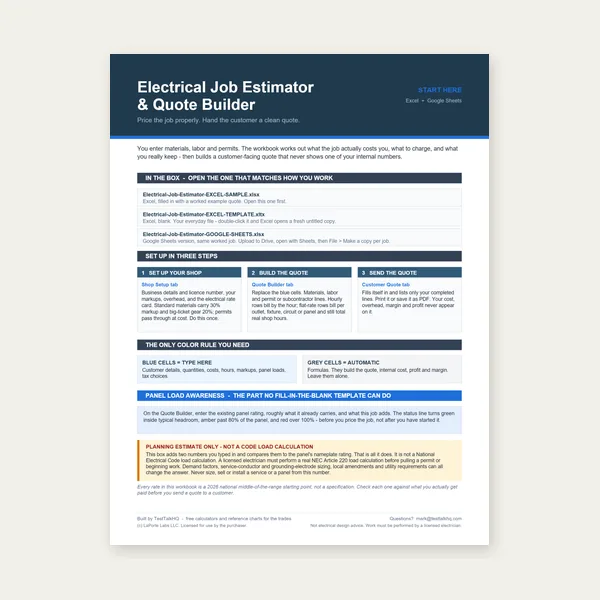
Quote electrical work and flag panel headroom before you price it.
Excel or Google Sheets. Best on a computer.
$29.00
Buy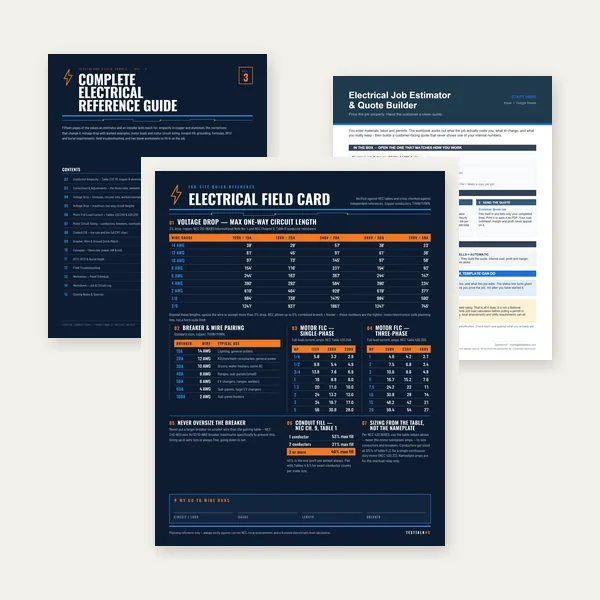
Card, 15-page guide and the estimator workbook. All six files.
Excel or Google Sheets. Best on a computer.
$34.99
$45.98 if bought separately — save $10.99
BuyCheckout opens in a new tab.
Anti-oxidant compound, ground wire, torque wrenches, and meters for verifying electrode connections.



As an Amazon Associate, TestTalkHQ earns from qualifying purchases. Prices and availability subject to change.
Table 250.66 does not size the equipment grounding conductor (EGC) inside branch circuits or feeders. It sizes the grounding electrode conductor — the wire that connects the grounded service neutral (or separately derived system ground) to the grounding electrode system at the building. The input is the largest ungrounded conductor feeding the service, not the load amperage. When service conductors are paralleled, you use the equivalent total circular mil area of one set as if they were a single conductor, then enter that equivalent size here. Bonding jumpers to metal water pipes, ground rings, rods, plates, and concrete-encased electrodes all originate from this conductor — but electrode-specific caps in 250.66(A) through (C) can reduce what Table 250.66 alone would require.
The equipment grounding conductor (green or bare wire in raceways and cables) provides a low-impedance fault return path from metal enclosures and devices back to the source so overcurrent devices can clear ground faults. The grounding electrode conductor connects the grounded conductor to earth through electrodes — its job is system grounding and voltage stabilization, not carrying load current under normal conditions. Confusing the two is a common inspection failure: upsizing the branch EGC does not satisfy GEC requirements at the service, and a correctly sized GEC does not replace EGC rules in 250.122. Service upgrades that enlarge ungrounded conductors without revisiting the GEC leave an undersized bond to the electrode system even when branch circuits were updated.
NEC 250.66(A) limits a conductor connected solely to rod, pipe, or plate electrodes to 6 AWG copper or 4 AWG aluminum. Section 250.66(B) limits a conductor connected solely to a concrete-encased electrode to 4 AWG copper. Section 250.66(C) says a conductor connected solely to a ground ring need not be larger than the ring conductor. These are maximum-required sizes for qualifying electrode-only connections, not minimums and not permission to reduce a common GEC serving other electrode types.
Correct GEC size means nothing if the termination fails. NEC 250.70 requires grounding electrode conductor connections to be accessible unless they are buried or encased in concrete, and connections to rods, pipes, and plates must be listed for the purpose. Mechanical connections must be exothermic welding, listed lugs, listed pressure connectors, or other listed means — not improvised clamps. Aluminum GEC may not be terminated within 18 inches of earth unless the fitting is listed for direct burial in contact with soil. Apply anti-oxidant compound on aluminum terminations where required, torque lugs to manufacturer specs, and keep the path from service neutral to electrode continuous and inspectable at every accessible point.