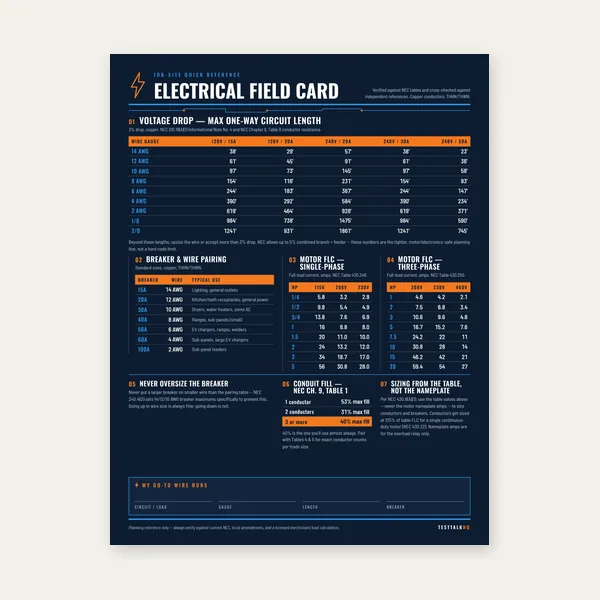
Electrical Reference Card
One page. Voltage drop lengths, breaker and wire pairing, motor FLC.
$3.99
BuyRod vs concrete-encased (Ufer) vs metal water pipe — what must be used, when supplementation is required, and how to make a sound exothermic connection.
The first decision is not “which single electrode do I prefer?” NEC 250.50 generally requires every qualifying electrode present at the building to be bonded into one grounding electrode system. This guide explains the field decision fork; use the GEC Calculator after identifying the electrode system.
| Condition found | Primary action | Important limit |
|---|---|---|
| Qualifying concrete-encased electrode in new footing | Bring out the Ufer connection and include it | Do not abandon it and install only rods |
| Metal underground water pipe with at least 10 ft earth contact | Use it as an electrode and add a supplemental electrode | Interior pipe alone is not enough; connection location rules apply |
| No qualifying Ufer, water pipe, building steel, or ground ring | Install a listed rod/pipe/plate system as permitted | A second rod is commonly required unless the single-rod resistance exception is demonstrated |
| More than one qualifying electrode type | Bond them into one grounding electrode system | Do not select one and leave the others isolated |
A concrete-encased electrode uses at least 20 ft of qualifying reinforcing steel or bare copper encased near the bottom of a concrete footing or foundation in direct contact with earth, subject to the adopted code’s details. Concrete’s large contact area and moisture retention usually produce a stable electrode. In new work, coordinate the stub-up before the pour; after concrete is placed, creating an equivalent Ufer can be impractical.
Choose/use it when: the building has a qualifying electrode. This is generally mandatory under the “all electrodes present” rule, not an optional upgrade. Protect the stub-up from concrete damage and future construction, identify it clearly, and use a listed rebar clamp or listed exothermic connection appropriate to the materials.
Common mistake: missing the footing inspection, cutting the rebar stub flush, or burying a mechanical connection that was required to remain accessible.
A metal underground water pipe qualifies only when it has the required direct contact with earth—commonly at least 10 ft. Plastic service pipe, interior copper piping with no qualifying underground metal, and isolated metal stubs are not water-pipe electrodes.
Choose/use it when: qualifying metal pipe is present. It must be bonded into the electrode system, but it must also be supplemented by another electrode. Make the GEC connection at the required location near the point of entrance unless an applicable exception allows otherwise. Coordinate around water meters, dielectric unions, filters, and repairs that can interrupt continuity; install bonding jumpers where required.
Common mistake: assuming a copper plumbing system is automatically an electrode, or relying on a water pipe as the sole electrode even though later utility replacement with plastic can remove earth contact.
Driven rods are practical and inexpensive, but their resistance depends heavily on soil, moisture, depth, spacing, and rock. Install the listed electrode to the required depth and orientation; do not cut it short because driving becomes difficult. Keep multiple rods at the required spacing.
Choose/use them when: a rod is the permitted electrode for a building without another qualifying electrode, or when a supplemental electrode is required. Where one rod is used, the NEC resistance rule may require a supplemental rod unless resistance to earth of 25 ohms or less is demonstrated. Many installers place two rods rather than pay for a formal test, but local requirements control.
Common mistake: assuming two rods replace a present Ufer or qualifying water pipe, using an indoor pipe clamp on a rod, or applying the 6 AWG copper cap to conductors serving the entire combined electrode system without checking the actual topology.
A ground ring can provide broad soil contact around a building and is useful for large facilities, lightning/surge coordination, and sites where a single rod is unreliable. Qualifying structural metal is included when it meets 250.52 conditions. These are not merely “better rods”; they are separate electrode types that must be bonded into the common system when present. Engineering and lightning-protection requirements can exceed minimum NEC grounding rules.
Use the GEC Sizing Guide for the full rule explanation and the calculator for a documented starting size. If installation is already failing, switch to GEC Troubleshooting.
Exothermic welding is an irreversible connection method; it is not a cure for uncertain design. Confirm electrode selection and GEC sizing before making the shot. For failed or questionable connections, follow the diagnostic path in GEC Troubleshooting.
One page. Voltage drop lengths, breaker and wire pairing, motor FLC.
$3.99
Buy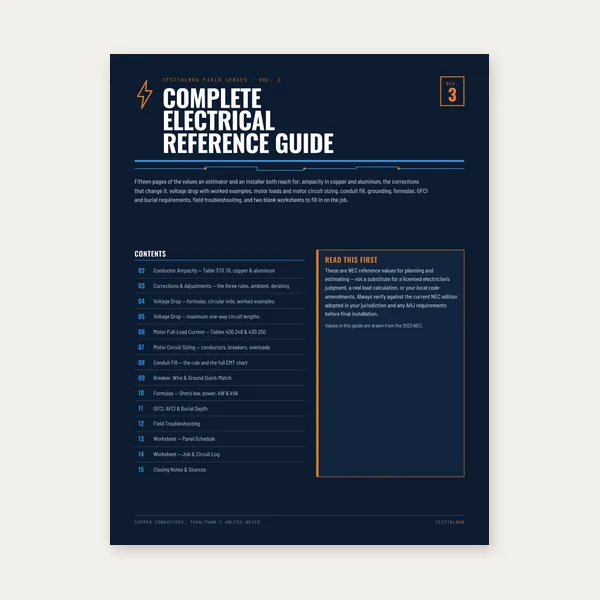
15 pages. Ampacity, corrections, voltage drop, motor circuits, conduit fill.
$12.99
Buy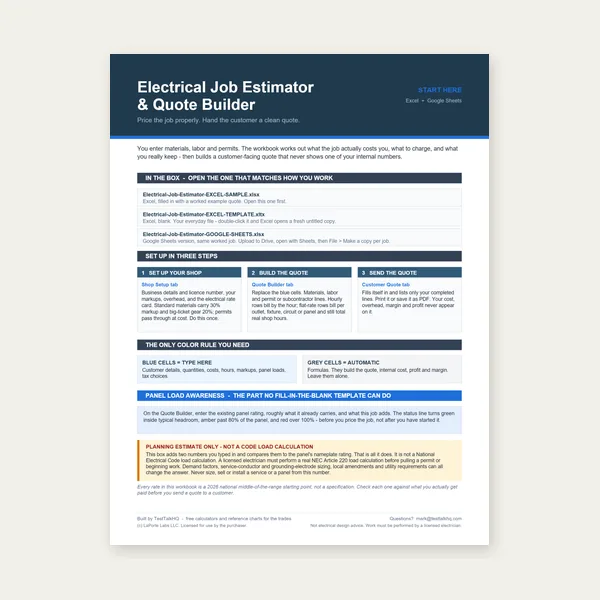
Quote electrical work and flag panel headroom before you price it.
Excel or Google Sheets. Best on a computer.
$29.00
Buy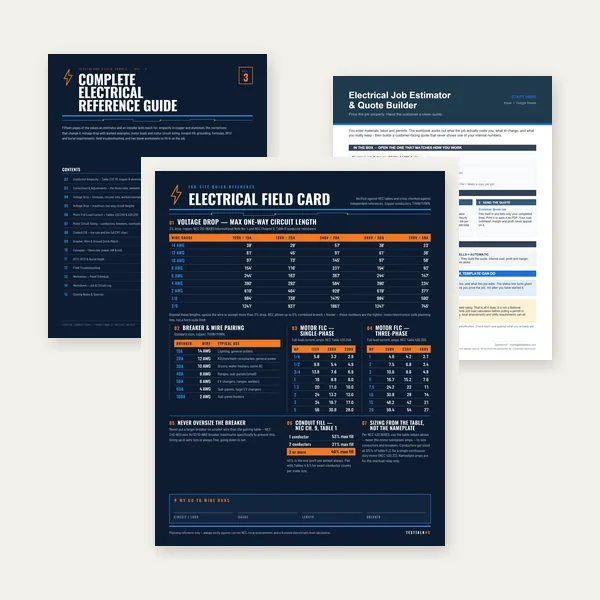
Card, 15-page guide and the estimator workbook. All six files.
Excel or Google Sheets. Best on a computer.
$34.99
$45.98 if bought separately — save $10.99
BuyCheckout opens in a new tab.
Five relevant picks from the live TestTalkHQ affiliate catalog for safe testing, termination work, and corrosion control.

Helps control oxide at listed aluminum terminations when the connector instructions require compound. It does not make an unlisted clamp acceptable.
Check Price
Useful for de-energized continuity screening and checking unexpected voltage before opening service equipment. It is not an earth-resistance tester.
Check Price
Checks current and voltage around service work without opening the circuit for every measurement. Do not confuse it with a clamp-on ground-resistance tester.
Check Price
A first-pass voltage screen at enclosures, water piping, and exposed metal before hands-on inspection. Prove the tester before and after use.
Check PriceApplies a documented clamp or lug torque instead of tightening by feel. Always use the connector manufacturer’s value and the correct socket or crowfoot correction.
Check PriceAs an Amazon Associate, TestTalkHQ earns from qualifying purchases. Catalog gaps: no ground rod, listed acorn clamp, exothermic-weld kit/mold, dedicated earth-resistance tester, or GEC-size copper conductor is present in the 311-row CSV.