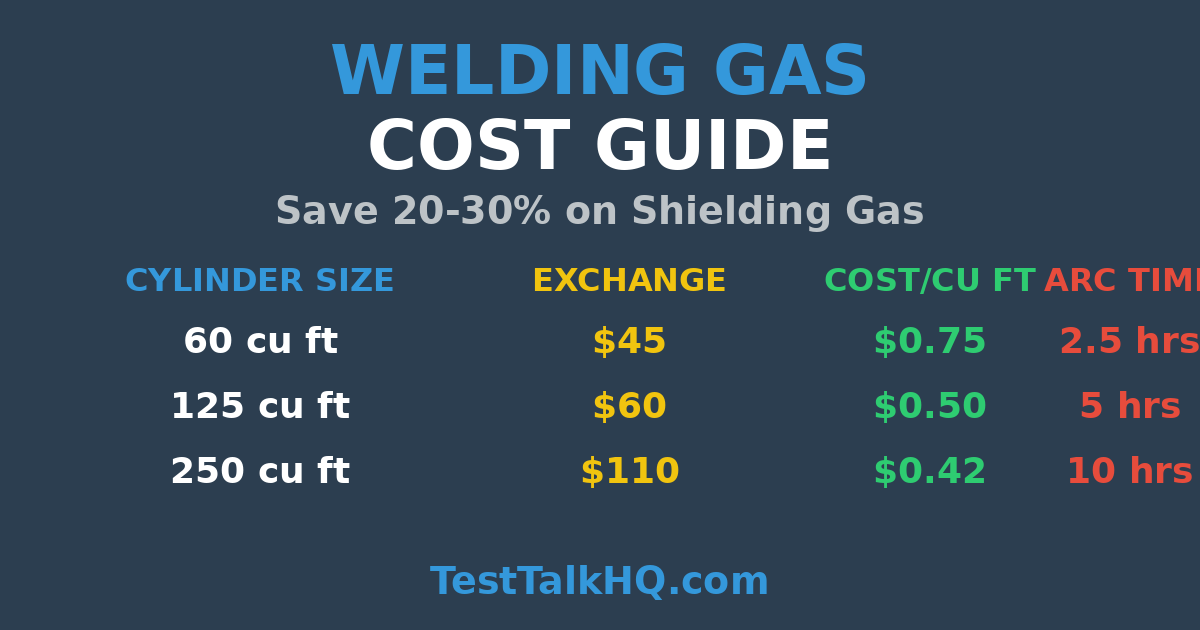
A 125 cubic foot argon cylinder costs about $60 to exchange, lasts roughly 5 hours of arc-on welding time, and quietly drains your wallet at $12 per hour if you’re not paying attention. But here’s what nobody tells you: you’re probably wasting 20-30% of that gas through poor regulator settings, wind blowing away coverage, post-flow running too long, or simply leaving the cylinder valve cracked open overnight. That’s $12-18 per cylinder literally venting into the atmosphere.
Welding gas costs are one of those expenses that creep up on fabricators—small enough per refill that you don’t think about it, large enough over a year that it becomes your third or fourth biggest consumable expense after wire, electricity, and grinding discs. And unlike wire or electricity where waste is obvious (you can see extra spatter or hear the motor running), gas waste is invisible until you’re standing at the welding supply wondering why you’re back again already.
This guide breaks down the real cost of welding gas: what you’ll actually pay for argon, CO2, and gas mixes in different cylinder sizes, the hidden costs of rental vs buying vs exchange programs, how to calculate exactly how much gas your welding consumes, and—most importantly—seven specific ways to cut your gas costs by 20-30% without changing how you weld.
Use our free Welding Gas Cost Calculator to estimate your annual gas expenses and see how much you could save.
Jump to what you need
Actual Welding Gas Costs: What You’ll Really Pay
Welding gas prices vary wildly depending on where you live, which supplier you use, and whether you own or rent your cylinders. But here’s real-world pricing data from multiple suppliers to give you a baseline:
Argon Exchange Costs (Customer-Owned Cylinders)
| Cylinder Size | Exchange Cost | Cost Per Cu Ft | Arc Time Hours |
|---|---|---|---|
| 60 cu ft | $45 | $0.75 | ~2.5 hours |
| 80 cu ft | $52 | $0.65 | ~3.2 hours |
| 125 cu ft | $60-70 | $0.50 | ~5 hours |
| 250 cu ft | $100-120 | $0.42 | ~10 hours |
Note: These are exchange prices for customer-owned cylinders. Rental cylinder programs add $5-15/month lease fees on top of exchange costs.
C25 (75% Argon / 25% CO2) Exchange Costs
| Cylinder Size | Exchange Cost | Cost Per Cu Ft |
|---|---|---|
| 60 cu ft | $42-48 | $0.72 |
| 80 cu ft | $48-55 | $0.62 |
| 125 cu ft | $58-68 | $0.48 |
| 250 cu ft | $95-115 | $0.40 |
100% CO2 Exchange Costs
CO2 is the cheapest shielding gas, typically 10-20% less than argon or C25 mixes:
- 60 cu ft CO2: $38-42
- 125 cu ft CO2: $50-60
- 250 cu ft CO2: $85-105
Why CO2 is cheaper: It’s a byproduct of industrial processes, while argon must be separated from air through cryogenic distillation. However, the cost savings are minimal for small users, and C25 produces cleaner welds with less spatter.
Real-World Cost Example: Small Fabrication Shop
Let’s say you’re running a small shop doing automotive fabrication and general steel work:
- MIG welding: 2 hours of arc-on time per week (C25 gas)
- TIG welding: 1 hour of arc-on time per week (Argon)
- Gas flow rate: 25 CFH average
Weekly gas consumption:
MIG: 2 hours × 25 CFH = 50 cu ft C25
TIG: 1 hour × 25 CFH = 25 cu ft Argon
Total: 75 cubic feet per week
Annual cost:
52 weeks × 50 cu ft C25 = 2,600 cu ft @ $0.48/cu ft = $1,248/year
52 weeks × 25 cu ft Argon = 1,300 cu ft @ $0.50/cu ft = $650/year
Total annual gas cost: $1,898
That’s nearly $2,000 per year just on shielding gas for a small shop. Scale that up to a production environment running 40 hours per week, and you’re looking at $15,000-25,000 annually.
Gas Cylinder Sizes and Cost Per Cubic Foot
Gas cylinders come in sizes ranging from tiny 20 cubic foot portables all the way up to 330+ cubic foot industrial tanks. Here’s how size affects your cost per cubic foot and what makes sense for different users:
Small Cylinders (20-60 Cubic Feet)
Typical use case: Hobbyists, occasional welders, mobile/portable work
Cylinder cost to purchase: $165-200 (owned)
Exchange cost: $40-48
Cost per cubic foot: $0.70-0.80
Arc time at 25 CFH: 1-2.5 hours
Pros:
- Low upfront cost
- Easy to handle and transport (one person can carry)
- Fits in car trunk or truck bed
- Good for infrequent welding (lasts months for hobbyists)
Cons:
- Highest cost per cubic foot
- Frequent exchanges if welding regularly
- Not economical for professional use
Medium Cylinders (80-125 Cubic Feet)
Typical use case: Serious hobbyists, small shops, general fabrication
Cylinder cost to purchase: $200-250 (owned)
Exchange cost: $52-70
Cost per cubic foot: $0.50-0.65
Arc time at 25 CFH: 3-5 hours
Pros:
- Best balance of cost, size, and convenience
- Still manageable for one person (100-150 lbs full)
- Economical gas cost per cubic foot
- Most common size for customer-owned cylinders
Cons:
- Heavier than small cylinders (harder to move around shop)
- Won’t last long in high-volume production
This is the sweet spot for most welders. A 125 cu ft cylinder costs about the same as a 60 cu ft to purchase initially ($200-250), but the gas inside costs 30% less per cubic foot. You exchange half as often and save money every time.
Large Cylinders (250-330 Cubic Feet)
Typical use case: Production shops, daily professional welding, high-volume work
Cylinder cost to purchase: $300-400+ (owned, IF supplier allows)
Exchange/rental cost: $100-140 exchange OR $15-30/month lease + gas
Cost per cubic foot: $0.38-0.45
Arc time at 25 CFH: 10-13 hours
Pros:
- Lowest cost per cubic foot
- Fewer exchanges (less downtime)
- Better for production environments
Cons:
- Very heavy (300-450 lbs full, requires two people or equipment)
- Many suppliers won’t sell large cylinders—rental only
- Monthly lease fees add up ($180-360/year per cylinder)
- Takes up more floor space
The Math: Why Bigger is Cheaper Per Cubic Foot
Gas suppliers have fixed costs for every cylinder exchange: labor to inspect, test, fill, transport, and process the paperwork. A 60 cu ft cylinder takes the same amount of work to exchange as a 125 cu ft cylinder, so they spread those fixed costs over more gas with larger cylinders.
Example:
- 60 cu ft @ $45 = $0.75 per cubic foot
- 125 cu ft @ $60 = $0.48 per cubic foot
- Savings: $0.27 per cubic foot (36% cheaper!)
Over a year of welding 100 cubic feet per month, that’s a savings of $324 just by using a larger cylinder.
Buy vs Rent vs Exchange: Which Costs Less?
There are three ways to get welding gas, and each has different cost structures:
Option 1: Buy Cylinders, Exchange for Gas
How it works: You purchase the cylinder outright ($165-400 depending on size), then exchange it for a full one whenever you run out. You always own A cylinder, but not necessarily THE SAME cylinder each time.
Upfront cost:
- 60 cu ft cylinder: $165-200
- 80 cu ft cylinder: $180-220
- 125 cu ft cylinder: $200-250
Exchange cost: $40-70 depending on size and gas type
Pros:
- No monthly lease fees
- You own the asset (can sell cylinders if you stop welding)
- Freedom to switch suppliers without returning cylinders
- Lower long-term cost
Cons:
- Higher upfront investment
- Cylinders must stay current on hydrostatic testing (every 5-10 years)
- You’re responsible for damaged cylinders
Best for: Anyone welding regularly (monthly or more). The upfront cost pays for itself in 6-12 months of avoided lease fees.
Option 2: Rent/Lease Cylinders from Supplier
How it works: Gas supplier owns the cylinders, you pay monthly lease fees plus gas refill costs.
Monthly lease fee:
- Small cylinders (60-125 cu ft): $5-12/month
- Large cylinders (250+ cu ft): $15-30/month
Gas refill cost: Same as exchange (but you’re also paying lease fees)
Annual lease cost example:
- Two 125 cu ft cylinders @ $10/month each = $240/year in lease fees
- Plus gas refills: $500-1,000/year
- Total: $740-1,240/year
Pros:
- No upfront cost
- Supplier handles testing, maintenance, repairs
- Can access larger cylinder sizes not available for purchase
Cons:
- Monthly fees add up ($60-360/year depending on cylinders)
- Locked into that supplier (can’t easily switch)
- Never own the asset
- Higher long-term cost
Best for: Temporary needs, trying out welding before committing, or needing very large cylinders suppliers won’t sell.
Option 3: Buy Gas in Disposable Cylinders
How it works: Small disposable cylinders sold at hardware stores and welding suppliers. Use once and throw away (or recycle).
Cost: $30-50 for a small disposable (roughly 10-20 cu ft equivalent)
Cost per cubic foot: $1.50-3.00 (300-500% more expensive than refillable!)
Pros:
- Available at hardware stores
- No cylinder investment
- Convenient for very occasional use
Cons:
- Extremely expensive per cubic foot
- Wasteful (disposable cylinders)
- Inconvenient for regular welding
Best for: Emergency repairs when your main cylinder is empty, or if you weld less than once per year.
The Breakeven Analysis: Buy vs Rent
Let’s compare buying two 125 cu ft cylinders vs renting:
Buy option:
- Upfront: $500 (two cylinders @ $250 each)
- Annual gas exchanges: $600 (10 exchanges @ $60 each)
- Year 1 total: $1,100
- Year 2+ total: $600/year
Rent option:
- Upfront: $0
- Annual lease fees: $240 ($10/month × 2 cylinders × 12 months)
- Annual gas exchanges: $600
- Every year total: $840/year
Breakeven point: After 2 years and 1 month, buying becomes cheaper. After 5 years, you’ve saved $1,200 by owning.
Gas Types and Their Costs (Argon, CO2, Mixes)
Different welding processes require different gases, and the cost varies significantly:
100% Argon – The Universal Gas
Used for: TIG welding (all metals), MIG welding aluminum, some stainless applications
Cost: $0.48-0.75 per cubic foot (depending on cylinder size)
Typical exchange: $60-70 for 125 cu ft
Why it costs more: Argon must be extracted from air through cryogenic separation. It makes up only 0.93% of the atmosphere, so it’s relatively expensive to produce compared to CO2 (which is a waste product).
Flow rates:
- TIG welding: 10-35 CFH depending on cup size and material
- MIG aluminum: 25-35 CFH
Runtime: A 125 cu ft cylinder lasts 3.5-12 hours of arc-on time depending on flow rate.
C25 (75% Argon / 25% CO2) – The MIG Standard
Used for: MIG welding steel in short-circuit transfer mode
Cost: $0.46-0.72 per cubic foot
Typical exchange: $58-68 for 125 cu ft
Why it’s popular: The 25% CO2 improves arc stability and penetration on steel while the 75% argon keeps spatter low and produces a cleaner weld than straight CO2.
Flow rate: 20-30 CFH for most MIG welding
Runtime: A 125 cu ft cylinder lasts 4-6 hours of arc-on MIG welding.
100% CO2 – The Budget Option
Used for: MIG welding steel (industrial/production settings)
Cost: $0.38-0.65 per cubic foot
Typical exchange: $50-60 for 125 cu ft
Cost savings: 10-20% cheaper than C25
Trade-offs:
- More spatter than C25
- Deeper penetration (can blow through thin material easier)
- Rougher arc characteristics
Many large production shops use straight CO2 to save money, but for small users, the cost difference is minimal ($8-10 per cylinder) and C25 produces better welds. Unless you’re going through 10+ cylinders per month, stick with C25.
90/10 Mix (90% Argon / 10% CO2) – The Versatile Option
Used for: Spray transfer MIG, pulse MIG, short-circuit MIG on steel
Cost: Similar to C25 ($0.48-0.70 per cubic foot)
Why it’s useful: One gas works for short-circuit AND spray transfer, whereas C25 only works well for short-circuit. If you have a machine capable of spray or pulse spray, 90/10 is more versatile.
Tri-Mix (Helium/Argon/CO2) – The Premium Option
Used for: Stainless steel MIG welding
Cost: $1.00-1.50+ per cubic foot (2-3x more expensive!)
Typical exchange: $120-180 for 125 cu ft
Why it’s expensive: Helium is scarce and difficult to produce. Most suppliers are moving away from tri-mix and recommending 98/2 (Argon/CO2) for stainless instead, which performs almost as well at half the cost.
Specialty Gases (Helium, Nitrogen, Oxygen)
Helium: $2.00-4.00 per cubic foot (extremely expensive, hard to find)
Nitrogen: $0.30-0.50 per cubic foot (plasma cutting, laser cutting)
Oxygen: $0.40-0.60 per cubic foot (oxy-fuel cutting and welding)
How to Calculate Your Gas Consumption
Here’s the simple formula to calculate how much gas your welding actually uses:
Gas Consumption (cu ft) = Flow Rate (CFH) × Arc-On Time (hours)
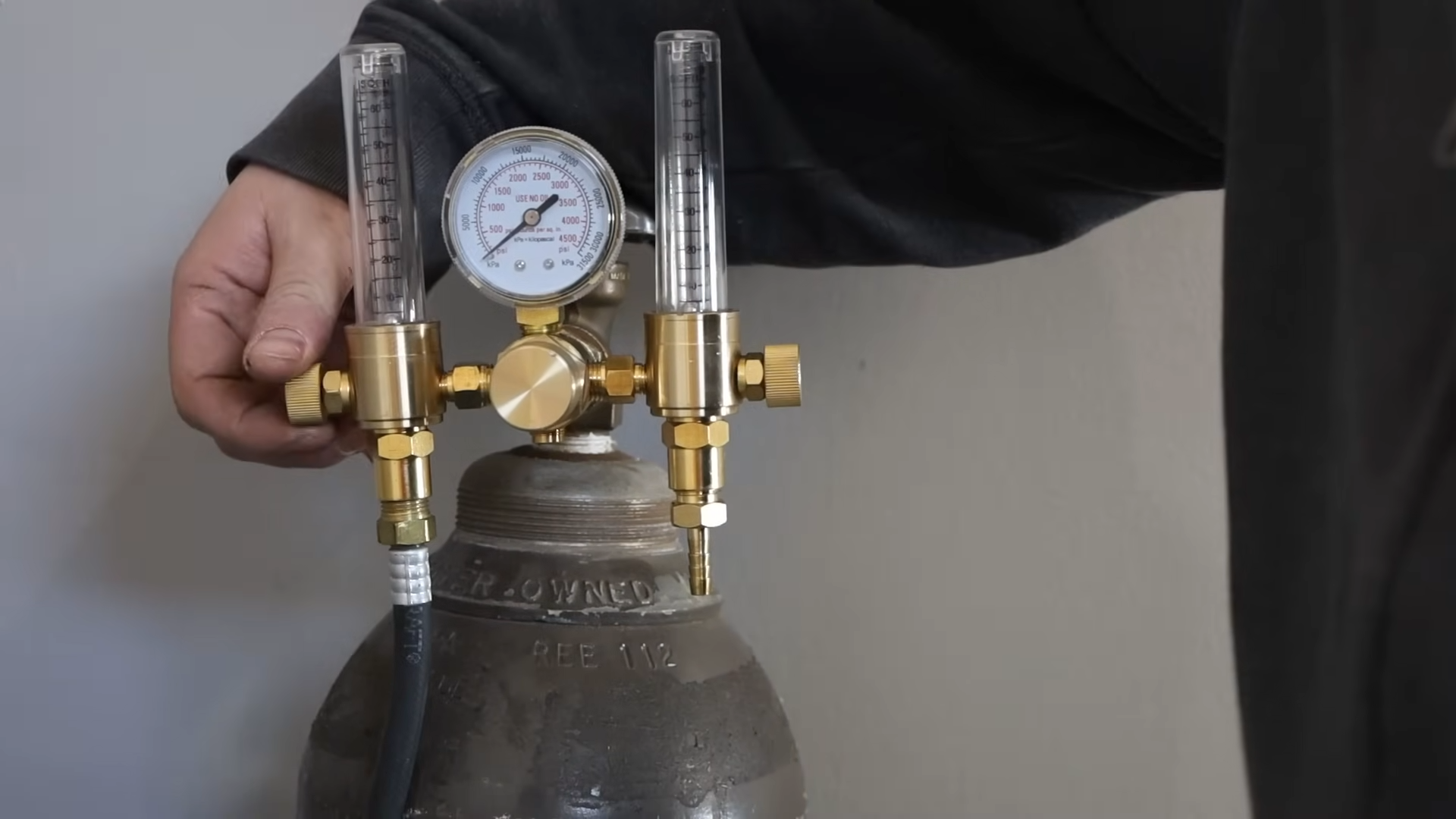
Step 1: Determine Your Flow Rate
Check your flowmeter while welding. Typical flow rates:
- MIG welding steel: 20-30 CFH
- MIG welding aluminum: 25-35 CFH
- TIG welding (small cup): 10-15 CFH
- TIG welding (large cup): 20-35 CFH
- TIG with back purge: Add 5-10 CFH for purge gas
Use our Welding Gas Flow Rate Calculator to determine the optimal CFH for your process.
Step 2: Calculate Arc-On Time
Arc-on time is NOT the same as how long you’re in the shop. It’s only the time your arc is actually running.
Example breakdown of a 4-hour welding session:
- Setup, positioning, measuring: 45 minutes
- Grinding and prep: 30 minutes
- Actual arc-on welding: 60 minutes
- Cleanup and inspection: 45 minutes
- Breaks: 60 minutes
Total session time: 4 hours
Actual arc-on time: 1 hour
For most fabricators, arc-on time is 20-30% of total shop time.
Step 3: Account for Pre-Flow and Post-Flow
Your gas doesn’t only flow during welding. TIG welders have pre-flow (gas starts before arc) and post-flow (gas continues after arc stops to protect cooling tungsten).
Typical pre/post-flow settings:
- Pre-flow: 0.5-1 second
- Post-flow: 5-15 seconds (longer for larger tungsten)
For intermittent TIG welding with lots of starts and stops, add 20-30% to your calculated gas consumption to account for pre/post flow.
Worked Example: Calculate Monthly Gas Cost
Scenario: You MIG weld 3 days per week for about 6 hours per day in the shop. Actual arc-on time is about 25% of that (1.5 hours per day).
Weekly arc-on time: 3 days × 1.5 hours = 4.5 hours
Flow rate: 25 CFH (typical for MIG)
Weekly gas consumption: 4.5 hours × 25 CFH = 112.5 cu ft
Monthly consumption: 112.5 cu ft × 4 weeks = 450 cu ft/month
Cylinders needed: 450 ÷ 125 = 3.6 cylinders per month (call it 4)
Monthly cost: 4 cylinders × $60 = $240/month
Annual cost: $240 × 12 = $2,880/year
Use our Gas Cost Calculator to run these numbers for your specific usage.
Hidden Costs You’re Not Tracking
The sticker price on a gas exchange isn’t the only cost. Here are expenses that sneak up on fabricators:
1. Cylinder Rental/Lease Fees
If you rent cylinders instead of owning them, you’re paying $5-30/month per cylinder in lease fees. Two rental cylinders = $120-720/year in fees that buy you nothing.
Hidden cost over 5 years: $600-3,600
2. Hydrostatic Testing Fees
Customer-owned cylinders must be hydrostatically tested every 5-10 years (depending on markings). Most suppliers charge $15-30 for this test when you bring in an expired cylinder for exchange.
Frequency: Every 5-10 years per cylinder
Cost: $15-30 per test
This isn’t a big deal—maybe $30-60 every 5 years—but it’s a surprise if you don’t know it’s coming.
3. Delivery Fees and Hazmat Charges
Some suppliers charge delivery fees ($25-75) if you want cylinders delivered instead of picking them up. Large suppliers may also tack on hazmat handling fees ($5-15 per cylinder) depending on your location and contract.
4. Cylinder Deposits for Exchanges
When you exchange a cylinder, some suppliers require a deposit ($50-150) that you get back when you return a cylinder. This ties up cash if you have multiple cylinders in rotation.
5. Wasted Gas from Leaks
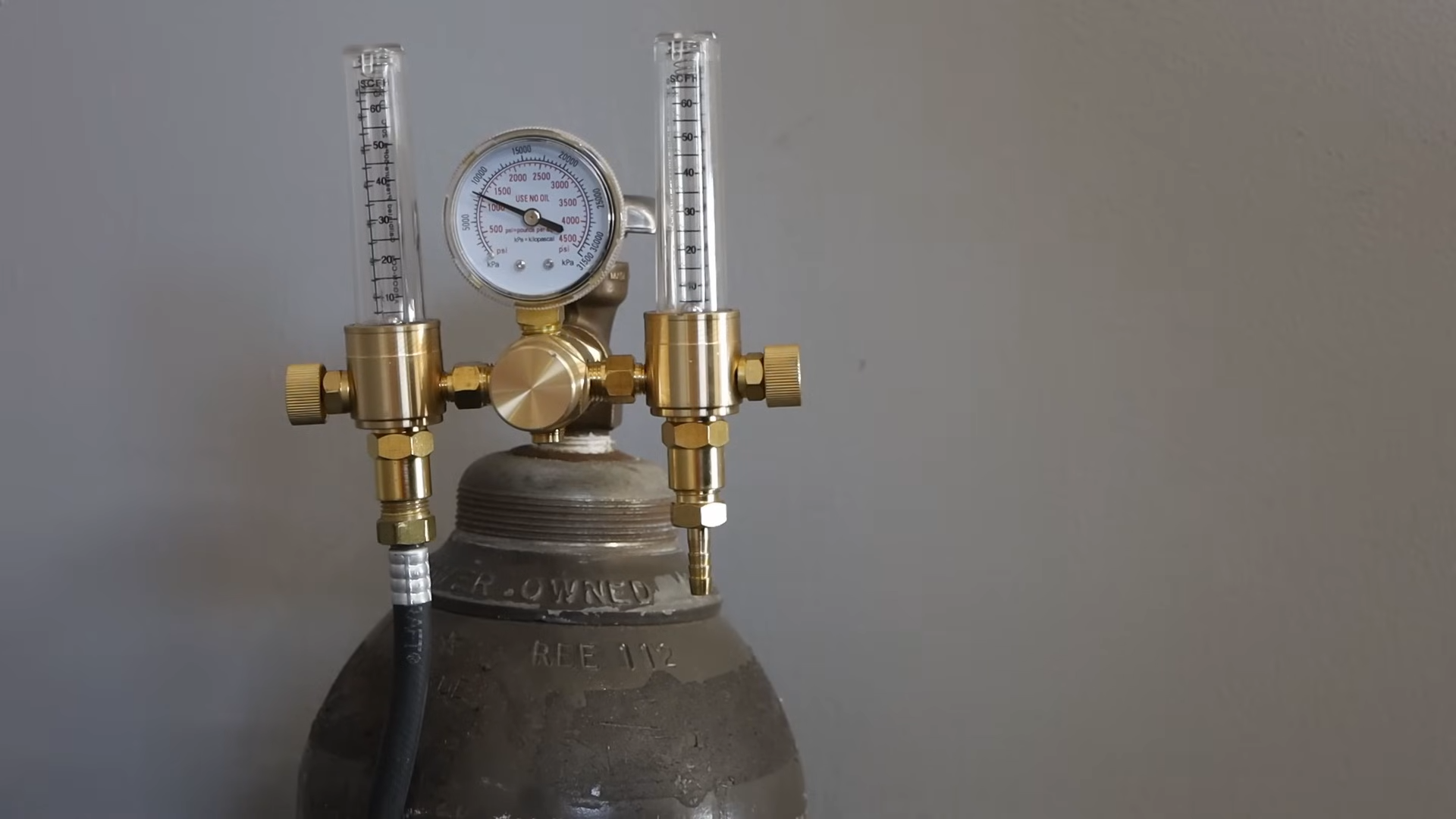
A regulator left slightly open overnight will drain an entire 125 cu ft cylinder in 2-3 days. That’s $60-70 literally vented into your shop.
Common leak sources:
- Regulator left cracked open
- Damaged hose or fittings
- Loose connections at regulator or torch
- Faulty cylinder valve
Test for leaks: Close cylinder valve, note regulator pressure. Come back in 30 minutes—if pressure dropped, you have a leak.
6. Distance to Gas Supplier
If your nearest supplier is 30 miles away, that’s a 60-mile round trip per exchange. At 4 exchanges per month, that’s 240 miles = $50-75 in fuel and 4+ hours of drive time monthly.
Annual hidden cost: $600-900 in fuel + 48+ hours of your time
7. Gas Waste from Wind
Welding outdoors or in a breezy shop? Wind blows away shielding gas before it can protect the weld. You might be running 30 CFH but only getting the protection of 15 CFH because half is blowing away.
Solution: Use wind screens, weld indoors when possible, or increase flow rate (which uses more gas but prevents bad welds).
7 Ways to Reduce Gas Waste by 20-30%
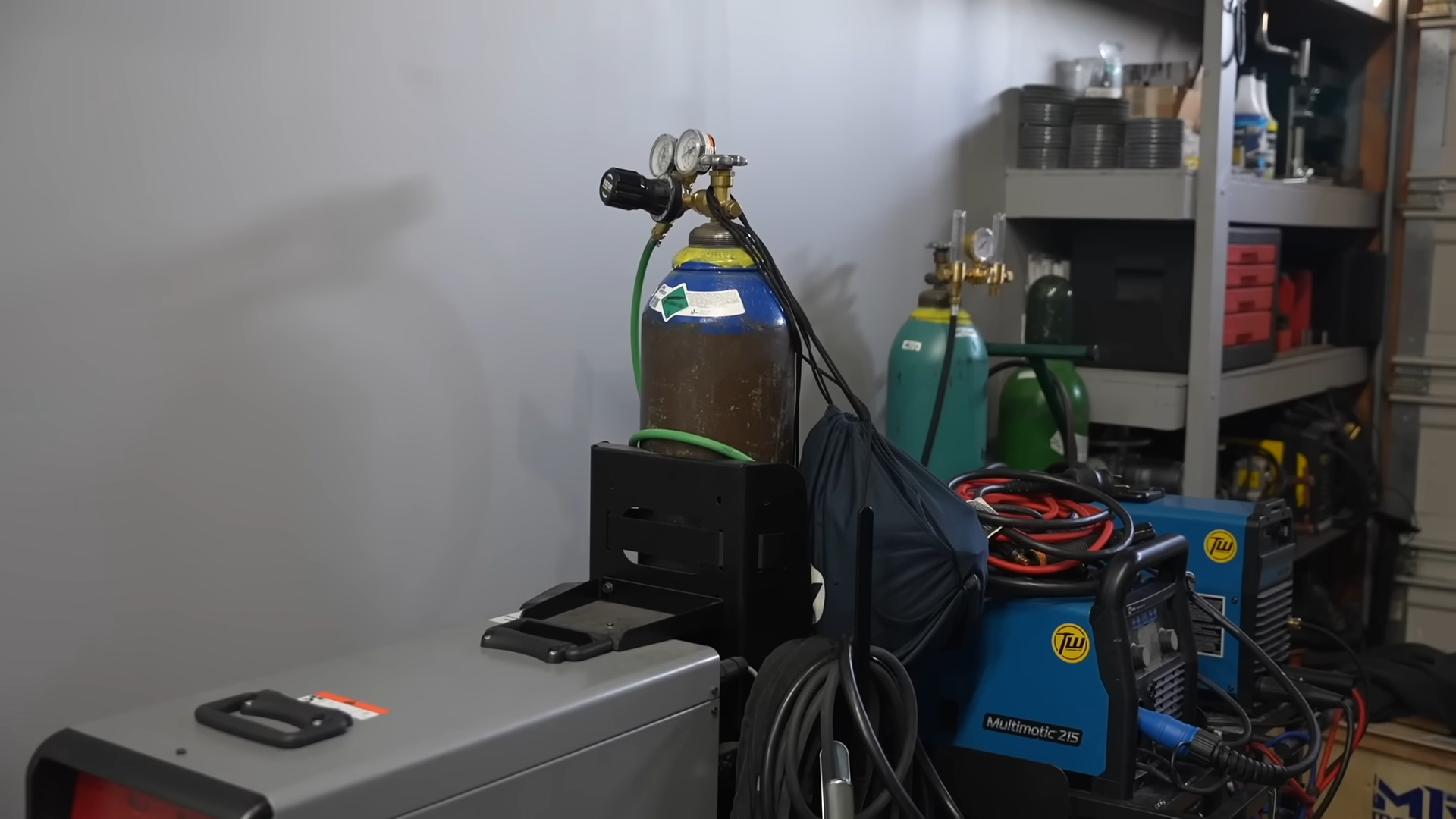
Most welders waste 20-30% of their shielding gas without realizing it. Here’s how to plug those leaks:
1. Reduce TIG Post-Flow (Save 10-15%)
TIG post-flow protects your tungsten as it cools, but many welders run it WAY too long. Default settings are often 10-15 seconds, which is overkill for small tungsten.
Recommended post-flow:
- 1/16″ tungsten: 3-5 seconds
- 3/32″ tungsten: 5-8 seconds
- 1/8″ tungsten: 8-12 seconds
- 5/32″+ tungsten: 12-15 seconds
If you’re TIG welding intermittently (lots of starts and stops), cutting post-flow from 15 seconds to 5 seconds saves 10-15% of your gas consumption.
Example: 100 weld starts per day × 10 seconds saved = 1,000 seconds = 16.6 minutes of gas saved. At 20 CFH, that’s 5.5 cu ft saved daily, or 27.5 cu ft per week = $13-18 saved per week!
2. Check for Leaks Weekly (Save 5-10%)
A tiny leak at a regulator fitting or hose connection will drain gas 24/7, even when you’re not welding.
Leak test procedure:
- Open cylinder valve, pressurize regulator
- Close cylinder valve
- Note pressure on regulator gauge
- Wait 30 minutes
- Check gauge—if pressure dropped, you have a leak
Fix: Tighten fittings, replace O-rings, or replace damaged hoses. A $5 O-ring replacement can save $50/month in wasted gas.
3. Turn Off Cylinder Valve When Not Welding (Save 5%)
Always close the cylinder valve when you’re done welding for the day. Leaving it open risks slow leaks and regulator damage.
Best practice:
- Close cylinder valve
- Purge remaining gas from lines (trigger gun until pressure drops to zero)
- Close regulator valve
This also prevents damage if a hose gets cut or a fitting loosens—gas won’t drain while you’re gone.
4. Use Wind Screens for Outdoor Welding (Save 10-20%)
Wind is a gas thief. Even a slight breeze (5-10 mph) blows away 20-30% of your shielding gas before it can protect the weld.
Solutions:
- Weld indoors when possible
- Use welding screens or tarps to block wind
- Position your body to block wind from the weld
- Increase gas flow 20-30% to compensate (costs more gas but prevents porosity)
5. Dial In Flow Rate—Don’t Just Guess (Save 5-10%)
Many welders set flow rate once and never touch it again. But optimal flow changes based on cup size, process, and material.
Too much flow = wasted gas + turbulence (sucks in air, causes porosity)
Too little flow = oxidation, porosity, bad welds
Optimal flow rates:
- MIG welding: 20-25 CFH (increase to 30 CFH outdoors or in drafts)
- TIG small cup (#4-6): 10-15 CFH
- TIG medium cup (#8-10): 15-25 CFH
- TIG large cup (#12-16): 25-35 CFH
Running 35 CFH when 20 CFH would work is wasting 75% more gas than necessary.
6. Fix Gas Coverage Issues Instead of Cranking Up Flow (Save 10%)
If you’re getting porosity or oxidation, the instinct is to increase gas flow. But often the problem is:
- Dirty base metal (mill scale, rust, oil)
- Contaminated filler wire
- Damaged gas cup or nozzle
- Wind or drafts
Cranking flow from 20 to 40 CFH doubles your gas cost but doesn’t fix the actual problem. Clean your metal, check your equipment, block wind—THEN adjust flow if needed.
7. Buy Larger Cylinders (Save 25-35% Per Cubic Foot)
This isn’t reducing “waste,” but it directly cuts your cost per cubic foot.
Cost comparison:
- 60 cu ft cylinder: $0.75/cu ft
- 125 cu ft cylinder: $0.50/cu ft (33% savings!)
- 250 cu ft cylinder: $0.42/cu ft (44% savings!)
If you’re going through 300 cu ft of gas per month:
- Using 60 cu ft cylinders: $225/month
- Using 125 cu ft cylinders: $150/month
- Annual savings: $900/year
A larger cylinder costs $50 more upfront but pays for itself in 2-3 months of savings.
Comparing Gas Suppliers and Prices
Gas prices vary wildly between suppliers. Here’s what to look for:
National Chains (Airgas, Praxair, Linde)
Pros:
- Locations everywhere
- Consistent quality and testing
- Large cylinder sizes available
- Delivery options for large users
Cons:
- Often 30-50% more expensive than local suppliers
- Push rental programs over ownership
- Less flexible on pricing for small customers
Typical pricing: $70-85 for 125 cu ft argon exchange
Local Welding Supply / Mom & Pop Shops
Pros:
- Often 30-40% cheaper than national chains
- More willing to work with small customers
- Better customer service
- Flexible on pricing and cylinder ownership
Cons:
- Fewer locations (may require longer drive)
- Limited hours (often closed weekends)
- May not carry specialty gases
Typical pricing: $50-65 for 125 cu ft argon exchange
Tractor Supply, Home Depot, Hardware Stores
Pros:
- Convenient (open weekends, evenings)
- No account needed
Cons:
- Limited cylinder sizes (usually only 40-60 cu ft)
- Expensive per cubic foot
- Often rental-only programs
Typical pricing: $60-75 for 60 cu ft (more expensive per cu ft than local suppliers)
How to Find the Cheapest Supplier
Call 3-5 local welding supply companies and ask:
- “What do you charge to exchange a customer-owned 125 cu ft argon cylinder?”
- “Do you sell cylinders or rental only?”
- “Is there a price difference between C25 and argon?”
- “Any delivery fees or hazmat charges?”
You’ll often find a 30-50% price spread between the most expensive and cheapest supplier in your area. Over a year, that’s $300-600 saved just by making a few phone calls.
Frequently Asked Questions
How much does it cost to fill a welding gas cylinder?
You don’t “fill” cylinders as a customer—you exchange them. For customer-owned cylinders, exchange costs range from $45 for a 60 cu ft cylinder to $100-120 for a 250 cu ft cylinder, depending on gas type and supplier. Argon and C25 cost about the same ($50-70 for 125 cu ft), while straight CO2 is 10-20% cheaper. Local welding suppliers are typically 30-40% cheaper than national chains.
Is it cheaper to rent or buy welding gas cylinders?
Buying cylinders is cheaper long-term. A 125 cu ft cylinder costs $200-250 to purchase, which pays for itself in 6-12 months of avoided rental fees ($10-15/month). After 2 years, you’ve saved $240-360 per cylinder by owning instead of renting. The only time rental makes sense is for very occasional use (less than monthly) or if you need large cylinders (250+ cu ft) that suppliers won’t sell.
How long does a welding gas cylinder last?
A 125 cu ft cylinder lasts about 5 hours of arc-on welding time at 25 CFH flow rate. For most fabricators, that translates to 2-4 weeks of shop use depending on how much you weld. Calculate runtime with: Cylinder Size (cu ft) ÷ Flow Rate (CFH) = Hours. For example, 125 cu ft ÷ 25 CFH = 5 hours of welding. Account for pre/post flow on TIG welding, which adds 20-30% more gas consumption.
What size welding gas cylinder should I buy?
For most welders, a 125 cu ft cylinder is the sweet spot—it balances cost per cubic foot ($0.48-0.52), ease of handling (one person can move it), and runtime (5 hours of arc-on time). Hobbyists welding monthly can use 60-80 cu ft cylinders to save upfront cost. Production shops welding daily should buy 250 cu ft cylinders for the lowest cost per cubic foot ($0.38-0.42) and fewer exchanges, though they require two people to move safely.
How much does argon gas cost for TIG welding?
Argon costs $0.48-0.75 per cubic foot depending on cylinder size and supplier. A 125 cu ft argon cylinder costs $60-70 to exchange at most local suppliers, which provides about 5 hours of TIG welding at 25 CFH. Annual cost for a shop using 100 cu ft per month is approximately $600-750/year. Buying larger cylinders (250 cu ft) reduces cost to $0.42/cu ft, saving $150-200 annually.
Is CO2 cheaper than argon for MIG welding?
Yes, CO2 is 10-20% cheaper than argon or C25 mix—typically $50-60 for a 125 cu ft cylinder versus $60-70 for C25. However, CO2 produces more spatter, has a rougher arc, and deeper penetration that can blow through thin material. For most small users, the $8-10 savings per cylinder isn’t worth the trade-off. Large production shops use CO2 to save money on high-volume welding, but for hobby or small shop use, stick with C25 for cleaner welds.
How do I know if I’m wasting welding gas?
Common signs of gas waste: going through cylinders faster than expected, visible oxidation or porosity in welds despite “adequate” flow, hearing gas leaks when not welding, finding empty cylinders you thought were full, or excessively long TIG post-flow (15+ seconds for small tungsten). Test for leaks by closing the cylinder valve and checking if regulator pressure drops over 30 minutes. Reduce waste by fixing leaks, lowering TIG post-flow to 5-8 seconds, using wind screens outdoors, and turning off cylinder valves when not welding.
Can I use the same gas for MIG and TIG welding?
Only if you’re welding aluminum or using 100% argon. For steel, MIG requires C25 (75% argon / 25% CO2) while TIG uses 100% argon. You cannot use C25 for TIG welding—the CO2 will contaminate your tungsten and ruin welds. If you MIG weld steel and TIG weld steel/stainless/aluminum, you’ll need two cylinders: one C25 for MIG and one argon for TIG. Some welders use 90/10 mix (90% argon / 10% CO2) for spray-transfer MIG to have one gas that works for both short-circuit and spray modes.
What’s the hydrostatic test date on a gas cylinder?
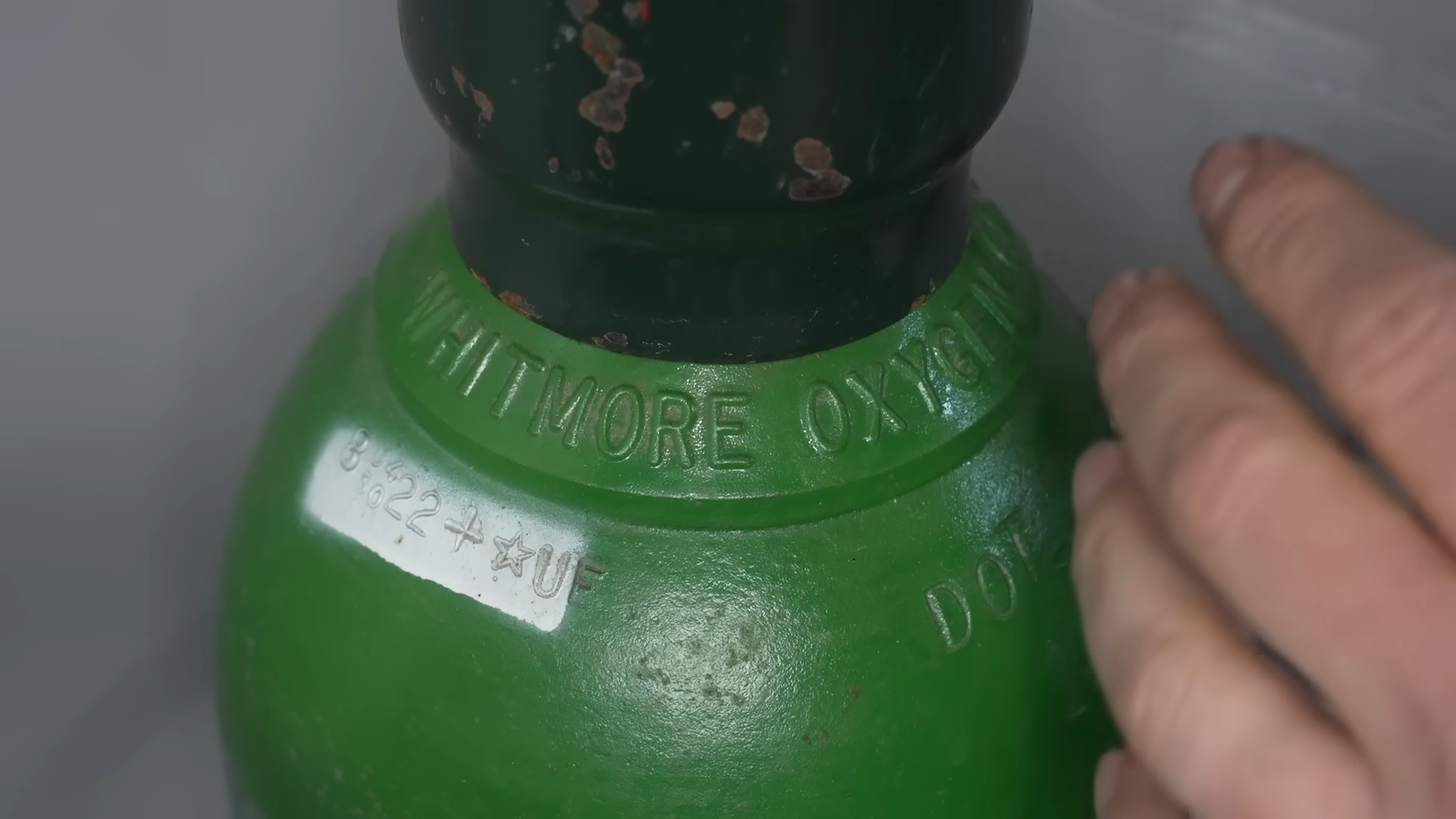
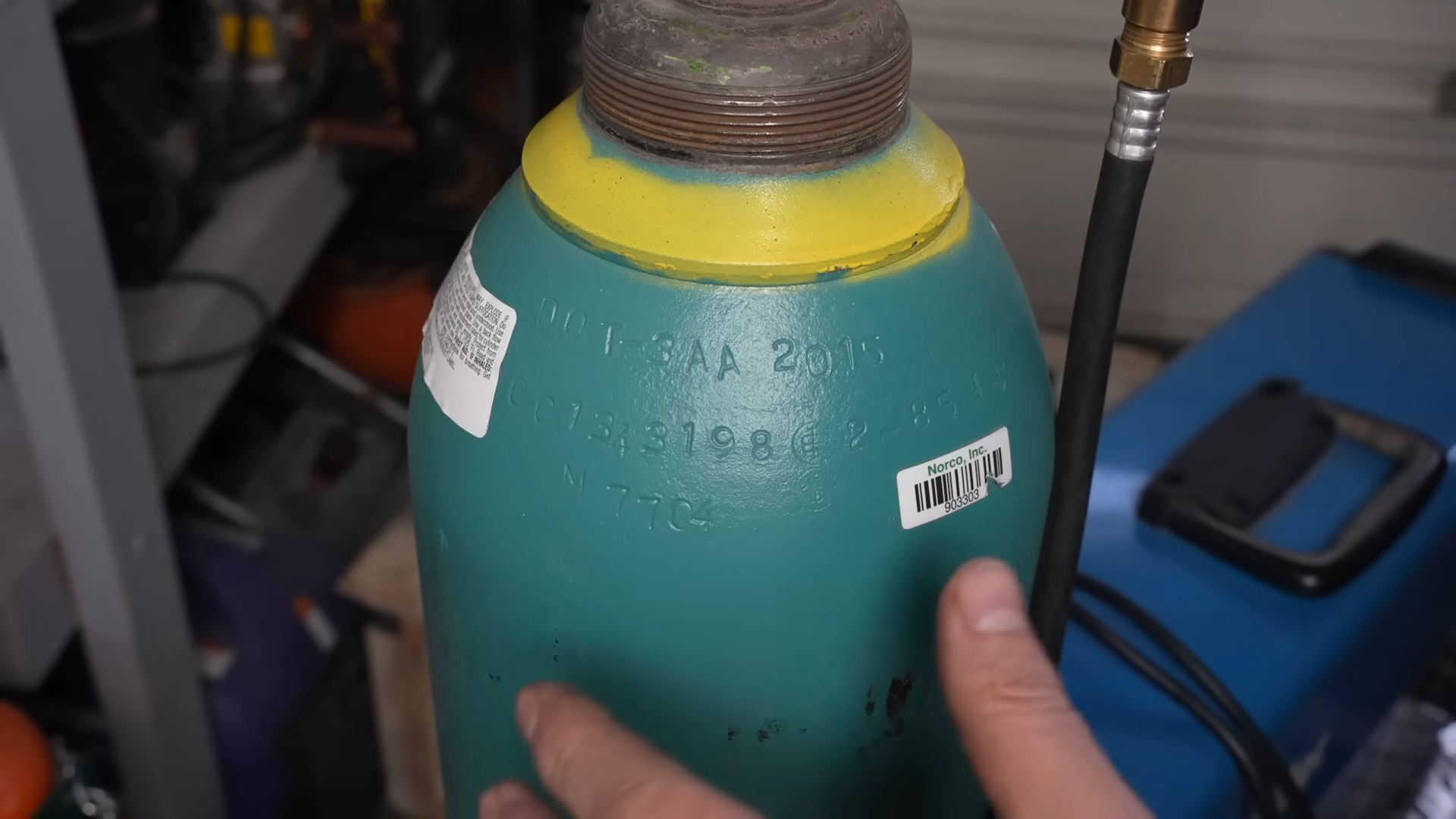
The hydrostatic test date is stamped on the cylinder shoulder and shows when the cylinder was last pressure tested for safety. Cylinders with a star marking are good for 10 years from the test date; cylinders without a star are good for 5 years. When a cylinder is out of date, most gas suppliers will still exchange it but may charge a $15-30 hydro test fee. The test date looks like “08 24” (August 2024) with a facility code between the month and year.
How much does welding gas cost per hour of welding?
At typical flow rates (25 CFH) and gas costs ($0.50/cu ft for argon in a 125 cu ft cylinder), welding costs about $12.50 per hour of arc-on time just for gas. MIG welding with C25 costs slightly less at $12/hour, while TIG welding with lower flow (15 CFH) costs $7.50/hour. Add 20-30% to account for TIG pre/post flow. This doesn’t include wire, electricity, or other consumables—just the shielding gas cost. Use our Weld Cost Calculator to estimate total welding costs including all consumables.
Related Gas Diagnostics, Choices, and Flow Data
Unexpectedly short cylinder life is a diagnostic problem, not just a price problem: use Gas Cylinder Duration Troubleshooting for leaks, post-flow, duty factor, freeze-up, and false pressure assumptions.
Set process-specific CFH with the Welding Gas Flow Rate Guide, then use the Shielding Gas Flow Rate Chart for quick reference. Choose between CO₂, C25, argon, helium, and self-shielded wire with How to Choose Shielding Gas.
Run your own price, flow, arc-time, and cylinder assumptions in the Welding Gas Cost Calculator.
Conclusion: Gas Costs Add Up—Track and Reduce Them
Welding gas is one of those expenses that’s small enough per refill ($60-70) that most welders don’t think about it, but large enough annually ($1,000-3,000+ for a small shop) that it’s worth optimizing. The three biggest opportunities to save money:
- Buy cylinders instead of renting – Saves $240-360/year per cylinder in lease fees
- Use larger cylinders – Reduces cost per cubic foot by 30-40%
- Reduce waste – Fix leaks, optimize post-flow, use wind screens – saves 20-30%
A small shop implementing all three strategies can cut gas costs from $2,500/year to $1,200/year—a savings of $1,300 annually, or enough to buy a nice TIG torch upgrade, quality tungsten for a year, or several spools of premium filler wire.
Use our calculators to optimize your gas costs:
- Gas Cost Calculator – Estimate annual gas expenses
- Weld Cost Calculator – Calculate total job costs including gas
- Welder Power Cost Calculator – Calculate electricity costs
- MIG Welding Calculator – Get complete MIG settings including gas flow
- TIG Welding Calculator – Get complete TIG settings including gas flow
Have questions about welding gas costs or ways to save? Drop a comment below or reach out—we’re here to help!
Welding
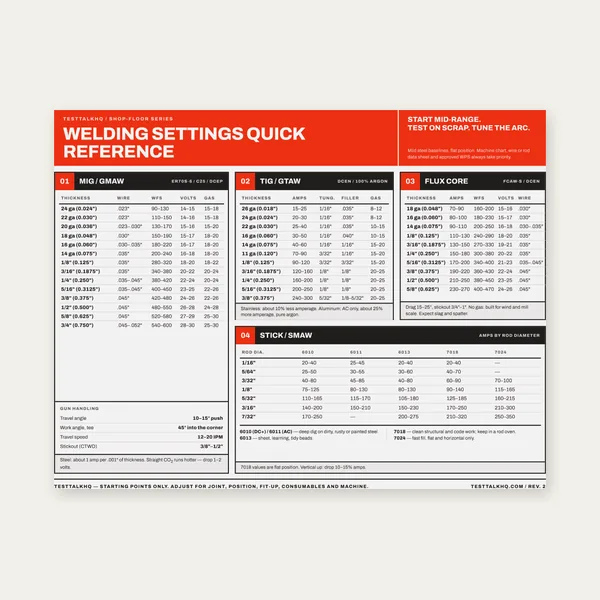
Welding Reference Card
One page. MIG, TIG, stick and flux core settings by thickness.
$3.99
Buy
Complete Welding Settings Guide
19 pages. Four processes, stainless and aluminum, symbols and inspection.
$12.99
Buy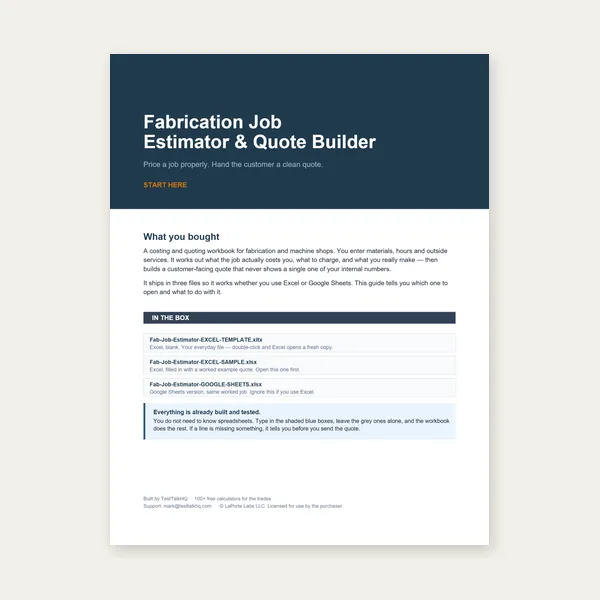
Welding Job Estimator
Price the job, then hand over a quote with no internal numbers.
Excel or Google Sheets. Best on a computer.
$29.00
Buy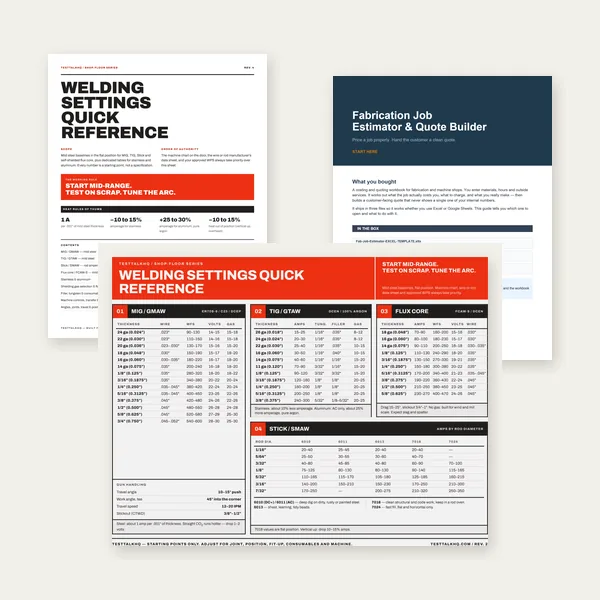
Welding Complete Bundle
Card, 19-page guide and the estimator workbook. All six files.
Excel or Google Sheets. Best on a computer.
$34.99
$45.98 if bought separately — save $10.99
BuyCheckout opens in a new tab.