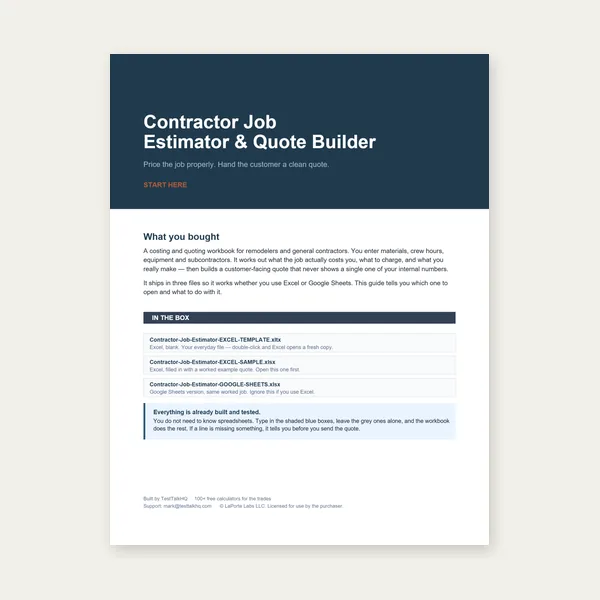
Contractor Job Estimator
Price remodels and GC work, then send a quote with no internal numbers.
Excel or Google Sheets. Best on a computer.
$29.00
BuySigns of a size mismatch beyond a wrong speedometer — ABS and traction control, fender rub, and AWD/4WD drivetrain strain
A speedometer that reads 62 at a true 65 is the polite symptom. The impolite ones are a stability-control light on a dry on-ramp, a growl from the transfer case on a tight parking lot, and a brand-new shoulder that is already kissing the liner. Those are still diameter and clearance problems. They just do not show up on the needle. Run the calculator so you know how far the rolling diameters actually moved, then work this list before you blame a module.
How the code becomes diameter: size-code guide. If the plan was plus-sizing for looks: plus-sizing vs same-diameter.
Check the diameter split first.Two size codes. Percentage, speedo error, revs/mile. Starting point only.
Open Calculator →Wheel-speed sensors report frequency. The module converts frequency to road speed using the original rolling circumference. If the front tires are on a different diameter than the rears, the module sees a constant difference that looks like brake drag or drive-wheel slip. Traction control may cut throttle. ABS may pulse on a light stop. ESC may throw a light after a single enthusiastic on-ramp.
Typical pattern after a size change:
A 3% diameter split is enough for some systems to notice. A 6% split (a common “I just wanted a little more sidewall” truck jump) is enough for almost all of them. The calculator’s revs-per-mile line is the number the module is fighting. Match rolling diameters axle-to-axle before you replace a wheel-speed sensor that was fine last week.
Rub on bump or full lock is a clearance problem. Diameter is only one of the three dimensions that eat clearance.
Listen for liner slap on driveway ramps and the first tight U-turn. Look for a polished or chewed spot on the plastic liner, the mud flap, or the strut body. A tire that only rubs at full lock with a passenger in the back is still a fail — that is a legal turning radius, not an edge case. The calculator will not predict rub. A turned wheel and a helper bouncing the corner will.
Price remodels and GC work, then send a quote with no internal numbers.
Excel or Google Sheets. Best on a computer.
$29.00
BuyCheckout opens here — you stay on this page.
A new size changes diameter, speedometer, and load on the wheel. Pressure, lug torque, tread depth, and a 12V inflator are the shop tools that keep the swap honest after the math.
A size change does not set PSI for you. Door-sticker pressure on a plus-sized tire is still the starting point — confirm it cold, in 0.1 PSI, not by kicking the sidewall.
View on Amazon →
Passenger-car lug nuts live in the middle of this range. After a size swap, torque to the door sticker or service manual — not “good and tight” with an impact.
View on Amazon →
ANSI-calibrated analog, no batteries. Use it to cross-check a digital glovebox gauge after you fill a plus-size or a load-range change.
View on Amazon →
AWD/4WD hates mixed rolling diameters. Measure remaining tread at the same spot on each corner before you mix a new size with a worn one.
View on Amazon →
Set cold pressure after the swap. Plus-sizing often needs a different inflation to carry the same load on a shorter sidewall — the door sticker is still the first number, then the load table.
View on Amazon →
Original vs proposed size. Diameter %, speedometer error, revs per mile, and a ±3% fitment flag.
Open Tire Size Calculator →As an Amazon Associate, TestTalkHQ earns from qualifying purchases.
Full-time AWD and many 4WD transfer cases are not open differentials between front and rear. They expect the front and rear axles to travel the same distance per revolution of the prop shaft. If the rear tires are taller, the rear axle covers more ground per turn and the transfer case has to slip the difference. Viscous couplings heat. Clutch-pack AWD systems chatter and sometimes set temperature codes. Part-time 4WD on pavement with mismatched diameters will wind the driveline until something hops or breaks.
Rules that actually hold up:
Symptoms: binding in tight turns at parking-lot speed, a moan that goes away in 2WD (if you have a 2WD mode), a transfer-case fluid that smells cooked, or an AWD warning after a tire shop visit. Fix the diameters before you rebuild the coupling.
Not every dash light after a tire appointment is geometry.
Inflate cold to the correct load table, scan for real codes, then compare diameters. Do not throw parts at a 4% split.
Some staggered performance cars are built that way. Open differentials forgive a lot. ABS still compares wheels. If the OEM did not stagger it, keep diameters close. The speedo follows the axle the vehicle is calibrated on — often the drive wheels or an average.
A cluster recode fixes indicated speed. It does not change the fact that two axles are covering different ground per revolution. AWD wants matched rolling diameters, not a happier needle.
Many makers spec 2/32 in to 4/32 in remaining-depth difference around the vehicle. That is a service-manual number, not a calculator output. Measure, do not guess.
Fender contact from a too-wide or too-positive/too-negative wheel is offset geometry, not rolling diameter. Convert the barrel on the offset & backspacing calculator. Measurement and target ET: guide. Rub vs scrub vs bearing wear: troubleshooting. Spacer vs buying the right ET: comparison.