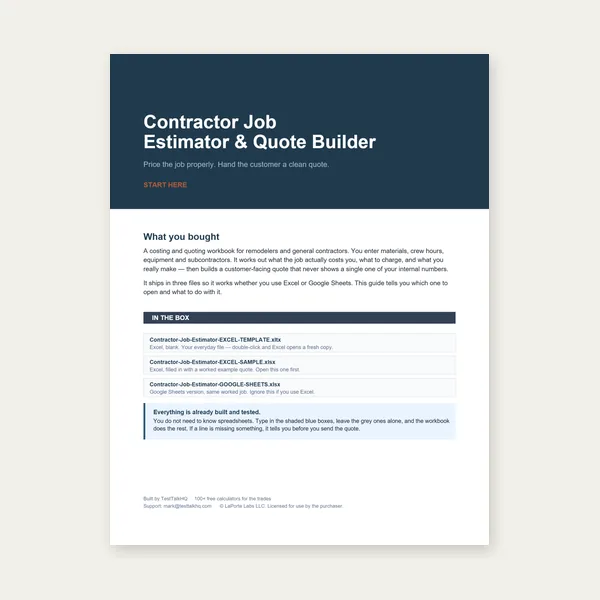
Contractor Job Estimator
Price remodels and GC work, then send a quote with no internal numbers.
Excel or Google Sheets. Best on a computer.
$29.00
BuyWhat 225/65R17 actually means, how diameter and circumference are built from those numbers, and why that math moves the speedometer and odometer
The sidewall is not decoration. 225/65R17 is a geometry recipe: section width, sidewall height as a percentage of that width, and the rim it is built for. Change any of those three and overall diameter changes. Change diameter and every wheel revolution covers a different amount of road — which is exactly what the speedometer and odometer count. The tire size & speedometer error calculator does that arithmetic. This page is the why.
Dash lights, fender rub, AWD strain: troubleshooting. Plus-size vs matching diameter on purpose: comparison. Automotive index: automotive calculators hub.
Need diameter % and speedo error?Original size, proposed size, a true speed. Starting point only.
Open Calculator →A typical passenger-car marking looks like P225/65R17 102H. The calculator cares about the first three numbers. The rest still matter on the car.
| Mark | Means | In 225/65R17 |
|---|---|---|
| P / LT / ST / T | Service type (passenger, light truck, special trailer, temporary spare). Optional; ignored in the diameter formula. | Often omitted on modern passenger tires |
| 225 | Section width in millimeters, bead to bead across the tread when mounted on the measuring rim. | 225 mm ≈ 8.86 in |
| 65 | Aspect ratio: sidewall height as a percent of section width. | Sidewall = 0.65 × 225 mm = 146.25 mm |
| R | Radial construction (almost everything on the road). ZR is a speed-rated radial; B and D are older bias/diagonal marks. | Radial |
| 17 | Nominal rim diameter in inches. | 17 in wheel |
| 102H | Load index 102 and speed rating H. Not in the diameter formula. Still legally required to meet or beat the door placard. | Load and speed, not geometry |
Width is not tread width you can put a tape on in the parking lot. It is the ISO section width of the carcass on a specified measuring rim. A 225 on a wheel that is too narrow or too wide will not measure 225 mm at the tread. Aspect ratio is not “how tall it looks.” It is a percentage of that section width, so a 225/65 and a 245/65 are not the same sidewall height. The 245 is taller because 65% of a wider section is a taller wall.
Rim diameter is the bead seat, not the outer lip of the wheel. You cannot put a 17-inch tire on an 18-inch wheel and “make up the difference in sidewall.” The beads will not seat. Plus-sizing that also changes the wheel is a different job: you drop aspect ratio as rim diameter goes up so overall diameter stays close. That is the plus-size vs same-diameter distinction.
Overall diameter is twice the sidewall plus the rim. Circumference is π times that diameter. There is no third mystery constant in the size code.
Worked example, 225/65R17:
Worked example, 245/65R17 (same rim, wider, same aspect):
That 3.59% is already outside the band most shops treat as a no-recalibration swap. The calculator will flag it. A same-diameter plus-size in the other direction — 225/65R17 to 245/60R17 — lands near 28.57 in, about +0.2%. Same extra width, shorter wall, diameter almost unchanged. That is the whole plus-size idea: buy width (and usually a larger wheel) without buying a taller tire.
Loaded radius — the distance from hub center to the ground with the vehicle sitting on the tire — is shorter than half the overall diameter because the contact patch flattens. Revolutions per mile published by a manufacturer sometimes use a loaded-radius test. The calculator uses geometric circumference so two size codes compare on the same basis. For speedometer error, the ratio of the two diameters is what matters; a consistent loaded-radius offset on both sizes largely cancels in the percentage.
Price remodels and GC work, then send a quote with no internal numbers.
Excel or Google Sheets. Best on a computer.
$29.00
BuyCheckout opens here — you stay on this page.
A new size changes diameter, speedometer, and load on the wheel. Pressure, lug torque, tread depth, and a 12V inflator are the shop tools that keep the swap honest after the math.
A size change does not set PSI for you. Door-sticker pressure on a plus-sized tire is still the starting point — confirm it cold, in 0.1 PSI, not by kicking the sidewall.
View on Amazon →
Passenger-car lug nuts live in the middle of this range. After a size swap, torque to the door sticker or service manual — not “good and tight” with an impact.
View on Amazon →
ANSI-calibrated analog, no batteries. Use it to cross-check a digital glovebox gauge after you fill a plus-size or a load-range change.
View on Amazon →
AWD/4WD hates mixed rolling diameters. Measure remaining tread at the same spot on each corner before you mix a new size with a worn one.
View on Amazon →
Set cold pressure after the swap. Plus-sizing often needs a different inflation to carry the same load on a shorter sidewall — the door sticker is still the first number, then the load table.
View on Amazon →
Original vs proposed size. Diameter %, speedometer error, revs per mile, and a ±3% fitment flag.
Open Tire Size Calculator →As an Amazon Associate, TestTalkHQ earns from qualifying purchases.
The instrument cluster does not have a GPS speed in most daily-driver calibrations. It counts pulses from a wheel-speed sensor or a transmission output-speed sensor that was calibrated for a specific tire circumference. More road per revolution means fewer pulses per mile. Fewer pulses per mile means the needle lags true speed and the odometer under-counts.
On the 225/65R17 → 245/65R17 pair (+3.59% diameter):
Go the other way — a shorter tire — and the needle leads. You are not going as fast as it says, and the odometer over-counts. Highway speeding tickets and warranty-mile arguments both care about this. So do shift points on a transmission that uses the same speed signal.
The speed you type into the calculator only scales that ratio. Error at 30 mph and error at 75 mph are the same percentage. There is no extra aerodynamic term. There is also no “the computer will figure it out” on a vehicle that has not been recoded. Some late-model clusters can be told a new tire size. Many cannot without a dealer tool. The ±3% flag is the shop shorthand for “you probably do not have to recode.” It is not a legal speedometer-accuracy certificate. FMVSS 122 (motorcycles) and in-use speedometer conventions for cars still assume the original equipment size.
Revolutions per mile is 63,360 inches per mile divided by circumference in inches. 225/65R17 is about 707 rev/mile. 245/65R17 is about 683. That 24-rev gap is the same 3.59% looking at you from the other side of the fraction.
ABS and traction control compare wheel-speed sensors. If one axle is on a different rolling diameter than the other, the module sees a persistent slip that is not slip. Stability control can pulse brakes or cut throttle on a straight, dry road. AWD/4WD transfer cases that expect matched diameters will wind up the viscous coupling or clutch pack. That is not a speedometer complaint. It is a drivetrain complaint that starts with the same diameter math. Details and symptoms: troubleshooting.
TPMS is usually pressure, not diameter. A size change does not by itself make a TPMS light. Mixing a new tall tire with a worn short tire on the same axle can, because some systems watch relative wheel speed as a proxy. Measure tread depth before you mix a new size onto a half-worn set, especially on AWD.
Not in the formula. P225/65R17 and 225/65R17 have the same geometry. LT changes load construction and often inflation tables. Use the LT tire’s load inflation chart, not the P-metric door sticker, when you mount LT on a passenger car or vice versa.
No. It is common retailer and shop guidance for staying near the original rolling diameter without recoding the cluster. Some manufacturers publish a tighter list of approved sizes. If the vehicle has an OEM size list, that list wins.
No. Diameter keeps the speedo honest. Load index keeps the tire from being overloaded. Speed rating keeps the carcass legal at highway speed. The calculator does not check either. Read both on the sidewall and on the door placard.