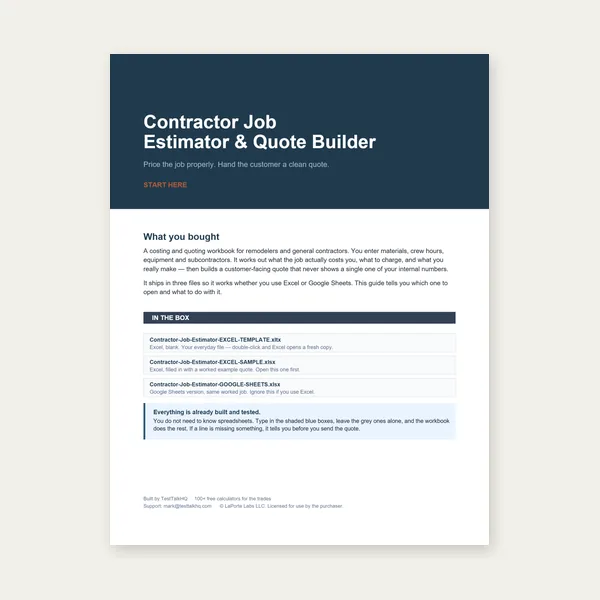
Contractor Job Estimator
$29.00
BuyTwo different reasons people change tire sizes — wider for looks and grip, or matched diameter so the speedo and odometer stay honest — and why the approach is not the same job
Plus-sizing is a styling and contact-patch decision: bigger wheel, shorter sidewall, similar overall diameter. A same-diameter swap at the same rim is the quieter cousin: change width or brand without moving the speedometer. A diameter-changing swap (taller all-terrains, a cheap close-out size, “just a little more sidewall”) is a third job, and it is the one that moves the needle. The calculator tells you which job you actually signed up for.
How the code works: size-code guide. When the swap already went wrong: troubleshooting.
See which job your two sizes are.If diameter moves more than ~3%, you are not plus-sizing. You are recalibrating.
Open Calculator →Classic plus-one: 16-inch wheel to 17, or 17 to 18, with aspect ratio dropped so overall diameter stays inside a percent or two. 205/55R16 to 215/45R17 is the textbook shape. You buy a shorter, stiffer sidewall and a wider contact patch. You do not (if you did it right) buy a new speedometer calibration.
What plus-sizing is trying to do:
What it is not trying to do: make the truck taller, add mud clearance, or “fix” a speedo that was already wrong. If overall diameter jumps 4% while you plus-size, you accidentally did a lift in rubber. The calculator will say so. Correct plus-size tables drop aspect ratio as rim diameter rises so that 2 × sidewall + rim stays near the original.
Ride and wheel damage are the plus-size tax. Less sidewall is less armor over a pothole. Plus-two and plus-three on a car that lived on 65-series rubber will feel every expansion joint. Load index still has to meet the placard; a pretty 18-inch setup that drops a load index is a failed plus-size even if diameter is perfect.
This is the replacement-tire problem. The 225/65R17 is discontinued, or you want a quieter touring tire, or a slightly wider all-season that still fits the stock wheel. The goal is to land inside the original rolling diameter so the speedometer, odometer, shift points, and AWD stay in the world the engineers calibrated.
Same-diameter does not mean the same size code. It means the geometry comes out close:
Use the calculator. Do not trust “it’s only 10 mm wider.” Aspect ratio and rim diameter have a vote. The ±3% flag is the same-diameter job’s pass band for cluster recoding. Stay inside it on purpose if the point of the swap was “new tires, old speedo.”
$29.00
BuyCheckout opens here — you stay on this page.
A new size changes diameter, speedometer, and load on the wheel. Pressure, lug torque, tread depth, and a 12V inflator are the shop tools that keep the swap honest after the math.
A size change does not set PSI for you. Door-sticker pressure on a plus-sized tire is still the starting point — confirm it cold, in 0.1 PSI, not by kicking the sidewall.
View on Amazon →
Passenger-car lug nuts live in the middle of this range. After a size swap, torque to the door sticker or service manual — not “good and tight” with an impact.
View on Amazon →
ANSI-calibrated analog, no batteries. Use it to cross-check a digital glovebox gauge after you fill a plus-size or a load-range change.
View on Amazon →
AWD/4WD hates mixed rolling diameters. Measure remaining tread at the same spot on each corner before you mix a new size with a worn one.
View on Amazon →
Set cold pressure after the swap. Plus-sizing often needs a different inflation to carry the same load on a shorter sidewall — the door sticker is still the first number, then the load table.
View on Amazon →
Original vs proposed size. Diameter %, speedometer error, revs per mile, and a ±3% fitment flag.
Open Tire Size Calculator →As an Amazon Associate, TestTalkHQ earns from qualifying purchases.
The two jobs optimize different variables.
| Plus-sizing | Same-diameter replacement | |
|---|---|---|
| Primary goal | Wheel diameter / width / looks / sidewall stiffness | Keep rolling diameter, speedo, odometer, AWD |
| What you hold constant | Overall diameter (by dropping aspect as rim grows) | Overall diameter (and usually the stock wheel) |
| What you are allowed to change | Rim diameter, width, offset (with a test-fit) | Brand, tread, sometimes a modest width change |
| Success test | Diameter still inside ~3%, it clears, load/speed ratings hold, you like the ride | Diameter inside ~3%, ratings hold, no dash lights |
| Failure mode | Rub, harsh ride, bent wheels, forgotten load index | Wrong close-out size that quietly adds 4% diameter |
If you want more ground clearance, you are not plus-sizing and you are not doing a same-diameter swap. You are upsizing diameter. That is a lift-in-rubber decision: recode or live with a slow speedo, check fender and control-arm clearance, and on AWD replace all four. The calculator’s job is to stop you from accidentally being in that third category while thinking you were in the first two.
Ask one question: are you trying to change how the car looks and turns, or are you trying to put new rubber on without teaching the cluster a new circumference?
Mixing the three — plus-size wheels with a leftover taller aspect ratio — is how you get a show wheel and a 5% speedo error. The math does not care what you meant.
Only if you also changed the wheel and dropped aspect ratio on purpose. A 3% change on the same rim is just a taller or shorter tire. Plus-sizing is the method (hold diameter, change wheel/width), not the error band.
If diameter stayed inside about 3% and the vehicle has no OEM restriction, most shops will not recode. If you care about indicated vs true to a tenth, recode or use GPS. The odometer still follows diameter, not your intentions.
On a 2WD staggered sports car that shipped that way, yes, using the OEM pair. On AWD, almost never. Mixed rolling diameters are a transfer-case problem, not a style problem. See troubleshooting.