Calculators & guides only — no articles or blog noise.
TIG Tungsten Electrode Troubleshooting
Excessive consumption, greenish or black tip discoloration, and cracking/splitting tips — diagnosed and fixed
This page goes deep on electrode-specific failure modes that show up over the life of a tip rather than during one bad dip. Check tungsten diameter against your amperage first with the Tungsten Electrode Selector Calculator, then work through the sections below.
Quick Answer
This page covers what happens to the tungsten itself over normal use — not a single contamination event. Jump to a section:
Looking for contamination (dipping the tip) or arc wander from a bad grind? Those deep-dives already live on the TIG Welding Troubleshooting page (sections 1 and 2) — this page will link to them rather than repeat that material. This page's focus is consumption rate, discoloration causes, and cracked/split tips.
1. Excessive Tungsten Consumption
What it looks like: You're re-grinding or replacing tungsten far more often than the job seems to justify — a tip that should last a full shift is eroding, blunting, or shrinking within an hour or two of arc time.
Root causes, in order of how often they show up:
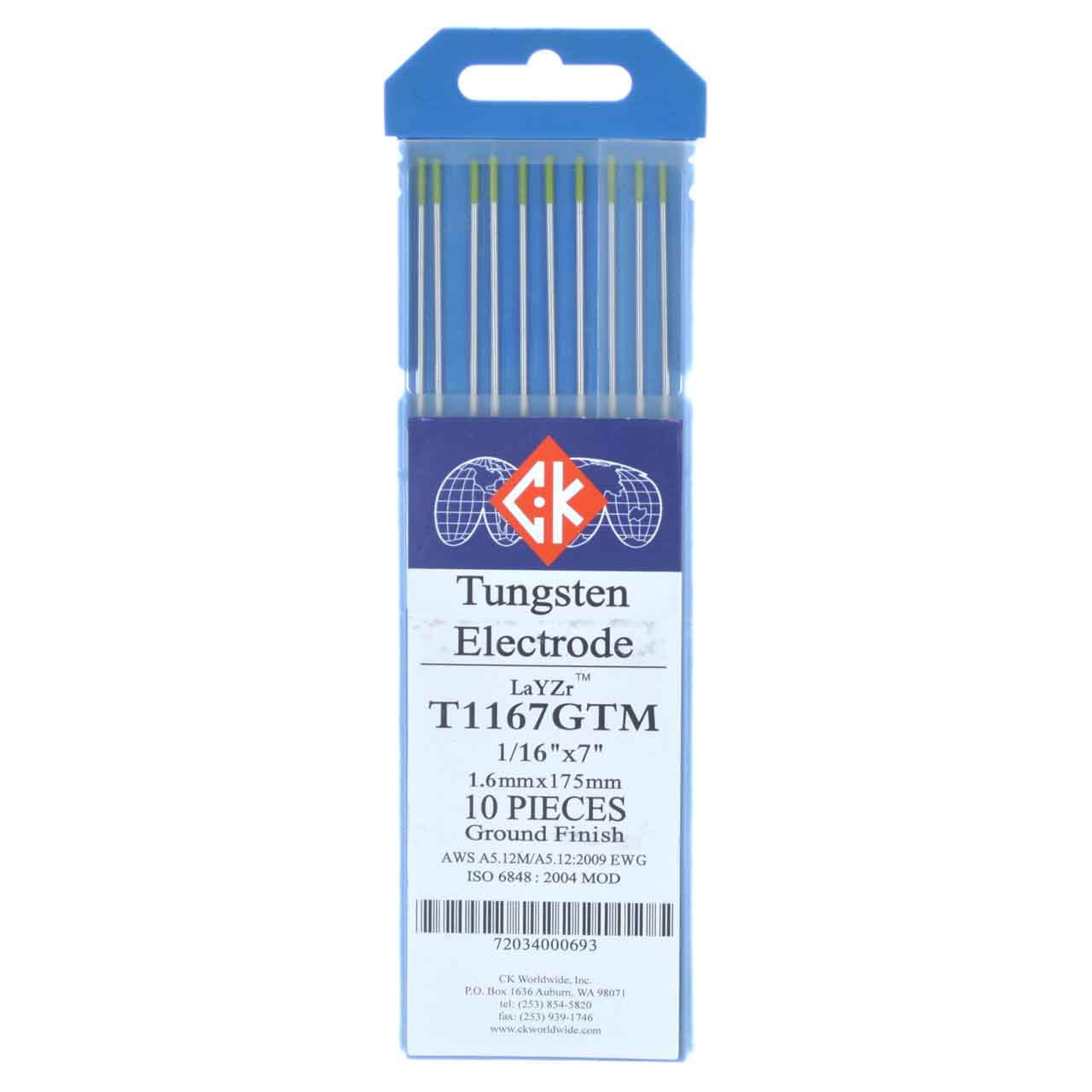
Undersized electrode for the amperage. The single most common cause. A 3/32" electrode pushed to the top of (or past) its rated amp range erodes fast because it's carrying more current than the tip geometry can dissipate. Check your actual amps against diameter with the tungsten selector calculator — sizing up one diameter is often the entire fix.
Wrong polarity heat load. Running DCEP (electrode positive) instead of DCEN on steel/stainless puts roughly two-thirds of the arc's heat into the electrode instead of the workpiece — tungsten will consume rapidly and the weld will barely penetrate. Steel and stainless should be DCEN; only aluminum/magnesium use AC (which splits time between EN and EP by design).
Too much electrode-positive (EP) balance on AC aluminum. Some EP time is necessary for oxide cleaning, but pushing balance too far toward EP overheats the tip on every cycle. If the ball keeps growing no matter how often you dress it, dial EP back toward EN and recheck.
Poor gas coverage oxidizing the tip in service. Tungsten oxidizes and erodes faster when it's not fully shielded — insufficient CFH, a cracked or spatter-clogged cup, excessive stick-out past the gas envelope, or drafts stripping the shield all starve the tip of inert coverage while it's hot. See the Shielding Gas Flow Rate Calculator to rule this out.
Contamination-driven regrinding. If you're regrinding constantly because the tip keeps getting dipped or dirty rather than eroding on its own, that's a technique/contamination issue, not a consumption issue — see the contamination section on the main troubleshooting page.
First fix to try: size up one tungsten diameter and confirm you're on the correct polarity for the material. That combination resolves the majority of "eating tungsten too fast" complaints before you touch anything else.
2. Greenish / Black Tip Discoloration
What it looks like: The electrode shank or tip develops a color change that isn't simple heat-tint straw/blue — often a dull grey-green oxide film partway up the shank, or a fully black, sometimes flaky, tip.
Black tip (usually the tip itself, not the shank)
Puddle contact (dipping): the most common cause of a black, glassy-looking tip. This is contamination, and the full diagnosis/fix lives on the main troubleshooting page's contamination section — cut back past the black zone and re-prep.
Short post-flow cutting off argon while the tip is still hot: the tungsten oxidizes as it cools in open air instead of finishing its cool-down under gas. Increase post-flow time (roughly 1 second per 10 amps is a common starting rule) so the tip stays shielded until it's no longer glowing.
Greenish / grey oxide film (usually higher up the shank)
Excessive stick-out: if the electrode extends too far past the cup, the portion outside the effective gas envelope oxidizes even though it never touched the puddle. Pull stick-out back to roughly 1–1.5x diameter for the joint you're running.
Contaminated or wrong shielding gas: shop-air argon mixed with moisture, a nearly-empty cylinder pulling in impurities, or an accidental mix-up with a reactive gas cylinder will oxidize tungsten along its whole exposed length, not just the tip. Verify cylinder/regulator and swap gas if suspect.
Leaking hose or torch gasket: a slow air leak into the gas line lets oxygen reach the tip during welding, producing a dull film even with correct CFH at the tank.
Quick differentiator: discoloration confined to the very tip that also shows a melted/glassy look is almost always a contamination dip. Discoloration running further up the shank in a dull, matte band points to post-flow, stick-out, or gas purity instead.
3. Cracking / Splitting Tips
What it looks like: The tip develops visible longitudinal cracks, a chunk breaks off mid-weld, or the electrode splits partway down its length rather than simply eroding or balling.
Root causes:
Cross-grinding. Grinding across the tip instead of longitudinally creates stress risers (small transverse notches) that propagate into cracks under thermal cycling. This is the single most preventable cause — always grind flutes running the length of the taper.
Thermal shock. Plunging a hot electrode into coolant, or an abrupt current spike from a poorly-set slope/start, stresses the tungsten faster than it can equalize temperature. Let tips cool in air (under post-flow) rather than quenching them.
Cheap or inconsistent electrodes. Off-spec tungsten with uneven oxide distribution or porosity in the rod stock is more prone to splitting under normal thermal cycling than electrodes from a consistent, reputable supplier.
Overheating during grinding. Pressing too hard against a grinding wheel (especially a worn or glazed wheel) heats the tip locally enough to introduce micro-cracks that don't show up until the electrode is back in service and thermally cycled by the arc.
Grinding at too steep an angle in one pass. Removing too much material too fast on one side of the taper can also flex/stress a thin tip unevenly, especially on smaller diameters like 0.040" and 1/16".
Safety note: a cracked tip can shed a small hot fragment during welding. Inspect tips before each session and retire (don't attempt to reuse) any electrode showing visible cracks or splits.
Welding
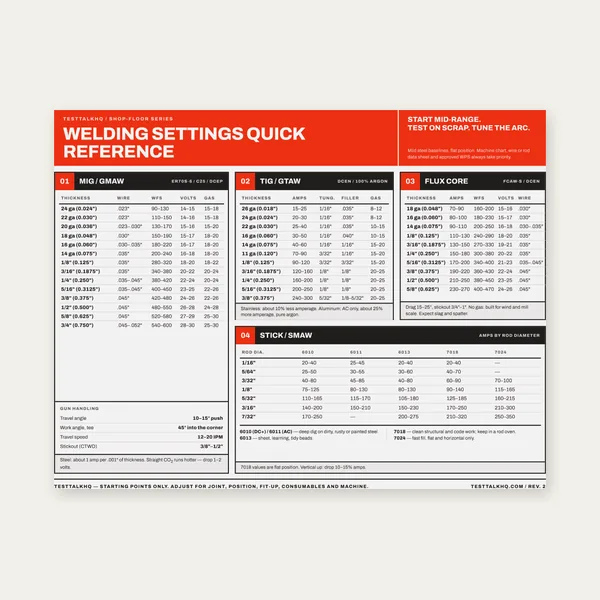
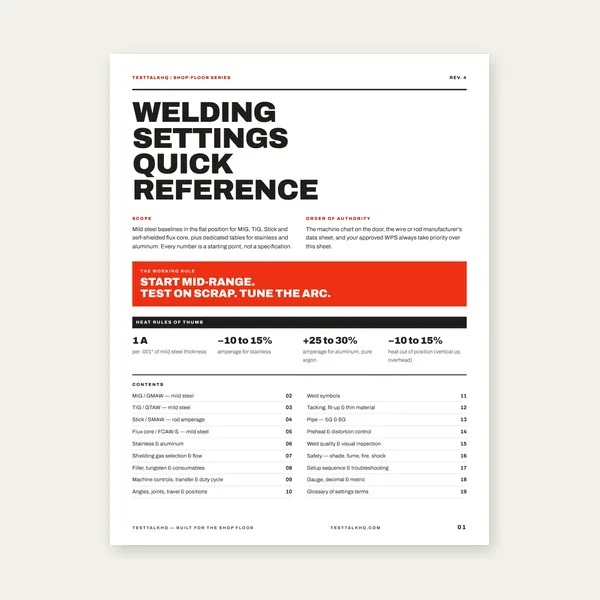
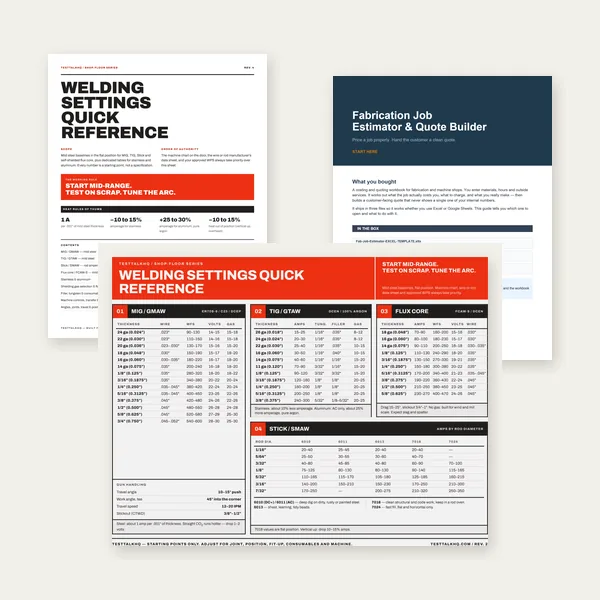
Welding Reference Card
One page. MIG, TIG, stick and flux core settings by thickness.
Regrind when the tip has a single clean contamination event, a slightly uneven point, or normal wear that shortened it — as long as enough straight shank remains to re-taper cleanly.
Replace when you see any crack or split, the electrode has been shortened by repeated regrinds to the point the collet no longer grips solidly, the tip has been overheated enough to discolor deep into the shank, or an AC ball has "flowered" into an irregular mushroom that won't true up with normal dressing.
Replace immediately, don't attempt to finish the joint on any electrode showing visible cracking — the risk of a fragment dropping into the weld or arc stream isn't worth finishing one pass.
Confirm you're even running the right diameter before you decide an electrode is "bad" — an undersized tip will look like a consumption or discoloration problem no matter how many times you regrind it. Recheck with the Tungsten Electrode Selector Calculator.
Contamination or Arc Wander Instead?
If the problem is a tungsten dip mid-weld, a fuzzy/wandering arc, or an oversized/lopsided AC ball right after a contamination event, that diagnosis and fix already lives in full on the main TIG troubleshooting page — this page intentionally doesn't duplicate it.
Why is my tungsten burning up so much faster than it used to?
Check amperage against diameter first — this is the most common cause of sudden fast consumption, especially if you recently switched jobs or bumped amps for a thicker material without sizing up the electrode.
Is a black tip always contamination?
Not always. A black, glassy tip right after a dip is contamination. A black tip with no dip and a matte (not glassy) look is more likely a short post-flow letting the hot tip oxidize as it cools.
Can I keep using a tungsten with a small crack?
No — retire it. A cracked tip can shed a fragment during welding. Regrind past the crack if there's enough shank left, otherwise replace the electrode.
Why does my AC aluminum ball keep growing no matter how often I dress it?
Almost always too much electrode-positive time in the AC balance setting, sometimes combined with an undersized diameter for the amperage. Reduce EP percentage and recheck diameter with the calculator.
Does gas purity really affect tungsten, or just the weld?
Both. Moist or contaminated argon oxidizes the tungsten tip and shank along with the puddle — a greenish shank film with no dip and correct post-flow often traces back to gas purity or a leak in the line.
Where do I find contamination and arc wander troubleshooting?
On the main TIG Welding Troubleshooting page — sections 1 and 2 cover tungsten contamination and arc wander in full, so this page doesn't repeat that material.
Tungsten electrode troubleshooting reference for shop use — inspect electrodes visually before each session and retire any tip showing cracks or splits.