:root{–orange:#e8611a;–orange-dark:#c4500f;–dark:#111111;–dark2:#1a1a1a;–dark3:#222222;–dark4:#2c2c2c;–gray:#888888;–border:#333333;–text:#e8e8e8;–text-dim:#aaaaaa;–green:#2ecc71;–yellow:#f1c40f;–red:#e74c3c;–blue:#3498db;}
*{box-sizing:border-box;margin:0;padding:0;}
body{background:var(–dark);color:var(–text);font-family:’Barlow’,sans-serif;font-size:16px;line-height:1.7;}
.hero{background:var(–dark2);border-bottom:3px solid var(–orange);padding:48px 24px 40px;text-align:center;position:relative;overflow:hidden;}
.hero::before{content:”;position:absolute;top:0;left:0;right:0;bottom:0;background:repeating-linear-gradient(45deg,transparent,transparent 20px,rgba(232,97,26,0.03) 20px,rgba(232,97,26,0.03) 40px);}
.hero-badge{display:inline-block;background:var(–orange);color:white;font-family:’Barlow Condensed’,sans-serif;font-weight:700;font-size:11px;letter-spacing:2px;text-transform:uppercase;padding:4px 14px;border-radius:2px;margin-bottom:14px;position:relative;}
.hero h1{font-family:’Barlow Condensed’,sans-serif;font-weight:900;font-size:clamp(26px,5vw,54px);text-transform:uppercase;color:white;line-height:1.05;max-width:860px;margin:0 auto 14px;position:relative;}
.hero h1 span{color:var(–orange);}
.hero-meta{display:flex;justify-content:center;gap:24px;flex-wrap:wrap;font-size:13px;color:var(–text-dim);position:relative;}
.article-wrap{max-width:820px;margin:0 auto;padding:40px 20px 60px;}
h2{font-family:’Barlow Condensed’,sans-serif;font-size:30px;font-weight:700;text-transform:uppercase;color:white;border-left:4px solid var(–orange);padding-left:14px;margin:44px 0 18px;}
h3{font-family:’Barlow Condensed’,sans-serif;font-size:21px;font-weight:700;text-transform:uppercase;color:var(–orange);margin:30px 0 12px;}
p{color:var(–text-dim);margin-bottom:18px;font-size:15.5px;line-height:1.85;}
p strong{color:var(–text);}
ul,ol{margin:10px 0 18px 22px;color:var(–text-dim);font-size:15.5px;line-height:1.85;}
li{margin-bottom:10px;}
li strong{color:var(–text);}
a{color:var(–orange);text-decoration:none;}
a:hover{text-decoration:underline;}
.lead{font-size:17px;color:var(–text);line-height:1.85;margin-bottom:28px;padding:22px 24px;background:var(–dark2);border-left:4px solid var(–orange);border-radius:4px;}
.pro-tip{background:rgba(232,97,26,0.08);border:1px solid rgba(232,97,26,0.22);border-left:4px solid var(–orange);border-radius:4px;padding:18px 22px;margin:26px 0;font-size:14.5px;color:var(–text-dim);line-height:1.75;}
.pro-tip strong{color:var(–orange);display:block;margin-bottom:6px;font-size:12px;text-transform:uppercase;letter-spacing:1px;}
.warning-box{background:rgba(231,76,60,0.08);border:1px solid rgba(231,76,60,0.22);border-left:4px solid var(–red);border-radius:4px;padding:18px 22px;margin:26px 0;font-size:14.5px;color:var(–text-dim);line-height:1.75;}
.warning-box strong{color:var(–red);display:block;margin-bottom:6px;font-size:12px;text-transform:uppercase;letter-spacing:1px;}
.info-box{background:rgba(52,152,219,0.07);border:1px solid rgba(52,152,219,0.2);border-left:4px solid var(–blue);border-radius:4px;padding:18px 22px;margin:26px 0;font-size:14.5px;color:var(–text-dim);line-height:1.75;}
.info-box strong{color:var(–blue);display:block;margin-bottom:6px;font-size:12px;text-transform:uppercase;letter-spacing:1px;}
.diagram{background:var(–dark2);border:1px solid var(–border);border-radius:8px;overflow:hidden;margin:30px 0;}
.diagram-title{background:var(–dark4);padding:10px 18px;font-family:’Barlow Condensed’,sans-serif;font-size:13px;font-weight:700;text-transform:uppercase;letter-spacing:1px;color:var(–orange);border-bottom:1px solid var(–border);}
.diagram svg{display:block;width:100%;height:auto;}
.data-table{background:var(–dark2);border:1px solid var(–border);border-radius:8px;overflow:hidden;margin:30px 0;}
.data-table-title{background:var(–dark4);padding:10px 18px;font-family:’Barlow Condensed’,sans-serif;font-size:13px;font-weight:700;text-transform:uppercase;letter-spacing:1px;color:var(–orange);border-bottom:1px solid var(–border);}
.data-table-wrap{overflow-x:auto;}
table{width:100%;border-collapse:collapse;font-size:13.5px;}
thead tr{background:var(–dark4);}
thead th{padding:10px 14px;text-align:left;font-size:10px;font-weight:700;text-transform:uppercase;letter-spacing:1px;color:var(–text-dim);border-bottom:1px solid var(–border);white-space:nowrap;}
tbody tr:nth-child(even){background:rgba(255,255,255,0.02);}
tbody tr:hover{background:rgba(232,97,26,0.05);}
tbody td{padding:9px 14px;border-bottom:1px solid rgba(255,255,255,0.04);color:var(–text-dim);}
tbody td:first-child{color:var(–text);font-weight:500;}
.td-green{color:var(–green)!important;font-weight:600;}
.td-yellow{color:var(–yellow)!important;font-weight:600;}
.td-red{color:var(–red)!important;font-weight:600;}
.td-orange{color:var(–orange)!important;font-weight:600;}
.td-blue{color:var(–blue)!important;font-weight:600;}
.calc-cta{background:var(–dark2);border:2px solid var(–orange);border-radius:8px;padding:26px 30px;margin:38px 0;text-align:center;}
.calc-cta h3{font-family:’Barlow Condensed’,sans-serif;font-size:24px;font-weight:700;text-transform:uppercase;color:white;margin:0 0 10px;padding:0;border:none;}
.calc-cta p{color:var(–text-dim);font-size:14px;margin-bottom:18px;}
.calc-cta a.cta-btn{display:inline-block;background:var(–orange);color:white;padding:14px 30px;border-radius:6px;font-family:’Barlow Condensed’,sans-serif;font-size:19px;font-weight:700;text-transform:uppercase;letter-spacing:0.5px;transition:background 0.2s;}
.calc-cta a.cta-btn:hover{background:var(–orange-dark);text-decoration:none;}
.calc-links{display:flex;flex-wrap:wrap;gap:10px;margin:22px 0;}
.calc-link-pill{display:inline-block;background:var(–dark3);border:1px solid var(–border);color:var(–orange);font-family:’Barlow Condensed’,sans-serif;font-size:13px;font-weight:600;text-transform:uppercase;letter-spacing:0.5px;padding:8px 14px;border-radius:4px;transition:border-color 0.2s,background 0.2s;}
.calc-link-pill:hover{border-color:var(–orange);background:rgba(232,97,26,0.08);text-decoration:none;}
.article-img{width:100%;border-radius:8px;margin:24px 0;background:var(–dark2);overflow:hidden;border:1px solid var(–border);}
.article-img img{width:100%;display:block;max-height:340px;object-fit:contain;background:var(–dark3);padding:20px;}
.article-img .caption{font-size:12px;color:var(–gray);text-align:center;padding:8px 12px;border-top:1px solid var(–border);}
.checklist{list-style:none;margin:14px 0 20px 0;padding:0;}
.checklist li{padding:9px 14px;color:var(–text-dim);font-size:14.5px;line-height:1.65;border-bottom:1px solid rgba(255,255,255,0.04);display:flex;align-items:flex-start;gap:10px;}
.checklist li:last-child{border-bottom:none;}
.checklist li::before{content:”☐”;color:var(–orange);font-size:16px;flex-shrink:0;margin-top:1px;}
.products-section{background:var(–dark2);border:1px solid var(–border);border-radius:8px;padding:28px;margin:38px 0;}
.products-section h3{font-family:’Barlow Condensed’,sans-serif;font-size:22px;font-weight:700;text-transform:uppercase;color:white;margin:0 0 6px;padding:0;border:none;}
.products-subtitle{font-size:13px;color:var(–text-dim);margin-bottom:22px;}
.product-grid{display:grid;grid-template-columns:repeat(auto-fit,minmax(200px,1fr));gap:16px;}
.product-card{background:var(–dark3);border:1px solid var(–border);border-radius:6px;padding:16px;position:relative;transition:border-color 0.2s;}
.product-card:hover{border-color:var(–orange);}
.product-card.featured{border-color:var(–orange);}
.product-badge{position:absolute;top:10px;right:10px;background:var(–orange);color:white;padding:3px 8px;border-radius:10px;font-size:9px;font-weight:700;text-transform:uppercase;}
.product-badge.best{background:var(–green);}
.product-card img{width:100%;height:140px;object-fit:contain;background:var(–dark4);padding:8px;border-radius:4px;margin-bottom:12px;}
.product-card h4{color:white;font-size:13px;font-weight:600;margin-bottom:10px;line-height:1.4;min-height:36px;}
.product-features{list-style:none;margin:0 0 14px 0;padding:0;}
.product-features li{font-size:12px;color:var(–text-dim);padding:3px 0;border-bottom:1px solid rgba(255,255,255,0.04);}
.product-features li:last-child{border-bottom:none;}
.product-features li::before{content:”2713 “;color:var(–green);font-weight:bold;}
.product-btn{display:block;padding:10px;background:var(–orange);color:white;text-align:center;border-radius:4px;font-family:’Barlow Condensed’,sans-serif;font-size:14px;font-weight:700;text-transform:uppercase;transition:background 0.2s;}
.product-btn:hover{background:var(–orange-dark);text-decoration:none;}
.products-disclaimer{font-size:11px;color:var(–gray);font-style:italic;text-align:center;margin-top:14px;}
.toc-box{background:var(–dark2);border:1px solid var(–border);border-left:4px solid var(–orange);border-radius:4px;padding:20px 24px;margin:28px 0;}
.toc-box h4{font-family:’Barlow Condensed’,sans-serif;font-size:14px;font-weight:700;text-transform:uppercase;letter-spacing:1px;color:var(–orange);margin-bottom:12px;}
.toc-box ol{margin:0 0 0 18px;}
.toc-box li{margin-bottom:6px;font-size:14px;color:var(–text-dim);}
.toc-box li a{color:var(–text-dim);}
.toc-box li a:hover{color:var(–orange);}
.section-divider{display:flex;align-items:center;gap:10px;margin:38px 0 28px;}
.section-divider span{font-size:10px;font-weight:700;text-transform:uppercase;letter-spacing:2px;color:var(–text-dim);white-space:nowrap;}
.section-divider::before,.section-divider::after{content:”;flex:1;height:1px;background:var(–border);}
.faq-item{background:var(–dark2);border:1px solid var(–border);border-radius:6px;margin-bottom:12px;overflow:hidden;}
.faq-q{padding:16px 20px;font-size:15px;font-weight:600;color:white;border-left:3px solid var(–orange);}
.faq-a{padding:12px 20px 16px;font-size:14px;color:var(–text-dim);line-height:1.75;border-left:3px solid transparent;}
.footer-note{text-align:center;font-size:12px;color:var(–gray);padding-top:20px;border-top:1px solid var(–border);margin-top:40px;}
@media(max-width:600px){.product-grid{grid-template-columns:1fr;}.hero-meta{gap:12px;}.calc-links{flex-direction:column;}}
TestTalkHQ.com — Electrical
How to Size a Service Panel
Residential Load Calculation Guide
📅 March 2026
⏱ 11 min read
🔌 Electrical / Service Sizing
You call for a permit on a panel upgrade and the inspector sends it back because your load calculation is missing or wrong. Or you size a 200A service on a house that needs 225A and find out after the meter is set. Both situations cost money and time. The residential load calculation is not complicated — it is a five-step process the NEC has already laid out — but it has to be done right, with the correct demand factors and every load accounted for. This guide walks you through every step, with real numbers and every relevant chart built in.
In This Guide
Why Load Calculations Matter
A load calculation is not paperwork — it is the engineering basis for every wire size, every breaker, every service conductor, and ultimately the size of the main disconnect feeding the building. Skip it or guess wrong and you end up with one of two problems: an undersized service that trips and overloads, or an oversized service you paid for and did not need.
More practically, most jurisdictions require a load calculation to pull a permit for a service upgrade, panel replacement, or major addition. The calculation is what the inspector uses to verify the service can handle the installed loads. Getting it wrong is the number one reason residential electrical permits get flagged or failed at plan review.
The NEC gives you two methods for calculating residential service loads. The Standard Method in NEC Article 220 Part III is a granular approach applying different demand factors to each load type individually. The Optional Method in NEC 220.82 combines everything into a simpler two-tier demand factor. Both are valid. The Optional Method is what most electricians use for single-family homes — it is faster, and it typically produces a smaller, more realistic calculated load.
Skip the Math — Use the Free Calculator
Our NEC 220.82 load calculator handles all five steps automatically. Enter your square footage, appliances, and HVAC system and get your service amps, recommended panel size, and conductor size in under two minutes.
⚡ Open Load Calculation Calculator →
Standard vs. Optional Method
Before you calculate anything, you need to know which method you are using — and stay consistent throughout. The methods produce different results and you cannot mix elements from both in the same calculation.
📋 Standard Method vs. Optional Method — Key Differences
| Factor | Standard Method (Part III) | Optional Method — NEC 220.82 |
|---|---|---|
| General lighting demand | 3 VA/sqft, then Table 220.42 demand factors | 3 VA/sqft, combined with all loads |
| Appliance demand factor | 75% if more than 4 fixed appliances (220.53) | Combined into single demand factor |
| Core demand factor | Varies by load type | 100% of first 10,000 VA + 40% of remainder |
| HVAC treatment | Largest of A/C or heat (220.60) | Largest of A/C or heat (220.82(C)) |
| Typical result | Higher calculated load (more conservative) | Lower calculated load (more realistic) |
| Minimum service | 100A per 230.79(C) | 100A minimum per 220.82(A) |
| Applicable to | Any dwelling, any service size | Single-family, 120/240V, 100A+ service only |
| Speed | Slower, more detailed | Faster, fewer steps |
For almost all single-family dwelling service calculations, the Optional Method is the right call. It was designed specifically for this situation, it is accepted by every jurisdiction, and it produces a realistic number that reflects actual usage patterns.
⚡ NEC 220.82 Optional Method — Calculation Flow
STEP 1 — 220.82(B)
General Loads
Lighting + appliances + circuits
DEMAND FACTOR
100% of first 10,000 VA
+ 40% of remainder
GENERAL DEMAND LOAD
Result in VA
STEP 2 — 220.82(C)
Heating or Cooling
Largest of A/C or heat only
TOTAL DEMAND LOAD
General Demand + HVAC Load
SERVICE SIZE
÷ 240V
= Required amps
Min 100A — NEC 230.79(C)
NEC 220.82 — Step-by-Step
Step 1 — Add All General Loads
Combine all of the following into one total VA figure before applying any demand factor:
- General lighting and receptacles: Outside dimensions of the habitable dwelling × 3 VA per square foot. Exclude garages, open porches, and unfinished spaces not adaptable for future use (NEC 220.82(B)(1)).
- Small appliance circuits: 1,500 VA for each required 20A, 120V small appliance branch circuit. Minimum of two circuits required per NEC 210.11(C)(1).
- Laundry circuit: 1,500 VA for the required 20A laundry circuit per NEC 220.52(B). Omit only if the dwelling is in a multifamily building with common laundry facilities.
- Fixed appliances (nameplate VA): All fastened-in-place or permanently connected appliances. Electric ranges, wall ovens, cooktops, dryers, water heaters, dishwashers, disposals, EV chargers, and any other permanently wired electric loads. Gas appliances are not included.
Step 2 — Apply the Demand Factor
Once you have a total for all general loads, apply the NEC 220.82(B) demand factor: first 10,000 VA at 100%, everything over 10,000 VA at 40%. The 40% factor reflects statistical data showing all residential loads never run simultaneously at full power.
📊 The 40% Demand Factor — What It Does to Your Total VA
EXAMPLE: 34,700 VA CONNECTED LOAD
Connected Load
34,700 VA
After 220.82(B)
19,880 VA
10,000 VA x 100%
24,700 VA x 40% = 9,880 VA
43% reduction
83A required at 240V
vs. 144A without demand factor
Step 3 — Add the Largest HVAC Load
After calculating the general demand load, add only the largest heating or cooling load. Per NEC 220.82(C) and NEC 220.60, a home does not heat and cool simultaneously. Calculate each with its demand factor, compare, and add only the bigger number. See the full HVAC chart below.
Step 4 — Divide by Voltage
Add the general demand load to the HVAC load. Divide by 240V (standard single-phase residential) to get required service amps.
Total Demand Load (VA) ÷ 240V = Required Service Amps
Step 5 — Select Panel and Conductors
Round up to the next standard panel size at or above your calculated amps. Minimum is 100A per NEC 230.79(C). Then use NEC Table 310.12 for service entrance conductor size. Both charts are below.
Typical Appliance Load Reference Chart
These are common nameplate VA ranges for residential appliances. Always use the actual nameplate when available — it is more accurate and often lower than these defaults. These are starting points when you do not have the nameplate in hand.
📋 Typical Residential Appliance Loads — NEC 220.82(B)(3)
| Appliance | Typical VA Range | Common Default | Notes |
|---|---|---|---|
| Electric Range (freestanding) | 8,000 – 14,400 VA | 12,000 VA | Use nameplate — varies significantly by model |
| Wall Oven (separate) | 3,500 – 6,000 VA | 4,500 VA | Per unit — add if second oven present |
| Cooktop (electric, separate) | 3,500 – 7,200 VA | 6,000 VA | Gas cooktop = 0 VA in the calculation |
| Electric Clothes Dryer | 4,000 – 6,000 VA | 5,000 VA | Gas dryer = 0 VA |
| Electric Water Heater (tank) | 3,500 – 6,000 VA | 4,500 VA | Gas water heater = 0 VA |
| Tankless Water Heater | 12,000 – 18,000 VA | 15,000 VA | Large load — nameplate is critical here |
| Dishwasher | 900 – 1,800 VA | 1,200 VA | Nameplate usually on door frame interior |
| Garbage Disposal | 500 – 1,200 VA | 900 VA | Motor load — nameplate on the unit housing |
| Microwave (built-in, dedicated) | 900 – 1,800 VA | 1,200 VA | Only if hard-wired or on a dedicated circuit |
| EV Charger (Level 2 EVSE) | 3,840 – 11,520 VA | 7,200 VA | 40A circuit = 9,600 VA; use actual circuit rating |
| Hot Tub / Spa | 3,000 – 6,000 VA | 5,000 VA | Use nameplate from equipment label |
| Well Pump (1 HP) | 1,440 – 2,400 VA | 1,920 VA | Motor load — use FLA x 125% x voltage |
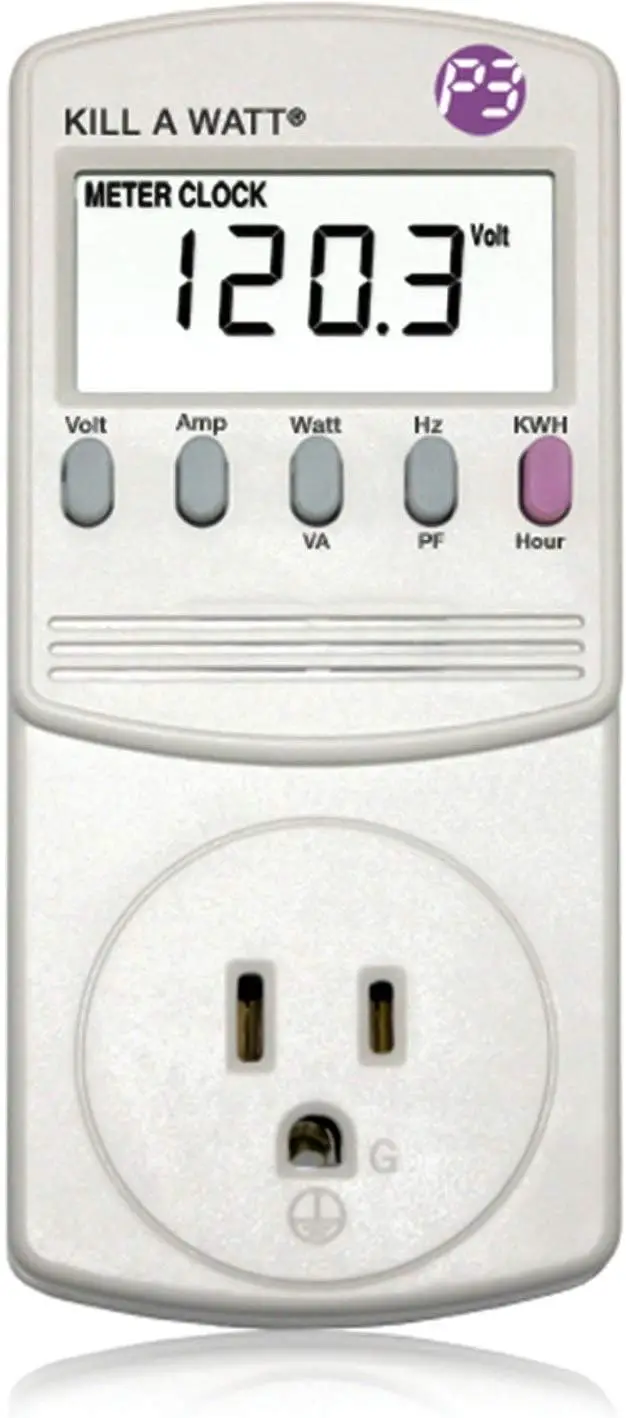
A Kill A Watt plugged into any 120V appliance gives you the actual VA draw — often lower than the nameplate, which tightens your load calc and shows more headroom.
💡 Pro Tip — Kill A Watt for Accuracy
Nameplate VA is a maximum rating, not average draw. A $25 Kill A Watt plugged into any 120V appliance reads actual running VA. For 240V loads, a clamp meter on one conductor times 240 gives you VA. Using actual measured loads instead of nameplate defaults often drops the calculated service amps by 10–15A, which can mean the difference between needing a 200A or 225A upgrade.
HVAC Demand Factor Chart — NEC 220.82(C)
Heating and cooling loads are handled separately from general loads and each has its own demand factor. You add only the largest result to your general demand.
📋 NEC 220.82(C) — Heating and Cooling Demand Factors
| System Type | How to Calculate VA | Demand % | NEC Section | Notes |
|---|---|---|---|---|
| Central Air Conditioning | Compressor nameplate + all A/C motor loads | 100% | 220.82(C)(1) | Include all connected A/C motor loads |
| Heat Pump — no supplemental heat | Heat pump nameplate VA | 100% | 220.82(C)(2) | Same treatment as standard A/C |
| Heat Pump + supplemental electric heat (simultaneous) | HP nameplate at 100% + supplemental at 65% | 100% HP / 65% heat | 220.82(C)(3) | Use when both can run at same time |
| Heat Pump + supp heat (NOT simultaneous, interlocked) | HP nameplate only at 100% | 100% HP only | 220.82(C)(3) exception | Requires documented interlocked controls |
| Electric space heating — 1 to 3 separately controlled units | Total nameplate VA × 65% | 65% | 220.82(C)(4) | Unit count = number of thermostats |
| Electric space heating — 4 or more separately controlled units | Total nameplate VA × 40% | 40% | 220.82(C)(5) | More units = more diversity assumed |
| Electric thermal storage / continuous heat | 100% of nameplate | 100% | 220.82(C)(6) | Designed to run continuously — no reduction |
ℹ Heat Pump + Backup Heat Strips — The Most Common Confusion
Most residential heat pumps have electric backup/auxiliary heat strips. Whether you use 220.82(C)(2) or (C)(3) depends on whether the compressor and heat strips can run simultaneously. In most systems they can, especially on cold days — use Section (C)(3): 100% of the compressor VA plus 65% of the strip heat VA. If the system is interlocked so they cannot run at the same time, you can use compressor-only at 100%. Verify this with the equipment documentation — do not assume.
Panel Size Guide — 100A to 400A
Once you have your calculated service amps, round up to the next standard panel size. Always aim for headroom above the calculated minimum. The cost difference between adjacent panel sizes is small; the cost of a service upgrade after the meter is set is not.
📋 Residential Service Panel Size Guide
| Panel Size | Typical Load Range | Best Application | Future Headroom |
|---|---|---|---|
| 100A | Under 95A | Code minimum; smaller gas-heated homes; detached structures | Very limited — no room for EV, heat pump, or electrification |
| 125A | 96A – 118A | Small all-gas homes; rural buildings with minimal electric load | Tight — one Level 2 EV charger likely maxes it |
| 150A | 119A – 142A | Medium homes with gas heat and electric appliances | Moderate — limited room for EV or future electrification |
| 200A | 143A – 190A | Modern standard — full electric appliances, heat pump, one EV | Good for most homes — handles most near-term additions |
| 225A | 191A – 213A | Larger all-electric; multiple large loads; second EV circuit | Solid — handles most electrification scenarios |
| 400A | Over 213A | Large homes, multiple EVs, pools, full electrification; parallel conductors required | Maximum standard residential service |
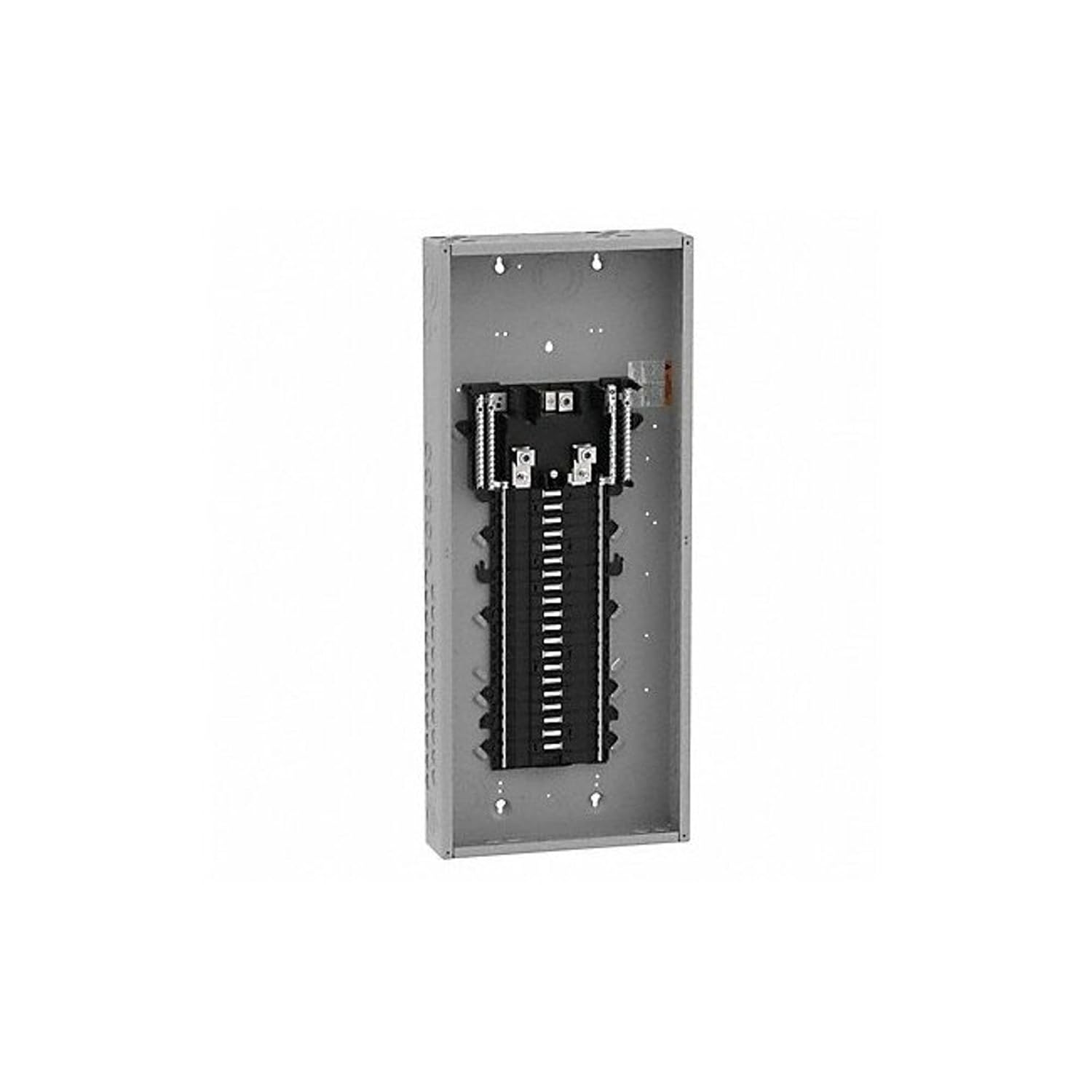
The Square D QO140L200PG 200A load center — the current standard for new construction single-family homes.
💡 Size Up When You Are Between Options
If your calculated load is 185A, install 200A. If it is 205A, install 225A. The cost difference between adjacent panel sizes at time of installation is minor — usually a few hundred dollars in material. The cost of a service upgrade later, after the utility has set the meter and you need to reschedule the dig, the inspector, and the power company, is several thousand dollars and weeks of scheduling. Size for where you are going, not where you are today.
Service Conductor Chart — NEC Table 310.12
NEC 310.12 gives you the conductor size for service entrance wires using the 83% rule: service conductors for single-phase dwelling services rated 100A–400A may have an ampacity of not less than 83% of the service rating. For a 200A service: 200 × 0.83 = 166A minimum required ampacity.
📋 NEC Table 310.12 — Service Entrance Conductor Sizes (83% Rule)
| Service Rating | Min Ampacity (83%) | Copper — 75°C | Aluminum — 75°C | Notes |
|---|---|---|---|---|
| 100A | 83A | 4 AWG | 2 AWG | Code minimum — most residential permits |
| 125A | 104A | 2 AWG | 1/0 AWG | Light residential |
| 150A | 125A | 1 AWG | 2/0 AWG | Medium homes with gas heat |
| 175A | 145A | 1/0 AWG | 3/0 AWG | Larger partial-electric homes |
| 200A | 166A | 2/0 AWG | 4/0 AWG | Most common residential choice |
| 225A | 187A | 3/0 AWG | 250 kcmil | Larger all-electric homes |
| 250A | 208A | 4/0 AWG | 300 kcmil | Multiple EVs, large electric |
| 300A | 249A | 250 kcmil | 350 kcmil | Large luxury, multi-HVAC |
| 350A | 291A | 350 kcmil | 500 kcmil | Very large full-electrification |
| 400A | 332A | 2 parallel sets | 2 parallel sets | Maximum standard residential |
Aluminum is the standard choice for service entrance conductors at residential ampacities. It is lighter, significantly cheaper, and fully code-compliant when installed with listed aluminum terminations and anti-oxidant compound at all connections. The 83% rule makes the math work: aluminum 4/0 AWG rated 180A at 75°C comfortably exceeds the 166A minimum for a 200A service.
Worked Example
Full Worked Example — 2,200 Sq Ft Home
A 2,200 square foot single-family home with electric range, dryer, water heater, dishwasher, garbage disposal, and a heat pump with electric backup heat strips (simultaneous operation, not interlocked).
📋 Worked Example — NEC 220.82 Complete Calculation
| Load Description | NEC Reference | VA |
|---|---|---|
| General lighting — 2,200 sq ft × 3 VA | 220.82(B)(1) | 6,600 |
| Small appliance circuits — 2 × 1,500 VA | 220.52(A) | 3,000 |
| Laundry circuit — 1 × 1,500 VA | 220.52(B) | 1,500 |
| Electric range (nameplate) | 220.82(B)(3) | 12,000 |
| Electric dryer (nameplate) | 220.82(B)(3) | 5,000 |
| Electric water heater (nameplate) | 220.82(B)(3) | 4,500 |
| Dishwasher (nameplate) | 220.82(B)(3) | 1,200 |
| Garbage disposal (nameplate) | 220.82(B)(3) | 900 |
| Total Connected General Loads | 34,700 VA | |
| First 10,000 VA × 100% | 220.82(B) | 10,000 |
| Remaining 24,700 VA × 40% | 220.82(B) | 9,880 |
| General Demand Load | 19,880 VA | |
| STEP 3 — Heating / Cooling (220.82(C)) — Use Largest | ||
| Heat pump compressor: 28A × 240V = 6,720 VA × 100% | 220.82(C)(3) | 6,720 |
| Backup heat strips: 10,000 VA × 65% | 220.82(C)(3) | 6,500 |
| HVAC Demand (Heat Pump + Strips = 13,220 VA vs. A/C at 6,720 VA — Heat Pump wins) | 13,220 VA | |
| Total Demand Load (19,880 + 13,220) | 33,100 VA | |
| Service Amps — 33,100 ÷ 240V | 137.9A | |
| Install: 200A service (150A is minimum, 200A recommended) | 2/0 Cu or 4/0 Al | |
The calculated load of 137.9A fits a 150A service mathematically — but this home should have 200A installed. Add a Level 2 EV charger (40A circuit = 9,600 VA) and the calculation jumps to approximately 167A, past the 150A rating. Install 200A now and the home handles the EV charger without a service upgrade later.
Run Your Own Numbers
Enter your actual square footage and appliance loads and the calculator shows the full step-by-step breakdown, panel size recommendation, and conductor size per NEC Table 310.12.
⚡ Open Load Calculation Calculator →
Service Upgrade Checklist
Service Upgrade Checklist
Run through this before you pull the permit. Every item should be confirmed before the work starts.
- Load calculation completed per NEC 220.82 Optional Method
- All electric appliances included at nameplate VA (gas appliances excluded)
- Minimum two small appliance circuits (3,000 VA total) per 220.52(A)
- Laundry circuit (1,500 VA) included per 220.52(B), or multifamily exemption confirmed
- HVAC system type identified — correct 220.82(C) demand factor applied
- Heating and cooling calculated separately — only the largest added
- Panel size selected at or above calculated amps, 100A minimum per 230.79(C)
- Service entrance conductors sized per NEC Table 310.12 (83% rule)
- Utility company contacted — service entrance and meter socket requirements confirmed
- Permit pulled with load calculation documentation attached
- Grounding electrode conductor sized per NEC Table 250.66
- Meter socket and weatherhead rated for new service ampacity
- Panel clearances meet NEC 110.26 — 36 inch working space confirmed
- Anti-oxidant compound on hand for aluminum conductor terminations
⚡ Tools for Residential Service Work
What you actually need on a service upgrade — from load verification to safe installation
Top Pick
Square D QO140L200PG 200A Load Center
- 200A main breaker — modern standard
- 40 spaces / 40 circuits — room to grow
- Plug-on neutral compatible
- Square D QO — electricians’ first choice
View on Amazon →
Measure Loads
P3 P4400 Kill A Watt Monitor
- Real VA readings on any 120V appliance
- More accurate than nameplate for load calcs
- Cumulative kWh — find energy hogs fast
- Best $25 spent before pulling a permit
View on Amazon →
Safety First

Klein Tools NCVT-6 Voltage Tester
- Non-contact detection 12–1000V AC
- Built-in laser distance for clearance check
- CAT IV — right rating for service work
- Required before touching service entrance
View on Amazon →
Verify Amps
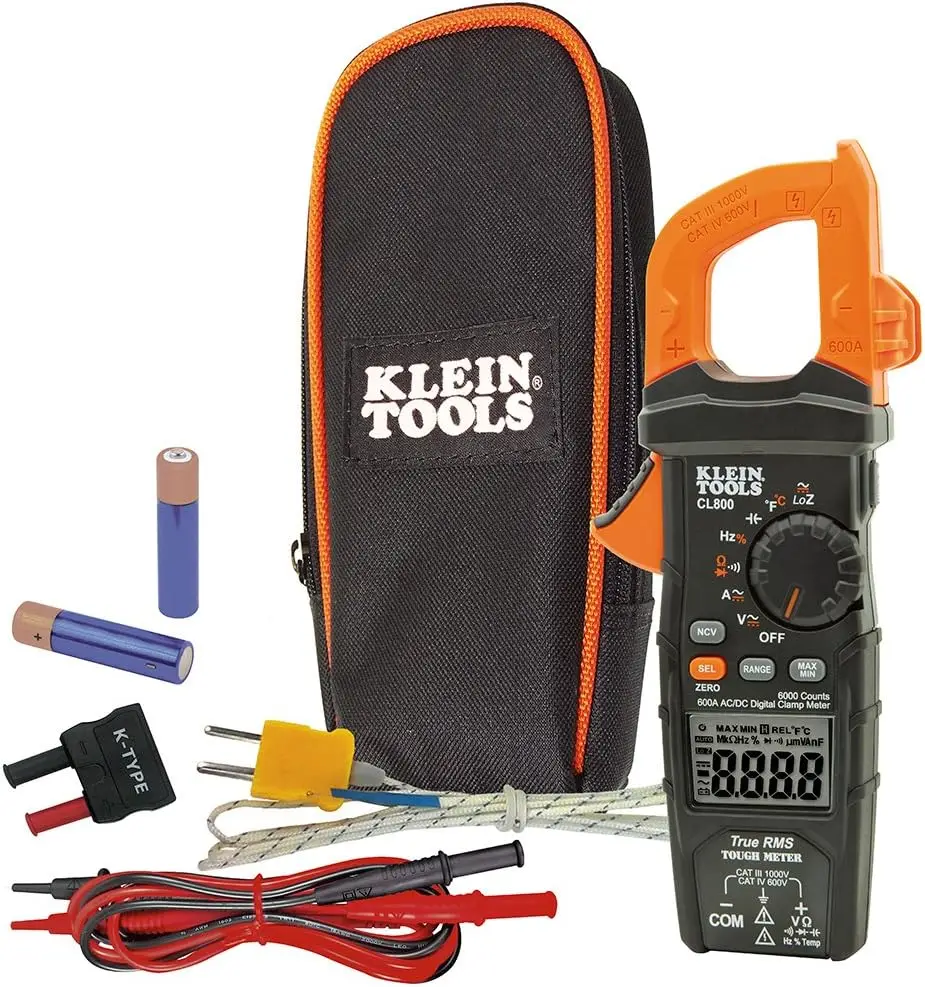
Klein Tools CL800 Clamp Meter 1000V
- Clamp around any conductor — read amps
- True RMS — accurate on HVAC motor loads
- CAT IV 600V — safe for service entrance
- Verify calculated loads vs. actual draw
View on Amazon →
Circuit ID
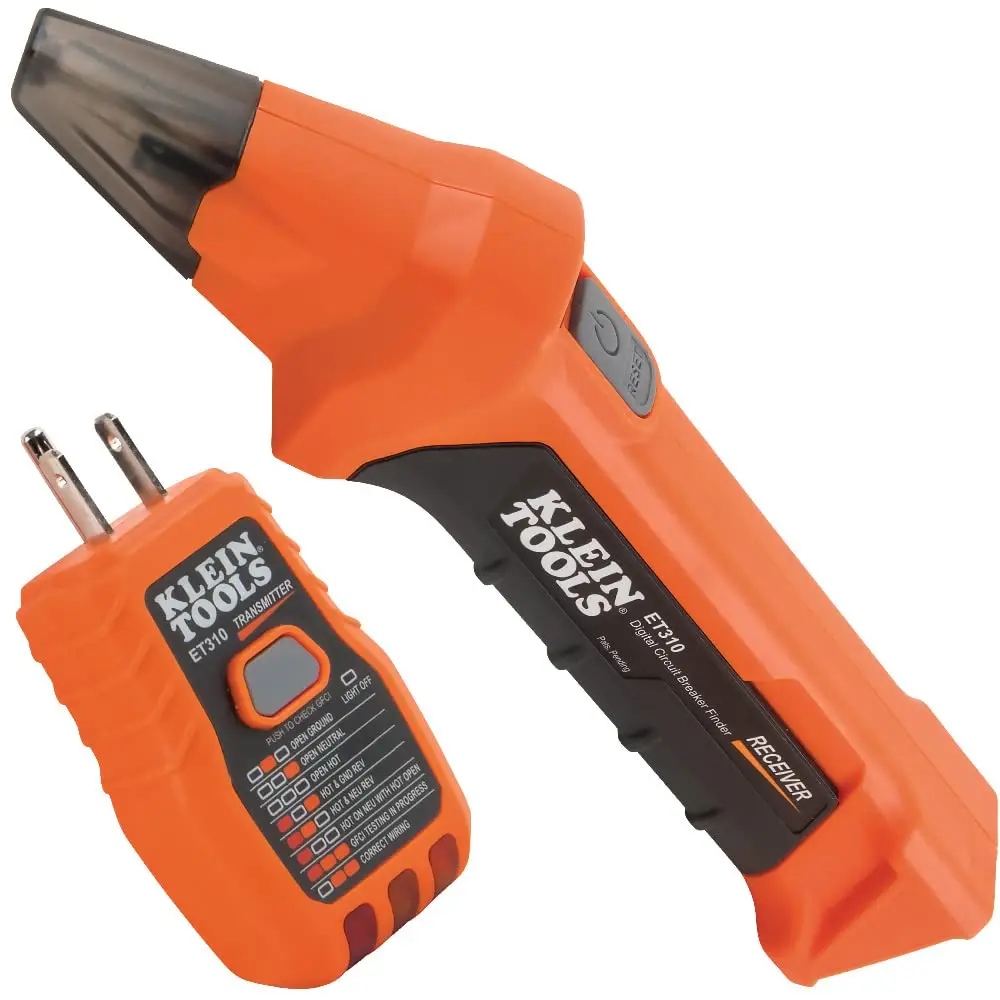
Klein Tools ET310 Breaker Finder + GFCI
- Find which breaker feeds any outlet
- Built-in GFCI tester — two tools in one
- Essential for documenting existing circuits
- Works through walls with transmitter
As an Amazon Associate, TestTalkHQ earns from qualifying purchases. Prices and availability subject to change.
5 Mistakes That Fail Inspections
1. Missing the Small Appliance Circuits
NEC 220.52(A) requires a minimum of two 1,500 VA small appliance branch circuits — 3,000 VA total — regardless of what appliances are actually installed. These are not optional. Omitting them is the single most common reason load calculations get kicked back at plan review.
2. Adding Both Heating and Cooling
NEC 220.82(C) is explicit: add only the largest heating or cooling load. Including both inflates the calculation and is wrong. Calculate each separately, compare, and add only the bigger number. The same principle applies across Article 220 per NEC 220.60 (noncoincident loads).
3. Wrong Demand Factor on Electric Heat
The demand factor for electric space heating depends on the number of separately controlled units — meaning the number of thermostats. One to three thermostats = 65% per 220.82(C)(4). Four or more = 40% per 220.82(C)(5). Using 40% when you only have two thermostats is wrong, and inspectors check this specifically.
4. Including Gas Appliances
A residential load calculation covers electric loads only. Gas ranges, gas dryers, gas water heaters, and gas furnaces do not appear in the calculation. Including them inflates the load and the resulting service size. The only gas-related items that might show up are electronic ignition circuits, which are negligible and covered by the general lighting allowance.
5. Mixing Standard and Optional Methods
Pick one method and use it from start to finish. You cannot apply the 220.82 demand factor (100%/40%) to general loads and then use Standard Method demand factors from Table 220.42 or NEC 220.53 for appliances in the same calculation. The Optional Method is all-or-nothing. Inspectors and plan reviewers who know what they are looking at will catch this immediately.
⚠ The Undersizing Problem
An undersized service trips its main breaker under peak loads, has no room for future additions, and creates a hazardous situation when owners add loads without permits. The load calculation exists to prevent this. Do it right, build in headroom, and install the correct size the first time.
Diagnose Load Calc Failures
When the 220.82 walkthrough is clear but the utility, inspector, or installed panel still disagrees, use
Residential Load Calculation Troubleshooting
— not another restatement of the five calculation steps.
Related Electrical Calculators
Once your service is sized, these calculators handle the downstream work — individual circuits, conductors, and conduit runs off the new panel.
⚡ Circuit Breaker Sizing
🔌 Wire Ampacity Derating
📈 Voltage Drop
📐 Conduit Fill
📦 Box Fill
⚙️ Motor FLA
🔢 Ohm’s Law
Supporting guides from the electrical section:
- Residential Load Calculation Troubleshooting — inspector/utility mismatch, undersized panels, HVAC and method errors
- Wire Ampacity and Derating Explained — sizing individual branch circuit conductors correctly
- How to Calculate Voltage Drop — essential for long runs to outbuildings and subpanels
- Conduit Fill Explained the Right Way — how many conductors fit in your service conduit
- How to Size a Circuit Breaker — individual branch circuit protection sizing
- How to Size Every Motor Circuit with NEC 430 — motor loads inside the panel
- Ohm’s Law and Power Formulas Explained — the math behind all electrical calculations
FAQ
Frequently Asked Questions
What is the NEC 220.82 optional method and when do I use it?
NEC 220.82 is the Optional Method for calculating residential service loads in single-family dwellings. It applies 100% to the first 10,000 VA of combined general and appliance loads, and 40% to everything above that, then adds the largest heating or cooling load. You can use it for any single-family dwelling served by a single 120/240V or 120/208V 3-wire service rated 100A or larger. You cannot use it for three-phase services, services under 100A, or for sizing an entire multifamily building service.
How do I calculate the square footage for the load calculation?
Use the outside dimensions of the habitable living area. Multiply length times width for each finished floor, then add floors together. Exclude attached garages, open porches, and unfinished basements or attics not adaptable for future use. A 2,000 sq ft finished home with a 500 sq ft attached garage uses only 2,000 sq ft in the calculation. Unfinished attic space that could be finished later is a judgment call — most electricians include it to build in headroom.
Is 200 amp service enough for a modern home?
For most modern single-family homes, yes. A 200A service provides 48,000 VA of capacity. After the NEC 220.82 demand factor, most homes with full electric appliances, a heat pump, and one Level 2 EV charger calculate in the 150–185A range, fitting under 200A with headroom. Homes with tankless water heaters, multiple EV chargers, or pools often need 225A or 400A. Run the calculation with your specific loads to know for certain — do not guess.
Do I add both heating and cooling loads?
No. NEC 220.82(C) requires adding only the largest. A home does not heat and cool simultaneously, so the NEC treats these as noncoincident loads under NEC 220.60. Calculate your A/C load at 100%, calculate your heating load at the applicable demand factor, compare, and add only the larger number to your general demand total.
What wire size do I need for 200 amp service?
Per NEC Table 310.12 (the 83% rule), a 200A single-phase residential service requires 2/0 AWG copper or 4/0 AWG aluminum service entrance conductors, assuming no ambient temperature correction factors apply. Both exceed the 166A minimum required by the 83% rule (200A times 0.83). Aluminum is the standard and economical choice for service entrance conductors when installed correctly with listed terminations and anti-oxidant compound.
What is the minimum service size for a single-family dwelling?
NEC 230.79(C) requires a minimum 100 ampere service disconnecting means for single-family dwellings regardless of calculated load. Even a small all-gas home with minimal electric load still needs a 100A service minimum. The NEC 220.82 Optional Method itself also only applies to services rated 100A or larger, so both requirements converge on 100A as the absolute floor.
Does an EV charger count in the residential load calculation?
Yes. A Level 2 EV charger is a fixed, permanently connected load included in the Step 1 general loads at its nameplate VA rating. A standard 40A, 240V Level 2 circuit = 9,600 VA. This goes through the same 40% demand factor as your other appliances. Under the 2026 NEC, EVSE must be calculated at 100% with no demand factor — some jurisdictions may already be enforcing the stricter treatment, so check with your AHJ.
Data per NEC 2023 Articles 220.82, 230.79(C), 310.12, and 220.60. Always verify with the current NEC edition adopted in your jurisdiction. AHJ requirements may differ from NEC defaults.
More free electrical tools: Load Calculation Calculator · Circuit Breaker Sizing · Wire Ampacity · Conduit Fill · Voltage Drop
Electrical
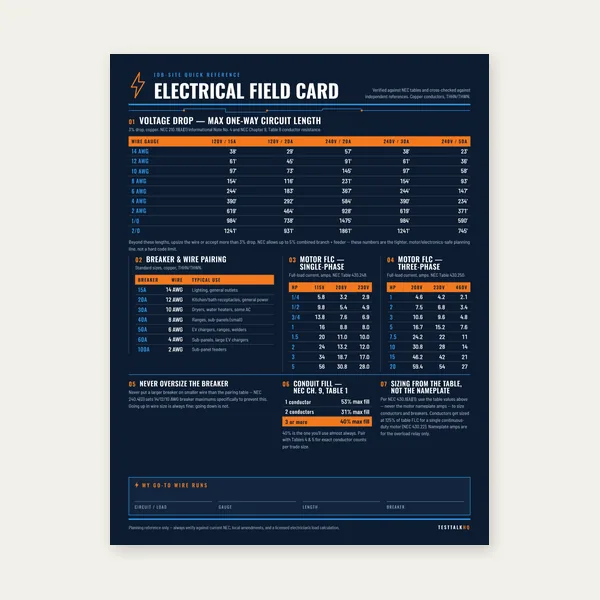
Electrical Reference Card
One page. Voltage drop lengths, breaker and wire pairing, motor FLC.
$3.99
Buy
Complete Electrical Reference Guide
15 pages. Ampacity, corrections, voltage drop, motor circuits, conduit fill.
$12.99
Buy
Electrical Job Estimator
Quote electrical work and flag panel headroom before you price it.
Excel or Google Sheets. Best on a computer.
$29.00
Buy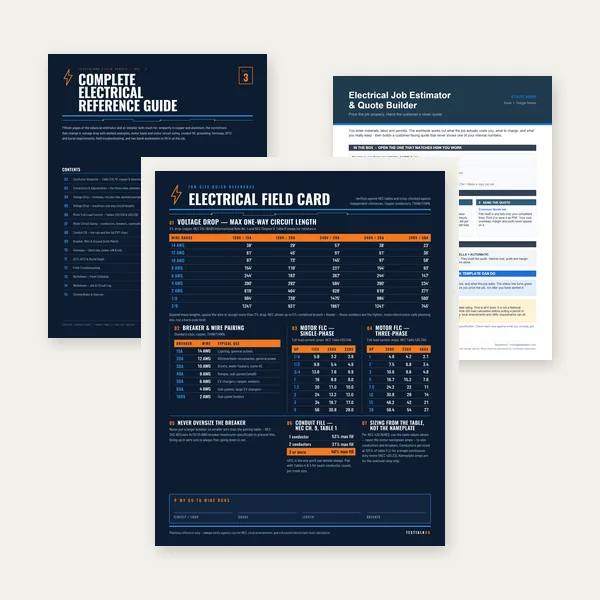
Electrical Complete Bundle
Card, 15-page guide and the estimator workbook. All six files.
Excel or Google Sheets. Best on a computer.
$34.99
$45.98 if bought separately — save $10.99
BuyCheckout opens in a new tab.