TestTalkHQ.com — Electrical
Circuit Breaker Chart — 125% Continuous & NEC 240.6
Circuit Breaker Sizing Calculator
Enter load amps and continuous vs motor — get the next NEC 240.6 breaker size. This page is the 125% / wire-ampacity chart; the calculator does mixed-load math.
📅 March 2026
⏱ 9 min read
🔌 Electrical / Breakers
You’re adding a 20A circuit and reach for a 20A breaker without thinking about it — because that’s what you always do. But if that circuit runs a space heater that operates for 4 hours at a stretch, you just installed a code violation. A 20A continuous load needs a 25A breaker minimum per NEC 210.20. Breaker sizing isn’t just matching amperage — it’s knowing when the multiplier applies and when it doesn’t.
The One Rule That Changes Everything — NEC 210.20(A)
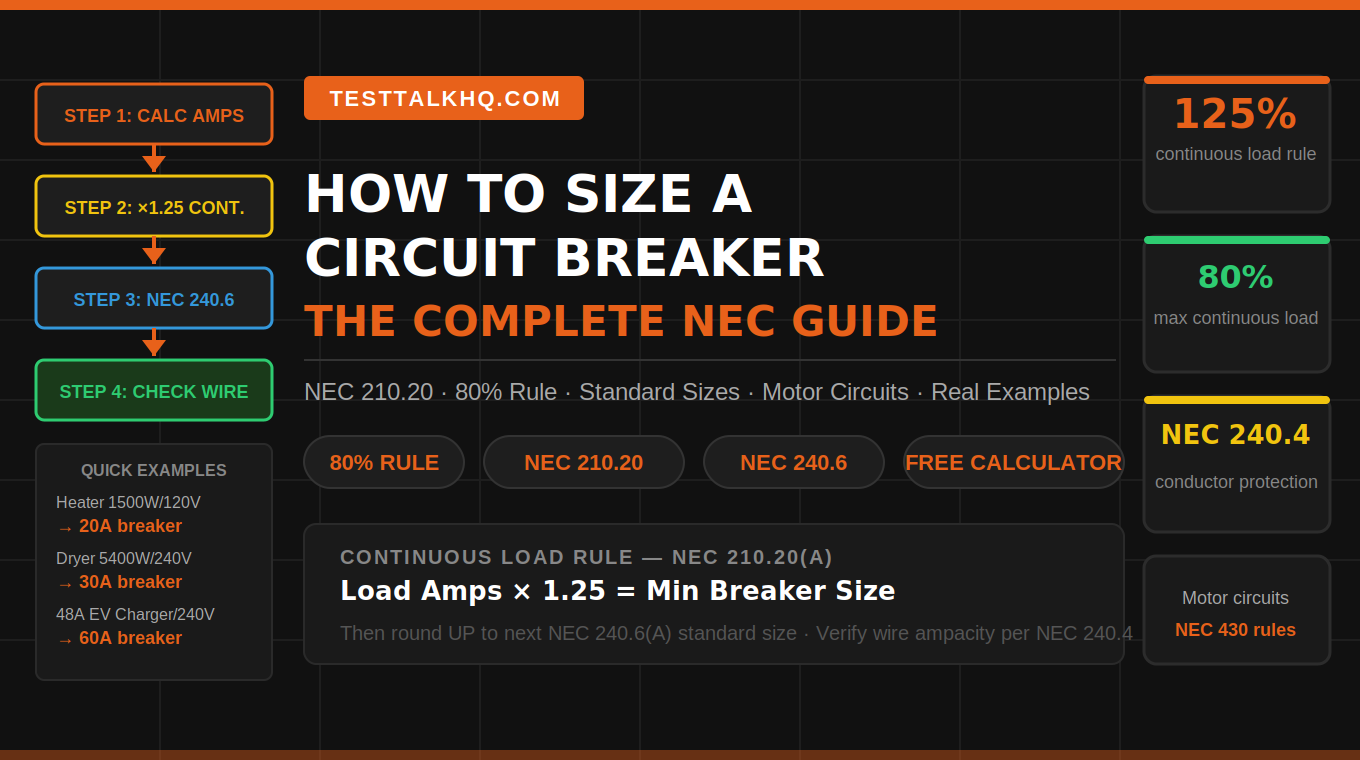
Most electricians know the 80% rule. Fewer can quote the actual code section. NEC 210.20(A) states that branch circuit overcurrent devices must be rated at no less than 125% of the continuous load, plus 100% of any non-continuous load on the same circuit.
A load qualifies as continuous if it’s expected to operate for three or more hours at a stretch. The 125% requirement exists because breakers are thermally rated — they’re designed to interrupt overcurrent events, not to run indefinitely at their full-rated current without generating heat that degrades the internal mechanism. The 125% multiplier keeps the breaker operating in its safe thermal window under continuous load conditions.
The math works both directions and they mean exactly the same thing:
- 125% sizing rule: Continuous load amps × 1.25 = minimum breaker size
- 80% loading rule: Breaker rating × 0.80 = maximum continuous load amps
⚡ Continuous vs. Non-Continuous Load — How the Multiplier Changes Your Breaker
The Four-Step Breaker Sizing Process
Proper circuit breaker sizing follows a logical sequence. Skip a step and you risk either a nuisance-tripping undersized breaker or a fire-hazard oversized one. Here’s the process every time:
📐 Circuit Breaker Sizing — Step by Step
NEC 240.6(A) — Standard Breaker Sizes You Must Use
You cannot install a non-standard breaker. NEC 240.6(A) defines the permitted standard ampere ratings. If your calculation yields 22A, the next standard size up is 25A — that’s your breaker, not a 22A. The only exception is for specific listed inverse time breakers that include additional ratings, but in standard residential and commercial work you’re picking from the table below.
📋 NEC 240.6(A) Standard Breaker Sizes + Minimum Wire Size (75°C Copper)
| Breaker Size | Min Wire (Cu, 75°C) | Max Continuous Load | Common Applications |
|---|---|---|---|
| 15A | 14 AWG | 12A | Lighting, general receptacles |
| 20A | 12 AWG | 16A | Kitchen, bath, garage, GFCI circuits |
| 25A | 10 AWG | 20A | Extended runs, some appliances |
| 30A | 10 AWG | 24A | Dryers, water heaters, EV Level 2 |
| 35A | 8 AWG | 28A | Large appliances, some HVAC |
| 40A | 8 AWG | 32A | Ranges, large HVAC, shop equipment |
| 50A | 6 AWG | 40A | Large ranges, hot tubs, EV fast charge |
| 60A | 6 AWG | 48A | Subpanels, large equipment feeders |
| 70A | 4 AWG | 56A | Larger subpanels, large feeders |
| 100A | 3 AWG | 80A | Small subpanels, large equipment |
| 125A | 1 AWG | 100A | Subpanels |
| 150A | 1/0 AWG | 120A | Subpanels, service entrance |
| 200A | 3/0 AWG | 160A | Main service, large subpanels |
ℹ The Conductor Protection Rule — NEC 240.4
NEC 240.4 requires conductors to be protected by an overcurrent device at or below the conductor’s ampacity. This means a 20A breaker requires minimum 12 AWG copper (rated 25A at 75°C — 20A is within its rating). A 25A breaker also requires 12 AWG minimum because 12 AWG at 75°C is rated 25A. A 30A breaker requires 10 AWG (rated 35A). The breaker can be smaller than the wire’s full ampacity — but it cannot be larger.
Run the Numbers Instantly
Our free circuit breaker sizing calculator handles continuous, non-continuous, motor, and mixed loads. Enter watts or amps and get your standard breaker size and wire size with NEC code references.
⚡ Open Breaker Sizing Calculator →
Real-World Breaker Sizing Examples
Space Heater — 1,500W at 120V (Continuous)
I = 1500 ÷ 120 = 12.5A. Continuous load (runs 4+ hours) → 12.5A × 1.25 = 15.6A minimum. Next standard size up = 20A breaker, 12 AWG wire. A 15A breaker at 12.5A continuous load would be running at 83% of rating — over the 80% limit. This is the single most common breaker sizing violation in residential electrical work.
Electric Clothes Dryer — 5,400W at 240V (Non-Continuous)
I = 5400 ÷ 240 = 22.5A. Non-continuous (cycle time 30–60 min) → 22.5A × 1.00 = 22.5A. Next standard size up = 30A breaker, 10 AWG wire (3-wire: two hots + ground, neutral for controls). Most dryer manufacturers specify a 30A circuit on the installation label — which aligns with this calculation.
Electric Vehicle Charger — Level 2 EVSE at 240V (Continuous)
A 48A Level 2 EVSE runs continuously for hours. 48A × 1.25 = 60A minimum breaker. Next standard size = 60A breaker, 6 AWG wire. The EVSE nameplate will specify its minimum circuit ampacity (MCA) — always use that value if it differs from the calculation. NEC 625.41 governs EVSE overcurrent protection.
Commercial Lighting — 2,400W at 120V (Continuous)
I = 2400 ÷ 120 = 20A. Continuous (lighting runs during business hours = 3+ hours) → 20A × 1.25 = 25A minimum. Next standard size = 25A breaker, 10 AWG wire. This is where the code bites commercial work — a 20A circuit maxes out at 16A of continuous lighting load, not 20A. Running 2,400W of continuous lighting on a 20A breaker is a violation regardless of whether it trips.
🔧 Common Scenarios — Load to Breaker Quick Reference
Motor Circuit Breakers — Why the Rules Are Different
Motor circuits follow NEC Article 430 instead of the standard branch circuit rules — and the sizing looks completely different. A motor branch circuit breaker is allowed up to 250% of the motor’s Full-Load Amps (FLA) per NEC 430.52 for inverse time breakers. That’s not a typo.
The reason: motors draw locked rotor current (LRC) on startup — typically 600–800% of running FLA. That 15A running motor draws 90–120A for a fraction of a second every time it starts. A breaker sized at the standard 125% rule would trip on every start. The 250% ceiling lets the breaker survive the inrush while still providing fault protection. The motor’s overload relay (a separate device sized at 115–125% of FLA) handles the running thermal protection the oversized breaker cannot.
⚠ HVAC Equipment — Always Use the Nameplate
Air conditioners, heat pumps, and refrigeration equipment fall under NEC Article 440, not 430. Article 440 uses MCA (Minimum Circuit Ampacity) and MOP (Maximum Overcurrent Protection) values printed on the equipment nameplate — calculated by the manufacturer. Do not manually calculate breaker size for HVAC hermetic compressors. Use the nameplate. The MOP is the maximum breaker size you can install; using a larger breaker is a code violation.
Tools for Circuit Breaker and Circuit Work
🔧 Measure First, Size Right, Work Safely
Know what your circuit is actually carrying before you pick a breaker
Top Pick
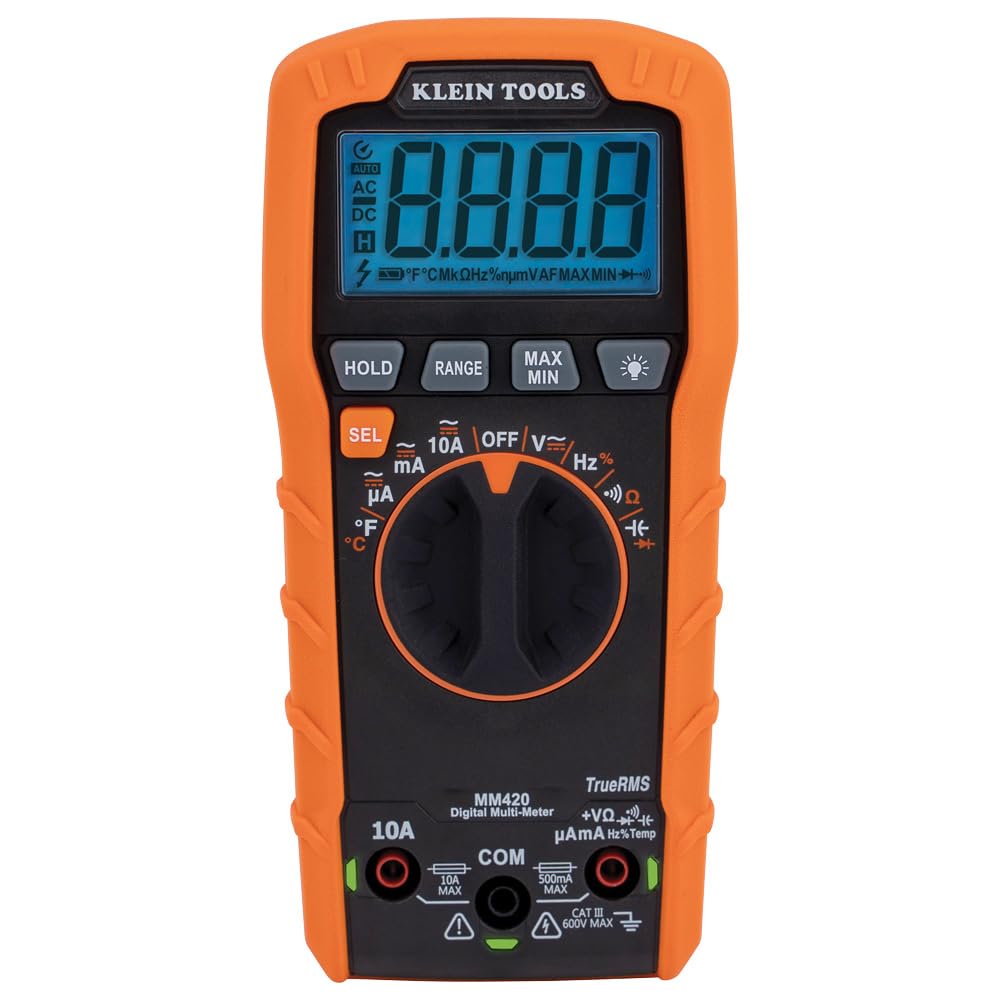
Klein Tools MM420 Digital Multimeter
- Measure actual load amps before sizing breaker
- True RMS — accurate on motor and switching loads
- AC/DC voltage, current, resistance, continuity
- Upgraded from MM400 — more input protection
View on Amazon →
Pull Wire
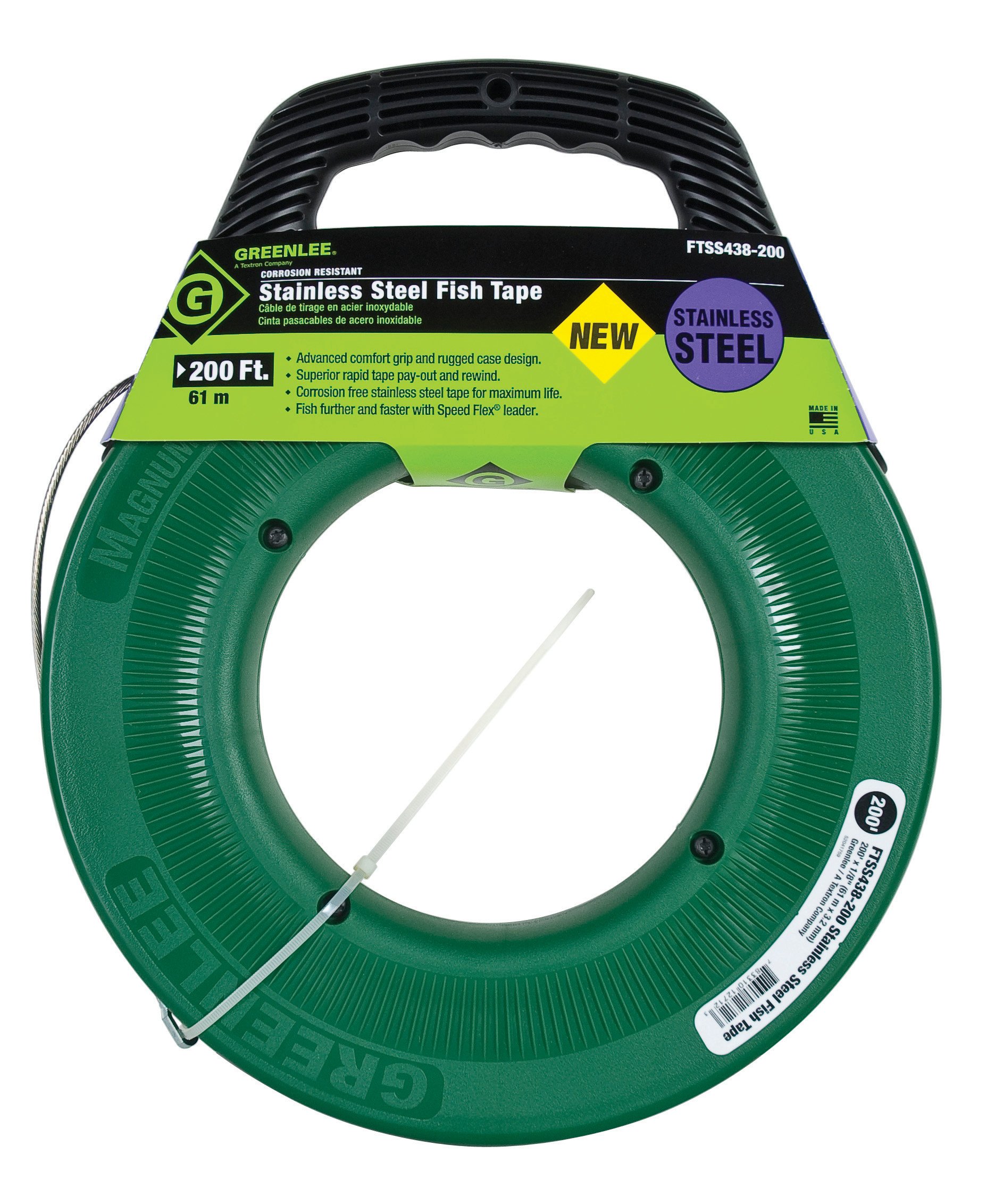
Greenlee FTSS438-200 Stainless Steel Fish Tape 200ft
- Pull wire to new circuits and panels
- Stainless steel — corrosion resistant
- 200ft — handles long commercial runs
- Greenlee quality built for daily use
View on Amazon →
Consumable
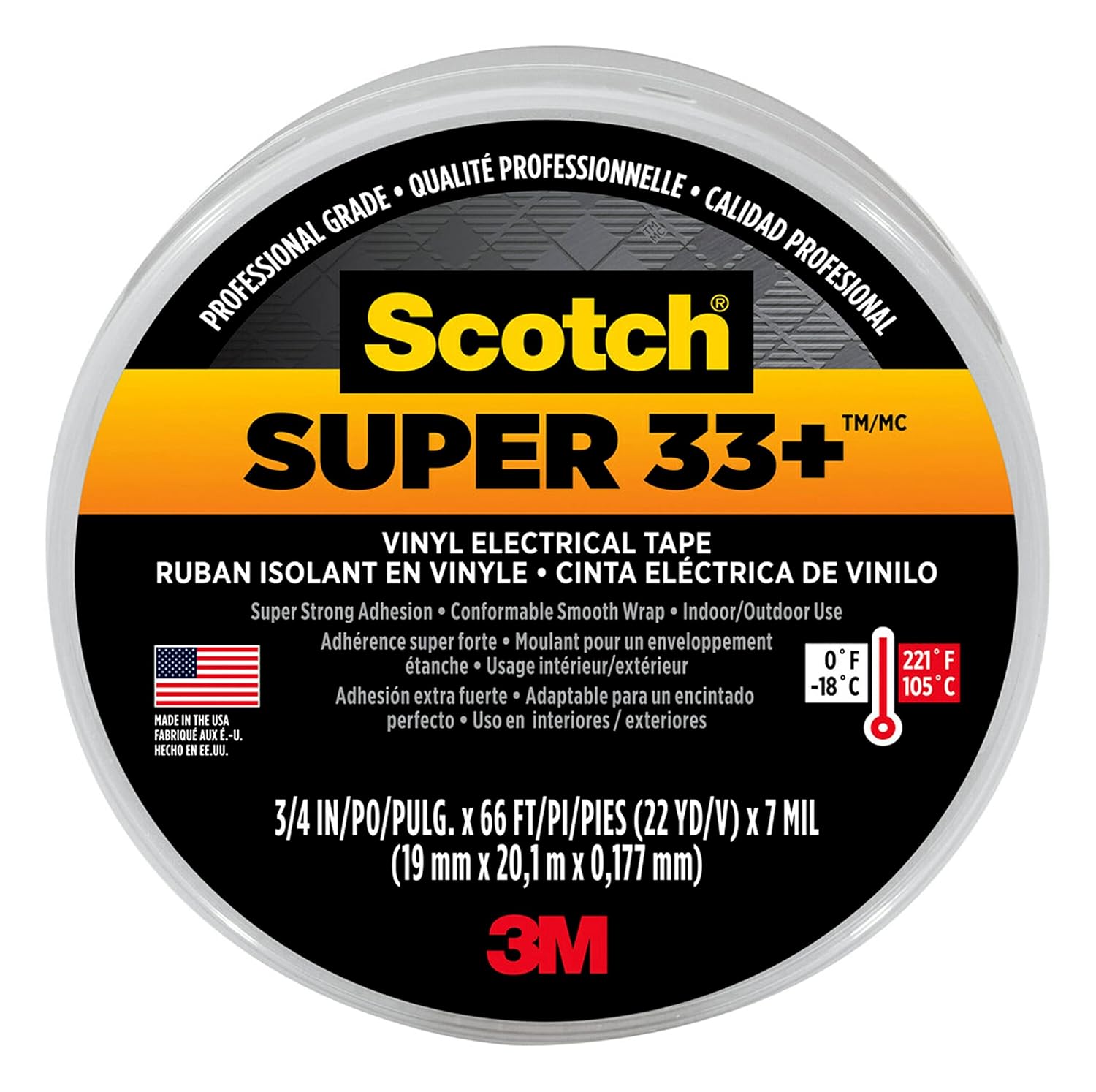
3M Scotch Super 33+ Electrical Tape — 10-Pack
- Phase identification and wire insulation
- Super 33+ — premium grade, not the cheap stuff
- Rated to 600V, –18°C to 105°C
- 10-pack — shop supply, always running out
As an Amazon Associate, TestTalkHQ earns from qualifying purchases.
FAQ
What is the 80% rule for circuit breakers?
The 80% rule states that a continuous load should not exceed 80% of the breaker’s rated amperage. It is the practical application of NEC 210.20(A), which requires breakers to be rated at 125% of the continuous load (125% and 80% are mathematically equivalent). A 20A breaker has a maximum continuous load of 20 × 0.80 = 16A. Running a 20A continuous load on a 20A breaker — such as 20A of lighting that runs all day — is a code violation even if the breaker never trips.
Can I use a larger breaker than the wire size calls for?
Generally no — NEC 240.4 requires conductors to be protected by an overcurrent device rated at or below the conductor’s ampacity. A 12 AWG copper wire is rated 25A at 75°C and can be protected by a 25A or smaller breaker, but not a 30A. Exceptions exist for motor circuits (NEC 240.4(G) defers to NEC 430.52), for tap conductors (NEC 240.21), and for certain listed assemblies. In standard branch circuit wiring, match or go smaller — never larger.
What size breaker for a 240V air conditioner?
For HVAC equipment including air conditioners and heat pumps, always use the nameplate MCA (Minimum Circuit Ampacity) and MOP (Maximum Overcurrent Protection) values. These are calculated by the manufacturer per NEC Article 440 and take precedence over any manual calculation. The MCA tells you the minimum wire ampacity; the MOP tells you the maximum breaker size. Using a breaker larger than the nameplate MOP is a code violation.
Does a 20A breaker require 12 AWG wire?
Yes — 12 AWG copper is the minimum conductor for a 20A breaker in standard branch circuit wiring per NEC 240.4(D). 14 AWG copper is rated 15A and cannot be protected by a 20A breaker. You can run 10 AWG or larger wire on a 20A breaker — the conductor can always be larger than the minimum — but never smaller. This is one of the most frequently cited residential electrical violations during inspections.
What is a tandem breaker and when can I use one?
A tandem breaker (also called a slimline or half-size breaker) puts two separate 15A or 20A circuits in a single breaker space. They’re used when a load center is full but additional circuits are needed. Tandem breakers are only permitted in panels that are listed and labeled for them — check the panel’s directory or label for the maximum number of tandem breakers and which slots accept them. Installing a tandem breaker in an unlisted slot is a code violation regardless of whether the panel door closes.
What size breaker for a 30-amp circuit?
A 30A circuit uses a 30A breaker with 10 AWG copper wire at 75°C per NEC 240.4(D). Common 30A applications include electric dryers (which are non-continuous so no 125% multiplier), well pumps, HVAC equipment per nameplate, and some EV chargers. Note that if the 30A load is continuous (runs 3+ hours), you need to apply the 125% multiplier: 30A × 1.25 = 37.5A minimum breaker, which rounds up to a 40A breaker with 8 AWG wire — not a 30A breaker.
Size Your Breaker Right Every Time
Our free circuit breaker sizing calculator handles continuous, non-continuous, motor, and mixed loads. Covers single-phase and three-phase, all standard voltages, and gives you the NEC code reference with every result.
⚡ Open Breaker Sizing Calculator →
Based on NEC 210.19, 210.20, 240.4, 240.6, 430.52, and 440.22. Always verify with current NEC edition and local jurisdiction requirements. TestTalkHQ.com — free tools for tradespeople.
Circuit Breaker Sizing Chart →
Electrical
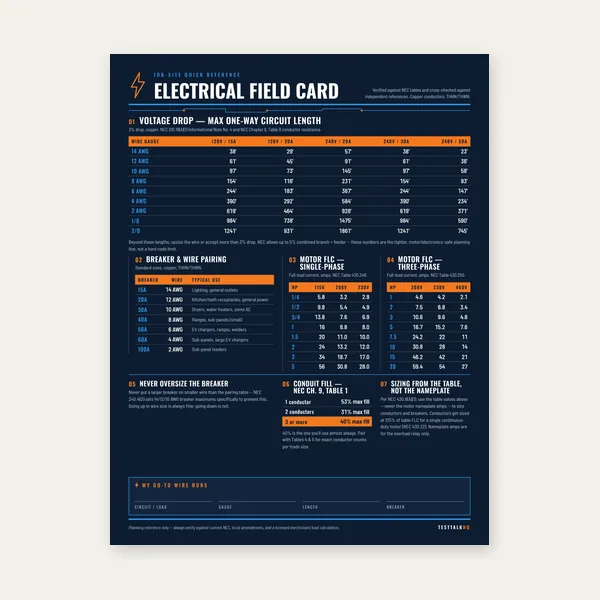
Electrical Reference Card
One page. Voltage drop lengths, breaker and wire pairing, motor FLC.
$3.99
Buy
Complete Electrical Reference Guide
15 pages. Ampacity, corrections, voltage drop, motor circuits, conduit fill.
$12.99
Buy
Electrical Job Estimator
Quote electrical work and flag panel headroom before you price it.
Excel or Google Sheets. Best on a computer.
$29.00
Buy
Electrical Complete Bundle
Card, 15-page guide and the estimator workbook. All six files.
Excel or Google Sheets. Best on a computer.
$34.99
$45.98 if bought separately — save $10.99
BuyCheckout opens in a new tab.