Standard overcurrent device ampere ratings and continuous-load (125%) breaker selection examples for general branch-circuit planning.
How to Use This Chart
For continuous loads (3 hours or more), size OCPD at not less than 125% of continuous load (NEC 210.20(A) / 215.3). Noncontinuous portion adds at 100%. Calculator: circuit breaker sizing calculator. Guide: how to size a circuit breaker.
Standard Ampere Ratings (NEC 240.6)
15 A, 20 A, 25 A, 30 A, 35 A, 40 A, 45 A, 50 A, 60 A, 70 A, 80 A, 90 A, 100 A, 110 A, 125 A, 150 A, 175 A, 200 A, 225 A, 250 A, 300 A, 350 A, 400 A, 450 A, 500 A, 600 A, 700 A, 800 A… (and larger through 6000 A).
Continuous Load → Minimum Breaker (125%)
| Continuous load (A) | × 1.25 (A) | Next standard breaker |
|---|---|---|
| 10 | 12.5 | 15 |
| 12 | 15.0 | 15 |
| 15 | 18.8 | 20 |
| 16 | 20.0 | 20 |
| 20 | 25.0 | 25 |
| 24 | 30.0 | 30 |
| 30 | 37.5 | 40 |
| 32 | 40.0 | 40 |
| 40 | 50.0 | 50 |
| 48 | 60.0 | 60 |
| 50 | 62.5 | 70 |
| 60 | 75.0 | 80 |
| 80 | 100.0 | 100 |
| 100 | 125.0 | 125 |
| 125 | 156.2 | 175 |
| 150 | 187.5 | 200 |
| 160 | 200.0 | 200 |
| 200 | 250.0 | 250 |
Common Pairings (planning)
| Circuit | Typical breaker | Notes |
|---|---|---|
| 15 A lighting / receptacle | 15 A | 14 AWG Cu (ampacity rules apply) |
| 20 A small appliance / bathroom | 20 A | 12 AWG Cu common |
| 30 A dryer / water heater (check nameplate) | 30 A | Confirm continuous / nameplate |
| 40–50 A range / EVSE Level 2 | 40–50 A | EVSE often continuous → 125% |
| 60 A subfeed / shop | 60 A | Feeder rules + VD |
What This Chart Is (and Isn’t)
This page is a static lookup for standard overcurrent device ampere ratings (NEC 240.6) and a quick continuous-load × 1.25 → next standard breaker table. It does not replace interactive mixed-load math, motor multipliers, or fault-current / AIC checks. Use it when you already know continuous amps and need the next standard OCPD size without opening the calculator.
Interactive continuous / non-continuous / motor sizing lives on the Circuit Breaker Sizing Calculator. Full NEC walkthrough lives in How to Size a Circuit Breaker. Protection type (standard vs GFCI vs AFCI vs dual-function) lives in Circuit Breaker Types Explained. Trips after a “correct” size lives in Why Does My Breaker Keep Tripping?.
Reading the 125% Continuous Column
NEC 210.20(A) and 215.3 require branch-circuit and feeder overcurrent devices to be sized at not less than 125% of continuous load (loads expected to run three hours or more), plus 100% of any noncontinuous portion on the same circuit. The middle column in the table is continuous amps × 1.25. The right column is the next standard ampere rating from NEC 240.6 that is at least that value.
Example: a 16 A continuous EVSE or heater load → 20 A calculated → 20 A standard breaker. A 50 A continuous load → 62.5 A calculated → 70 A standard breaker. Do not round down. Do not skip the conductor ampacity check — the breaker must still protect the wire per NEC 240.4.
Standard Ratings vs. Special Sizes
NEC 240.6 lists the permitted standard ampere ratings for fuses and inverse-time circuit breakers. The chart lists the common residential and light-commercial ladder through 800 A. Larger ratings exist through 6000 A for services and industrial gear. If a calculated value falls between two listed sizes, you go up to the next standard rating — unless an exception allows the next lower size (those exceptions are rare on ordinary branch circuits and must be verified in the adopted code).
Some equipment ships with a Maximum Overcurrent Protection (MOP) or Maximum Fuse Size on the nameplate. That label can force a smaller breaker than the continuous-load table alone would suggest. Always read the nameplate before overriding this chart with a larger device.
Wire Pairing Still Rules the Breaker
A 40 A breaker on 14 AWG copper is never acceptable on a general branch circuit. The chart picks OCPD ampacity from load; conductor ampacity must equal or exceed that OCPD rating (with the usual 240.4 exceptions for motors, taps, and certain appliances). After you pick a breaker from this table, confirm wire size with ampacity / derating tools — not by habit.
Long runs add voltage drop. Motors on a long feeder can draw excess current and trip a correctly sized breaker. Pair this chart with voltage-drop and motor-circuit tools when the load is inductive or the run is long.
When This Chart Does Not Apply
- Motor branch circuits — use NEC 430 multipliers and the motor circuit sizing tools, not the 125% continuous table alone.
- Welders / industrial equipment — nameplate and Article 630 / equipment standards control.
- Protection type — amp rating is independent of GFCI / AFCI / dual-function requirements.
- AIC / interrupting rating — available fault current must not exceed the breaker’s AIC. Size can be correct while the interrupting rating is wrong.
If the chart (or calculator) says the amp rating is fine and the breaker still trips, diagnose overload vs short vs ground fault, continuous-load misclassification, and loose connections on the troubleshooting page — do not upsize the breaker on the same conductors.
Size OCPD for continuous and mixed loads
VoltKit — Electrical Calculators Offline
Grounding, motors, transformers, and load tools on Android.
Related Calculators & Guides
Electrical
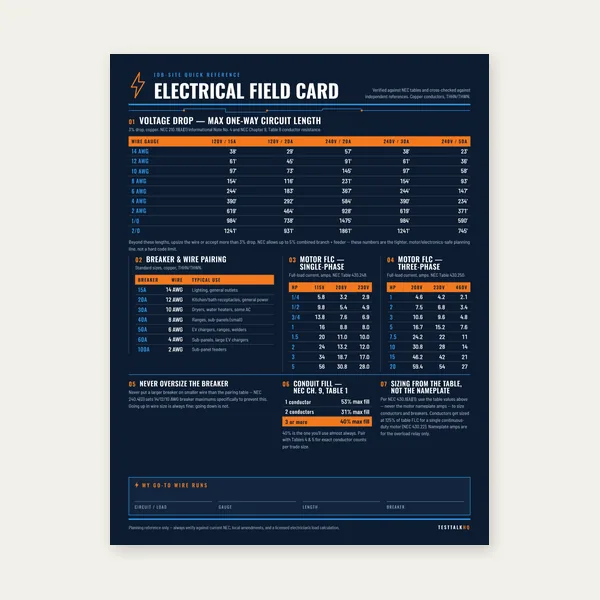
Electrical Reference Card
One page. Voltage drop lengths, breaker and wire pairing, motor FLC.
$3.99
Buy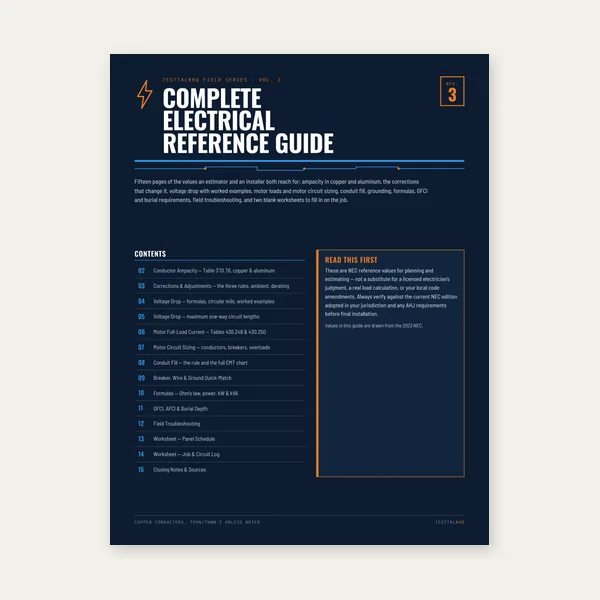
Complete Electrical Reference Guide
15 pages. Ampacity, corrections, voltage drop, motor circuits, conduit fill.
$12.99
Buy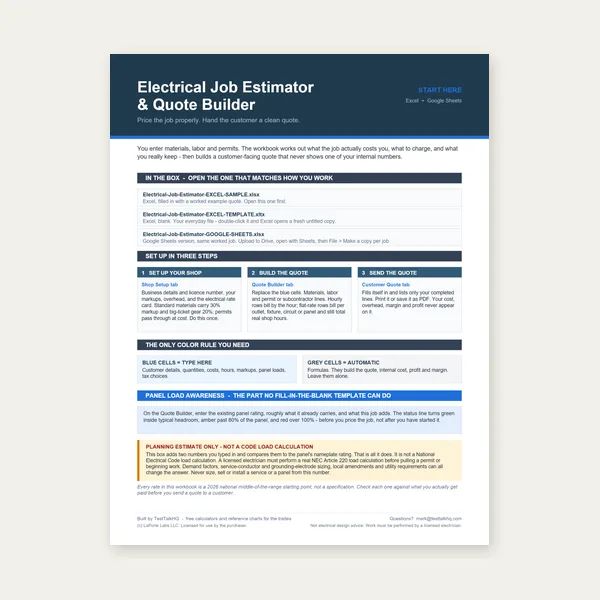
Electrical Job Estimator
Quote electrical work and flag panel headroom before you price it.
Excel or Google Sheets. Best on a computer.
$29.00
Buy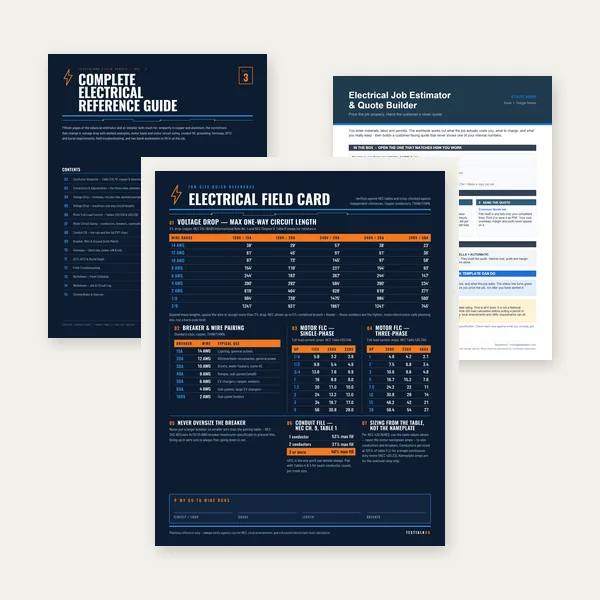
Electrical Complete Bundle
Card, 15-page guide and the estimator workbook. All six files.
Excel or Google Sheets. Best on a computer.
$34.99
$45.98 if bought separately — save $10.99
BuyCheckout opens in a new tab.