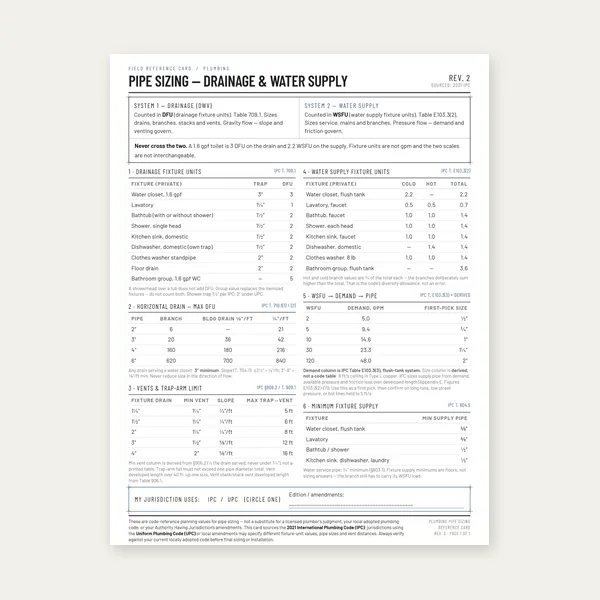
Plumbing Pipe Sizing Card
$3.99
BuyWhy plumbing code uses fixture units instead of counting fixtures, why the same toilet is 2.2 WSFU and 3 DFU, and a worked 3-bed / 2-bath house
The fixture unit calculator is the on-ramp. This page is the unit. Hunter’s curve does not assume every fixture opens at once. A fixture unit is a load factor on that curve. Water-supply fixture units live in Appendix E. Drainage fixture units live in Chapter 7. They share a name and almost nothing else.
Counting mistakes: troubleshooting. Group vs pieces: bathroom group vs individual counting. Side-by-side values: fixture unit chart. Then size the pipe: supply, vent, slope. Plumbing index: plumbing calculators hub.
Need both totals?Quantity of each fixture. IPC Table E103.3(2) WSFU and Table 709.1 DFU, then the calculators that consume them.
Open Calculator →If you opened every faucet and flushed every toilet at once, you would size a fire main for a bungalow. Roy Hunter’s 1940s work — still the skeleton of Appendix E and Chapter 7 — asked a different question: what is the peak probable demand given how people actually use fixtures. A fixture unit is that probability, boiled into a number you can add.
That is why a lavatory is not “1” just because it is one sink. Table E103.3(2) gives a private lavatory 0.7 total WSFU (0.5 cold / 0.5 hot). Table 709.1 gives the same lavatory 1 DFU. The supply number is about how hard the faucet hits the incoming pipe. The drain number is about how hard the bowl hits the waste. They were built by different committees for different physics.
Public occupancy uses heavier rows. A public flushometer water closet is 10 WSFU in E103.3(2) and 4 DFU (1.6 gpf) in 709.1. Putting those rows on a house is the mistake the troubleshooting page exists to stop. This calculator lists private residential values only.
A private flush-tank water closet is 2.2 WSFU (cold only — there is no hot column) and 3 DFU if it is 1.6 gallons per flush or less. The tank fills slowly from the supply. The bowl dumps fast into the drain. Supply diversity and drain diversity are not the same curve, so the numbers are not scaled copies of each other.
A private bathroom group on a flush tank is 3.6 WSFU and 5 DFU. Add the pieces instead and you get 2.2 + 0.7 + 1.4 = 4.3 WSFU and 3 + 1 + 2 = 6 DFU. The group number already includes diversity inside that room. That is not a rounding error. It is why the comparison page exists: bathroom group vs individual counting.
Hot-only and cold-only branches use the hot and cold columns, which Table E103.3(2) note 1 sets at three-fourths of the total. The calculator prints the Total column because that is what you take to the meter and the building supply. Size a hot branch on the hot column yourself. There is no “hot DFU.”
Two bathroom groups on flush tanks, 1.6 gpf (IPC §202: WC + lav + tub or shower, same floor). Kitchen sink. Dishwasher that discharges into the kitchen sink. Residential clothes washer. One hose bibb.
That 11.4 WSFU is the number you type into the water supply pipe sizing calculator (16.5 was a worked example that counted hose bibbs the UPC way plus a second hose; do not mix the two houses). The 14 DFU is the number you type into the vent calculator. Drain diameter is Table 710.1(2). Slope is still Table 704.1 on the slope calculator — DFU does not set the fall.
Do not also add two water closets, two lavs, and two tubs on top of the groups. That is how 11.4 WSFU becomes 20 and a 3/4 in trunk gets blamed for a counting error.
WSFU → supply pipe (Table E104.1). DFU → vent (906.2) and drain size (710.1(2)). Slope → fall (704.1). First-hour rating → water heater (DOE worksheet). Four different calculators after this one. The fixture-unit tool is the start of the vertical, not a dead end.
No. See WSFU vs DFU.
No. IPC §202 wants a tub or shower in the group. A WC + lav is two individual fixtures: 2.2 + 0.7 WSFU and 3 + 1 DFU.
UPC Table 610.3, not IPC Table E103.3(2). The calculator keeps it on its own line.
$3.99
Buy
$12.99
Buy
$29.00
Buy
$39.00
BuyCheckout opens here — you stay on this page.