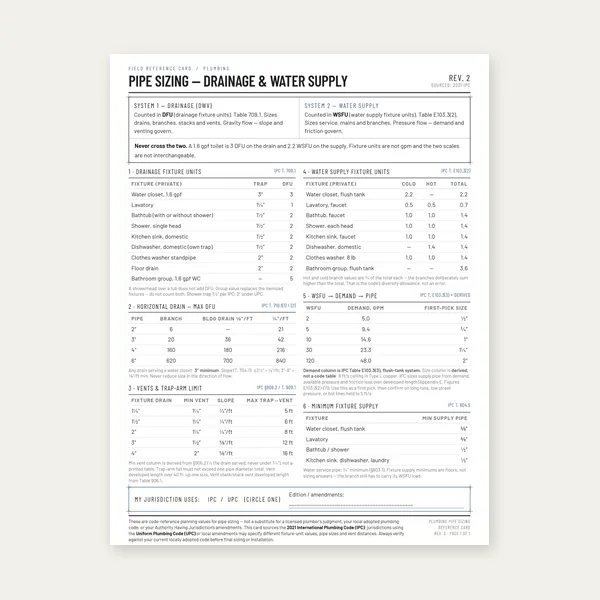
Plumbing Pipe Sizing Card
One page. DFU, drain and vent sizing, WSFU and supply, 2021 IPC.
$3.99
BuyHow water expansion and Boyle’s law become a tank size — and how incoming pressure and a PRV change the answer
People buy expansion tanks by a hallway rule: “50 gallon heater, get the little 2 gallon tank.” That is sometimes right at 50 psig house pressure and a 90°F rise. It is wrong at 80 psig with no PRV, and it is wrong the day the city makes you add a backflow preventer and the system that used to push back into the main becomes a closed bottle. The expansion tank sizing calculator takes heater gallons, incoming pressure, PRV setting, and temperature rise, then reports the minimum tank volume and the next common residential size. This page is the why.
T&P dripping, gauge spikes, waterlogged bladder: troubleshooting. Whether you can just lower the PRV instead of hanging a tank: expansion tank vs PRV adjustment. Plumbing index: plumbing calculators hub.
Heater gallons and first-hour rating are a different worksheet: Water Heater Sizing Calculator (DOE peak-hour — starting point, not a plumber’s fixture survey). The tank you hang here does not make a 40 gal heater into a 50.
Need the minimum tank gallons?Heater volume, incoming pressure, PRV setting, temperature rise. Starting point only.
Open Calculator →Two physics problems are glued together. First, water gets bigger when you heat it. Second, the only spare room in a closed house is the air on the dry side of an expansion tank. You calculate how many extra gallons appear, then you calculate how big a tank must be so that air can shrink enough to swallow those gallons before pressure reaches the T&P.
Vs is the heater tank gallons you typed. Density ρ is saturated liquid water at atmospheric pressure, interpolated against temperature. Absolute pressures add 14.7 psi to the gauge readings. Pfill is house static when the heater is cold — the calculator uses the lower of incoming pressure and the PRV setting. Pmax is 150 psig, the standard water-heater T&P.
That second line is Boyle’s law on the air cushion, assumed isothermal: P1V1 = P2V2. The tank starts full of air at fill pressure. As water enters the wet side, the air is compressed toward T&P pressure. The fraction of the tank that can accept water is 1 minus the ratio of those absolute pressures. Divide the expansion volume by that fraction and you have minimum tank volume.
The calculator does that interpolation and the Boyle’s-law step every time. It does not invent piping gallons you did not type, and it does not pretend a 2.0 gal carton has 2.0 gal of acceptance at every pressure.
Fill pressure is the pressure the closed system sits at when nothing is running and the heater is cold. That is also the precharge you put on the tank. Get it wrong and the tank is already half full of water before the first recovery.
Incoming is the street or well static. A hose-bibb gauge at 2 a.m. on the meter side of the PRV is the usual field number. Cities at 70–90 psig are common. Some wells and some rural mains sit lower.
PRV setting is house static after the reducer. 50–60 psig is a typical residential setpoint. If the PRV is actually reducing, the heater never sees the street pressure. Fill is the PRV number. If there is no PRV, or the PRV is set above the street, fill is incoming.
Higher fill shrinks acceptance. The air is already compressed, so a smaller fraction of the tank is left to swallow expansion, so Vt goes up. That is why the same 50 gal heater that is happy with a 2.0 gal tank at 50 psig may want the next size at 80 psig with no reducer.
Lowering the PRV therefore reduces required tank size. That is a real lever. It is not a free pass to skip the tank on a closed system. That split is the whole point of the comparison.
A tired or clogged PRV is a pressure problem at the fixtures, not this worksheet: water supply pipe troubleshooting.
An open system can push expanded water back into the main. The street is a giant expansion tank you do not own. Many older houses ran that way for decades: no PRV, no check at the meter, T&P never weeps.
Install a pressure-reducing valve, a dual-check, an RPZ, or any device that will not let water reverse, and you have bottled the house. The next recovery has nowhere to go except the T&P. That is the usual origin story of a dripping relief valve “that started after the city changed the meter.”
IPC 607.3 (thermal expansion control) and the UPC 608 family require a means to control that pressure on a closed water-heating system. The means in residential work is a potable diaphragm expansion tank on the cold inlet, precharged to the static fill, with the air valve left accessible. A water-hammer arrester is not that tank. A mixing valve is not that tank.
Tankless heaters store almost nothing. Expansion is smaller and some manufacturers use a different accessory. Do not hang a 2.0 gal potable tank on a tankless and call the storage-tank math done. Storage vs tankless demand is tank vs tankless; this page is the cushion on a storage tank.
Match the new heater’s actual tank gallons, not the old carton and not the first-hour rating. A 50 gal that replaced a 40 gal expands more water. A 140°F thermostat instead of 120°F is a bigger rise. If the plumber (or the city) added a PRV or a check while they were in the pit, fill pressure may have changed on the same afternoon.
Heater selection itself — people, baths, peak hour, gas vs electric — stays on the water heater sizing calculator and sizing guide. This page does not change first-hour rating.
No. It is enough when Vt is under 2.0 gal at your fill and rise — typical at ~50 psig and a 70–90°F rise. High incoming with no PRV, a 160°F setpoint, or extra storage you did not count will push you to ST-8 / ST-12 class. Run the calculator.
No. Expansion is stored volume. FHR is delivery. Use carton gallons here and FHR on the heater worksheet.
On the cold inlet to the heater, on the house side of the PRV / backflow preventer, tank upright (check the carton — some are listed any-orientation), air valve accessible for a tire gauge.
One page. DFU, drain and vent sizing, WSFU and supply, 2021 IPC.
$3.99
Buy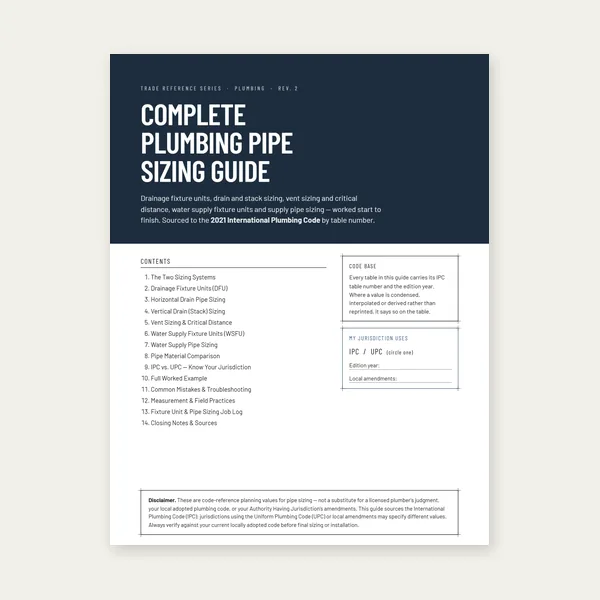
18 pages. DWV and supply sizing, plus one job worked end to end.
$12.99
Buy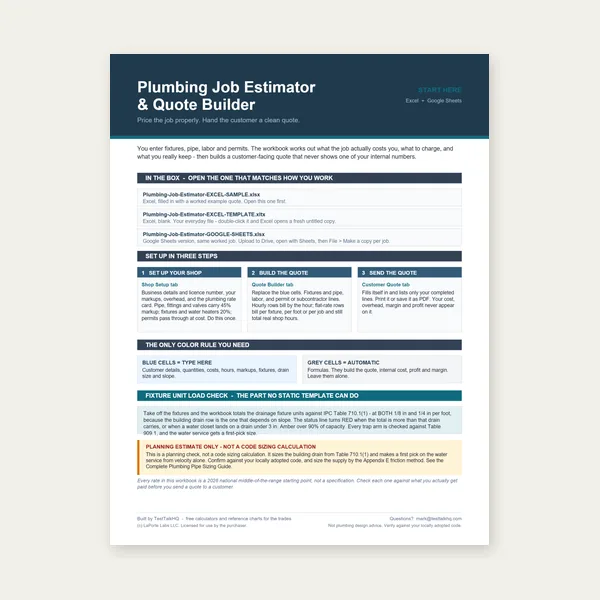
Quote plumbing work and total fixture units against the drain size.
Excel or Google Sheets. Best on a computer.
$29.00
Buy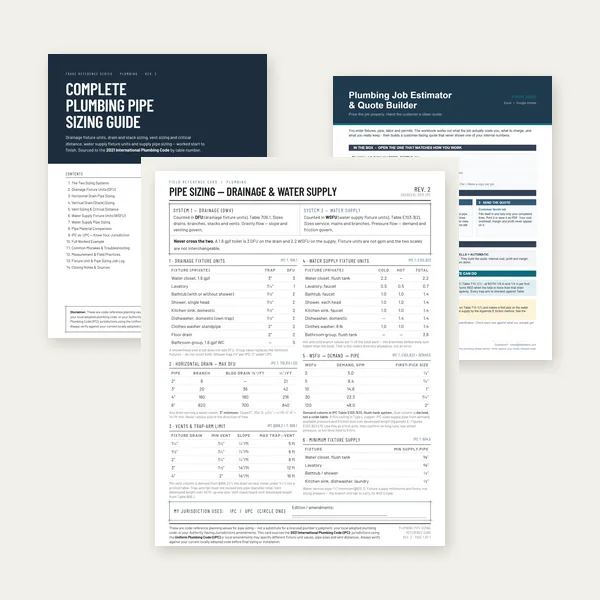
Card, 18-page guide and the estimator workbook. All six files.
Excel or Google Sheets. Best on a computer.
$34.99
$45.98 if bought separately — save $10.99
BuyCheckout opens in a new tab.
The gallons are a number until you hang a tank, set the precharge, and keep the T&P from becoming the expansion device.

Potable diaphragm tank on the cold inlet. Size it from the calculator, then precharge to house static before you fill the system.
View on Amazon →
150 psi / 210°F is the usual heater relief. A weeping T&P is a symptom. Do not cap it.
View on Amazon →
Dielectric unions, the tank tee, and a stuck T&P still come apart with a wrench.
View on Amazon →
Store at 140°F, deliver 120°F. ASSE 1017 covers the mixer. It does not size this tank.
View on Amazon →
Hang it upright on the cold line with the Schrader where you can put a tire gauge on it.
View on Amazon →
Heater gallons, incoming pressure, PRV setting, temperature rise. Minimum tank gallons.
Open Expansion Tank Sizing Calculator →As an Amazon Associate, TestTalkHQ earns from qualifying purchases.