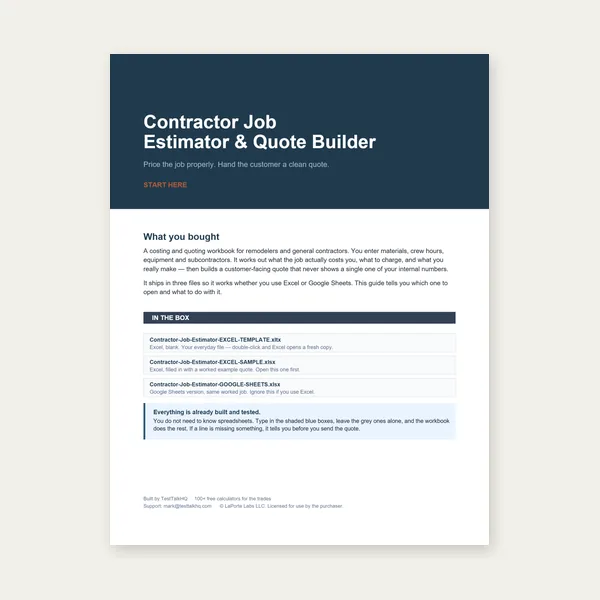
Contractor Job Estimator
Price remodels and GC work, then send a quote with no internal numbers.
Excel or Google Sheets. Best on a computer.
$29.00
BuyA real decision on lumber cost, span capability, and what the yard actually has — not a generic “LVL is stronger” summary
Three ways to span a door or window in a wood-frame wall: a single sawn member (IRC R602.7.1), a built-up of 2, 3, or 4 dimension-lumber plies (the R602.7 schedule), or a laminated veneer lumber header. The header size calculator will recommend a built-up size or an LVL equivalent. This page is which one to buy when both would span.
This is not 16" vs 24" stud spacing (that comparison), not deck-beam treated lumber (deck beam guide), and not floor joist I-joist vs sawn (joist span guide).
Need the size first? Span and NJ come from the table; material is this page.
Open Calculator →IRC R602.7.1 lets you run a single header with flat 2x plates top and bottom, face-nailed, in place of a built-up. The R602.7(1) table still lists 1-2x6 through 1-2x12, and those spans are short. A single 2x12, roof only, 24 ft, 30 psf, is 5′-5". That covers interior doors and small windows, not a 6 ft slider.
Cost and availability: cheapest stick in the bunk, always in stock. Span: the worst of the three. Job reality: useful for nonbearing pockets (or the flat 2x4 in R602.7.4) and small bearing openings where a 2-ply is overkill. Crown, knots, and a 1½" thickness that does not fill a 3½" wall are the usual complaints — you pack it out or live with a recess.
Two, three, or four 2x plies nailed together are what the header schedule is written around. A 2-2x10 is the default “real header” on a lot of houses; 3-ply and 4-ply are how you stay in sawn lumber when the opening or the floor load grows.
Cost: still yard 2x. Three 2x12s can approach LVL price on a wide opening once you add labor to nail them. Span: the calculator’s sawn column. A 4-2x12, roof only, 24 ft, 30 psf, reaches 11′-8" — past that you leave the table. Availability: 2x6 through 2x12 are everywhere; matching crowns and getting four straight 2x12s is the tax. Job reality: you can cut it with a circular saw, nail it with the framing gun, and the inspector knows the table. You must nail the plies as a unit and give it jack bearing. Failures: troubleshooting.
1½" or 1¾" 2.0E (and stiffer grades) in 7¼", 9¼", 11⅞", 14" depths, single or multiple ply. Not in IRC R602.7. The span comes from the manufacturer table on the sticker. The calculator’s LVL line is a conservative equivalent so you can compare, not a substitute for that sticker.
Cost: more than 2-ply sawn on small openings; often cheaper than 4-ply 2x12 plus labor on 8–12 ft openings. Span: the reason you buy it. One 1¾" × 11⅞" can replace a deep built-up and still leave room for a nailing edge. Availability: 9¼" and 11⅞" are common; 14" and long lengths may be next-day. Job reality: do not notch, do not rip to “make it fit,” use the hangers they published, keep the stamp readable. Fills a 2x4 wall better than a single 2x. Two-ply LVL (3½") for 2x4 walls with long spans.
When LVL still is not enough, that is glulam or steel — steel beam calculator — not another 2x12.
| Situation | Default | Why |
|---|---|---|
| Nonbearing, RO ≤ 8 ft, shallow pocket | Flat 2x4 or single 2x6 | R602.7.4 / short 1-ply spans; save the LVL |
| Bearing, RO ≤ ~4 ft, roof only, 24 ft house | 2-2x6 or 2-2x8 | Table cell is cheap sawn; LVL is a waste |
| Bearing, 5–7 ft, roof only | 2-2x10 / 2-2x12 | Still in the bunk; two jacks |
| Same opening, roof + floor | 3-ply sawn or 1¾" LVL | 2-ply sawn often misses; LVL may be one stick |
| 8–12 ft opening, bearing | LVL (or 4-ply if the table still reaches) | Labor on 4-2x12 vs one LVL; stamp required |
| Past last R602.7 row, or shear wall / point load | Engineered LVL / steel | Prescriptive table ended |
Run the size: calculator. Understand tributary: guide. Scan every cell: header span table. Price the sticks in board feet if the yard sells that way: board foot calculator.
Yes — two 2x10s are the 2-2x10 row, not twice a 1-2x10 by coincidence. Nail them as one member or you do not get the table span.
No. The table assumes equal plies. Packing a wall with mismatched depths is not a 2-2x12.
No. Bearing and hangers still follow the manufacturer and the king/jack layout. NJ from the sawn table is a floor, not a waiver.
Price remodels and GC work, then send a quote with no internal numbers.
Excel or Google Sheets. Best on a computer.
$29.00
BuyCheckout opens in a new tab.
A header is only as good as the cut, the nails, and the jacks under each end. These are the tools that turn the table lookup into a wall that will not sag.

Nail built-up plies, king-to-jack, and header-to-king per the schedule. After you know the size, this is what assembles it.
View on Amazon →
Square the header ends, mark jack cuts, and check the king/jack plumb before you commit the nailer.
View on Amazon →
Confirm the header is level and the jacks are not kicked in or out. A 1/4" rack shows up later as a door that binds.
View on Amazon →
Cut header plies and jack studs to length. Built-up headers need matching lengths or the bearing seat is a lie.
View on Amazon →
Find existing kings, jacks, and header edges in finished walls before you cut a new opening or sister a sagging member.
View on Amazon →
Clamp to a square for repeatable jack and cripple cuts when several openings share a header height.
View on Amazon →As an Amazon Associate, TestTalkHQ earns from qualifying purchases.