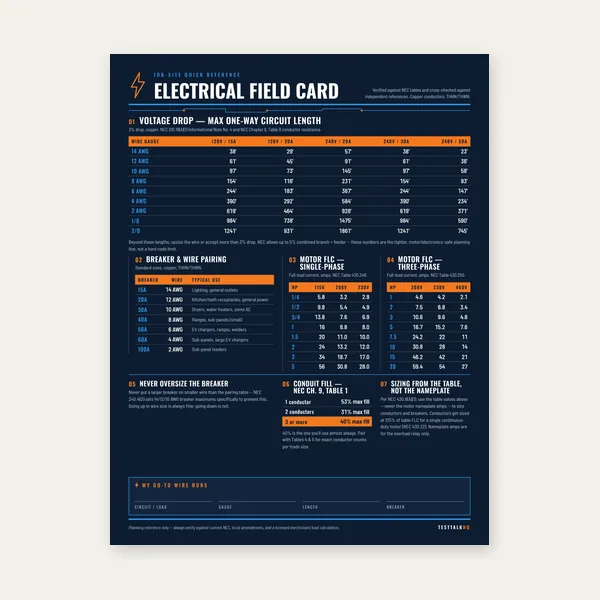
Electrical Reference Card
One page. Voltage drop lengths, breaker and wire pairing, motor FLC.
$3.99
BuyDiagnose early-empty tanks, load-factor mistakes, gauge lies, altitude derate, and fuel-type conversions — when the calculator already “passed”
Not another gal/kWh lesson. Pair this with the Generator Fuel Runtime Calculator when the hours looked right and the tank still died early. For burn-rate formulas, fuel-type tradeoffs, and tank sizing for outages use the Generator Fuel Runtime Guide. Capacity first: Generator Sizing Calculator. Safe connection: Transfer Switch Guide. This page stays on diagnosis.

Use this when calculated runtime was “in range” but the set burns fuel faster than predicted, dies short of the plan, the gauge lied near empty, altitude/temperature ate the margin, or a propane conversion changed the math without anyone noticing.
| Problem | What it usually means | First fix | Next tool |
|---|---|---|---|
| Burns fuel faster than calculated | Actual continuous kW higher than entered; OEM curve worse than defaults; dirty air filter / choke | Clamp or measure real continuous load; re-run calc at measured kW | Fuel Runtime Calculator |
| Runtime ignores real load factor | Used rated kW or surge as continuous; essential circuits only on paper | Load % = actual continuous kW ÷ rated kW — not nameplate ÷ nameplate | kW / kVA / Amps |
| Gauge / level wrong near empty | Usable gallons < nameplate; tank geometry; stale gas; float inaccuracy | Plan on usable volume (~80–90%); verify with measured burn | Fuel Runtime Guide |
| Altitude / cold weather shortfall | Derate not applied; denser cold air + richer mixtures; thin air at elevation | Add 10–30% burn margin; check OEM altitude derate | Sizing Calculator |
| Propane / dual-fuel math wrong | lb vs liquid gallons mixed; LP gal/kWh applied to gasoline tank size | Convert units first; re-select fuel type in the calculator | Fuel Type Tradeoffs |
What it looks like: Calculator said ~14 hours at 50% load on a 5-gallon tank; the set dies at 8–10 hours. Operators blame “bad gas” or “the calculator is wrong” before checking load.
Likely causes: Entered load percent from wishful essential-circuit lists while the fridge, well, sump, furnace blower, and chargers all ran together. Used rated kW in the fuel math instead of measured continuous draw. OEM specific consumption worse than the planning defaults (0.10 / 0.15 gal/kWh gasoline). Restricted air filter, partial choke, or carb issues raising burn. Long extension cords and voltage sag making motors draw more watts for the same work.
Fixes: Measure. Clamp the feeder or use a kill-a-watt on 120 V loads; convert amps to kW with the kW / kVA / Amps Calculator. Re-run the Fuel Runtime Calculator at measured continuous kW. Prefer the OEM fuel curve when published. Stage a known-good air filter and verify choke is fully open at operating temp. Shorten or upsize generator cords — voltage drop is a fuel problem when motors labor.
What it looks like: Plan used “10 kW generator at 50%” because the sticker says 10 kW. Actual continuous draw is 7 kW of house load — 70% load factor — and fuel burn tracks that, not the marketing split.
Likely causes: Confusing rated (or peak surge) with continuous. Treating motor start watts as average load. Running a transfer switch with more circuits than the fuel plan assumed. Ignoring cycling loads that average higher overnight than a daytime walkthrough.
Fixes: Size capacity with the Generator Sizing Calculator, then feed continuous kW into fuel math — never surge. Build the outage circuit list against the transfer switch you will actually throw (see Transfer Switch Guide). Log fridge/well cycles for a few hours; use average kW for runtime, peak for capacity.
Wrong capacity vs wrong fuel plan? If the set is undersized, fuel math will always look “early empty.” Confirm kW headroom before blaming gal/kWh.
Generator Sizing CalculatorWhat it looks like: Gauge shows ¼ tank with “hours left”; set dies minutes later. Or the tank “looks half full” but runtime matches an almost-empty tank.
Likely causes: Nameplate gallons ≠ usable gallons — you will not (and should not) run bone-dry. Tank sump geometry and float gauges that stick or read high. Ethanol gasoline phase separation leaving unusable bottom layer. Propane cylinder vapor withdrawal slowing as liquid level and temperature drop — feels like “empty” with liquid still inside.
Fixes: Plan fuel on usable volume (often 80–90% of stamped capacity for portables). Time a known burn: fill to a mark, run a measured load for one hour, weigh or stick the difference. For multi-day outages, stage sealed cans / cylinders outdoors away from the running set — do not refuel hot. Prefer measured burn rate over the last quarter of a sketchy gauge.
What it looks like: Same generator, same “50%” house list, fine at sea level in fall — dies early at a mountain cabin or in a deep freeze. Calculator defaults unchanged.
Likely causes: Thin air reduces power and often worsens specific consumption; OEM altitude derates apply to capacity and can push you closer to redline (higher load %). Cold starts and richer mixtures burn more until warm. Winter house loads (heat, longer furnace duty) raise continuous kW vs summer assumptions.
Fixes: Read the OEM altitude/temperature notes. Derate available kW first, then recompute load % at the new available rating. Add 10–30% fuel margin for cold/high sites when you lack a curve. Recalculate continuous load for heating season — do not reuse a July walkthrough.
What it looks like: Plan built on gasoline gallons; kit converted to propane; hours still quoted from the gasoline tank size. Or 20 lb cylinder treated as “5 gallons of gas equivalent” without LP gal/kWh.
Likely causes: Mixing pounds, liquid gallons, and gasoline gallons. Applying gasoline defaults after a dual-fuel switch. Ignoring that LP often has higher gal/kWh (worse specific consumption) than gasoline on the same set. Natural-gas pipeline mode has burn rate but no “tank hours.”
Fixes: In the calculator, select the fuel you will actually burn. Convert lb → liquid gallons before entering tank size (~0.24 gal/lb as a planning factor in the guide/calculator — confirm your cylinder data). Re-read the guide’s Fuel Type Tradeoffs and Sizing Tanks for Outages sections — do not invent a third decision article. Stage enough cylinders for the measured continuous load, not the gasoline jerry-can count.
Gasoline vs propane vs diesel tradeoffs and bigger-tank vs resupply planning already live in the Generator Fuel Runtime Guide (Fuel Type Tradeoffs table + Sizing Tanks for Outages). Do not duplicate those here — open the guide when the diagnosis says “wrong fuel strategy,” then return to the calculator with corrected inputs.
One page. Voltage drop lengths, breaker and wire pairing, motor FLC.
$3.99
Buy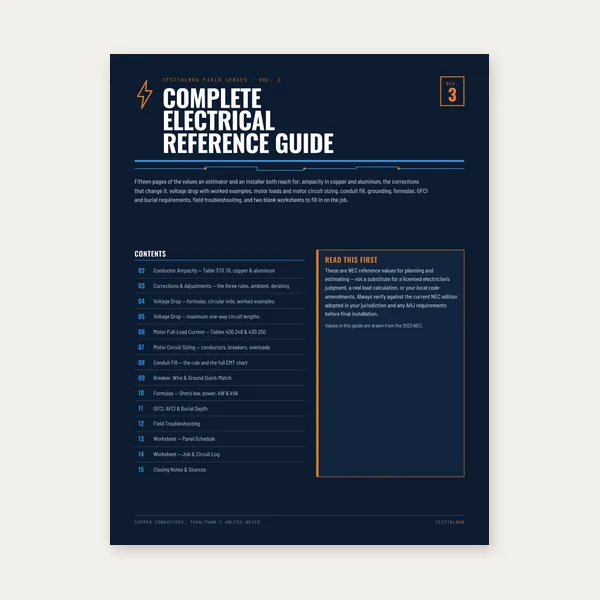
15 pages. Ampacity, corrections, voltage drop, motor circuits, conduit fill.
$12.99
Buy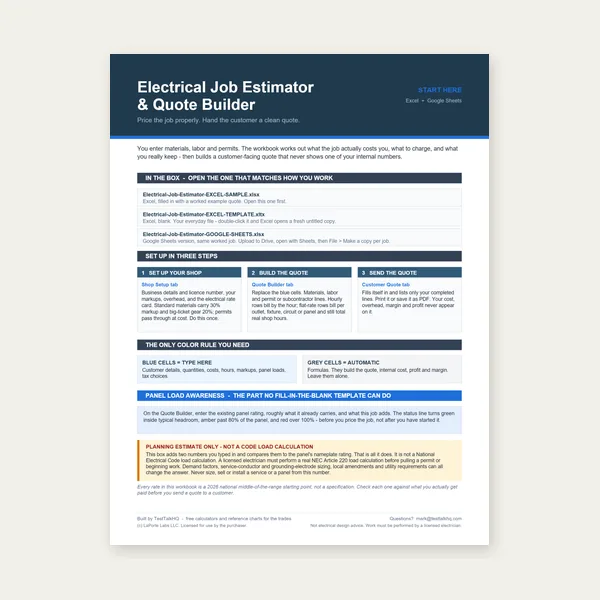
Quote electrical work and flag panel headroom before you price it.
Excel or Google Sheets. Best on a computer.
$29.00
Buy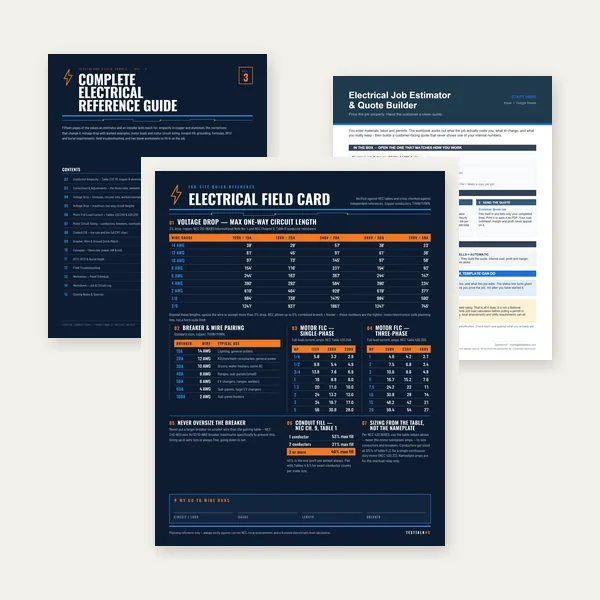
Card, 15-page guide and the estimator workbook. All six files.
Excel or Google Sheets. Best on a computer.
$34.99
$45.98 if bought separately — save $10.99
BuyCheckout opens in a new tab.
Five catalog picks that close the generator-fuel gaps — cans, stabilizer, transfer kit, heavy cord, and portable CO alarm
As an Amazon Associate, TestTalkHQ earns from qualifying purchases. All five cards are sourced from the affiliate CSV (Fuel Storage, Fuel Additives, Transfer Switches, Generator Accessories, Safety / PPE).
Re-check continuous kW (not surge), usable gallons (not nameplate), and fuel type units. Most early-empty failures are input errors, not bad gal/kWh defaults.
Not by itself — it changes which loads you can run. Fewer circuits usually means lower average kW and longer runtime. Size switch and fuel together.
Not near empty. Time a measured burn or plan on usable volume. Gauges and floats lie; burn rate does not.
No. The guide teaches formulas, fuel-type tradeoffs, and tank sizing. This page diagnoses failures when the calculation already looked correct.
Use the Generator Fuel Runtime Guide Fuel Type Tradeoffs section — that decision content already lives there.