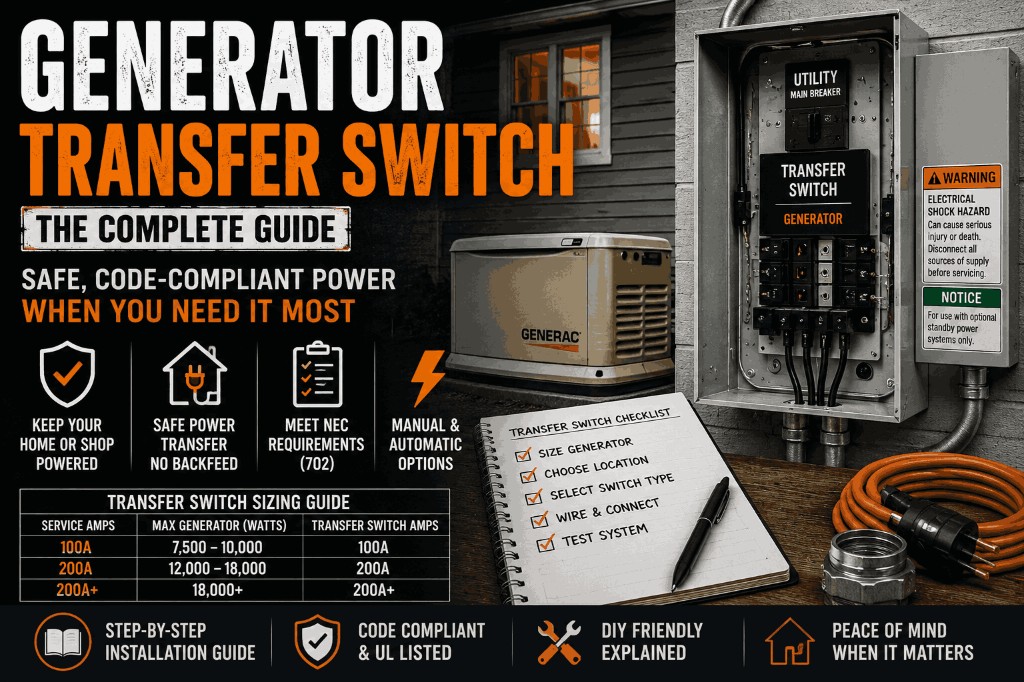
You have a generator. Now you need to connect it to your house safely and legally — without killing a utility worker or burning the place down. That’s what a transfer switch is for.
Why You Can’t Skip the Transfer Switch
A lot of people plug a generator into an extension cord, run it through a window, and call it done. That works for running a lamp or charging a phone. It does not work for your furnace, your well pump, your sump pump, or anything else that’s hardwired into your electrical panel. For those, you need the power to go through the panel.
Here’s the problem: if you connect a generator directly to your panel without a transfer switch, the generator’s power can backfeed onto the utility lines. Utility workers working on those lines — who have every reason to believe the lines are dead — can be electrocuted. People have died this way. It’s also a code violation in every jurisdiction in the US and will void your homeowner’s insurance if something goes wrong.
Connecting a generator directly to your electrical panel without a proper transfer switch — sometimes called a “suicide cord” or “backfeed cord” — is illegal under NEC Article 702, dangerous to utility workers, and will create serious liability for you if something goes wrong. A transfer switch costs $300–$800. Don’t skip it.
A transfer switch solves this by physically disconnecting your home from the utility grid before connecting the generator. It’s not optional — it’s how you do this correctly.
Manual vs Automatic Transfer Switch
There are two main types of transfer switches. Which one you need depends on your budget, your generator, and how much inconvenience you’re willing to tolerate during a power outage.
- How it works: You start the generator, go inside, and manually flip the switch from “line” to “generator”
- Best for: Portable generators, budget-conscious installs, most residential applications
- Install: Mounted next to your main panel, wired into selected circuits
- Permits: Required — pull one before starting
- DIY: Concept is simple but hire a licensed electrician for the panel work
- Limitation: You have to be home and manually switch it over
- How it works: Detects power loss automatically, starts the generator, switches over — all without you doing anything
- Best for: Standby generators, medical equipment, vacation homes, anyone who travels
- Install: More complex — requires a standby generator with auto-start capability
- Permits: Required — always
- DIY: Not recommended — significant complexity
- Limitation: Much more expensive, requires compatible standby generator
For most homeowners with a portable generator, a manual transfer switch is the right call. It’s significantly cheaper, simpler to install, and handles everything a portable generator can deliver. If you have a standby generator already, an ATS is worth the investment — but that’s a different conversation.
How a Manual Transfer Switch Works
A manual transfer switch mounts on the wall next to your main electrical panel. Inside it are individual circuit breakers — typically 6, 10, or more — one for each circuit you want to run on generator power. Each breaker has a toggle switch with two positions: LINE (utility power) and GENERATOR.
During normal operation, all switches are in the LINE position and power flows from the utility through your main panel as usual. The transfer switch just sits there doing nothing.
When the power goes out:
- Roll the generator outside — at least 5 feet from any window or door, exhaust pointed away from the house
- Plug the generator into the power inlet box on the exterior of your house using the supplied cord
- Start the generator
- Go inside and flip the transfer switch from LINE to GENERATOR for each circuit you want powered
- That’s it — those circuits are now running on generator power, isolated from the utility grid
When utility power comes back, reverse the process: flip switches back to LINE, then shut down the generator.
The power inlet is a weatherproof outlet mounted on the outside of your house — usually near the electrical panel. Your generator plugs into this inlet with a heavy-duty cord (typically 10–25 feet). Most transfer switch kits come with a 10-foot cord, which is often not long enough. Buy cord in bulk at a home center and make a longer one — 50 feet is more practical for most setups.
Choosing Which Circuits to Include
A manual transfer switch typically covers 6–10 circuits. Your portable generator won’t power everything in the house, so you need to choose carefully. The goal is essential systems only.
Essential — always include
Optional — if generator capacity allows
Skip these — generator can’t handle them
A 240V circuit (like a well pump or large AC unit) uses two slots on the transfer switch, not one. A 10-circuit transfer switch only gives you 5 240V circuits if you use all of them for 240V loads. Plan your circuit list before buying the switch.
Sizing Your Transfer Switch
The transfer switch amp rating must match or exceed your generator’s output. Most portable generators output 30 amps at 240V (7,200 watts). A 30-amp transfer switch handles this. If you have a larger generator — 50 amps, 12,500 watts — you need a 50-amp switch.
| Generator Output | Transfer Switch Size | Common Generator Size | Typical Use Case |
|---|---|---|---|
| 30A / 240V | 30-amp MTS | 5,000–8,000W | Essential home circuits, well, furnace |
| 50A / 240V | 50-amp MTS | 10,000–15,000W | Larger homes, more circuits, AC capable |
| Whole-home | ATS + standby generator | 11kW–22kW | Full house coverage, automatic operation |
Not sure what size transfer switch you need? Use our transfer switch sizing calculator — enter your generator’s wattage and get the right amp rating, recommended switch model, and circuit count.
What the NEC Requires
Generator transfer equipment is covered under NEC Article 702 (Optional Standby Systems). Key requirements:
- Transfer equipment required (NEC 702.6) — transfer equipment must be designed to prevent simultaneous connection of normal and alternate power sources. This is exactly what a transfer switch provides.
- Overcurrent protection — the transfer switch must include overcurrent protection for each circuit (circuit breakers in the switch itself handle this).
- Permit required — transfer switch installation requires an electrical permit in virtually every jurisdiction. Pull the permit. The inspection protects you.
- Electrician required — the panel work (disconnecting wires from your main breakers and routing them through the transfer switch) must be done by a licensed electrician in most states.
- Generator placement — NEC 702 and local codes require generators to be placed at least 5 feet from windows, doors, and any opening into the building. Exhaust must point away from occupied spaces.
When you pull the permit, ask your building department if they have a preferred installation method or inspector notes for transfer switch installs. Some jurisdictions have specific requirements around the inlet box location, cord rating, and labeling that your electrician needs to know about before they start.
The Installation Process — What Your Electrician Will Do
You don’t need to do this yourself, but understanding the process helps you have a real conversation with your electrician and know what you’re paying for.
Buying a Transfer Switch — What to Look For
Most homeowners doing a portable generator install use a 10-circuit 30-amp manual transfer switch. Common brands include Reliance Controls, Generac, and Champion. Here’s what matters when you’re shopping:
- Number of circuits — 6, 8, or 10 circuit models are common. Count your essential circuits before buying. 10-circuit gives you flexibility.
- Amp rating — must match or exceed your generator’s output. Most portable generators max at 30A. Verify your generator’s spec before buying the switch.
- Included cord and inlet — most kits include a 10-foot cord and inlet box. The cord is usually too short — plan to make or buy a longer one. 50 feet is practical for most homes.
- Indoor or outdoor rated — the transfer switch itself mounts indoors next to your panel. The inlet box mounts outdoors and must be weatherproof (NEMA 3R minimum).
- UL listing — don’t buy anything that isn’t UL listed. Your electrician should refuse to install it if it isn’t.
Frequently Asked Questions
Can I install a transfer switch myself?
The panel work — disconnecting wires from main breakers and rerouting them — requires working inside a live electrical panel, which is dangerous and requires a permit and licensed electrician in most states. The inlet box and cord connections outside the panel are simpler, but most jurisdictions require the whole job be done by a licensed electrician. Don’t cut corners here.
How much does a transfer switch installation cost?
Expect $400–$900 total for a 10-circuit manual transfer switch installed by a licensed electrician, including the switch, inlet box, cord, permit, and labor. The switch itself runs $150–$400 depending on the model. Labor and permit make up the rest. Get at least two quotes.
Do I need a transfer switch for a small portable generator?
If you’re just running extension cords to plug-in devices, technically no — but you can’t power hardwired items like your furnace, well pump, or sump pump that way. If those matter to you, you need a transfer switch. And if you ever plug into an outlet in your house, you absolutely need one.
What’s the difference between a transfer switch and an interlock kit?
An interlock kit is a mechanical device that physically prevents your main breaker and generator breaker from both being on simultaneously. It’s less expensive ($50–$150) and allows you to use your entire panel on generator power — but your generator has to be sized for your whole panel load, and the installation is more complex. A transfer switch is simpler to use in an outage and easier to install correctly.
How far does the generator need to be from the house?
NEC and most local codes require at least 5 feet from any window, door, or opening. In practice, more is better — 10–20 feet keeps exhaust well away from the house. Never run a generator in a garage, even with the door open. Carbon monoxide kills faster than you’d expect.
Size your transfer switch Enter your generator wattage and get the right amp rating, circuit count, and product recommendations.
VoltKit — Electrical Calculators for the Job
Generator sizing, load calculation, circuit breaker sizing, voltage drop, and more. Free on Android. Works offline.
Related Calculators & Guides
Any trade
Contractor Job Estimator
Price remodels and GC work, then send a quote with no internal numbers.
Excel or Google Sheets. Best on a computer.
$29.00
BuyCheckout opens in a new tab.