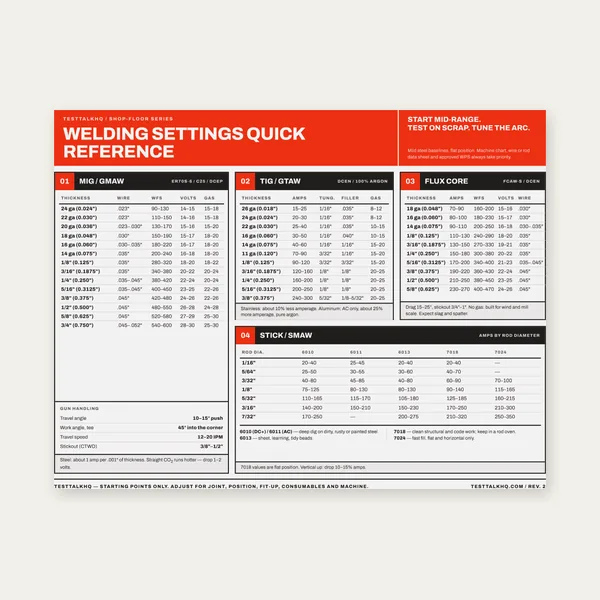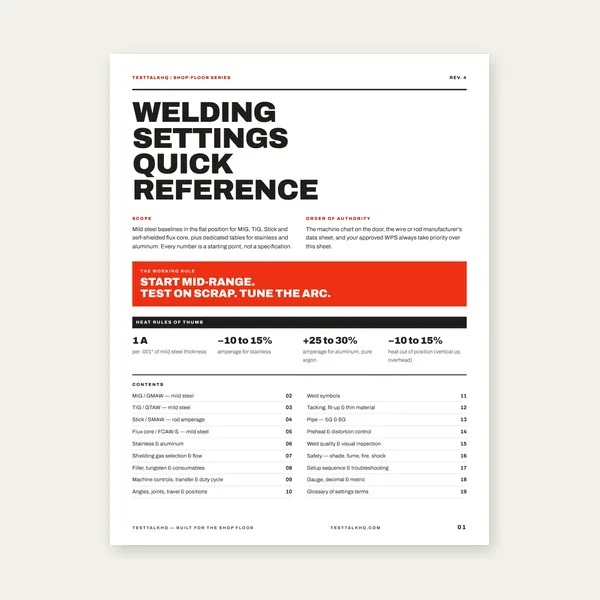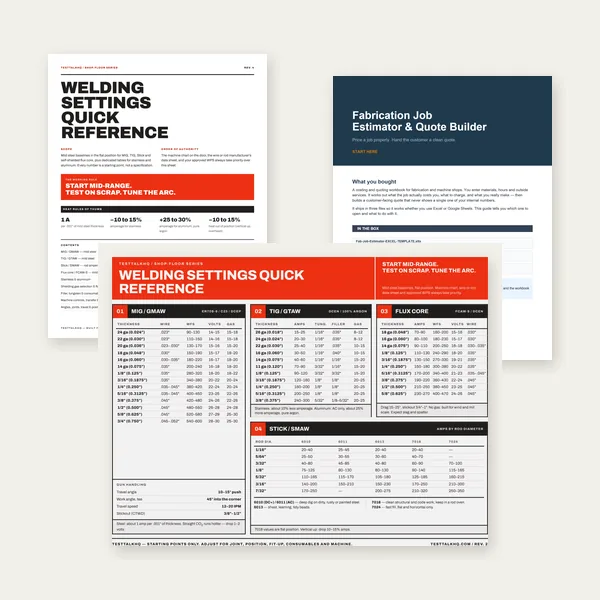
Get accurate amperage, tungsten size, filler rod, and gas flow for any aluminum thickness — before you strike an arc.
Aluminum is rewarding to TIG weld, but it punishes bad settings faster than steel. The oxide layer melts at roughly 3,700°F — almost three times higher than the aluminum beneath it. If you do not burn through that oxide first, you get contamination, porosity, and welds that look like they belong in a trash can.
That is why aluminum TIG requires AC (alternating current) instead of DC. The EP half of the AC cycle cleans oxide; the EN half puts heat into the base metal. Aluminum also conducts heat about four times faster than steel — so travel speed, preheat on thick sections, and amp control matter more.
TIG Aluminum Quick Answer
Starting points by thickness. Tune for joint fit-up, machine capability, and heat sink. Higher AC frequency tightens the arc on thin sheet; lower frequency adds penetration on plate.
| Thickness | Amps | Tungsten | Filler | Gas (CFH) | AC Freq | AC Balance |
|---|---|---|---|---|---|---|
| 1/16 in (0.062) | 60–80A | 3/32 in pure or zirconiated | 3/32 in ER4043 or ER5356 | 15–20 | 120 Hz | 70% EN / 30% EP |
| 1/8 in (0.125) | 100–130A | 3/32 or 1/8 in | 3/32 or 1/8 in ER4043 | 15–20 | 80–120 Hz | 68% EN / 32% EP |
| 3/16 in (0.187) | 150–180A | 1/8 in zirconiated | 1/8 in ER4043 or ER5356 | 20–25 | 60–80 Hz | 65% EN / 35% EP |
| 1/4 in (0.250) | 200–250A | 5/32 or 3/16 in | 1/8 in ER5356 | 25–30 | 60 Hz | 60% EN / 40% EP |
Use these as starting points only. Dial in from arc sound, cleaning action, and puddle behavior on your machine.
Need the numbers, not the lecture?
Use the calculators below for TIG settings, gas flow, and heat input without guessing.
Why Aluminum TIG Welding Is Different
Aluminum needs AC because the oxide layer resists DC penetration. EP cleans oxide; EN drives penetration and keeps tungsten stable. Get the balance wrong and you fight contamination constantly or ball your tungsten into the puddle.
What changes in the shop
- Oxide layer: melts far above base metal — must be broken through before you fuse cleanly.
- Heat pull: aluminum conducts heat away fast — move with purpose on thin material.
- AC tuning: frequency and EN/EP balance control cleaning vs penetration on every thickness.
TIG Aluminum Settings by Thickness
Use these as your starting point. Dial in from there based on your machine, filler, and joint configuration.
1/16 in (0.062) — Sheet Metal, Thin Extrusions
| Amperage | 60–80A |
|---|---|
| Tungsten | 3/32 in pure or zirconiated |
| Filler Rod | 3/32 in ER4043 or ER5356 |
| Gas | 100% Argon, 15–20 CFH |
| AC Frequency | 120 Hz |
| AC Balance | 70% EN / 30% EP |
At this thickness you are fighting burn-through constantly. Keep your arc tight, move fast, and consider a copper backing bar to pull heat away from the back side.
1/8 in (0.125) — Most Common Shop Aluminum
| Amperage | 100–130A |
|---|---|
| Tungsten | 3/32 or 1/8 in pure or zirconiated |
| Filler Rod | 3/32 or 1/8 in ER4043 |
| Gas | 100% Argon, 15–20 CFH |
| AC Frequency | 80–120 Hz |
| AC Balance | 68% EN / 32% EP |
Sweet spot for most fabrication work — frames, brackets, box sections. Your tungsten should form a small balled end. If it is pointing, you need more EP. If it melts into a large ball, back off EP.
3/16 in (0.187) — Structural Aluminum, Plate
| Amperage | 150–180A |
|---|---|
| Tungsten | 1/8 in zirconiated |
| Filler Rod | 1/8 in ER4043 or ER5356 |
| Gas | 100% Argon, 20–25 CFH |
| AC Frequency | 60–80 Hz |
| AC Balance | 65% EN / 35% EP |
Preheat to 150–200°F for sections thicker than 3/16 in. Aluminum does not show heat color like steel — use a temp stick or infrared thermometer. Do not guess.
1/4 in (0.250) — Heavy Plate, Thick Extrusions
| Amperage | 200–250A |
|---|---|
| Tungsten | 5/32 or 3/16 in zirconiated |
| Filler Rod | 1/8 in ER5356 |
| Gas | 100% Argon, 25–30 CFH |
| AC Frequency | 60 Hz |
| AC Balance | 60% EN / 40% EP |
Full preheat required. Consider multiple passes rather than filling the joint in one go. Move your torch faster than feels comfortable — aluminum will sag and crater if you linger.
Choosing the Right Filler Rod
ER4043
Silicon-alloyed. Flows easier, less crack-sensitive, better for castings and heat-treatable alloys (6061, 6063). Lower strength than ER5356 but easier to work with. Start here for most 6061 work.
ER5356
Magnesium-alloyed. Higher strength, better color match after anodizing, better for marine applications and 5xxx series base metals. More crack-sensitive on castings. Use for structural work and anything that will be anodized.
Rule of thumb: When in doubt on 6061, start with ER4043. Switch to ER5356 if you need higher strength or the part will be anodized.
Tungsten Selection for Aluminum
For aluminum on AC, do not use the sharp pointed 2% thoriated (red) tungsten you would use on DC steel work.
| Type | Notes |
|---|---|
| Pure (green) | Traditional choice. Forms a clean ball on AC. Melts back more easily at high amperage. |
| Zirconiated (white/grey) | Better current capacity, holds the ball better, lasts longer. Worth the cost for regular aluminum work. |
| Ceriated / lanthanated | Can work on AC but not optimized for aluminum like zirconiated. |
Diameter guidelines: up to 100A → 3/32 in | 100–200A → 1/8 in | 200A+ → 5/32 or 3/16 in
Always start with a clean, blunt-ended tungsten. The ball forms naturally once you strike an arc on AC. Do not grind a point for aluminum work.
AC Frequency and Balance Explained
AC Frequency (Hz)
- Lower (60 Hz): wider, hotter arc, deeper penetration, more cleaning
- Higher (120–200 Hz): tighter arc, better control on thin material, less heat input
- Thin sheet: go higher. Thick plate: go lower.
AC Balance (EN/EP ratio)
- More EN: more penetration, less cleaning, cooler tungsten
- More EP: more oxide cleaning, larger tungsten ball, more heat
- 65–70% EN is a good baseline for most work
- Grey film in puddle: add EP. Excessive balling: reduce EP.
Common Aluminum TIG Problems and Fixes
| Problem | Fix |
|---|---|
| Black soot around the weld | Too much EP, or contaminated base metal. Clean with acetone, dial back EP slightly. |
| Porosity (holes in weld) | Contaminated filler or base metal. Store filler dry. Use aluminum-only stainless brush. |
| Tungsten balling too large | Too much EP or amperage too high for tungsten size. Step up tungsten or reduce EP. |
| Grey dull bead, no shine | Insufficient cleaning action. Add EP or slow travel slightly. |
| Burn-through on thin material | Reduce amps, increase travel speed, copper backing bar, or pulse if available. |
| Crater cracking at end | Taper amps with foot pedal at end of weld, or add a run-out tab. |
Pre-Weld Prep: The Step Most Welders Skip
Aluminum oxidizes the moment it is exposed to air. That oxide layer is your enemy. Here is the right sequence:
- Degrease with acetone — wipe in one direction with a clean cloth. Do not scrub back and forth.
- Brush with a dedicated stainless steel brush — mark it ALUMINUM ONLY and never use it on steel.
- Weld within 30 minutes — oxide starts reforming immediately.
Skip this step and you will fight contamination no matter how good your settings are.
Need these calculations on the job without pulling up a browser? WeldKit includes TIG, MIG, stick, flux-core, and plasma calculators — built for shop use and works offline. Get WeldKit Free on Google Play
Frequently Asked Questions
What gas do you use for TIG welding aluminum?
100% argon is standard for TIG aluminum.
Why do you use AC for aluminum TIG?
AC provides EP cleaning of oxide and EN penetration in the same arc.
What filler rod for 6061 aluminum?
ER4043 is the common default; use ER5356 for higher strength or anodized finish match.
What AC balance should I start with on aluminum?
About 65–70% EN is a solid baseline for most fabrication thicknesses.
How many amps for 1/8 inch aluminum?
Typically 100–130A to start, then tune by puddle and cleaning action.
Can you TIG aluminum without filler?
Sometimes on thin, tight-fit joints, but gap and strength requirements decide if it is appropriate.
Conclusion
To TIG aluminum cleanly: run AC, clean base metal and filler, protect the puddle with real gas coverage, and tune frequency/balance for thickness. If you see grey film or soot, fix cleaning and EP/EN balance before continuing.