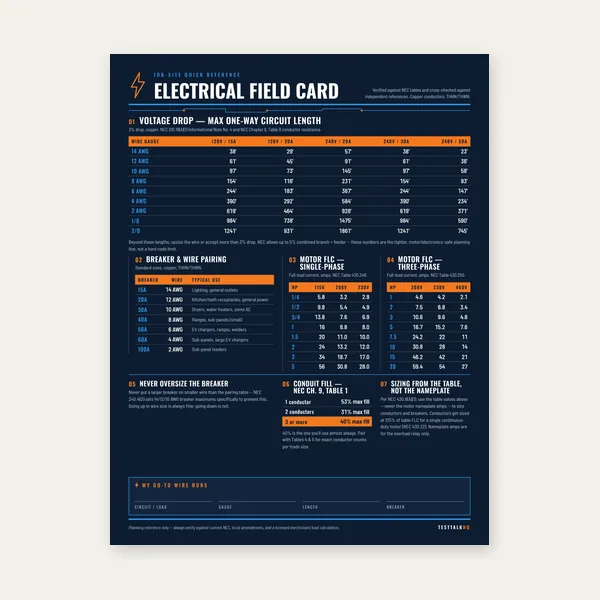
Electrical Reference Card
One page. Voltage drop lengths, breaker and wire pairing, motor FLC.
$3.99
BuyWire gauge, breaker size, and conduit sizing for PV systems per NEC 690
One page. Voltage drop lengths, breaker and wire pairing, motor FLC.
$3.99
Buy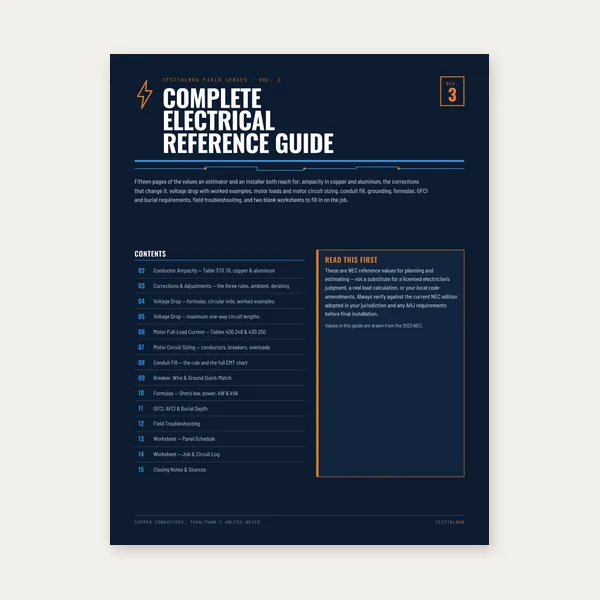
15 pages. Ampacity, corrections, voltage drop, motor circuits, conduit fill.
$12.99
Buy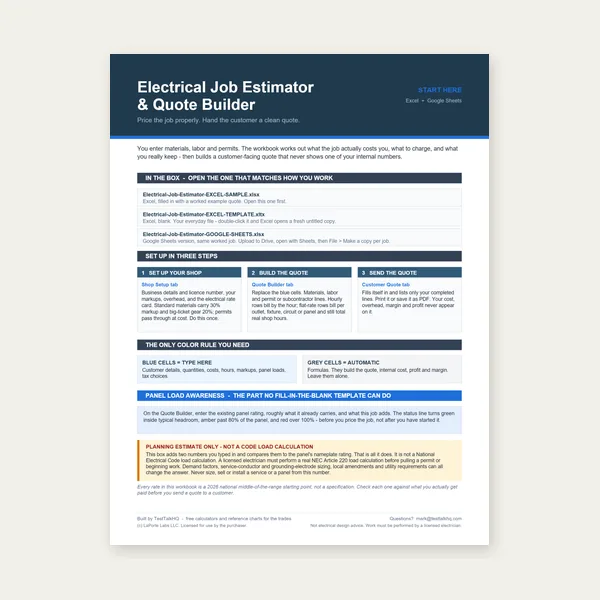
Quote electrical work and flag panel headroom before you price it.
Excel or Google Sheets. Best on a computer.
$29.00
Buy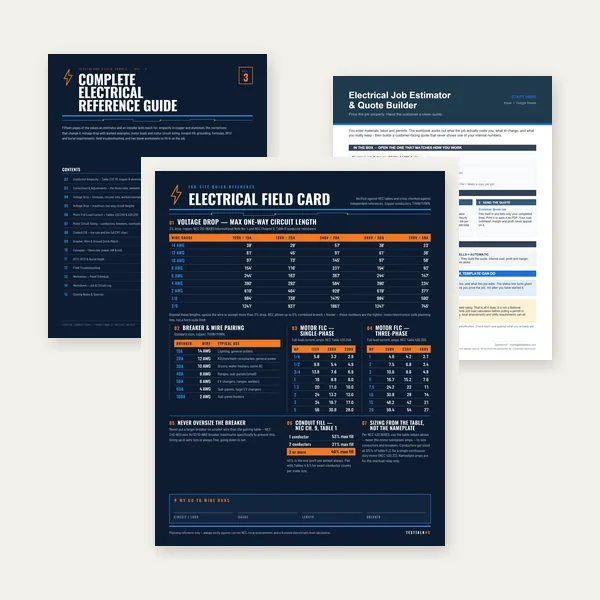
Card, 15-page guide and the estimator workbook. All six files.
Excel or Google Sheets. Best on a computer.
$34.99
$45.98 if bought separately — save $10.99
BuyCheckout opens in a new tab.
Select your nominal system voltage (12 V, 24 V, or 48 V), enter total array wattage at STC, and specify how modules are wired (panels in series per string and how many parallel strings). Add the one-way conductor run in feet and choose copper or aluminum. Click Calculate circuit size to see maximum circuit current, recommended AWG, minimum breaker size, and voltage drop percentage.
For accurate Isc-based sizing, use the short-circuit current from each module label. This tool estimates Isc from array wattage and voltage when nameplate data is not handy — always confirm with the manufacturer sheet before ordering wire or breakers.
Max circuit current: Calculated as Isc × 1.25 per NEC 690.8(B)(1). Isc is estimated from array power and nominal voltage (conservative factor applied). This is the value used to size conductors and overcurrent devices on the DC source circuit.
Recommended wire gauge: Smallest standard conductor in NEC Table 310.16 (75°C) that meets the required ampacity for your selected material. Does not include additional derating for ambient temperature, conduit fill, or terminal limits — use our wire ampacity derating calculator for those adjustments.
Minimum breaker size: Next standard overcurrent protective device rating at or above the maximum circuit current, per NEC 240.6(A). PV OCPD must also comply with 690.9 — verify series fuse ratings and listed equipment limits.
Voltage drop: Approximate percent drop at maximum power-point current (Imp) over your entered run length. Values over 3% are highlighted in red; NEC informational guidance for branch circuits often targets 3% or less — consider upsizing one wire size for long DC homeruns.