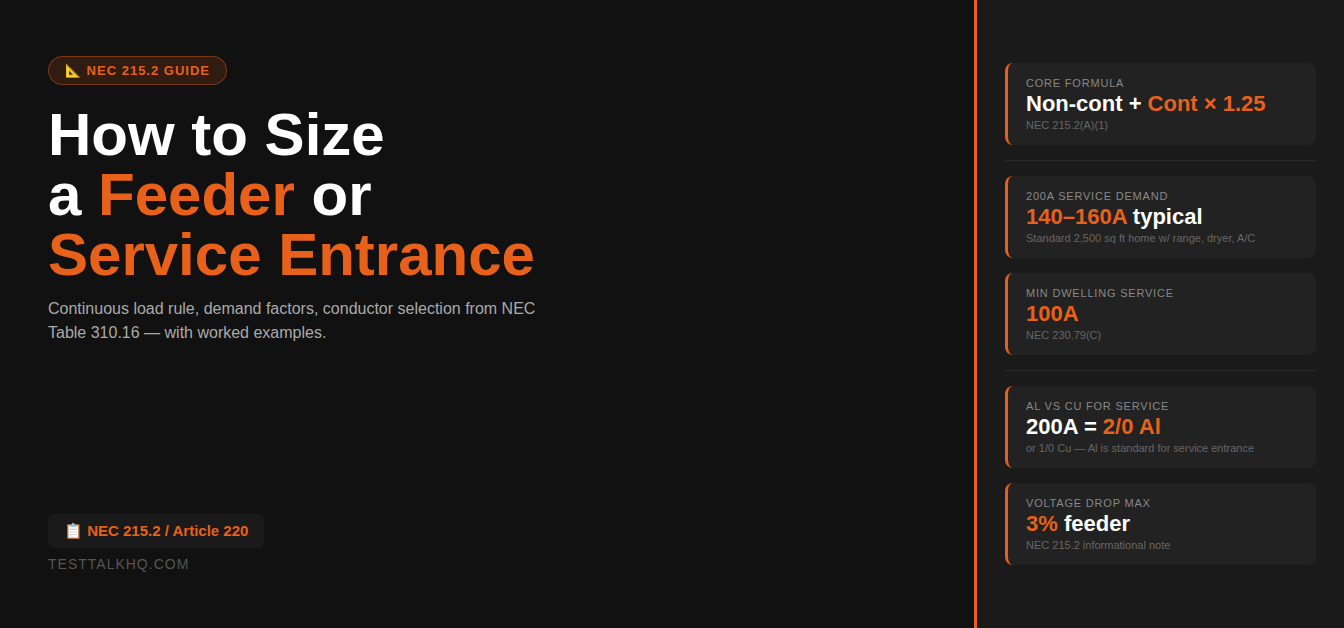
Feeder and service sizing errors are one of the top reasons projects get red-tagged. The calculation looks simple — add up the loads, apply demand factors, size the wire — but the continuous load rule and proper application of NEC Table 310.16 trip up a lot of people. This guide walks through the complete process with real worked examples.
Branch Circuit vs. Feeder — What’s the Difference?
This matters because different NEC articles apply depending on what you’re sizing:
- Branch circuit: Conductors between the last OCPD (breaker or fuse) and the load (outlet, appliance, equipment). Governed by NEC Article 210.
- Feeder: Conductors between service equipment (or a source of separately derived power) and the final branch-circuit OCPD. Could be the wires from your main panel to a subpanel in a garage, or the service entrance conductors from the meter to your main panel. Governed by NEC Article 215.
Every subpanel feed is a feeder. The service entrance conductors from meter to main panel follow NEC 230 for services but 215.2 for feeders. The rules are the same for conductor ampacity.
The Core Rule — NEC 215.2(A)(1)
NEC 215.2(A)(1) sets the minimum ampacity for feeder conductors: they must carry the non-continuous load at 100% plus the continuous load at 125%. Both the conductors and the OCPD protecting them must meet this calculation.
💡 The Formula
Minimum ampacity = (Non-continuous load) + (Continuous load × 1.25)
A continuous load is any load expected to operate at maximum current for 3 or more hours continuously — lighting, HVAC, EV chargers, motors running shifts, commercial kitchen equipment.
⚠️ The Most Common Sizing Mistake
Adding up all loads and sizing the wire for the total — without applying the 125% multiplier to continuous loads. A feeder serving 100A of continuous load needs 125A ampacity conductors, not 100A. Always identify which loads are continuous before you size the wire.
Step-by-Step Feeder Sizing Process
Step 1 — Calculate the Total Load (NEC Article 220)
Sum all branch circuit loads, applying applicable demand factors from NEC Article 220. Key demand factors for residential feeders:
- NEC 220.42 (General Lighting): First 3,000 VA at 100%, next 3,001–120,000 VA at 35%, remainder at 25% (dwelling units)
- NEC 220.53 (Fixed Appliances): Four or more fixed appliances (excluding dryer, range, A/C, heat) — apply 75%
- NEC 220.54 (Dryers): 5,000W or nameplate, whichever is larger
- NEC 220.55 (Cooking Equipment): Demand factor per Table 220.55
Step 2 — Separate Continuous from Non-Continuous Loads
Go through your load list and flag every load that runs at full current for 3 or more hours at a time. In residential work, this is typically lighting, HVAC, and EV chargers. In commercial work, most loads qualify as continuous.
Step 3 — Apply NEC 215.2(A)(1)
Calculate: Non-continuous VA + (Continuous VA × 1.25) = Minimum feeder VA
Divide by system voltage (240V for single-phase, 1.732 × 480V for 3-phase) to get minimum ampacity in amps.
Step 4 — Select Conductor from NEC Table 310.16
Use the 75°C column for most installations (standard panel terminal ratings). Select the conductor with ampacity equal to or greater than your calculated minimum. For service entrance conductors on single-family dwellings, NEC 310.12 allows a simplified table.
Step 5 — Size the OCPD
The OCPD (breaker or fuse) must be rated at no less than the calculated minimum ampacity per NEC 215.3. Round up to the next standard breaker size per NEC 240.6(A) — 15, 20, 25, 30, 35, 40, 50, 60, 70, 80, 90, 100, 110, 125, 150, 175, 200A.
Step 6 — Check Voltage Drop (Optional but Best Practice)
NEC 215.2(A)(3)(b) informational note recommends voltage drop on feeders not exceed 3%, with total feeder plus branch circuit not exceeding 5%. Check voltage drop on long runs — especially if the feeder is more than 100 feet. Start with the voltage drop calculator, or use our Advanced Voltage Drop Calculator for a full analysis.
Worked Example 1 — Residential Garage Subpanel
Scenario: 60A subpanel in detached garage, 80 feet from main panel
Garage loads: General lighting (continuous), 20A receptacle circuits (non-continuous), 240V air compressor circuit (non-continuous).
1 Total calculated load: 4,000 VA general lighting + 3,000 VA receptacles + 2,400 VA compressor circuit = 9,400 VA
2 Separate continuous/non-continuous: Lighting (4,000 VA) is continuous. Receptacles and compressor (5,400 VA) are non-continuous.
3 Apply 215.2(A)(1): 5,400 + (4,000 × 1.25) = 5,400 + 5,000 = 10,400 VA minimum
4 Convert to amps: 10,400 VA ÷ 240V = 43.3A minimum ampacity
5 Select conductor: Need ≥43.3A at 75°C. From NEC Table 310.16: 8 AWG copper = 50A. ✓
6 OCPD: Next standard size at or above 43.3A = 50A breaker
7 Voltage drop check: 80 feet, 43A continuous load, 8 AWG Cu = ~2.7% drop. Within the 3% recommendation. ✓
Result: 8 AWG copper THHN in conduit, 50A two-pole breaker in main panel. This feeds a 60A rated subpanel because the panel rating and the feeder rating can be different — the panel can be rated higher than the feeder to allow for future expansion.
Worked Example 2 — 200A Residential Service
Scenario: New single-family home, 200A service
Using NEC Optional Method (220.82) for simplicity:
1 General load: 2,500 sq ft × 3 VA/sq ft = 7,500 VA. Two small appliance circuits (1,500 × 2) + one laundry circuit (1,500) = 4,500 VA. Total general load = 12,000 VA.
2 Apply NEC 220.82 demand: First 10,000 VA at 100% = 10,000 VA. Remainder (2,000 VA) at 40% = 800 VA. General demand = 10,800 VA.
3 Add specific loads: 10kW electric range (8,000 VA demand per 220.55). 5kW dryer (5,000 VA). 5kW water heater (100%). 3.5-ton A/C (100% of nameplate, ~5,000 VA).
4 Total demand: 10,800 + 8,000 + 5,000 + 5,000 + 5,000 = 33,800 VA
5 Convert to amps: 33,800 ÷ 240V = 140.8A
6 Service conductor per NEC 310.12: A 200A service — the calculated load (141A) is below 200A, so a 200A service is appropriate. Per NEC Table 310.12, a 200A single-family service requires 2/0 AWG aluminum or 1/0 AWG copper service entrance conductors.
Result: 2/0 AWG aluminum SER cable or individual 1/0 AWG copper THWN conductors, 200A main breaker.
Aluminum vs. Copper for Feeders
Aluminum is the standard choice for service entrance conductors and large feeders — it’s significantly cheaper per foot on large gauge sizes and lighter to handle. The key rules:
- Size aluminum one to two AWG sizes larger than copper for equivalent ampacity
- Always use anti-oxidant compound (Noalox or equivalent) at all aluminum terminations
- Use connectors and lugs listed for aluminum — “AL/CU” marking on breakers and lugs confirms compatibility
- NEC 310.15(B)(1)(c): Aluminum conductors in raceways must be stranded, not solid, for feeders
Common Feeder Sizing Reference Table
| Load (Continuous) | Min Ampacity (×1.25) | OCPD | Copper (75°C) | Aluminum (75°C) |
|---|---|---|---|---|
| 40A | 50A | 50A | 8 AWG | 6 AWG |
| 60A | 75A | 80A | 4 AWG | 2 AWG |
| 80A | 100A | 100A | 1 AWG | 2/0 AWG |
| 100A | 125A | 125A | 2/0 AWG | 4/0 AWG |
| 120A | 150A | 150A | 3/0 AWG | 350 kcmil |
| 160A | 200A | 200A | 4/0 AWG | 350 kcmil |
Note: This table assumes 100% continuous loads. Mixed continuous/non-continuous loads may allow smaller conductors. Always calculate per NEC 215.2(A)(1) for your specific situation.
⚡ Calculate Your Feeder Size
Enter your loads into our Feeder & Service Load Calculator for a complete calculation with step-by-step breakdown and NEC reference for every number.
Frequently Asked Questions
What is the minimum feeder size for a residential service per the NEC?
NEC 230.79(C) requires a minimum 100A service for single dwelling units. The actual feeder conductors must be sized for the calculated load per NEC 215.2, but the service cannot be less than 100A regardless of how low the calculated load comes out. Most new construction uses 200A service to accommodate modern loads and future growth.
Do I always have to apply the 125% multiplier to continuous loads on feeders?
Yes, per NEC 215.2(A)(1), unless the assembly (panelboard and OCPD) is listed for 100% continuous loading. Equipment listed for 100% continuous use is rare below 400A — you’d see it on large commercial switchboards. For standard residential and light commercial work, always apply the 125% continuous load rule.
Can I use aluminum wire for a feeder to a subpanel?
Yes. Aluminum is commonly used for feeder conductors to subpanels, outbuildings, and service entrances. Use anti-oxidant compound at all terminations, verify lugs are AL/CU listed, and size one to two AWG larger than copper equivalents. SER (service entrance cable) is a common choice for aluminum feeder runs to detached garages and outbuildings.
What’s the difference between a feeder and a service entrance?
A service entrance consists of the conductors from the utility connection point (or meter) to the main service disconnecting means. A feeder runs from the main service disconnect (or any OCPD) to a downstream distribution point. Service entrance conductors are governed by NEC Article 230 for installation requirements, but sizing follows similar principles. NEC 310.12 provides simplified sizing tables for single-family dwelling service and feeder conductors.
How do I size the neutral conductor for a feeder?
Per NEC 215.2(B), the neutral must be sized to carry the maximum unbalanced load (calculated per NEC 220.61) but not smaller than the equipment grounding conductor required by NEC 250.122. For feeders with no 120V loads (like a dedicated 240V welder subpanel), the neutral can be smaller than the phase conductors. For general-purpose feeders, the neutral is typically the same size as the phase conductors up to 200A.
After the feeder is sized, the pull through the raceway still has a max tension: Wire Pulling Tension Guide.
Related: Feeder & Service Load Troubleshooting · Service Upgrade vs Subpanel · Feeder & Service Load Chart
Any trade
Contractor Job Estimator
Price remodels and GC work, then send a quote with no internal numbers.
Excel or Google Sheets. Best on a computer.
$29.00
BuyCheckout opens in a new tab.