NEC Article 220 demand-factor reference for feeder and service planning — general lighting, receptacle, motor, and common continuous-load factors. Apply demand before converting VA to amps at system voltage.
How to Use This Chart
Apply demand factors to connected load before converting VA to amps at system voltage. Full interactive takeoff: feeder/service load calculator. Walkthrough: how to size a feeder or service entrance.
Article 220 builds calculated load in layers: connected loads → demand factors → largest motor contribution → continuous-load adjustment → neutral load where applicable. This chart covers the most common non-dwelling factors; dwelling units use optional methods in 220.82 or 220.83 — use the residential load calculator for those.
General Lighting Demand (NEC 220.42)
| Portion of lighting load | Demand factor |
|---|---|
| First 3,000 VA | 100% |
| 3,001–120,000 VA | 35% |
| Remainder over 120,000 VA | 25% |
General lighting load is often assigned by occupancy (Table 220.12) — e.g., office 1 VA/ft² — then reduced by these demand factors for feeder and service conductors. Branch-circuit conductors upstream of the demand point may still be sized to connected load per 210.
Receptacle Loads — Non-Dwelling (220.44 / Table 220.44)
| Portion of receptacle load | Demand factor |
|---|---|
| First 10 kVA (10,000 VA) | 100% |
| Remainder over 10 kVA | 50% |
Applies to receptacle loads calculated per 220.14(I) and (K). Fixed equipment with dedicated circuits is usually calculated at nameplate, not through this table.
Other Common Demand Factors
| Load type | Code ref | Demand factor |
|---|---|---|
| Household electric range (each) | Table 220.55 | Per column — not 100% of nameplate |
| Commercial cooking | 220.56 | 65% if thermostatic control; 100% otherwise |
| Fixed electric space heating | 220.51 | 100% (no reduction) |
| Noncoincident loads (heat vs AC) | 220.60 | Larger of the two — not sum |
| Largest motor | 220.50 | 125% of largest motor FLA added |
| Remaining motors | 430.24 / 430.26 | Sum FLA at 100%; apply 430.26 if applicable |
| EVSE (general) | 625.41 | 100% unless 625.42 load management applies |
Continuous vs Noncontinuous
| Load type | Feeder/service conductor & OCPD |
|---|---|
| Continuous (3+ hours) | Size at 125% of continuous (215.2 / 230.42) |
| Noncontinuous | 100% of noncontinuous |
| Mixed | Noncontinuous + 125% of continuous |
Lighting in many commercial occupancies runs 3+ hours — treat as continuous unless you can document otherwise. Data racks, ventilation, and process loads are almost always continuous. Receptacle loads are often noncontinuous unless dedicated to continuous equipment.
VA → Amps at Common Voltages
| Demand VA | 120/240 1φ (A) | 120/208 3φ (A) | 277/480 3φ (A) | 120/240 3φ (A) |
|---|---|---|---|---|
| 5,000 | 20.8 | 13.9 | 6.0 | 12.0 |
| 10,000 | 41.7 | 27.8 | 12.0 | 24.1 |
| 15,000 | 62.5 | 41.6 | 18.0 | 36.1 |
| 25,000 | 104.2 | 69.4 | 30.1 | 60.1 |
| 50,000 | 208.3 | 138.8 | 60.1 | 120.3 |
| 75,000 | 312.5 | 208.2 | 90.2 | 180.4 |
| 100,000 | 416.7 | 277.6 | 120.3 | 240.6 |
| 150,000 | 625.0 | 416.4 | 180.4 | 360.8 |
| 200,000 | 833.3 | 555.2 | 240.6 | 481.1 |
| 300,000 | 1250.0 | 832.7 | 360.8 | 721.7 |
| 400,000 | 1666.7 | 1110.3 | 481.1 | 962.3 |
1φ amps = VA ÷ 240. 3φ amps = VA ÷ (√3 × VLL). 120/240 3φ (high-leg delta) line current uses 240 V line-to-line for the formula when loading is balanced across phases.
Worked Example — Small Office Service
Given: 3,000 ft² office, 120/208 V 3φ service.
- General lighting: 3,000 ft² × 1 VA/ft² = 3,000 VA → 100% = 3,000 VA
- Receptacles: 3,000 ft² × 1 VA/ft² = 3,000 VA → 100% (under 10 kVA) = 3,000 VA
- HVAC motor: 15 A × 208 V × √3 = 5,402 VA → 125% largest motor add = 6,753 VA (per 220.50)
- Water heater 4,500 VA — noncontinuous → 4,500 VA
Total calculated load ≈ 17,253 VA (simplified — actual takeoff may combine lighting/receptacle per 220.42/220.44 separately on larger buildings).
Amps at 208 V 3φ: 17,253 ÷ (1.732 × 208) = 47.9 A. Size service conductors and OCPD to next standard rating above calculated load after continuous adjustments.
Build a full feeder or service takeoff
VoltKit — Electrical Calculators Offline
Grounding, motors, transformers, and load tools on Android.
Related Calculators & Guides
Related: Feeder & Service Load Troubleshooting · Service Upgrade vs Subpanel · Feeder / Service Load Calculator
Electrical
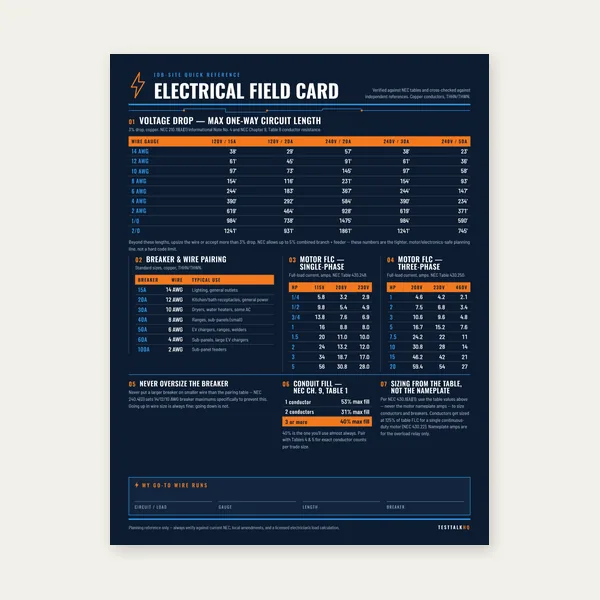
Electrical Reference Card
One page. Voltage drop lengths, breaker and wire pairing, motor FLC.
$3.99
Buy
Complete Electrical Reference Guide
15 pages. Ampacity, corrections, voltage drop, motor circuits, conduit fill.
$12.99
Buy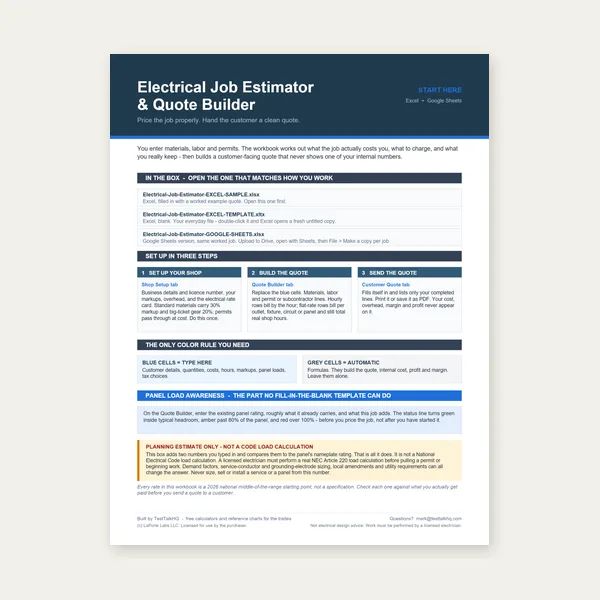
Electrical Job Estimator
Quote electrical work and flag panel headroom before you price it.
Excel or Google Sheets. Best on a computer.
$29.00
Buy
Electrical Complete Bundle
Card, 15-page guide and the estimator workbook. All six files.
Excel or Google Sheets. Best on a computer.
$34.99
$45.98 if bought separately — save $10.99
BuyCheckout opens in a new tab.