TestTalkHQ.com — Fabrication
Drill Speed and Feed Rate for Metal
The Complete Guide
📅 March 2026
⏱ 9 min read
🔧 Fabrication / Drilling
You’re drilling through 3/8″ mild steel and your bit lasts two holes before it’s dull. Or you’re burning through stainless and the drill starts squealing halfway through. The problem almost always comes down to the same two variables — wrong speed and wrong feed rate. Get those right and the same bit that was failing in two holes will last a hundred.
Why Speed and Feed Rate Are the Variables That Matter Most
Drill bits fail for one reason: heat. Heat softens the cutting edge, and once that edge rounds over, it’s rubbing instead of cutting — which generates more heat, which accelerates the damage. It’s a fast spiral once it starts.
Speed (RPM) and feed rate (how aggressively you’re advancing the drill) are the two controls you have over how much heat builds up at the cutting edge. Too fast and you’re generating friction heat faster than the chip and coolant can carry it away. Too slow and you’re dwelling on the work — also generating heat without productive cutting. The right combination puts you in the zone where chips form cleanly, carry heat away, and the edge stays sharp.
Understanding this relationship is the difference between a shop that goes through bits constantly and one where a quality cobalt set lasts for years.
🔥 Drill Speed vs. Heat — Finding the Right Zone
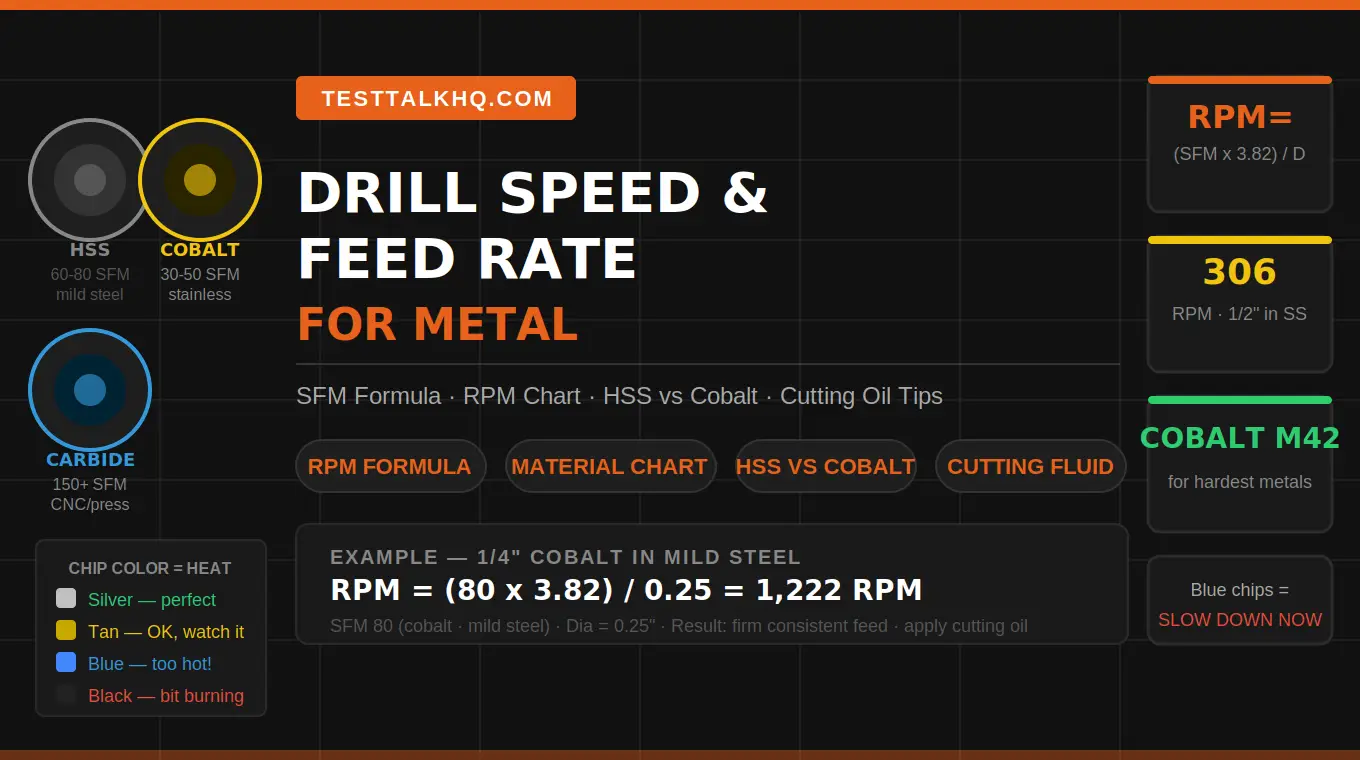
The RPM Formula — How to Calculate the Right Speed
The correct drill speed is not a fixed RPM — it’s calculated from Surface Feet per Minute (SFM), which is a material property that describes how fast the cutting edge should move across the workpiece. Each material has a recommended SFM range, and you convert that to RPM based on your drill bit diameter.
📐 The RPM Formula — Surface Feet Per Minute to RPM
The constant 3.82 comes from converting the formula — SFM describes edge speed in feet per minute, RPM describes rotations per minute, and the circumference relationship between them (12 / π ≈ 3.82) bridges the two.
Where does SFM come from? It’s a machining guideline specific to the material you’re cutting and the bit material you’re using. Harder materials need slower surface speeds. Softer materials (aluminum, brass) can run much faster. Your bit type matters too — cobalt and carbide can handle higher SFM than standard HSS.
Get Your RPM in Seconds
Our free drill speed calculator handles HSS, cobalt, and carbide bits across all common metals. Enter your bit size and material — get RPM and feed rate recommendations instantly.
SFM Reference Chart by Material and Bit Type
📋 Recommended SFM by Material — HSS, Cobalt, and Carbide Bits
| Material | HSS SFM | Cobalt SFM | Carbide SFM | Cutting Fluid |
|---|---|---|---|---|
| Mild Steel (1018, A36) | 60–80 | 80–100 | 150–200 | Yes — required |
| Tool Steel (D2, H13) | 30–50 | 50–70 | 80–120 | Yes — required |
| Stainless Steel (304, 316) | 20–30 | 30–50 | 60–80 | Yes — critical |
| Stainless Steel (17-4, 15-5) | 15–25 | 25–40 | 50–70 | Yes — critical |
| Cast Iron (gray) | 50–80 | 80–100 | 120–180 | Dry or light oil |
| Aluminum (6061, 7075) | 200–300 | 250–400 | 400–600 | Recommended |
| Brass / Bronze | 150–200 | 200–300 | 300–450 | Optional |
| Copper | 100–150 | 150–200 | 250–350 | Recommended |
| Titanium (Grade 5) | 15–25 | 25–40 | 50–70 | Yes — critical |
ℹ SFM Ranges — Use the Low End First
When starting on an unfamiliar material or with a new bit, use the lower end of the SFM range and work up. You can always increase speed if chips look clean and the bit is staying cool. You cannot un-dull a bit that burned because you started too fast. Cobalt sets earn their price by running the higher end of these ranges without breaking down.
Worked Example — Drilling 1/2″ Hole in 304 Stainless
Stainless is where most machinists and fabricators lose bits — it work-hardens when you dwell, it’s gummy, and it generates intense heat. Let’s walk through the calculation for a 1/2″ cobalt bit in 304 stainless steel.
📒 Worked Example — 1/2″ Cobalt Bit in 304 Stainless
306 RPM is slow — much slower than most people intuitively run a drill press when they think “stainless.” Most people crank the press up out of habit and immediately wonder why their bits are toast after one hole. Stainless requires patience, low speed, high feed pressure, and aggressive lubrication.
The chip color tells you everything: silver or tan chips mean you’re in the zone. Blue chips mean the metal is reaching temperatures where it’s starting to anneal — slow down immediately. Purple or black chips mean your bit is already getting damaged.
Feed Rate — The Variable Everyone Ignores
Feed rate is how fast you’re advancing the bit into the material — typically measured in inches per revolution (IPR) in machining, but in manual drilling it’s mostly about feel and pressure.
The key principle: feed rate and speed work together. You can’t compensate for wrong speed with aggressive feeding, and you can’t compensate for too-light feed with more speed. The right combination produces clean curled chips. Wrong combinations produce dust (too fast, too light), long stringy birds-nests (too slow, too aggressive), or blue chips (too fast with any feed rate).
📋 Feed Rate Guidelines by Drill Diameter — Manual Drilling
| Drill Diameter | Feed Rate (IPR) | Manual Pressure | Chips Should Look Like |
|---|---|---|---|
| Under 1/8″ | 0.001–0.002 IPR | Very light | Fine curls or powder |
| 1/8″ – 1/4″ | 0.002–0.004 IPR | Light | Short curls |
| 1/4″ – 1/2″ | 0.004–0.007 IPR | Moderate | Curled chips, 1–2″ long |
| 1/2″ – 1″ | 0.007–0.015 IPR | Firm | Longer curls, clearing freely |
| Over 1″ | 0.015–0.025 IPR | Heavy | Long curls, continuous clearing |
⚠ The Work Hardening Trap in Stainless and Inconel
Stainless steel and nickel alloys work-harden when you don’t apply enough feed pressure — the surface layer becomes harder than the base material, and subsequent drilling becomes dramatically more difficult. With these materials, once you start a hole you commit to firm, consistent feed pressure all the way through. Stopping mid-hole or dwelling without cutting lets the surface harden under the bit. This is why stainless eats bits so fast on hand drills — human hands can’t maintain the consistent pressure that prevents work hardening.
Feed Rate in IPM and How Long the Hole Will Take
RPM gets all the attention. Feed rate is what actually decides whether you cut metal or polish it. On a drill press with a power feed — or when you are estimating job time — convert that inches-per-revolution feel into inches per minute (IPM):
Feed rate (IPM) = IPR × RPM
Twist drills do not use the milling formula (chip load × flutes × RPM). A two-flute drill’s “chip load” is already baked into the IPR charts. If your calculator or Machinery’s Handbook table gives 0.004 IPR and you are turning 800 RPM, you are feeding at 3.2 IPM. That is the number a power-feed dial wants — and the number you use for time.
Estimated cut time for a through-hole (or to depth) is just distance over speed:
Cut time (minutes) = hole depth ÷ IPM
Example: 1/2″ cobalt bit in mild steel at ~700 RPM and 0.006 IPR → 4.2 IPM. A 1.5″ deep hole is about 0.36 minutes (~21 seconds) of actual cutting — before you count peck retracts. Deep holes in stainless are slower because you peck more; the formula still gives the continuous-cut floor so you stop guessing from “it felt like a minute.”
Metric shops: same math in mm/rev and mm/min. 0.004 IPR is about 0.10 mm/rev; multiply by RPM for mm/min. The Drill Speed Calculator toggles inch/mm and returns RPM, feed rate, and cut time once you enter hole depth.
If the math says 4 IPM but chips go blue, you are too hot — drop RPM ~10% or add fluid before you blame the feed chart. Silver/tan curls mean the IPM is earning its keep. Dust or squeal usually means you are spinning without enough feed (especially deadly in stainless).
HSS vs. Cobalt vs. Carbide — Which Bit for Which Job
Bit selection isn’t about brand loyalty — it’s about matching the bit material to the workpiece hardness and the heat you’re generating.
- HSS (High Speed Steel). The standard for wood, plastic, aluminum, brass, and mild steel on lighter work. Affordable, easy to resharpen, but degrades quickly if you’re running too fast or not using cutting fluid in steel. HSS starts to soften around 1,000°F — which is easy to hit in stainless without proper technique.
- Cobalt (M35, M42). 5–8% cobalt content gives cobalt bits significantly better heat resistance than HSS — M42 stays hard to about 1,100°F. This is the right choice for stainless steel, hardened steel, tool steel, cast iron, and any material where heat is the enemy. Cobalt bits cost more but last far longer in these applications. M42 (8% cobalt) is preferred over M35 for the hardest materials.
- Carbide (solid or indexable). The top tier — extreme hardness, best heat resistance, and the longest tool life when used correctly. Carbide is brittle, though: a hand drill’s wobble and vibration can chip carbide immediately. Carbide is at home in CNC machines, rigid drill presses, and production environments. Wrong tool for a hand drill or worn chuck.
- TiN, TiAlN, black oxide coatings. Coatings improve lubricity and can add modest heat resistance, but they’re surface treatments — once worn through, you’re back to the base bit material. A TiN-coated HSS bit is still HSS underneath.
💡 Pro Tip — Pilot Hole Strategy for Large Diameters
Drilling holes larger than 1/2″ in steel? Use a pilot hole. Start with a bit 1/8″ to 3/16″ smaller than your final size. The pilot hole establishes the center, reduces the cutting load on the final bit, and lets the larger bit find its depth without the web at the center tip doing all the work. For holes over 1″, pilot drilling is essentially mandatory — without it you’re fighting the full web contact area against solid steel from the start, which generates brutal heat even at the right RPM.
Cutting Fluid — When You Need It and What to Use
Cutting fluid serves two functions: lubrication (reducing friction at the cutting edge) and cooling (carrying heat away in the fluid film). For steel and stainless, it’s not optional — it’s the difference between a bit that lasts and one that doesn’t.
- Mild steel and alloy steel: Cutting oil, sulfurized cutting fluid, or dark-colored thread cutting oil. Apply liberally at the start and continue throughout. Flood is better than drip.
- Stainless steel: Sulfurized cutting oil or a purpose-made stainless cutting fluid. Stainless is chemically reactive — the right fluid prevents the chips from welding back onto the cutting edge (built-up edge), which is one of the primary failure modes in stainless drilling.
- Aluminum: WD-40 works surprisingly well as a cutting fluid for aluminum — it lubricates and prevents the aluminum from loading up the flutes. Dedicated aluminum cutting fluid is better for production work.
- Cast iron: Drill dry. Cast iron is graphitic — the graphite itself lubricates the cutting edge. Cutting fluid in cast iron creates a slurry of iron particles that abrades the bit faster than dry cutting. Blow chips out frequently instead.
- Brass and bronze: Light cutting oil or dry. Brass machines easily and doesn’t generate excessive heat at normal speeds.
- Titanium: Cutting fluid is critical. Titanium ignites if the chips overheat — this isn’t a machinist’s urban legend. Keep it cool.
Recommended Bits and Supplies
🔧 What’s in Our Shop for Metal Drilling
Right bit for the material, right lube for the heat — here’s what we use
Top Pick
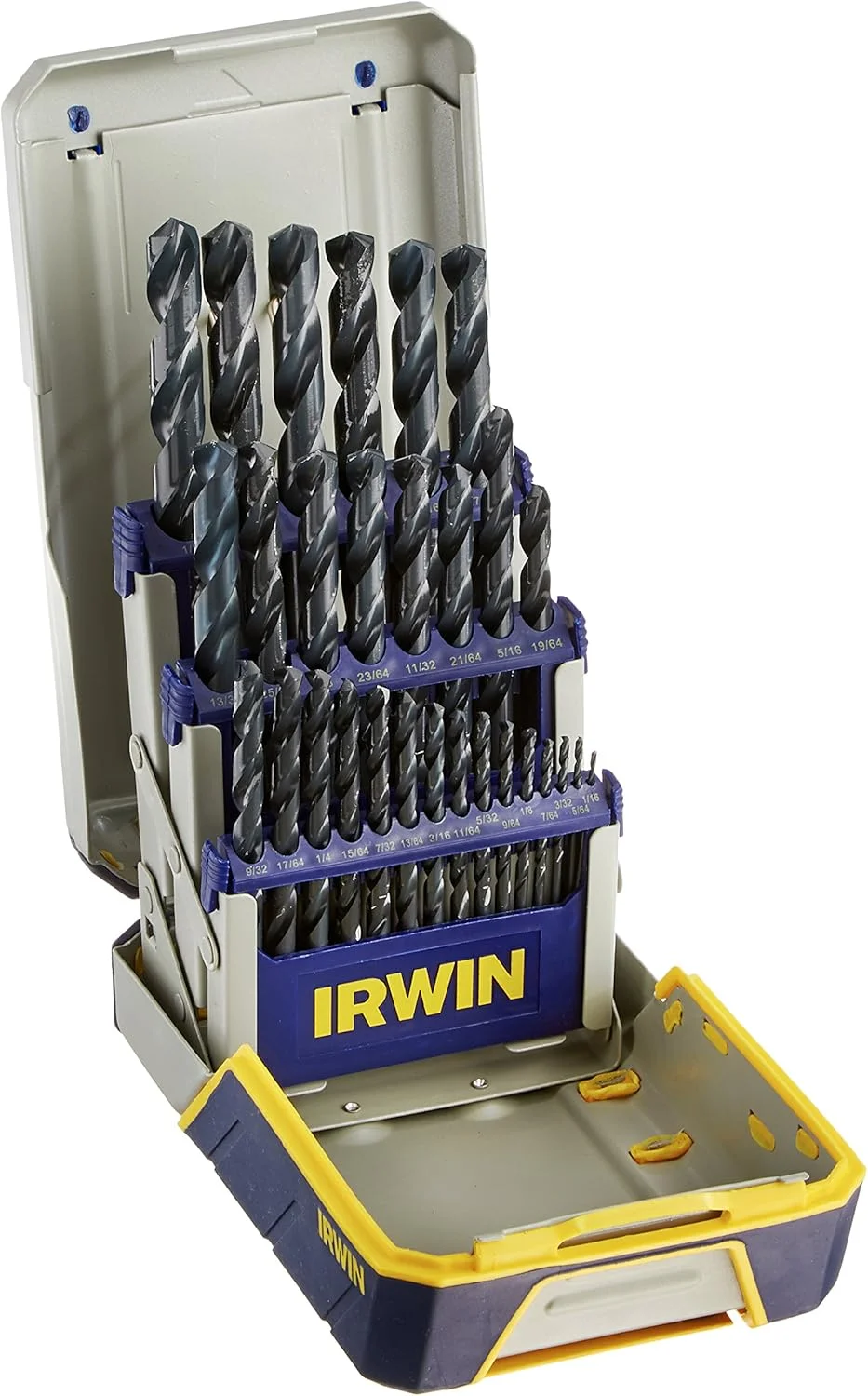
Irwin Tools 29-Piece Cobalt M35 Drill Bit Set
- M35 cobalt — handles steel and stainless
- 29-piece — 1/16″ through 1/2″ by 64ths
- 135° split point — no center punch needed
- Gold finish indicates cobalt content
View on Amazon →
Hard Material
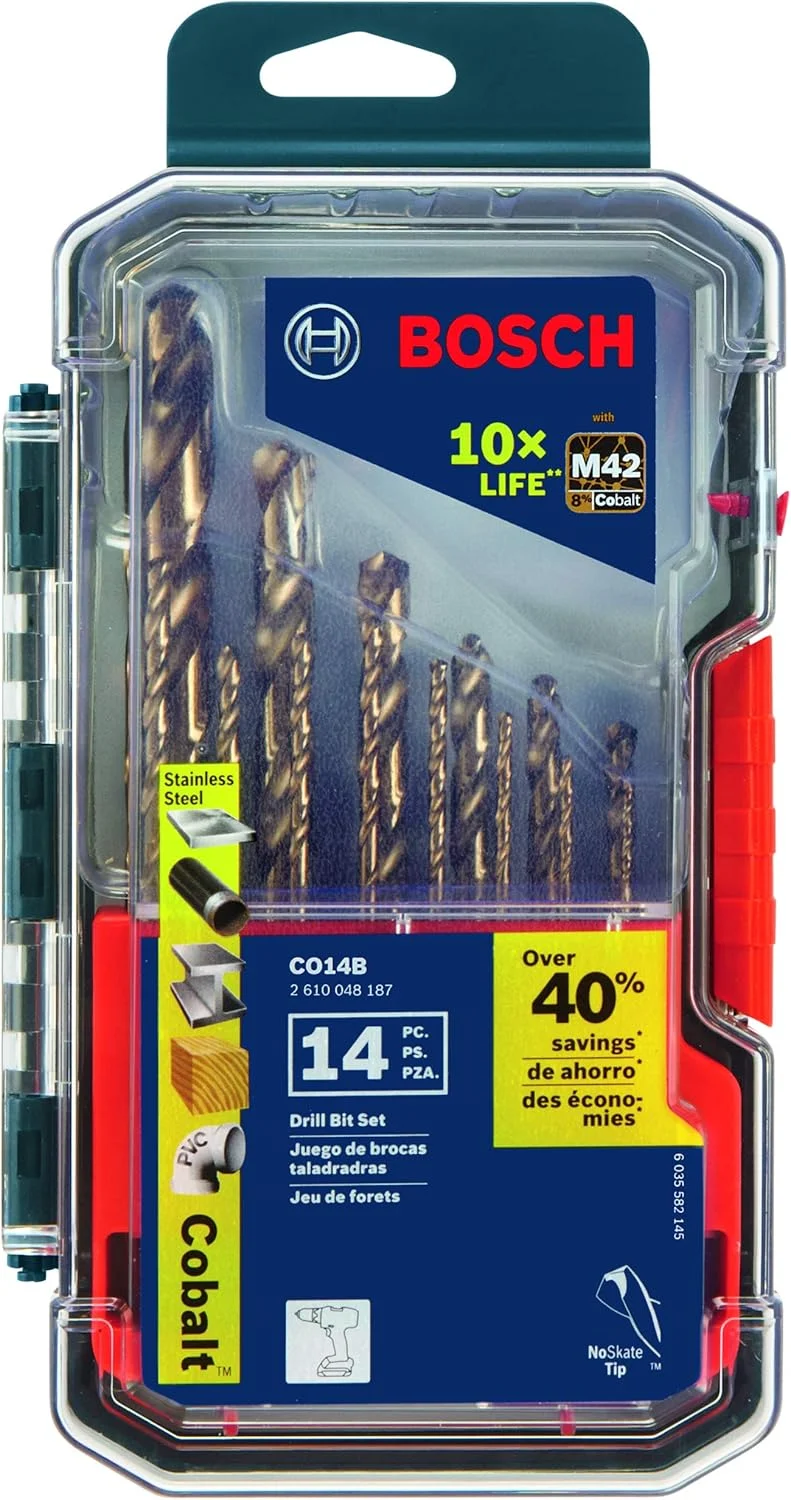
Bosch CO14B M42 Cobalt Set — 14-Piece
- M42 = 8% cobalt — premium heat resistance
- Best for stainless, hardened steel, Inconel
- 135° split point for accurate starts
- Longer tool life in the toughest materials
View on Amazon →
Lubrication

WD-40 Specialist Cutting & Drilling Oil
- Reduces heat and friction at the cutting edge
- Works on steel, aluminum, and most metals
- Extends bit life significantly vs. dry drilling
- Easy application — spray directly on bit and work
As an Amazon Associate, TestTalkHQ earns from qualifying purchases.
Common Drilling Mistakes — And How to Fix Them
- Running too fast on steel. The most universal mistake. When in doubt, slow down. A bit dulled by too much speed is wasted money; a bit running too slow just takes longer.
- No center punch. Walking drill bits leave oversize, off-center holes and put stress on the bit that accelerates wear. A center punch and one sharp strike before drilling is 30 seconds that saves your bit.
- Not clearing chips. Chips in the flutes act as an insulator, trapping heat and re-cutting already-cut material. For deep holes, peck-drill — advance, retract to clear chips, advance again. For shallow holes, you’ll see chips clearing on their own if your feed and speed are right.
- Using HSS where cobalt is needed. A cobalt bit in stainless steel is not a luxury — it’s a requirement. Running HSS in stainless isn’t just frustrating, it’s more expensive per hole than buying the cobalt set to start.
- Drilling dry in steel. The cutting edge hitting dry steel without lubrication is the fastest path to a dull bit. Keep cutting oil at the drill press — it’s inexpensive and the ROI in bit life is immediate.
- Inconsistent feed pressure. Especially critical in stainless and titanium. Establish your feed rate and maintain it. Hesitation mid-hole causes work hardening and built-up edge that ruins the hole and the bit.
FAQ
What RPM should I use to drill stainless steel?
For a 1/4″ cobalt bit in 304 stainless, target around 580 RPM — calculated from SFM 38 (mid of 30–50 range) using RPM = (38 × 3.82) / 0.25. For a 1/2″ cobalt bit, that drops to around 290 RPM. Stainless requires far slower speeds than most people expect. The slower speed, combined with firm feed pressure and cutting oil, is what makes the difference between a hole and a destroyed bit.
What do blue chips mean when drilling?
Blue chips indicate the metal is reaching temperatures where it’s beginning to oxidize and discolor — typically above 400°F for steel. This means your cutting edge is getting too hot, which softens the bit material and accelerates wear. Slow down your RPM immediately, apply more cutting oil, and verify your feed rate. Continuous blue chips with cutting oil applied means your speed is still too high for the material and bit combination.
Is cobalt drill bit better than titanium-coated (TiN)?
For drilling steel, stainless, and hard metals — yes, solid cobalt (M35 or M42) outperforms TiN-coated HSS significantly. TiN coating improves surface lubricity and adds modest heat resistance, but it’s a coating over HSS. Once the coating wears through, which happens quickly in hard materials, the bit performs like standard HSS underneath. Cobalt alloy is through-and-through — it retains its heat resistance even as the bit wears and is resharpened.
Can I use a hand drill for stainless steel?
Yes, but it’s harder to do well than a drill press. The challenge with hand drilling stainless is maintaining consistent feed pressure, which is critical to prevent work hardening. Use a sharp cobalt bit, start with a center punch, flood with cutting oil, and apply firm constant pressure. Avoid variable-speed trigger hunting — set a slow consistent speed and feed. A drill press is significantly more effective for stainless because it maintains consistent pressure automatically.
Why do my drill bits dull so fast?
The most common reasons: running too fast (heat softens the edge), drilling without cutting fluid in steel, dwelling on the workpiece without cutting (especially deadly in stainless), using HSS bits in materials that require cobalt, and not center-punching (causing walking and uneven edge loading). Address these in order — most shops find that simply slowing down and adding cutting oil dramatically extends bit life before changing to a better bit grade.
What’s the difference between M35 and M42 cobalt drill bits?
M35 contains 5% cobalt and M42 contains 8% cobalt. M42 has better hot hardness — it holds its edge at higher temperatures than M35. For general use in mild steel and 300-series stainless, M35 is adequate and less expensive. For hardened steels, 17-4 PH stainless, Inconel, and other difficult materials, M42 is worth the premium. Both are vastly better than standard HSS in any steel application where heat is a concern.
Get Your Exact RPM and Feed Rate
Our free drill speed calculator covers all common metals with material-specific SFM values for HSS, cobalt, and carbide. Enter your bit diameter and material — get your target RPM and feed rate guidance.
🔧 Open Drill Speed Calculator →
SFM values per industry machining data and Machinery’s Handbook guidelines. Always verify with your bit manufacturer’s recommendations for specific alloys. TestTalkHQ.com — free tools for tradespeople.
Bandsaw blades are not twist-drill SFM: Bandsaw Blade Selection Guide. Bolt-circle layouts: Bolt-Circle / Hole-Pattern Generator. Sine-bar setup before a precision hole: Sine Bar Setup Guide.
When calculated RPM looks right but the bit burns, walks, finishes poorly, or snaps, use Drill Speed Troubleshooting. Bit type and coating decisions: How to Choose Drill Bits for Metal.