Calculators & guides only — no articles or blog noise.
Compound Miter Angle Calculator
Miter and bevel for crown and any sprung moulding, worked from the corner you actually measured — the published formulas your saw’s detents were cut from
Standard US crown in a square corner is 31.62° miter and 33.86° bevel, and your saw almost certainly has a detent for both. That is the easy case, and it is the only case every chart online covers. Put a protractor in a real corner and you will read 87° or 93°, and the settings move to 32.97°/34.86° or 30.30°/32.85°. DeWALT says so in its own manual — “since most rooms do not have angles of precisely 90°, you will have to fine tune your settings anyway” — and Gary Katz, who has installed crown for 25 years, puts it more bluntly: if the corners are not 90°, “which they rarely are, all your cuts will be off.” This page takes the corner you measured and the spring angle your moulding actually has, including the 33° patterns that no chart lists, and prints both the flat-cut pair and the in-position setting — plus how much a one-degree mis-measure costs you, so you know whether to trust the protractor or cut a test piece.
Embed this calculatorFree · no API key · keep the attribution link
Copy the snippet below to embed this calculator on your site. The attribution link must stay intact and dofollow (no rel="nofollow"). Browse all embeddable calculators
Every setting on this page is only as good as two numbers: the plan angle of the corner and the spring angle of the moulding in your hand. Both come off the job rather than off paper, and the first one is the reason the standard chart fails — a drywall corner is routinely a degree or two out, which is worth about half a degree of miter. The rest of the list is the part of crown work that happens after the cut is right.
Measures the corner and sets the bevel
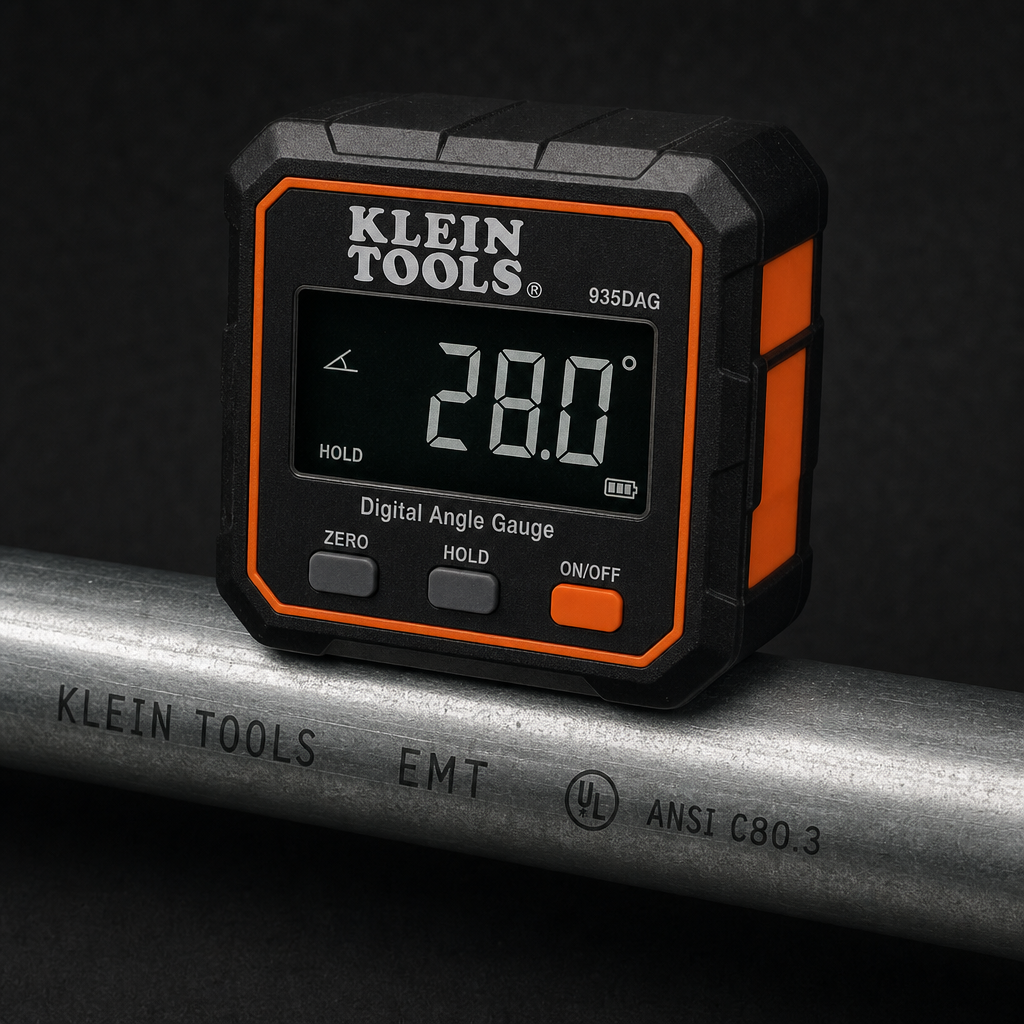
Klein Tools 935DGGP Digital Angle Gauge
Reads the real corner angle instead of assuming 90°
Also sets the blade tilt, which no saw bevel scale does well
Magnetic base sits on the saw table or a wall face
As an Amazon Associate, TestTalkHQ earns from qualifying purchases. Prices and availability can change.
How to Use This Compound Miter Angle Calculator
Two angles in, three settings out. The reason to do this rather than reach for the printed chart is that the chart assumes both numbers, and in a real room both are usually wrong.
tan(miter) = sin(spring) ÷ tan(corner ÷ 2) sin(bevel) = cos(spring) × cos(corner ÷ 2) with the spring angle measured from the back of the moulding to the wall, and the corner the full plan angle the moulding turns through
Get the spring angle from the back of the moulding, not the front. For stock sold as 52/38 it is 38; for 45/45 it is 45. If it is neither, hold the moulding in position against a framing square and measure the two legs — how far it drops down the wall and how far it reaches onto the ceiling — and let the calculator take the arctangent. Gary Katz: “it is the back that determines the spring angle, not the front.”
Measure the corner. Every corner. This is the step that separates a tight joint from a caulked one. An angle finder in the corner, read on the side the moulding is on. Two corners in the same room are routinely a degree apart.
Say whether it is inside or outside. The calculator converts an outside corner to its plan angle for you. You will notice the miter and bevel come out the same either way — that is correct, and only the waste side changes.
Check the saw range card. On a sharp corner the flat-cut miter can run past what the saw will swing while the in-position setting is still easily reachable. That is a decision the geometry makes for you.
Read the one-degree card before you trust the protractor. It tells you what your measurement error is actually worth. Around a square corner it is roughly 0.45° of miter per degree of corner — small enough that a half-degree reading error will not ruin the joint, large enough that a three-degree assumption will.
Cut scrap first. Not optional, and not our idea. DeWALT prints it in capitals: “PRETESTING WITH SCRAP MATERIAL IS EXTREMELY IMPORTANT!”
Why 31.62° and 33.9° are stamped on your saw
Pick up almost any compound miter saw and you will find a detent at 31.62° on the miter scale and a stop pawl at 33.9° on the bevel. Those are not arbitrary factory choices and they are not a brand convention. They are this page’s two formulas evaluated at a 38° spring angle and a 90° corner:
miter = arctan( sin 38° ÷ tan 45° ) = 31.6197° bevel = arcsin( cos 38° × cos 45° ) = 33.8616°
DeWALT’s own manual states the detents and the reason for them in the same paragraph: “your miter saw has special pre-set miter latch points at 31.62° left and right for cutting crown molding at the proper angle and bevel stop pawls at 33.9° left and right,” and “the settings below are for all standard (U.S.) crown molding with 52° and 38° angles.” Swap the moulding for a 45/45 pattern and the same two formulas give 35.26° and 30.00°, which is the other pair published everywhere — WOODWEB states both: “on 38-52 crown, bevel angle is 33.9 and miter angle is 31.6. On 45-45 crown, bevel angle 30.0 and miter angle is 35.3.”
So the detents are right, exactly twice: 38° spring in a true 90° corner, and 45° spring in a true 90° corner. Everything else on a real job is off the detent, and that is the whole reason this calculator exists rather than a chart.
The convention trap that produces plausible wrong answers
A moulding called “52/38” names both of its rear flats. The spring angle — the number the formula wants — is the smaller one, 38°, because that is the flat that bears on the wall. DeWALT spells it out: crown has “a top rear angle (the section that fits flat against the ceiling) of 52° and a bottom rear angle (the part that fits flat against the wall) of 38°.”
Put 52 into the formula instead of 38 and you get 38.24° miter and 25.81° bevel. Nothing about those numbers looks wrong. They are in the right range, they are not round, and they will waste a whole run of moulding. If a set of settings is not landing near the detents for a near-square corner, this is the first thing to check.
Where the two formulas come from
Neither formula is a fudge factor, and you do not have to take them on faith. Both fall out of one piece of vector geometry, and the derivation is short enough to follow.
Stand the corner up along a vertical line. The two walls meet at a plan angle, so each wall runs away from the corner at half that angle either side of the bisector. A sprung moulding on a wall does not lie in the wall plane — it leans out, pivoting about its own length, by exactly the spring angle. So the plane the moulding occupies is spanned by two directions: along the wall, and the wall’s vertical rotated out toward the room by the spring angle.
A mitre joint is where the two mouldings’ planes intersect, and because the two pieces are symmetric about the corner bisector, that intersection line sits in the bisector plane. Solve for it and the line comes out as:
mitre line ∝ ( sin(spring) ÷ sin(corner÷2), 0, cos(spring) )
Two readings of that one line give the two settings:
The miter is the angle of that line measured within the plane of the board, away from a square crosscut. Working it out gives arctan( sin(spring) × cot(corner÷2) ), which is the first formula.
The bevel is how far the cut plane is tilted away from the board’s own face normal. That comes out as arcsin( cos(spring) × cos(corner÷2) ), the second formula.
The derivation is worth having because it tells you what the formulas assume, and therefore when they stop being true: that both pieces are sprung at the same angle, that the cut bisects the corner, that the back of the moulding is flat, and that the corner is a vertical line. Break any of those — a raked ceiling, a cupped board, one piece left square on purpose — and the answer is not slightly off, it is the answer to a different question.
Four sanity checks you can do in your head
Spring 90°, corner 90° → miter 45°, bevel 0°. A 90° spring angle means the stock is lying flat on the ceiling, so it is a plain 45° miter with the blade square. Correct.
Spring 0°, corner 90° → miter 0°, bevel 45°. A 0° spring angle is flat stock against the wall. Laid flat on the saw table, that is a plain 45° blade tilt. Correct.
Corner 180° → miter 0°, bevel 0°. A straight run is a square cut. Correct.
Corner C and corner 360°−C → identical settings. Inside and outside corners of the same reading share one pair of numbers, which is why your saw needs only one detent for both.
Polygon corners: bays, columns and gazebos
When the corner is set by construction rather than by a drywall crew, the angle is exact and you should use it rather than measuring. A regular polygon with n sides has interior corners of 180° − 360°/n. Note the form carefully — it is not 360°/n, and that slip is the most common mistake in polygon trim work.
Flat-cut settings at a 38° spring angle, with the in-position miter for comparison
Shape
Sides
Corner
Miter (flat)
Bevel (flat)
In position
Square corner / square column
4
90.00°
31.62°
33.86°
45.00°
Pentagon
5
108.00°
24.10°
27.59°
36.00°
Hexagon
6
120.00°
19.57°
23.20°
30.00°
Heptagon
7
128.57°
16.51°
19.99°
25.71°
Octagon (the common bay)
8
135.00°
14.31°
17.55°
22.50°
Nonagon
9
140.00°
12.63°
15.64°
20.00°
Decagon
10
144.00°
11.31°
14.09°
18.00°
Dodecagon
12
150.00°
9.37°
11.77°
15.00°
Hexadecagon
16
157.50°
6.98°
8.84°
11.25°
Every row here reproduces from the two formulas to within 0.005° of the table SBE Builders publishes for a 38° spring angle, which is a useful independent check on both the formulas and the transcription.
The common bay window is the octagon row: a 135° corner, needing 14.31° of miter and 17.55° of bevel. It is a long way from the 31.62° detent, and it is the case where people reach for “half of 45” and get it wrong.
Cutting flat versus cutting in position
There are two legitimate ways to cut crown and this calculator gives you the settings for both. The choice is not obvious and the trade is real, which is why 25-year installers still disagree about it in public.
Flat on the table (the compound cut)
The moulding lies flat, face up, and both the table and the blade are set off square. This is what the 31.62°/33.9° detents are for. It is the only option once the moulding is taller than the saw fence — as one WOODWEB contributor points out, on many saws “the fence is only 1 1/2 inch tall.” The cost is that you are now relying on two scales, and one of them is poor. Katz again: “it is tough to dial in most bevel gauges to even one degree of accuracy, let alone 1/2 degree … the bevel gauge on a miter saw is not nearly as accurate as the miter gauge — just look at the difference in the radius of each gauge.”
In position (nested against the fence)
The moulding is held at its spring angle against the fence, the blade stays square, and only the table swings. The setting is simply half the turn — 45° for a square corner, whatever the spring angle is. DeWALT recommends this route and says why: “the advantage to cutting crown molding using this method is that no bevel cut is required. Minute changes in the miter angle can be made without affecting the bevel angle. This way, when corners other than 90° are encountered, the saw can be quickly and easily adjusted for them.” The catch is that the moulding has to sit at exactly its spring angle every time, which means a crown stop, a jig or the accessory fence — and the two rear flats must “rest squarely on the fence and saw table.”
The short version. If the moulding fits against the fence and you have a way to hold it there, cutting in position needs one accurate gauge instead of two and adapts to odd corners in seconds. If the moulding is too tall to nest, cut it flat and spend your attention on the bevel setting, because that is the one that will drift.
One thing the geometry settles that opinion cannot: on a sharp corner the flat-cut miter can exceed what the saw will physically swing. A 60° corner at a 38° spring angle needs 46.84° of miter and 43.03° of bevel, past a saw that stops at 45°. The same corner cut in position needs 60° of miter and no bevel at all — which some saws have and some do not. The calculator checks both against the range you enter.
What this calculator will not do, and why
Each of these is a real question people arrive with, and in each case a number here would be worse than no number.
Coped inside corners. A cope is a scribe to the profile of the adjoining piece, not an angle setting. It is also the better joint for inside corners in painted work, because it does not open when the building moves. There is no miter and bevel pair to give you.
Cathedral and raked ceilings. When crown runs up a slope the effective spring angle changes along the run and the two pieces meeting at a peak are not symmetric about a vertical bisector. That breaks the central assumption of the derivation above. It is a solvable problem, but not with these two formulas, and an approximate answer would look right and fit badly.
Cupped, twisted or non-parallel stock. The formulas assume the back of the moulding is flat and bears on both surfaces. Katz: “if the back is cupped, even a little, it will throw off your compound angle cuts big time.” No formula recovers that. Measure the back, and test-cut.
Corners you intend to cut asymmetrically. Leaving one piece square and throwing the whole angle onto the other is a legitimate trick, especially on a short return. It is not what these formulas compute — they assume a true bisecting mitre with both pieces sprung the same.
Length, quantity and waste. Different job. So are fasteners and whether the crown lands on framing, which is a stud-finder question rather than a trigonometry one.
If what you are really chasing is seasonal gaps opening in joints that were tight when you cut them, the angle is not your problem — that is wood movement, and the wood shrinkage calculator and its moisture-content guide are the right place to start.
Related Calculators
More free trade calculators from TestTalkHQ — same shop floor, neighboring trades.