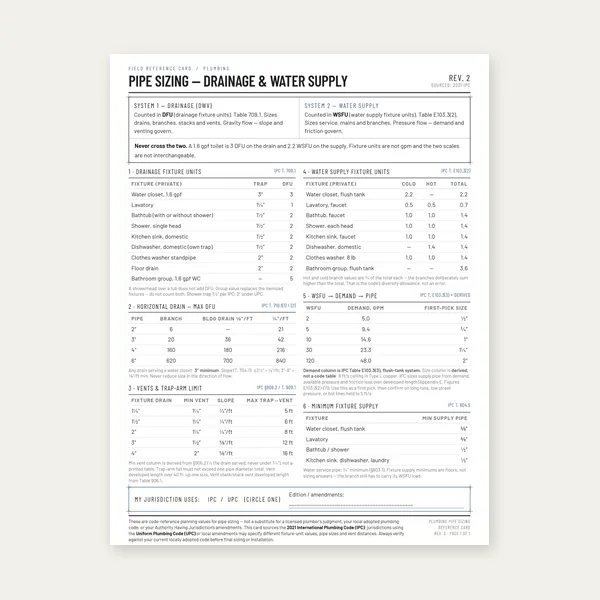
Plumbing Pipe Sizing Card
$3.99
BuyStandard grain capacity by household size and hardness band — and when well water, iron, and oversizing make the table the wrong answer
The water softener sizing calculator is the live formula: your people count, your gallons, your GPG or ppm, optional iron, a 7-day cycle, and a 25% reserve, then round up to a standard grain class. This page is the lookup for visitors who want a grid first. It is a different shape from a single result — household bands down the side, hardness bands across the top, recommended class in each cell — not a restatement of one worked example.
Why the cells say 24,000 vs 32,000 vs 48,000: sizing guide. Salt-based only (salt-free has no grain column): comparison. Regenerating too often or hardness still at the tap: troubleshooting. Plumbing index: plumbing calculators hub.
Have a lab number or a water bill?Override gallons and enter exact GPG or ppm. Iron field for wells.
Open Calculator →Read down to your household size, then across to the hardness band from a strip or a lab. The cell is the standard salt-based class this site would round you to under city-water assumptions. Slightly hard is 1–3.5 GPG, moderately hard 3.5–7, hard 7–10.5, very hard 10.5+ (this grid uses 15 GPG as the planning figure for that last column). Household 1–2 uses 2 people, 3–4 uses 4, 5–6 uses 6, 7+ uses 8. If you are a family of four on 10 GPG city water, you are in 3–4 people × hard: 32,000 grains. That is the same landing the calculator gives for 4 × 75 × 10 with the 25% reserve.
| Household | Slightly hard 1–3.5 GPG |
Moderately hard 3.5–7 GPG |
Hard 7–10.5 GPG |
Very hard 10.5+ GPG |
|---|---|---|---|---|
| 1–2 people | 24,000 | 24,000 | 24,000 | 24,000 |
| 3–4 people | 24,000 | 24,000 | 32,000 | 48,000 |
| 5–6 people | 24,000 | 32,000 | 48,000 | 64,000 |
| 7+ people | 24,000 | 48,000 | 64,000 | 80,000 |
Capacities are grain classes, not product names. Very hard at 20+ GPG, iron, or a daily-use override from a water bill can move you off this grid. 7+ people at slightly hard still lands on 24,000 because 8 × 75 × 3.5 GPG × 7 × 1.25 is under 24,000. Do not read that as “tiny house, tiny problem” if the well is actually 18 GPG.
The grid is conservative on the axes (high end of each band) and honest about what it omits. It assumes all indoor water is softened at 75 gallons per person. It assumes no iron. It assumes you want a 7-day cycle with a 25% reserve, the same rules as the calculator. A two-person apartment on 3 GPG municipal water that only showers at the gym will be happy on 24,000 grains; the table cannot see the gym. A water bill is the override that belongs in the calculator, not a second table.
Hardness bands follow the usual slightly / moderately / hard / very hard splits in grains per gallon (ppm ÷ 17.1). If your report is 180 ppm, that is about 10.5 GPG — the left edge of very hard, not “hard.” Using the hard column would undersize a 3–4 person house (32,000 vs 48,000 at 15 GPG planning). When the number sits on a boundary, use the harder column or type the exact figure into the calculator.
The 1–2 person row is 24,000 grains in every hardness band on this grid, including very hard at 15 GPG. That is math, not a recommendation to ignore a 25 GPG well. Two people at 25 GPG is 2 × 75 × 25 = 3,750 grains/day, 26,250/week, 32,813 with reserve — a 48,000-grain class, which the very-hard column does not show because it stops at a 15 GPG planning value. Off-grid hardness is why the calculator exists beside the chart.
Well water is why this chart is not a substitute for the calculator. Iron at 1 ppm is treated as 5 extra GPG of hardness on the worksheet. That can be a full commercial class by itself. A 3–4 person well at 7 GPG (moderately hard cell: 24,000) with 1.5 ppm iron is compensated to 14.5 GPG — past the hard column and into 48,000-grain territory after reserve. If you only read the 24,000 cell, you will own the mid-week hardness failure described in troubleshooting.
Size up one full tier from whatever cell you land on when any of these is true: (1) the source is a well and you have not tested iron yet, (2) iron is measured above a trace, (3) manganese is on the lab sheet, (4) the household is 6+ people with overlapping showers. “One tier” means 24,000 becomes 32,000, 32,000 becomes 48,000, 48,000 becomes 64,000. It does not mean jump to 96,000 because the well “looks rusty.” Test, then calculate. Well pumps that feed this water are a different size problem: well pump sizing calculator.
City water can have iron too, but it is unusual as a sizing driver. Municipal reports in ppm still need the ÷ 17.1 conversion before you pick a column. Do not pick “hard” because the city said the water was hard in prose if the number is 80 ppm (about 4.7 GPG, moderately hard).
The failure everyone knows is undersizing: the valve regenerates every other day, salt disappears, hardness leaks by Thursday. The failure the table is here to prevent in the other direction is a 64,000-grain tank on a two-person, slightly hard city house. Nameplate capacity is huge. Daily grain load is tiny (2 × 75 × 3.5 = 525 grains/day). Even a 75% drawdown is 48,000 grains — about 90 days if you tried to use it. In practice the control is set for a 7-day clock or a meter that barely ticks. Regeneration then treats a thin slice of the bed. Brine does not contact the whole resin volume evenly. The bed channels. You get hard water with a tank that looks oversized on the invoice.
Inefficient low-flow regeneration is not “saving salt.” It is rinsing a poorly used bed and sending water to drain without exchanging a week of actual hardness. Metered valves help, but they cannot fix a tank that is two classes too large for the load. Stay on the cell, or one tier up for well iron, not three tiers up for peace of mind. Peace of mind on a well is an iron test.
Salt-free conditioners do not appear in this grid because they have no grain class. If that is the product you are comparing, stop using this chart and read salt-based vs salt-free. Flow rate is the spec. A 32,000 in a cell is not a 32,000-grain salt-free cartridge.
4 × 75 × 10.5 (top of “hard”) = 3,150 grains/day. × 7 = 22,050. × 1.25 = 27,563, which rounds to 32,000. At exactly 10 GPG the reserve is 26,250, still 32,000. 24,000 is the weekly demand without reserve. Same story as the calculator’s family-of-four city example.
5–6 people. The row uses 6 as the high end, so it is slightly conservative for five. If you want the exact 5-person number, use the calculator.
No. Heaters are first-hour rating. Well pumps are GPM at total dynamic head. Softeners are grains between regenerations. Three worksheets: water heater, well pump, softener.
$3.99
Buy
$12.99
Buy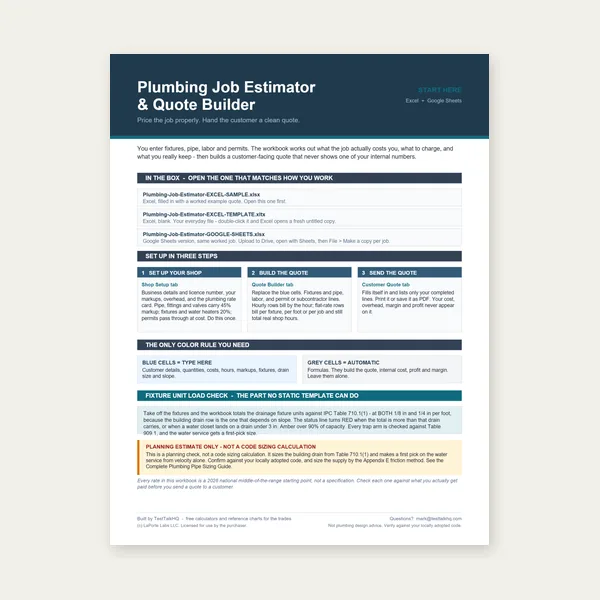
$29.00
Buy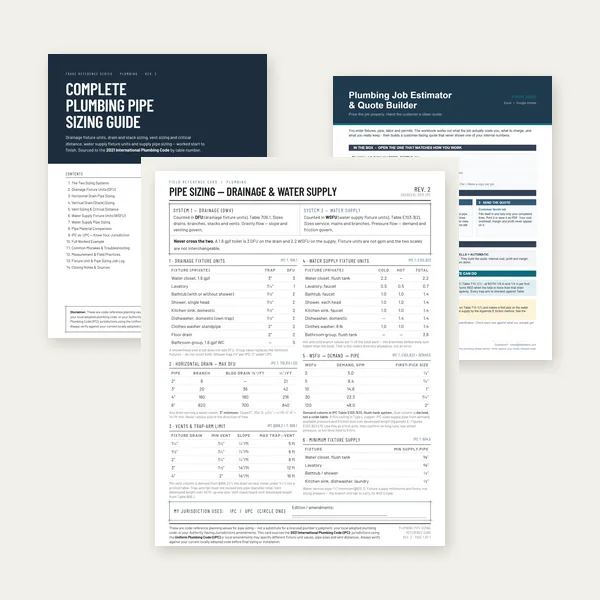
$39.00
BuyCheckout opens here — you stay on this page.