Ohm's Law & Power Troubleshooting
When V = IR and P = VI look right on the calculator but the meter, the load, and the breaker disagree
This is field diagnosis of bad inputs and wrong assumptions — not another formula walkthrough. Solve unknowns with the Ohm's Law & Power Calculator. Learn the relationships in Ohm's Law and Power Formulas Explained. When the failure is really PF / kW / kVA / phase, jump to kW / kVA / Amps Troubleshooting.

Ohm's Law Problems Quick Answer
Use this when the algebra matched but the clamp, the Kill-A-Watt, or the breaker story doesn't. Most failures are bad measurements or applying DC Ohm's Law to AC loads that aren't resistive.
| Symptom | What it usually means | First fix | Next tool |
|---|---|---|---|
| Calculated I off by ~1.4× | Peak voltage used as RMS (or reverse) | Use true-RMS V; Vpeak ≈ VRMS × √2 | Ohm's Law Calculator |
| Measured R absurdly low / high | Resistance taken in-circuit (parallel paths or still powered) | De-energize, isolate the component, then measure | Ohm's Law Guide |
| W from V×I doesn't match wattmeter | PF < 1 — you calculated VA, not watts | Include PF or measure true watts | kW/kVA Troubleshooting |
| Equivalent R doesn't match parts | Series sum used on a parallel string (or reverse) | Confirm topology; re-solve series vs parallel | Series-Parallel Calculator |
| DC Ohm's Law on motor/transformer | Inductive AC load treated as pure R | Use impedance / PF-aware power equations | Three-Phase Power Calculator |
1. Peak Voltage Used as RMS — ~1.414× Current Error
What it looks like: Scope or meter peak reading fed into I = V/R or P = VI. Calculated current or power is ~41% high (or low if you reverse it). Breaker and wire sizing based on that number don't match field clamps.
Likely causes: For a sine wave, Vpeak = VRMS × √2. Ohm's Law and power equations for AC use RMS values unless you deliberately work in peak and convert. Average-responding meters on distorted waveforms also lie — need true RMS.
Fixes: Enter true-RMS voltage and current into the Ohm's Law Calculator. If you only have a peak reading from a scope, divide by √2 before calculating. Prefer a true-RMS meter on non-linear loads.
2. Resistance Measured In-Circuit — Parallel Paths or Live Circuit
What it looks like: Ohm reading is far below the part's marked value, or the meter beeps continuity across something that should be open. Or the meter is damaged after probing a live circuit on the ohms range.
Likely causes: Measuring a resistor (or winding) still connected in parallel with other paths — the meter sees the network, not the part. Measuring with power applied injects foreign voltage into the ohms function. Capacitors, diodes, and semiconductor paths further distort DC ohms readings.
Fixes: De-energize and verify with a voltage tester. Lift at least one lead of the component (or disconnect the circuit) before measuring resistance. Compare against the nameplate/color code, then use V and I under load if you need operating resistance of a hot element.
3. V × I Called "Watts" on a Non-Unity PF Load
What it looks like: Clamp × volts says 1,800 VA. Kill-A-Watt or power analyzer says 1,200 W. Someone sized a generator or circuit on the higher number as "watts" — or the reverse, undersized on watts when conductors care about amps/VA.
Likely causes: On AC, V × I is apparent power (VA) only when you ignore PF. Real power W = V × I × PF (1φ). Motors, transformers, and switch-mode supplies routinely run PF 0.6–0.9. This is the same failure mode covered in depth by kW / kVA / Amps Troubleshooting — cross-link there rather than re-deriving PF traps here.
Fixes: Measure true watts when you need energy/work; use VA/amps for conductor and source sizing. Reconcile with the Ohm's Law calculator only when PF is known or the load is resistive.
PF, phase, or generator kVA vs kW? That's the kW/kVA cluster, not basic Ohm's Law.
kW/kVA Diag4. Series Formula on a Parallel Network (or Reverse)
What it looks like: Equivalent resistance is way too high or too low versus the parts on the bench. Current splits don't match predictions. A "total R" was summed when the resistors are in parallel — or paralleled when they're in series.
Likely causes: Series: Req = R1 + R2 + … Parallel: 1/Req = 1/R1 + 1/R2 + …. Mixing the rules is the classic student/field error when tracing a schematic under time pressure. Voltage dividers and current dividers get swapped the same way.
Fixes: Confirm topology before calculating. Use the Series-Parallel Circuit Calculator and the Series-Parallel Circuits Guide when the network isn't a single resistor.
5. DC Ohm's Law Forced Onto Inductive AC Loads
What it looks like: Motor or transformer winding DC resistance is a few ohms, so "I = V/R" predicts hundreds of amps. Nameplate FLA is nothing like that. Someone planned protection from the DC ohms number.
Likely causes: AC inductive loads are governed by impedance Z = √(R² + XL²), not just R. Locked-rotor and inrush currents are higher than FLA but still not V/RDC. Applying DC Ohm's Law to coil resistance predicts a short that isn't there in normal AC operation.
Fixes: Use nameplate FLA / power equations for motors and transformers. Treat DC resistance as a winding-health check, not an operating-current predictor. For three-phase power math, use the Three-Phase Power Calculator; for motor current, use the Motor FLA Calculator.
Decision: Which Formula Set — Already Covered
No new decision article for this cluster. Watts vs VA vs kWh is covered in the Ohm's Law guide; series vs parallel has its own calculator and guide; PF / kW / kVA / phase failures live on the kW/kVA troubleshooting page. Use those instead of duplicating.
Ohm's Law Guide → Series-Parallel Calculator → kW / kVA Troubleshooting →
Recommended Tools for V, I, R & Power Checks
Five CSV catalog picks with verified images — measure true-RMS volts and amps, capture real watts, and verify de-energization before ohms tests
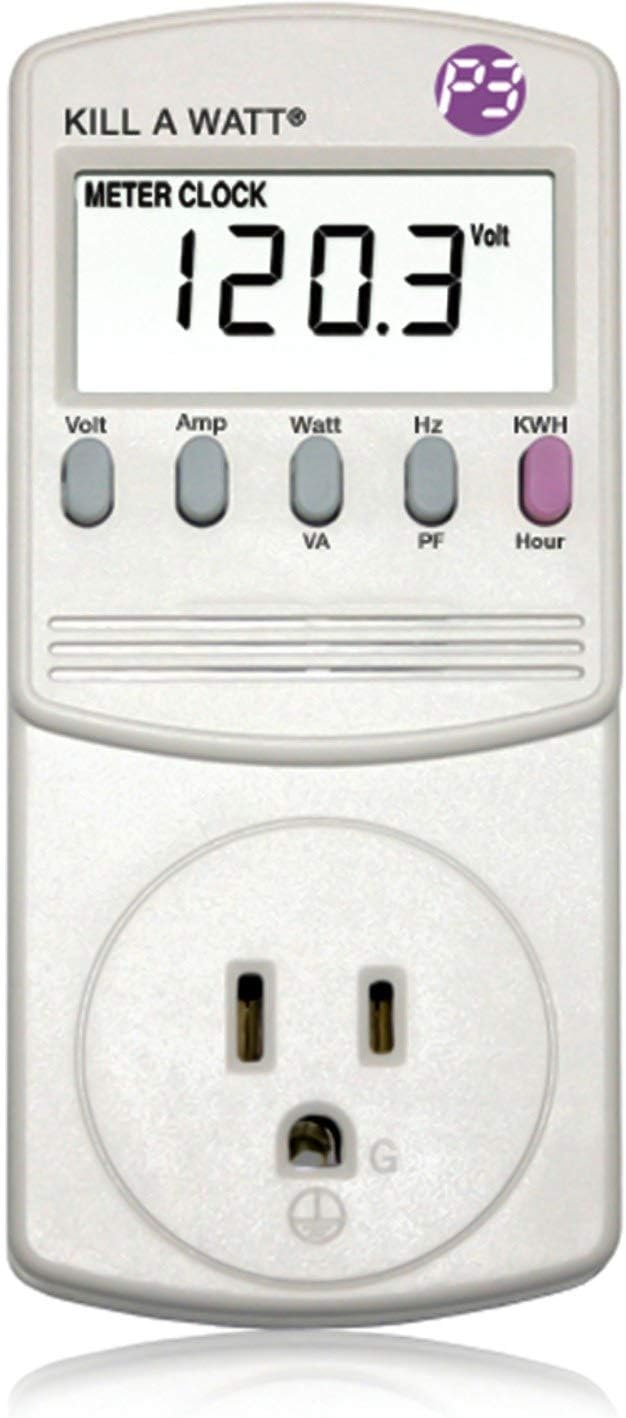
P3 Kill A Watt Electricity Usage Monitor
- Live V, A, and true watts on plug loads
- Expose V×I vs watts (PF) gaps
- Quick sanity vs calculator
- Electrical catalog

Fluke 117 Electricians True RMS Multimeter
- True-RMS voltage for Ohm's Law inputs
- Resistance / continuity for isolated R
- CAT III for panel work
- Electrical catalog

Ideal Industries 61-757 Clamp Meter
- 600A AC/DC TRMS line current
- Reconcile I with V and calculated R
- TightSight for panel conductors
- Electrical catalog

Klein Tools CL800 Digital Clamp Meter
- 1000V class TRMS clamp
- Confirm branch amps vs P/V math
- 1φ and 3φ feeder checks
- Electrical catalog

Klein Tools NCVT-3P Non-Contact Voltage Tester
- Confirm de-energized before ohms tests
- Dual-range presence check
- Prevent meter damage on live R checks
- Electrical catalog
As an Amazon Associate, TestTalkHQ earns from qualifying purchases. All five cards are sourced only from the affiliate CSV with verified product images. Catalog gap flagged by name: no dedicated LCR / impedance meter SKU (for measuring XL/XC on inductive AC loads) currently exists in the CSV.
Frequently Asked Questions
Why doesn't V×I match my wattmeter?
On AC with PF < 1, V×I is VA (apparent power), not watts. Measure true watts or include PF. See kW / kVA Troubleshooting.
Can I measure resistance with the circuit powered?
No. De-energize and isolate the component. Live ohms measurements are wrong and can damage the meter.
Why is motor winding resistance so low compared to FLA?
DC resistance isn't operating impedance. AC inductive loads follow Z, not just R. Use nameplate FLA / power equations for operating current.
Is this the same as the Ohm's Law guide?
No. The guide teaches V, I, R, and P relationships. This page diagnoses bad measurements and wrong assumptions when the formula already looked correct.
Series or parallel — how do I know?
Same current through each part → series. Same voltage across each part → parallel. When unsure, use the Series-Parallel Calculator.