Commercial service and feeder demand follows NEC Article 220 Part III — occupancy lighting unit loads, receptacle VA, equipment demand factors, and noncoincident HVAC rules. This is not the dwelling optional method in 220.82.
When Commercial Load Calc Applies
Use commercial (Part III) methods for offices, retail, restaurants, warehouses, banks, schools, and similar tenant or building spaces. Dwelling units — including most single-family service upgrades — belong on the residential load calculation guide and the residential / load calculation tools (NEC 220.82 optional method).
Mixing methods is a common plan-review failure: you cannot take dwelling 40%-after-10kVA demand and apply it to a storefront lighting load.
Single-family / multifamily dwelling unit → residential optional or standard dwelling rules. Everything else with occupancy unit loads → commercial Part III (this guide).
NEC Article 220 Part III — Method Overview
Connected load is what is installed. Demand load is what the code allows you to size feeders and service for after diversification factors. Commercial calcs typically:
- General lighting — floor area × unit load (VA/ft²) from NEC 220.12 by occupancy. Some occupancies also allow lighting demand factors in 220.42 where applicable.
- Receptacles — often 180 VA per general-purpose outlet (220.14), then receptacle demand factors when the count is large (220.44).
- Fixed equipment — nameplate VA at the factors the article assigns (e.g. kitchen equipment 220.56, motors, process loads).
- HVAC — heating and cooling that cannot run together: take the larger per the noncoincident rule (220.60). Do not add both at 100%.
- EVSE — continuous; include per 220.57 / Article 625 when chargers are part of the project (see EV charger circuit sizing).
Convert total demand VA to amps with the correct system: single-phase ÷ V, three-phase ÷ (√3 × V). Round service/feeder OCPD to a standard size after ampacity and continuous-load rules.
Occupancy Unit Loads Matter
Lighting VA/ft² is occupancy-driven. Offices, banks, and schools are not the same as warehouses or parking garages. Enter the occupancy that matches the space you are designing — not “whatever looks close.” Tenant improvement calcs should use the tenant occupancy, not the shell warehouse figure, when the build-out lighting and receptacle density are office/retail.
The commercial load calculator applies lighting unit loads from occupancy selection, then folds in receptacles, HVAC, kitchen, and EV loads with the demand factors coded for planning estimates.
Some AHJs require energy-code lighting power densities or utility service worksheets in addition to NEC Article 220. The NEC number is necessary but not always sufficient for the utility.
How to Apply the Result
- Service / main — calculated demand amps → next standard service size with headroom for known future tenant loads.
- Feeders — size conductors and OCPD per 215.2 (continuous at 125% unless 100%-rated equipment). Pair with the feeder / service entrance guide.
- Panel schedules — demand sizes the gear; the directory still needs circuit-by-circuit labels — use the panel schedule guide and calculator.
- Outbuildings — a commercial shop annex may need a sub-panel feeder; see the sub-panel sizing guide.
Common Mistakes
- Using 220.82 on a storefront — optional dwelling method is not a commercial shortcut.
- Adding heat and AC — violate 220.60 when loads are noncoincident.
- Ignoring continuous load — lighting, EVSE, and many process loads need 125% on branch/feeder ampacity even after demand VA is calculated.
- Wrong area basis — using rentable vs. calculated floor area inconsistently, or omitting mezzanines that will be finished.
- Kitchen demand without 220.56 — restaurant equipment lists at 100% connected VA oversize service badly; apply the article’s demand table when it applies.
Run a commercial demand estimate Pick occupancy, area, and equipment loads — get demand VA, amps, and a service-size recommendation.
Frequently Asked Questions
Is commercial load calc the same as the residential optional method?
No. Residential optional method is NEC 220.82 for qualifying dwellings. Commercial work uses Article 220 Part III occupancy and equipment demand rules.
Do I still need a panel schedule after the demand calc?
Yes. Demand sizes service and feeders. NEC 408.4 still requires a clear circuit directory for the panelboard.
Where do EV chargers fit in a commercial calc?
Include EVSE at continuous-load rules and 220.57 demand factors when multiple chargers share a feeder. Size each branch circuit with the EV charger calculator, then roll nameplate into the building demand.
VoltKit — Electrical Calculators Offline
Load calc, panel schedule, EV demand, voltage drop, and more on Android.
Diagnose Failures & Confirm the Method
When the Part III walkthrough is clear but utility demand, service size, or occupancy still fights the sheet, use
Commercial Load Calculation Troubleshooting.
For mixed-use, live-work, or small commercial that “feels residential,” settle the fork first:
Residential vs Commercial — Which Method Applies.
Related Calculators & Guides
Electrical
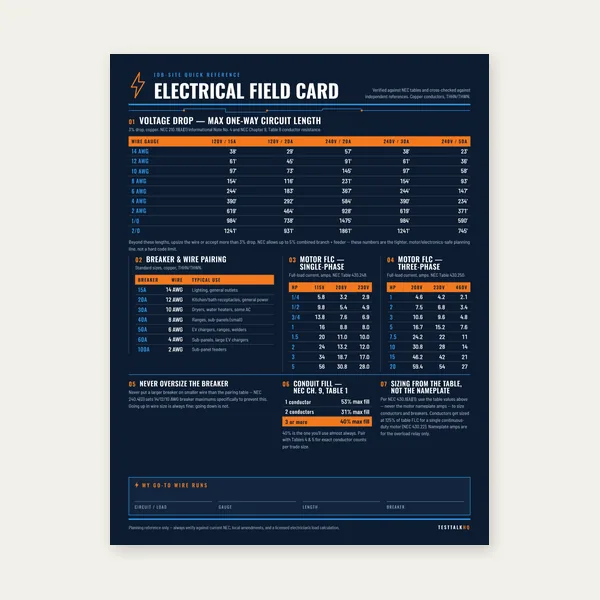
Electrical Reference Card
One page. Voltage drop lengths, breaker and wire pairing, motor FLC.
$3.99
Buy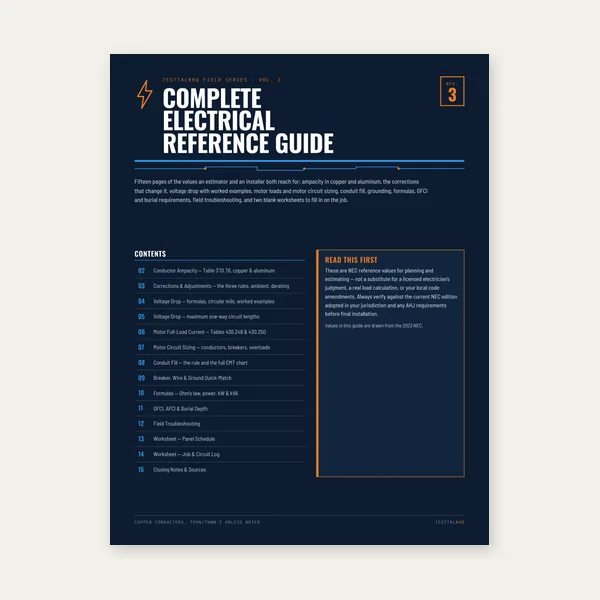
Complete Electrical Reference Guide
15 pages. Ampacity, corrections, voltage drop, motor circuits, conduit fill.
$12.99
Buy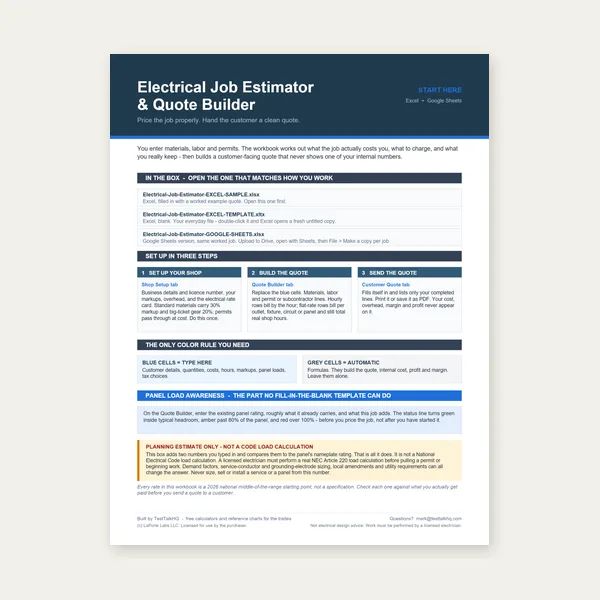
Electrical Job Estimator
Quote electrical work and flag panel headroom before you price it.
Excel or Google Sheets. Best on a computer.
$29.00
Buy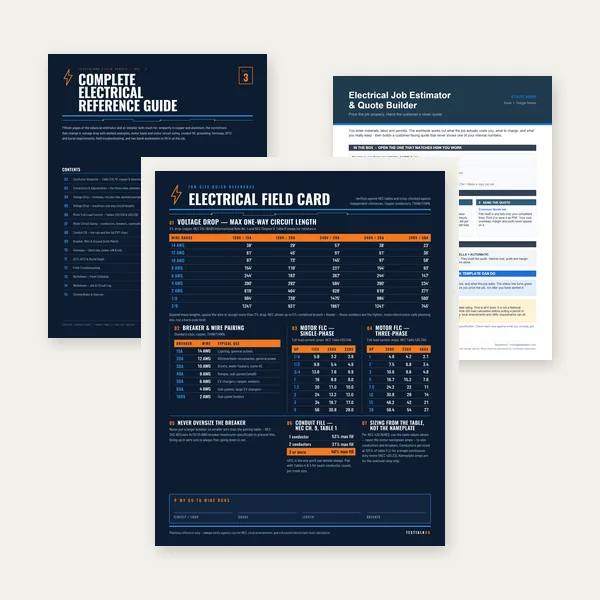
Electrical Complete Bundle
Card, 15-page guide and the estimator workbook. All six files.
Excel or Google Sheets. Best on a computer.
$34.99
$45.98 if bought separately — save $10.99
BuyCheckout opens in a new tab.