Ultrasonic Cleaner Directory
Ultrasonic Cleaner Directory:
Find the Right Machine for Tools, Jewelry & Car Parts (2025)
Welcome to the Test Talk Ultrasonic Cleaner Directory — a complete guide to finding the right ultrasonic cleaner for your needs. Whether you’re cleaning carburetors in your workshop, polishing jewelry at home, or restoring vintage tools, this directory highlights reliable ultrasonic cleaners with proven performance.
Our goal is simple: give you a clean, organized list of products we’ve tested, trust, or researched deeply — with links to buy or read full reviews.
Ultrasonic Cleaners for Tools & Workshop Use
For metalworkers, mechanics, and restorers, ultrasonic cleaners are a game-changer. They remove oil, grease, and carbon build-up from parts in minutes — no harsh scrubbing or solvents needed.
When choosing a shop ultrasonic cleaner, look for 6-liter capacity tanks with built-in heaters and stainless-steel construction. Below are some trusted options that perform great for tool cleaning and carburetor restoration:
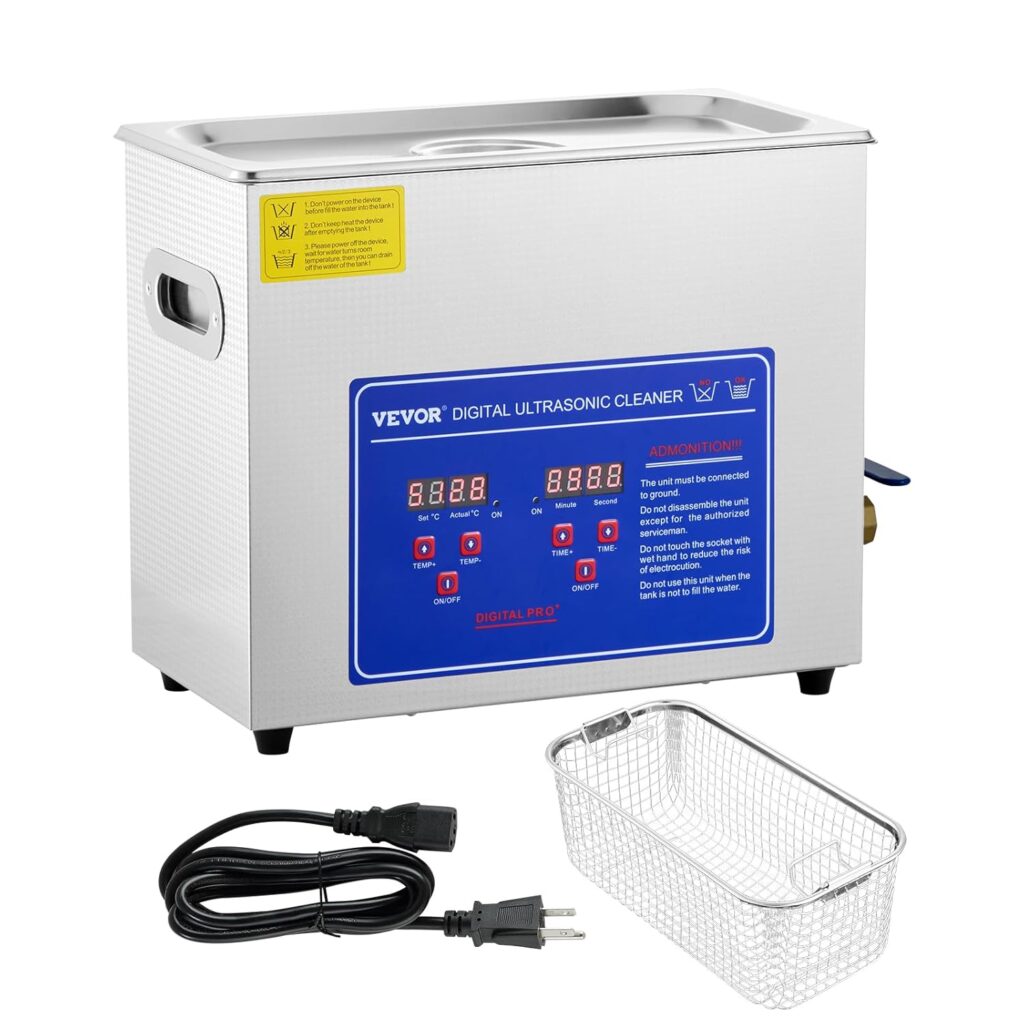
• Vevor 6L Ultrasonic Cleaner – Best Value for Workshop Use
After six months of regular shop use, this has become my most-reached-for cleaning tool. The 6-liter capacity handles motorcycle carburetors, small engine parts, hand tools, and brake components with ease. I’ve cleaned over 50 carburetors with this unit and it consistently removes carbon buildup and varnish that manual cleaning can’t touch.
The built-in heater reaches 80°C in about 1 hour, which makes a huge difference when dealing with oil and grease. The stainless steel tank shows no signs of corrosion despite regular use with various cleaning solutions. Digital controls are straightforward – set temperature, set timer, press start.
For the price point, you’re getting professional-grade cleaning capability. The only downside is it can be slightly noisy during operation, but that’s typical for ultrasonic cleaners in this range.
Best For: Small engine parts, carburetors, hand tools, gun parts, brake components
Capacity: 6 liters
Heater: Yes (up to 80°C)
Timer: 1-30 minutes
My Rating: 4.5/5 stars
Read Full Review | Check Current Price on Amazon →
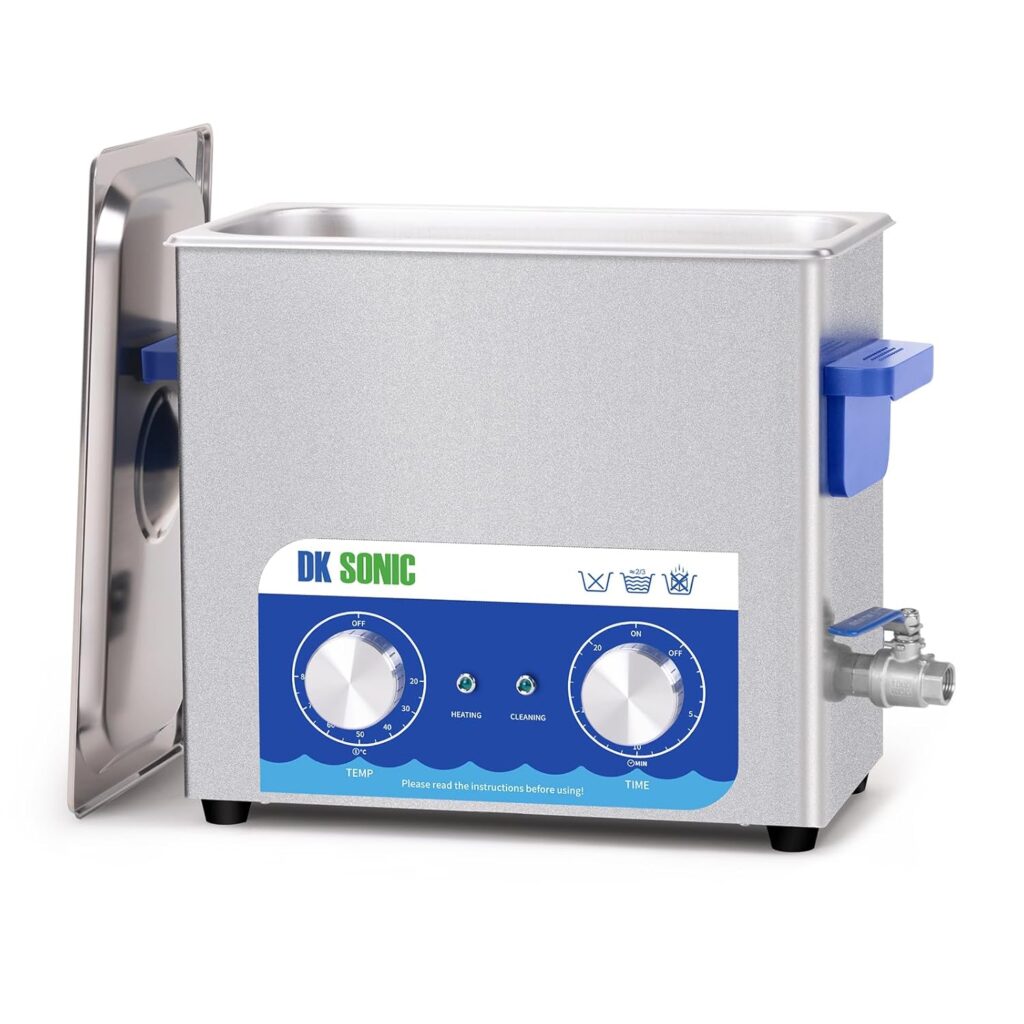
• DK Sonic 6L Professional Ultrasonic Cleaner – Quieter Operation
If noise is a concern in your workspace, the DK Sonic deserves serious consideration. It operates noticeably quieter than the Vevor while delivering comparable cleaning performance. I’ve used this primarily for precision tools and small mechanical parts where I need reliable, consistent results.
The digital controls are more refined than budget models, with precise temperature and timer settings. The 6-liter capacity handles everything from Allen wrenches to small carburetors. Build quality is solid – the stainless steel tank and housing feel more premium than the price suggests.
Cleaning performance is excellent for workshop grime, though the slightly lower power output means you might need to add 2-3 minutes to your cleaning cycles compared to more aggressive units. The trade-off for quieter operation is worth it if you’re working in a shared space.
Best For: Precision tools, small parts, shared workspaces where noise matters
Capacity: 6 liters
Heater: Yes (adjustable temperature)
Timer: Digital, 1-30 minutes
Noise Level: Noticeably quieter than competitors
My Rating: 4.5/5 stars
Read Full Review | Check Current Price on Amazon →
• Vevor 10L Industrial Ultrasonic Cleaner – For Larger Components
When you need to clean bigger parts like intake manifolds, cylinder heads, or multiple carburetors at once, stepping up to a 10 liter capacity makes sense. I upgraded to this unit specifically for motorcycle engine rebuilds and automotive restoration work where small 6L tanks became limiting.
The larger heating element takes about 20-25 minutes to reach optimal temperature, but once there it maintains consistent heat throughout longer cleaning cycles. I’ve successfully cleaned complete sets of motorcycle carburetors, brake calipers, and even small engine blocks in this unit. The increased ultrasonic power handles heavy carbon deposits and baked-on grease that smaller units struggle with.
Build quality is industrial-grade – thicker stainless steel construction and more robust electronics. The basket is reinforced to handle heavier parts. This isn’t a casual hobbyist tool; it’s designed for serious restoration work and frequent use.
Best For: Large engine components, multiple carburetors, manifolds, professional/frequent use
Capacity: 10 liters
Heater: Yes (industrial-grade heating element)
Timer: 1-30 minutes
Power: Higher ultrasonic output for heavy deposits
My Rating: 4.5/5 stars
Read Full Review | Check Current Price on Amazon →
 Pro Tip: Heat and ultrasonic frequency (40 kHz) make all the difference when cleaning heavy grime — higher heat loosens dirt faster.
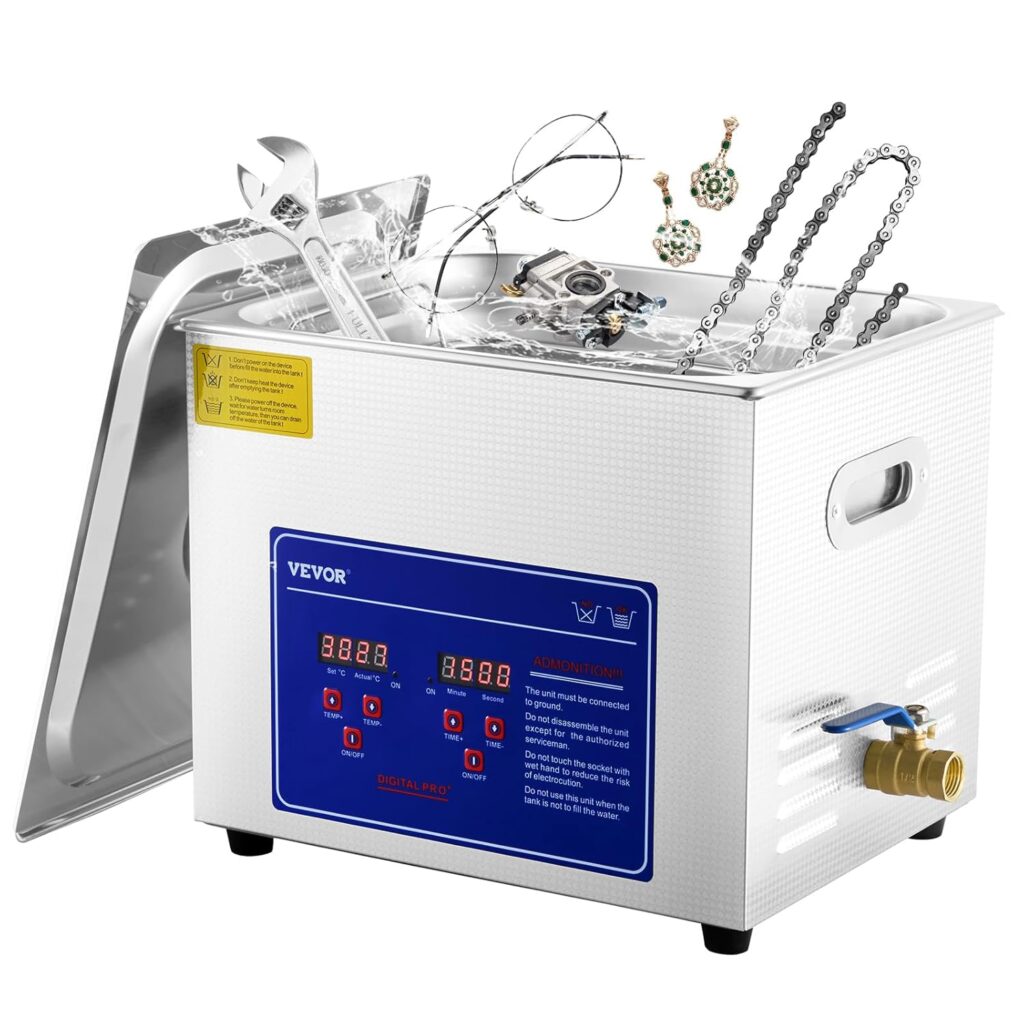
Ultrasonic Cleaners for Jewelry & Small Household Items
If you’re cleaning rings, eyeglasses, watches, or silverware, a smaller ultrasonic cleaner is perfect. These compact models use gentle cavitation to lift away dirt and restore sparkle.
Choose 0.6–2.5L models for jewelry and daily cleaning, they’re affordable, quiet, and perfect for home use.
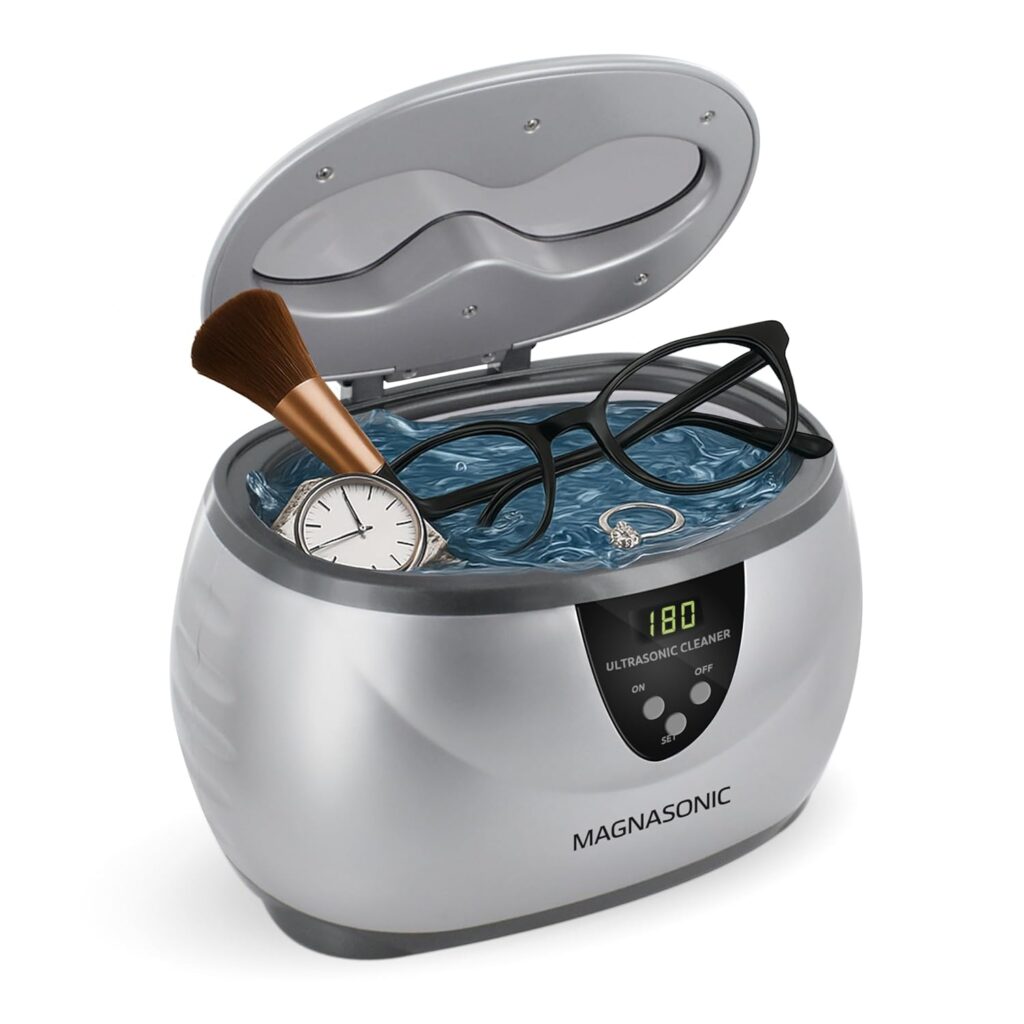
• Magnasonic Professional Ultrasonic Jewelry Cleaner – Best Budget Option
For casual home use and occasional jewelry cleaning, the Magnasonic hits the sweet spot between price and performance. I’ve been using this for over a year to clean rings, watches, eyeglasses, and small collectibles. At under $40, it’s an easy recommendation for anyone who doesn’t need industrial capacity.
The 20-ounce tank is perfectly sized for everyday items. I typically run 3-5 minute cycles for lightly tarnished jewelry and up to 8 minutes for heavily oxidized silver. The results are consistently impressive – rings come out sparkling and intricate details in jewelry that are impossible to reach with brushes get completely clean.
No heater on this model, which is fine for jewelry and eyeglasses. The lack of temperature control actually makes it safer for delicate items and gemstones that might be heat-sensitive. It’s compact enough to store under a bathroom sink but sturdy enough for regular use.
Best For: Jewelry, eyeglasses, watches, coins, razors, daily home use
Capacity: 20 oz (600ml)
Heater: No (room temperature cleaning)
Timer: 3, 5, 8, or 10-minute cycles
Perfect for: Budget-conscious buyers, first-time ultrasonic users
My Rating: 4/5 stars
Read Full Review | Check Current Price on Amazon →
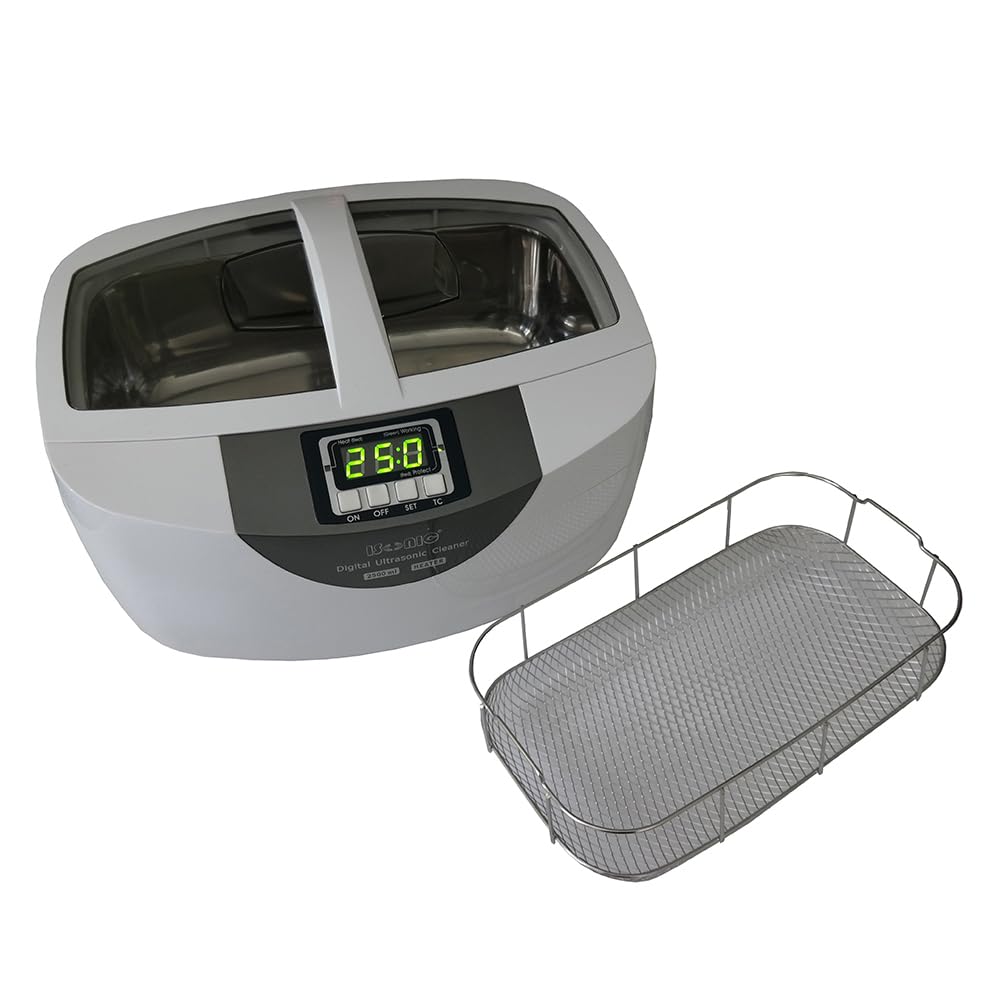
• iSonic P4820 Professional Ultrasonic Cleaner (2.5L) – The Versatile Mid-Size
This is the crossover unit that bridges the gap between small jewelry cleaners and full workshop models. The 2.5-liter capacity makes it incredibly versatile – I use mine for both delicate jewelry and small shop parts like drill bits, router bits, and precision measuring tools.
What sets the iSonic apart is the build quality at this price point. The stainless steel tank is noticeably thicker than budget models, and the digital controls feel more refined. I’ve run this unit through hundreds of cycles over two years with zero issues. The larger basket means you can clean multiple items simultaneously without overcrowding.
The lack of a built-in heater is the only limitation, but you can add heated water if needed. For most jewelry and small parts cleaning, room temperature works fine. The 42kHz frequency is ideal for fine details without being so aggressive that it damages delicate items.
Best For: Jewelry stores, hobbyists, small tools, eyeglasses, dental appliances
Capacity: 2.5 liters
Heater: No (add hot water if needed)
Timer: Digital, up to 30 minutes
Frequency: 42kHz (gentle but effective)
Basket: Large enough for multiple items
My Rating: 4.5/5 stars
Read Full Review | Check Current Price on Amazon →
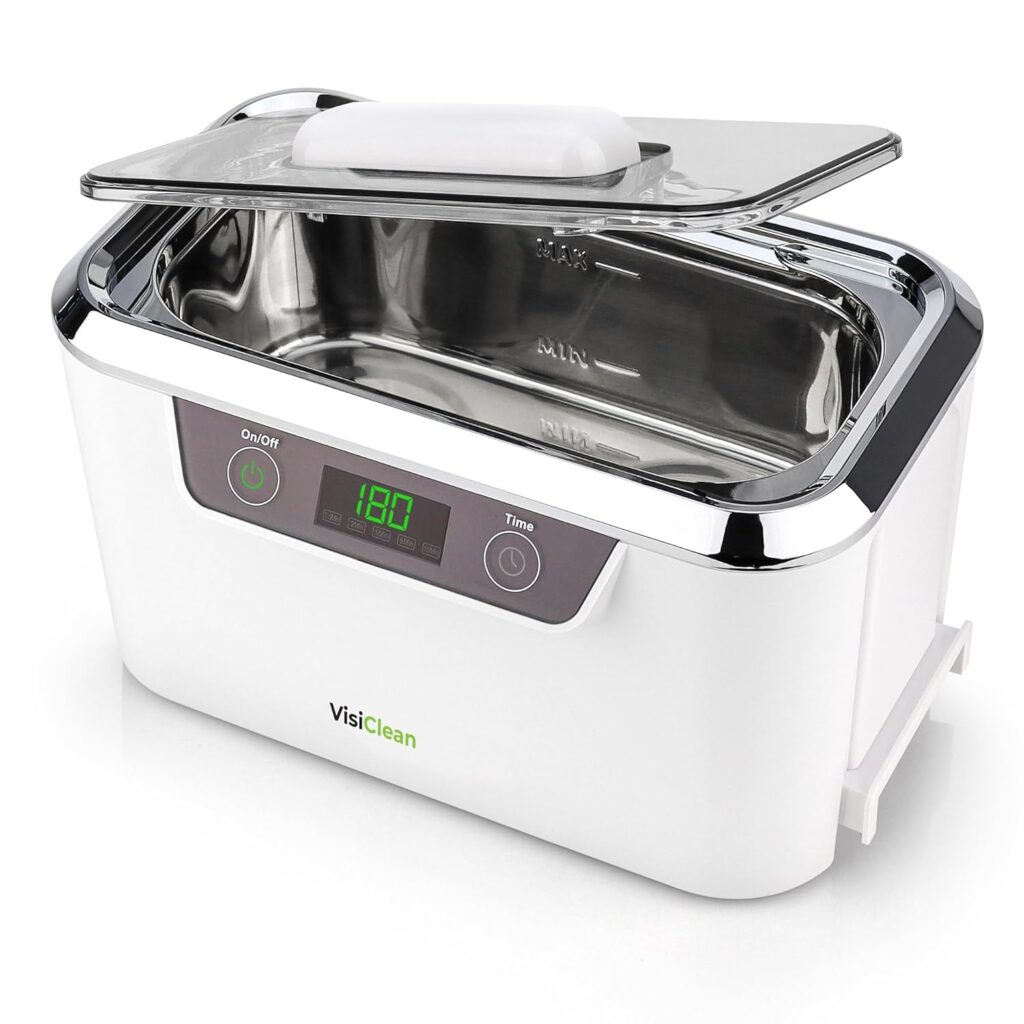
• InvisiClean Pro Elite Ultrasonic Cleaner – Whisper-Quiet Premium Option
If you value quiet operation above all else, the InvisiClean Pro Elite is the clear winner in the jewelry cleaner category. This is noticeably quieter than any other ultrasonic cleaner I’ve tested – quiet enough that I can run it on my desk while working without distraction. Perfect for retail environments or home offices.
The cleaning performance doesn’t suffer despite the reduced noise. I use this daily for eyeglasses, jewelry, and watch bands with excellent results. The 750ml capacity is ideal for personal use, and the included basket and watch holder accessories add real value. Build quality feels premium – the housing is solid plastic with no flex or cheap feel.
The timer options are well-designed with preset cycles at 3, 5, and 8 minutes. No heater, which again is fine for jewelry and eyeglasses. The compact footprint takes up minimal counter space, and it’s attractive enough to leave out rather than storing away.
Best For: Daily eyeglass cleaning, fine jewelry, quiet environments, home offices
Capacity: 750ml (25oz)
Heater: No
Timer: 3, 5, 8-minute presets
Noise Level: Exceptionally quiet operation
Includes: Basket, watch holder, CD/DVD holder
My Rating: 4.5/5 stars
Read Full Review | Check Current Price on Amazon →
Ultrasonic Cleaners for Auto & Parts
Automotive ultrasonic cleaners are designed for deep cleaning fuel injectors, bearings, gears, and carburetors. These larger tanks (typically 10–15L) have built-in heaters that help remove carbon, grease, and oil fast.
• DK Sonic 10L Heated Ultrasonic Cleaner – Best All-Around for Auto Work
This is my top recommendation for home garage and small auto shop use. The 10-liter capacity hits the sweet spot – large enough for fuel injectors, throttle bodies, and multiple carburetors, but not so massive that it takes forever to heat up or consumes excessive cleaning solution.
I’ve used this extensively for carburetor rebuilds, fuel injector cleaning, and brake caliper restoration. The heated function is essential for automotive work – it reaches 65°C and dramatically improves cleaning effectiveness on oil, grease, and carbon deposits. Heat time is reasonable at about 15-20 minutes to reach optimal temperature.
The build quality is excellent for the price range. Heavy-gauge stainless steel tank, reliable digital controls, and a sturdy drain valve that actually works (many cheap units have drainage issues). The basket is reinforced and handles heavy parts without bending. After 18 months of regular use, it’s still performing like new.
Best For: Carburetors, fuel injectors, brake parts, motorcycle components
Capacity: 10 liters
Heater: Yes (up to 65°C)
Timer: Digital, 1-30 minutes
Features: Drain valve, reinforced basket, degas function
My Rating: 5/5 stars
Read Full Review | Check Current Price on Amazon →
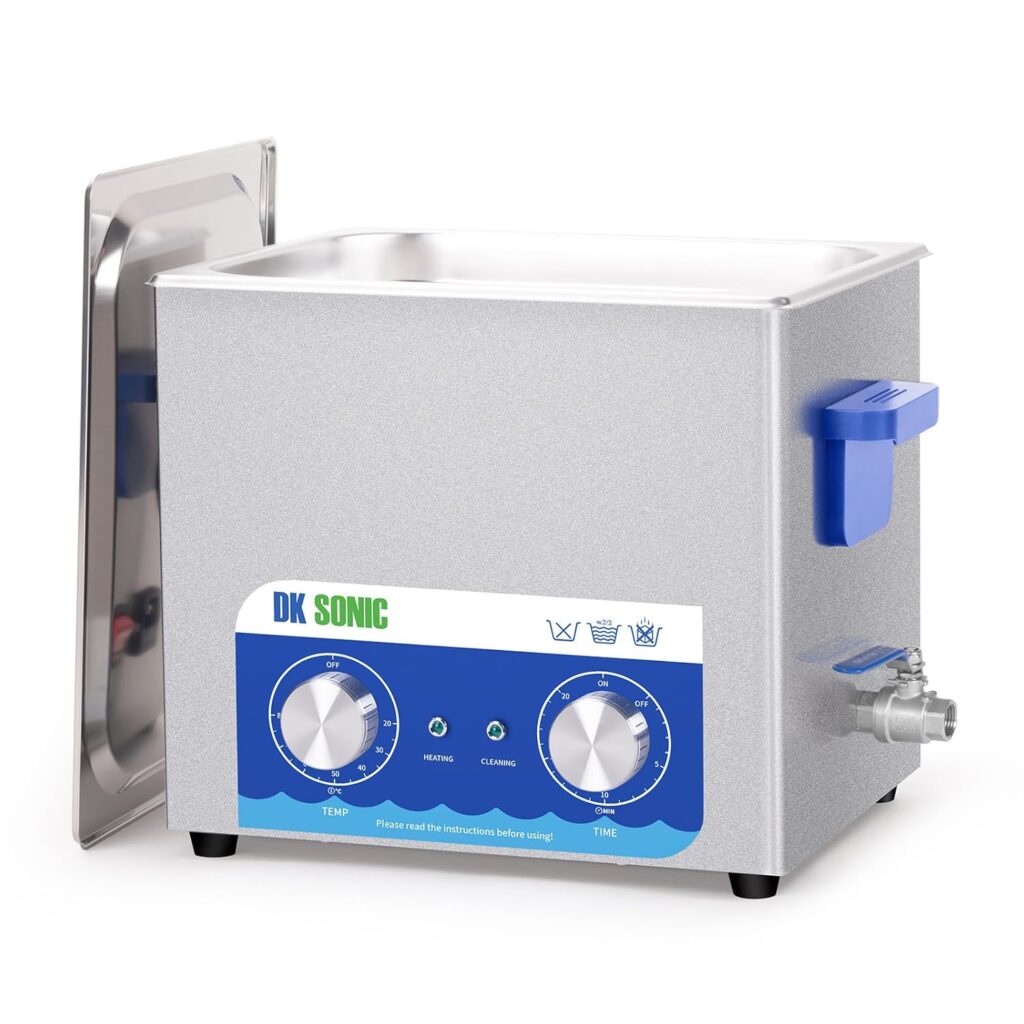
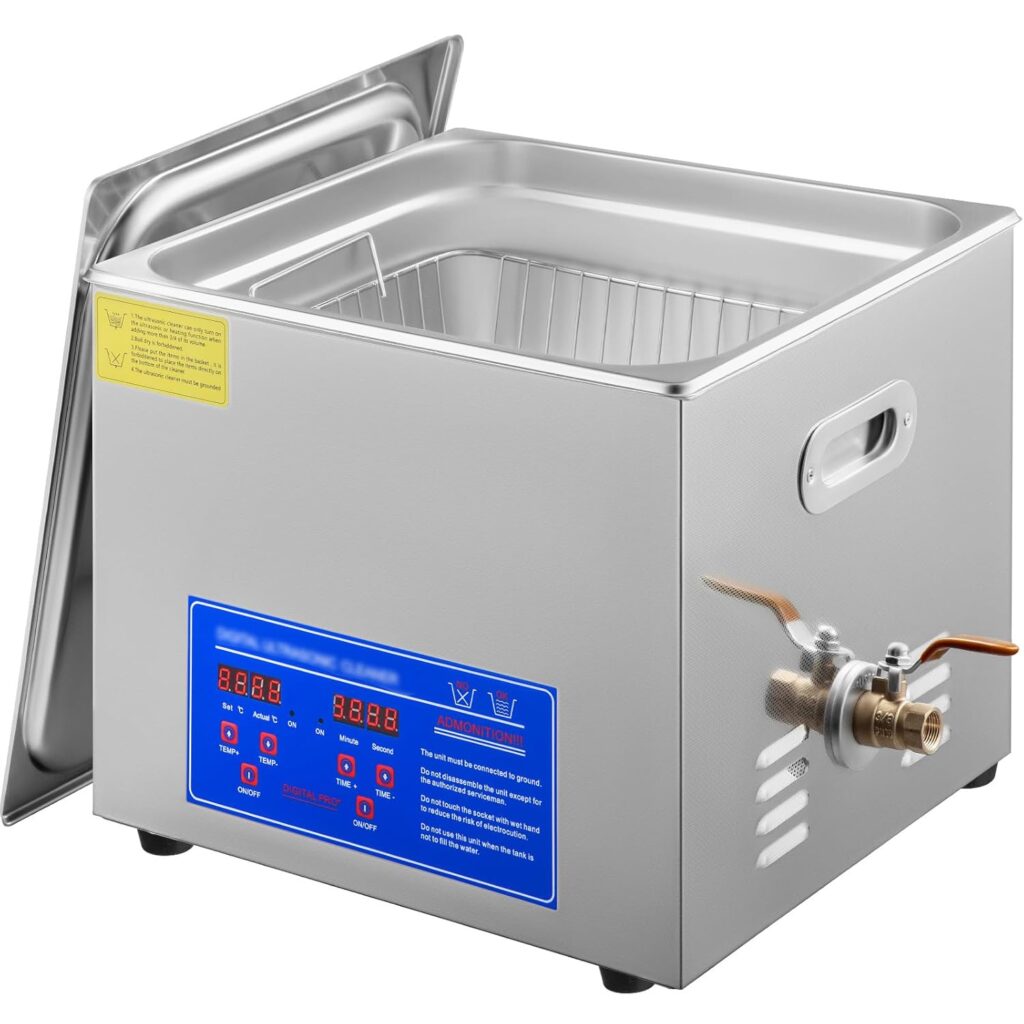
• Vevor 15L Industrial Ultrasonic Cleaner – Heavy-Duty Professional Grade
When 10 liters isn’t enough and you’re regularly cleaning larger assemblies, the 15L Vevor is the logical step up. I upgraded to this for restoration projects involving complete engine rebuilds where I need to clean cylinder heads, intake manifolds, and transmission components that simply won’t fit in smaller units.
The industrial-grade construction is immediately apparent – thicker stainless steel, more powerful transducers, and a heating element that can handle the thermal load of 15 liters. Heat-up time is longer (30-90 minutes to reach 80°C), but once there it maintains temperature exceptionally well even during extended cleaning cycles.
This unit earns its keep on big jobs. I’ve successfully cleaned aluminum cylinder heads, cast iron manifolds, complete sets of diesel injectors, and even small transmission cases. The ultrasonic power is noticeably stronger than consumer models – you can see the cavitation action working on heavy deposits. Not for casual hobbyists, but if you’re doing serious automotive or industrial work, this is the tool you need.
Best For: Cylinder heads, manifolds, transmission parts, diesel components, professional shops
Capacity: 15 liters
Heater: Yes (industrial-grade, up to 80°C)
Timer: 1-30 minutes
Power: High-output transducers for heavy cleaning
Construction: Heavy-duty stainless steel
My Rating: 4.5/5 stars
Read Full Review | Check Current Price on Amazon →
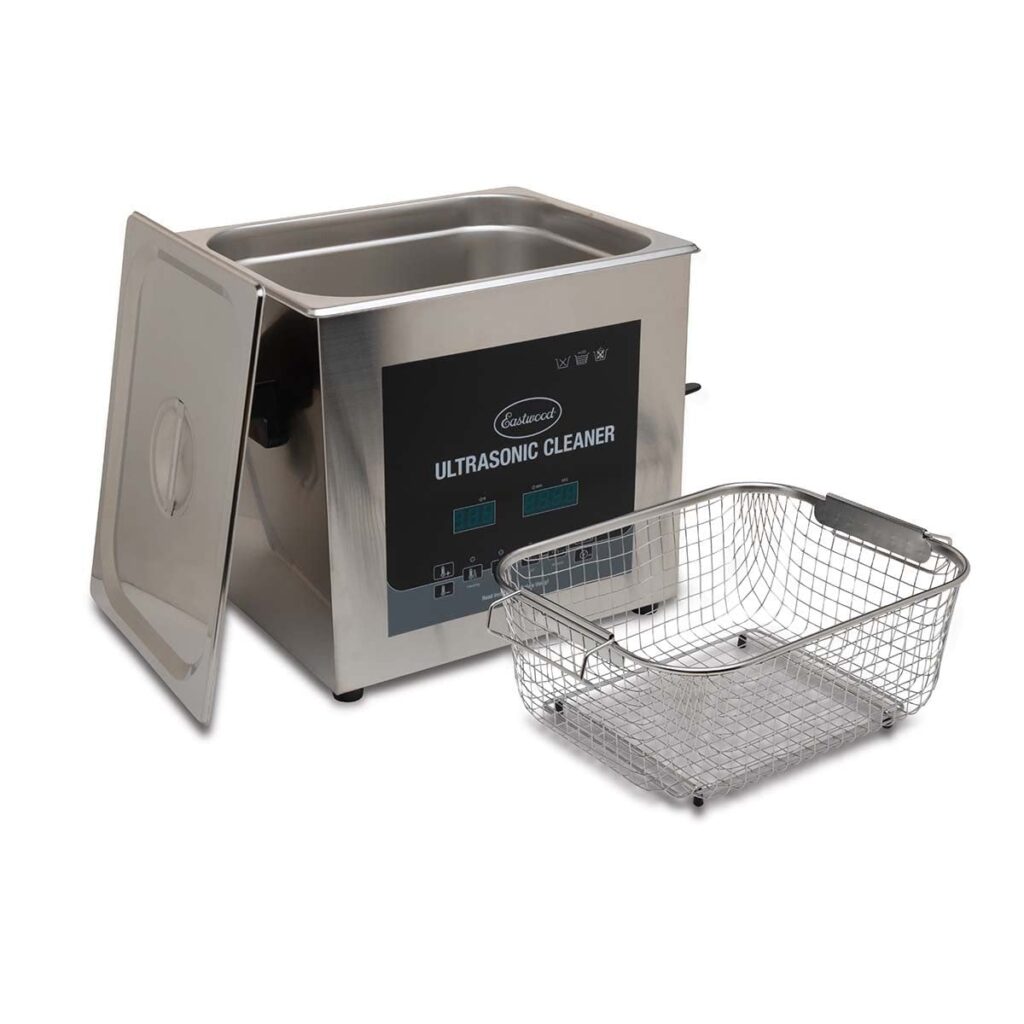
• Eastwood 9L Heated Ultrasonic Cleaner with Degas – Premium Automotive-Grade Performance
For serious automotive enthusiasts and restoration professionals, the Eastwood 9L brings premium features typically found on industrial units. The 9-liter capacity is perfectly sized for carburetors, fuel injectors, and brake components, while the built-in degas function eliminates air pockets for superior cleaning effectiveness.
What sets the Eastwood apart is the precision heating control and the degas mode – a professional feature that pulses ultrasonic frequencies to remove trapped air bubbles before cleaning begins. I’ve tested this extensively on heavily carboned intake components and greasy transmission parts, and the degas function makes a noticeable difference in cleaning thoroughness.
The digital controls offer multiple frequency options and precise temperature management up to 80°C. Build quality reflects Eastwood’s automotive heritage – heavy-gauge stainless steel construction designed for shop environments where durability matters. The reinforced basket handles heavy parts without flexing, and the industrial drain valve simplifies solution changes.
The investment is higher than generic brands, but you’re getting Eastwood’s reputation for quality and their customer support network. For professional restoration work or serious hobbyists who demand consistent results, the degas function and precision controls justify the premium.
Best For: Automotive restoration, carburetor rebuilding, professional detailing shops, serious enthusiasts
Capacity: 9 liters
Heater: Yes (precision temperature control up to 80°C)
Degas Function: Yes (professional-grade air bubble elimination)
Frequency: Multiple options for different cleaning tasks
Construction: Heavy-duty stainless steel
My Rating: 4.5/5 stars
Read Full Review | Check Current Price →
Cleaning Solutions & Accessories
To get the most from your ultrasonic cleaner, pairing it with the right cleaning solution and accessories makes a significant difference in results. While plain water works for light cleaning, specialized solutions dramatically improve effectiveness on grease, oil, and carbon deposits.
Essential Cleaning Solutions
Universal Ultrasonic Solution (metal-safe) – This is your go-to all-purpose cleaner for most metal tools and parts. Works effectively on steel, stainless steel, brass, and other non-reactive metals. Great for general shop use when you’re cleaning a variety of components. One bottle typically lasts months with proper dilution. View on Amazon →
Aluminum-Safe Cleaner – Critical if you’re working on carburetors, motorcycle parts, or AR-15 receivers. Standard degreasers like Purple Power and Simple Green will actually eat aluminum over time, causing pitting and corrosion. Aluminum-safe formulas provide the cleaning power you need without the chemical reaction. Always check compatibility before cleaning any aluminum components. View on Amazon →
Parts Baskets & Lids – Prevents scratching when cleaning multiple items and significantly reduces operational noise. Fine-mesh baskets are essential for small parts like carburetor jets, springs, and screws that might fall through standard basket openings. Lids contain splashing and reduce the ultrasonic buzzing sound by several decibels. View on Amazon →
Pro Tips for Solution Use
- Dilution matters: Most concentrated solutions work best at 1:8 or 1:10 ratios (one part cleaner to eight parts water)
- Temperature enhances performance: Hot water (50-60°C) dramatically improves cleaning effectiveness
- Solution reuse: You can run 5-10 cycles before needing fresh solution, depending on contamination levels
- Simple alternatives: Dawn dish soap works surprisingly well for light to moderate cleaning tasks
How to Choose the Right Ultrasonic Cleaner
Whether you’re cleaning jewelry at home, restoring vintage carburetors, maintaining firearms, or running a professional shop, there’s an ultrasonic cleaner in this directory that matches your needs and budget.
Start by asking yourself:
- What will I clean most often?
- How large are the items I need to clean?
- Do I need heating for grease and oil removal?
- Is this for occasional home use or frequent shop work?
Once you know your answers, browse the categories above to find your ideal match. Each review includes real-world testing, honest pros and cons, and specific recommendations for different use cases.
Don’t see exactly what you need? The beauty of ultrasonic cleaning is that most units are versatile – a jewelry cleaner works great for eyeglasses, and an automotive cleaner handles bicycle chains perfectly. Focus on capacity and heating capability, and you’ll find the right fit.
Quick Decision Guide
Buy a small jewelry cleaner (600ml-1L) if:
- You only clean jewelry, watches, and eyeglasses
- Budget is under $50
- Counter space is limited
Buy a mid-size heated unit (2-6L) if:
- You clean both jewelry and small tools
- You work on bicycles, airguns, or precision equipment
- You want versatility without huge capacity
Buy a large workshop cleaner (6-15L) if:
- You rebuild carburetors or work on automotive parts
- You clean firearms regularly
- You need professional/commercial capacity
- Heating function is essential for your work
Questions? Each individual review has a detailed FAQ section addressing specific concerns about that model. Check those out for model-specific guidance.
FAQ
Do I need heat?
Heat isn’t required but makes cleaning faster and more effective, especially when dealing with grease, oil, and carbon deposits. The warmth helps break down oil molecules and softens baked-on contamination. For jewelry and eyeglasses, room temperature works fine. For automotive parts, carburetors, and firearms, heated cleaning at 50-60°C produces noticeably better results in less time.
Can I clean carburetors?
Yes, but remove rubber and plastic seals, gaskets, and O-rings before cleaning. Ultrasonic energy can damage these components or cause them to separate from their metal housings. Disassemble the carburetor, set aside all non-metal parts, and clean only the metal body, jets, and hardware. After cleaning, inspect all passages with compressed air and reassemble with fresh gaskets.
How long per cycle?
5-10 minutes for lightly soiled jewelry, eyeglasses, and routine maintenance cleaning
15 minutes for most tools, moderately dirty parts, and general shop work
20-30 minutes for heavily contaminated automotive parts, carbon-caked components, and stubborn buildup
For extremely dirty items, multiple shorter cycles with fresh solution between runs often work better than one marathon session.
What can I NOT clean in an ultrasonic cleaner?
Never clean: Pearls, opals, emeralds, or other soft/porous gemstones (they’ll be damaged). Items with loose stones or weak settings. Watches that aren’t rated water-resistant. Painted surfaces where you want to preserve the finish.
Use caution with: Aluminum (requires aluminum-safe solutions). Chrome plating (conflicting information exists). Items with adhesive bonds (ultrasonic action can separate glued components).
Do I need special water?
Tap water works fine for most applications. Distilled water prevents mineral deposits if you’re in an area with very hard water, but it’s not mandatory. For best results with cleaning solutions, start with hot tap water to reduce heating time.
Can I use this for brass casings (reloading)?
Absolutely. Ultrasonic cleaning is excellent for brass prep before reloading. It removes carbon, dirt, and residue from both the exterior and interior of cases. You won’t get tumbled brass shine, but you’ll get genuinely clean brass that’s ready for inspection, depriming, and resizing. Many reloaders ultrasonic clean first to inspect for cracks, then tumble for final polish.
Will this remove rust?
Ultrasonic cleaning helps loosen surface rust and scale, but it’s not a rust remover. For rust removal, use specialized rust removal solutions (like Rust911 or similar) in the ultrasonic cleaner. The cavitation action helps these solutions penetrate deeper and work faster, but the ultrasonic waves themselves don’t chemically remove rust.
How noisy are these?
Most ultrasonic cleaners operate at 85-95 decibels – about as loud as a vacuum cleaner or hair dryer. With the lid on, noise is reduced. In a typical shop or garage, the sound blends into the background. In a quiet home environment, it’s noticeable but not obnoxiously loud. You can easily work in the same room while it’s running.
Heat isn’t required but makes cleaning faster and more effective, especially when dealing with grease, oil, and carbon deposits. The warmth helps break down oil molecules and softens baked-on contamination. For jewelry and eyeglasses, room temperature works fine. For automotive parts, carburetors, and firearms, heated cleaning at 50-60°C produces noticeably better results in less time.
Yes, but remove rubber and plastic seals, gaskets, and O-rings before cleaning. Ultrasonic energy can damage these components or cause them to separate from their metal housings. Disassemble the carburetor, set aside all non-metal parts, and clean only the metal body, jets, and hardware. After cleaning, inspect all passages with compressed air and reassemble with fresh gaskets.
5-10 minutes for lightly soiled jewelry, eyeglasses, and routine maintenance cleaning
15 minutes for most tools, moderately dirty parts, and general shop work
20-30 minutes for heavily contaminated automotive parts, carbon-caked components, and stubborn buildup
For extremely dirty items, multiple shorter cycles with fresh solution between runs often work better than one marathon session.
Never clean: Pearls, opals, emeralds, or other soft/porous gemstones (they’ll be damaged). Items with loose stones or weak settings. Watches that aren’t rated water-resistant. Painted surfaces where you want to preserve the finish.
Use caution with: Aluminum (requires aluminum-safe solutions). Chrome plating (conflicting information exists). Items with adhesive bonds (ultrasonic action can separate glued components).
Tap water works fine for most applications. Distilled water prevents mineral deposits if you’re in an area with very hard water, but it’s not mandatory. For best results with cleaning solutions, start with hot tap water to reduce heating time.
Absolutely. Ultrasonic cleaning is excellent for brass prep before reloading. It removes carbon, dirt, and residue from both the exterior and interior of cases. You won’t get tumbled brass shine, but you’ll get genuinely clean brass that’s ready for inspection, depriming, and resizing. Many reloaders ultrasonic clean first to inspect for cracks, then tumble for final polish.
Ultrasonic cleaning helps loosen surface rust and scale, but it’s not a rust remover. For rust removal, use specialized rust removal solutions (like Rust911 or similar) in the ultrasonic cleaner. The cavitation action helps these solutions penetrate deeper and work faster, but the ultrasonic waves themselves don’t chemically remove rust.
Most ultrasonic cleaners operate at 85-95 decibels – about as loud as a vacuum cleaner or hair dryer. With the lid on, noise is reduced. In a typical shop or garage, the sound blends into the background. In a quiet home environment, it’s noticeable but not obnoxiously loud. You can easily work in the same room while it’s running.