Best Air Compressors: Complete Directory for Home, Garage & Professional Use (2026)
Choosing the right air compressor can make or break your shop experience. Too small, and your tools won’t run properly, you’ll spend more time waiting for the tank to refill than actually working. Too large, and you’ve wasted money on capacity you’ll never use. Get the CFM rating wrong, and even expensive tools become paperweights. Not sure what CFM you need? Use our free CFM Calculator to calculate the exact air flow requirements for your tools.
Welcome to the Test Talk Air Compressor Directory! Your complete guide to finding the perfect compressor for your needs. Whether you’re a weekend DIYer running brad nailers for trim work, a contractor framing houses daily, or a serious hobbyist building a fully-equipped workshop, this directory breaks down exactly which compressors deliver real performance for each application.
We’ve researched and analyzed dozens of air compressors across every category – from ultra-portable pancake models to industrial two-stage units. Each compressor featured here has been evaluated based on actual user testing, real-world performance data, and hands-on experience from trusted sources. No fluff, no sponsored nonsense – just honest assessments of what works, what doesn’t, and who each model is actually built for.
Our approach is simple: match the compressor to the job. We organize by compressor type (pancake, vertical, stationary) and application (portable job site, home garage, professional shop), explain the specifications that actually matter (CFM is king, not tank size), and give you straight answers about noise levels, duty cycles, and long-term reliability. You’ll find detailed individual reviews, comparison data, and a comprehensive buying guide that cuts through marketing hype.
Whether you need a quiet operation for a residential garage, maximum portability for job sites, or industrial capacity for running multiple tools simultaneously, you’ll find your answer here.
PANCAKE COMPRESSORS
Pancake compressors are the most popular choice for homeowners and DIYers. Their low-profile design and portability make them perfect for trim work, brad nailing, and light shop tasks. Most pancake compressors feature 2-6 gallon tanks and deliver 2-3 CFM at 90 PSI which is enough for nail guns and small impact tools.
Porter-Cable C2002 – Best Budget Pancake
The Porter-Cable C2002 has earned its reputation as the go-to budget pancake compressor for good reason. This 6-gallon workhorse delivers 2.6 CFM at 90 PSI – enough to run brad nailers, finish nailers, and even small framing nailers without constant cycling. The 150 max PSI rating means faster recovery times between demanding tasks, keeping you productive rather than waiting on your compressor.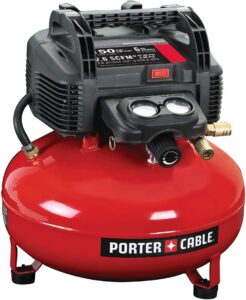
What makes this the budget champion isn’t just the price – it’s the reliability. This compressor consistently shows up in professional contractors’ truck beds alongside premium tools because it simply works. The oil-free pump requires zero maintenance beyond draining the tank, and the pancake design keeps the center of gravity low for stability on uneven job sites.
The noise level sits at 82 dB, which is standard for this category – noticeably loud but not unbearable for shop use. The 13-pound weight makes it genuinely portable, and the shrouded regulator protects it from accidental damage during transport. For DIYers running occasional weekend projects or contractors who need a reliable backup unit, the Porter-Cable C2002 delivers professional performance without the professional price tag.
Specs: 6 gallon, 2.6 CFM @ 90 PSI, 150 max PSI, 82 dB
Best For: Budget-conscious DIYers, basic nailing tasks, occasional use
My Rating: 4/5 stars
Read Full Review | Check Price on Amazon →
Makita MAC210Q – Quietest Pancake Option
The Makita MAC210Q changed the game for noise-conscious users when it launched, delivering true quiet operation in a pancake format. At just 60 dB, this compressor runs at conversation level – you can literally talk over it while it’s running. For anyone working in an attached garage, apartment workshop, or noise-sensitive neighborhood, this feature alone justifies the premium over standard compressors.
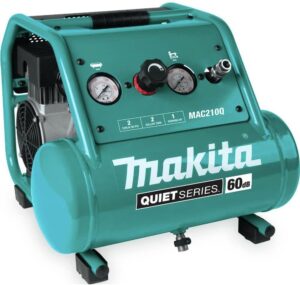
The 2-gallon tank might seem limiting compared to 6-gallon competitors, but the 2.0 CFM output at 90 PSI handles brad nailers, finish nailers, and pin nailers without issue. The quick recovery time means you’re rarely waiting on the compressor during trim work. The oil-free pump requires no maintenance, and the roll-cage design protects the tank and motor during job site transport.
Where the MAC210Q truly excels is finish carpentry and interior work. The quiet operation means you can work early mornings or late evenings without disturbing family or neighbors. The compact 2-gallon footprint takes up minimal truck space, and at just 46 pounds, it’s genuinely portable for one person. If noise has ever stopped you from using a compressor when you needed it, the Makita MAC210Q eliminates that barrier completely.
Specs: 2 gallon, 2.0 CFM @ 90 PSI, 130 max PSI, 60 dB
Best For: Noise-sensitive environments, finish carpentry, apartment workshops
My Rating: 4.5/5 stars
Read Full Review | Check Price on Amazon →
Bostitch BTFP02012 – Best Overall Value
The Bostitch BTFP02012 occupies the sweet spot between budget and premium pancake compressors, delivering performance that rivals units costing twice as much. The 6-gallon tank paired with 2.6 CFM at 90 PSI gives you genuine versatility – this compressor handles everything from delicate pin nailing to aggressive framing nailer use without complaint.
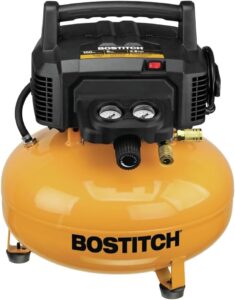
What sets the Bostitch apart is the attention to detail. The high-efficiency motor provides faster recovery time than competing 6-gallon models, meaning less downtime between nail runs. The oil-free pump is built for longevity, and users consistently report 5-10 years of reliable daily use. The control panel features an easy-to-read dual gauge setup and a conveniently placed regulator that’s accessible even when hoses are connected.
The shrouded tank design protects against dings and damage during transport, while the 29-pound weight keeps it manageable for moving around job sites. The noise level sits in the standard range for pancake compressors – not quiet like the Makita, but perfectly acceptable for garage and outdoor use. For home DIYers who want a compressor they won’t outgrow and contractors who need reliable daily performance, the Bostitch BTFP02012 consistently delivers without drama.
Specs: 6 gallon, 2.6 CFM @ 90 PSI, 150 max PSI
Best For: Home garage, trim work, general DIY projects
My Rating: 4.5/5 stars
Read Full Review | Check Price on Amazon →
DeWalt DWFP55126 – Most Durable Pancake
When contractors need a pancake compressor that can withstand daily job site abuse, the DeWalt DWFP55126 consistently tops the list. This 6-gallon unit is built like a tank – literally. The roll-cage design protects vital components from the inevitable drops, bumps, and rough handling that come with professional use. DeWalt engineered this compressor to survive in truck beds, on dusty job sites, and through years of daily operation.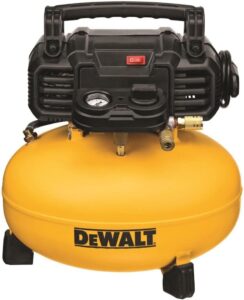
The performance specs match the durability: 2.6 CFM at 90 PSI with a 165 max PSI rating. That higher max pressure translates to faster recovery times when you’re running framing nailers all day. The high-flow regulator and dual quick-couplers mean you can connect multiple hoses and switch between tools without constant disconnecting. The oil-free pump requires minimal maintenance – just drain the tank regularly and keep using it.
At 30 pounds, it’s slightly heavier than some competitors, but that weight is protective steel and robust components, not wasted bulk. The console design is thoughtful – large gauges are easy to read in varying light conditions, and controls are positioned to prevent accidental adjustment during transport. If you’re a professional who depends on your tools daily or a serious DIYer who wants to buy once and be done, the DeWalt DWFP55126 is built to outlast its warranty many times over.
Specs: 6 gallon, 2.6 CFM @ 90 PSI, 165 max PSI
Best For: Contractors, job site use, frequent daily use
My Rating: 4.5/5 stars
Read Full Review | Check Price on Amazon →
HOT DOG / TWIN-STACK COMPRESSORS
Hot dog and twin-stack compressors bridge the gap between portable pancake models and stationary workshop units. The elongated cylindrical design (hot dog) or vertically stacked tanks (twin-stack) provide 4-5 CFM output while maintaining reasonable portability – enough power to run framing nailers continuously, operate small impact wrenches, or run multiple brad nailers simultaneously without constant tank cycling.
These compressors are the workhorses of professional trim carpenters and framing contractors who need serious CFM delivery but can’t sacrifice portability. The larger tank capacity (typically 4-5 gallons) and higher horsepower motors (2.0-2.5 HP) mean you spend more time working and less time waiting for recovery. If you’ve outgrown a pancake compressor but aren’t ready for a stationary vertical unit, hot dog and twin-stack models deliver the performance jump you need.
Makita MAC2400 Big Bore – Best Performance Hot Dog
The Makita MAC2400 Big Bore is the hot dog compressor that professionals reach for when performance matters more than price. The 2.5 HP “Big Bore” motor and pump combination delivers a genuine 4.2 CFM at 90 PSI – matching its tank capacity perfectly for optimal performance. This isn’t marketing fluff; the MAC2400 consistently outperforms competitors rated at similar specs because Makita’s engineering focuses on actual delivered CFM rather than peak numbers.
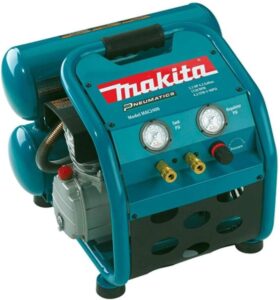
What separates this from lesser hot dog compressors is the duty cycle and recovery speed. Contractors running framing nailers all day report the MAC2400 keeps pace without overheating or excessive cycling. The cast-iron construction and oil-lubricated pump design mean this compressor is built for years of daily professional use, not occasional weekend projects. The roll-cage design protects the tank and motor during job site transport, and the low center of gravity prevents tip-overs on uneven surfaces.
The 79 dB noise level sits in the moderate range – noticeably quieter than budget compressors but not whisper-quiet like California Air Tools models. At 77 pounds, it’s substantial but still manageable for one person moving between job locations. The dual quick-couplers and conveniently positioned controls make tool changes fast during production work. For framing contractors, siding installers, and anyone running air tools continuously throughout the day, the Makita MAC2400 Big Bore delivers professional-grade performance that justifies its premium pricing through years of reliable service.
Specs: 4.2 gallon, 4.2 CFM @ 90 PSI, 2.5 HP, 79 dB
Best For: Contractors, framing work, running multiple tools
My Rating: 5/5 stars
Read Full Review | Check Price on Amazon →
California Air Tools CAT-4620AC – Quiet Hot Dog
California Air Tools takes their signature ultra-quiet technology and packages it with serious CFM output in the CAT-4620AC. At just 70 dB, this hot dog compressor runs quieter than normal conversation – a dramatic difference from the 85+ dB standard compressors. But here’s what makes this special: the 4.7 CFM output at 90 PSI means you’re not sacrificing performance for peace and quiet. This compressor delivers higher CFM than many louder, larger competitors.
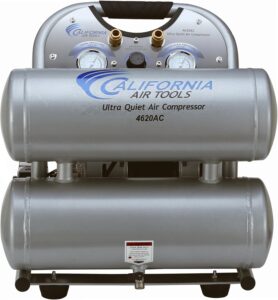
The engineering that achieves this combination is impressive. The dual-piston pump design with precision-balanced components eliminates the vibration and mechanical noise that plagues standard compressors. The ultra-efficient motor runs cooler and quieter while delivering consistent airflow. The 2-gallon tank might seem small for this CFM rating, but the rapid recovery time means you rarely notice the capacity limitation during actual use. The oil-free pump requires zero maintenance while delivering reliable performance cycle after cycle.
Where the CAT-4620AC becomes transformative is in residential settings and noise-sensitive environments. Attached garage workshops, apartment buildings, early morning or late evening work – situations where standard compressor noise would be prohibitive suddenly become viable. The 40-pound weight and integrated wheels make it genuinely portable despite the hot dog configuration. For contractors working in occupied homes, DIYers in residential neighborhoods, or anyone who values hearing protection and peace of mind, the California Air Tools CAT-4620AC delivers professional CFM output with revolutionary quiet operation.
Specs: 2 gallon, 4.7 CFM @ 90 PSI, 120 max PSI, 70 dB
Best For: Quiet operation with higher CFM, residential use
My Rating: 4.8/5 stars
Read Full Review | Check Price on Amazon →
VERTICAL/UPRIGHT COMPRESSORS
Vertical compressors are the backbone of serious home workshops and professional garages. The upright tank design maximizes capacity (typically 10-30 gallons) while minimizing floor space footprint – perfect for permanent installation against a garage wall or in a dedicated shop corner. With 5-7 CFM output at 90 PSI, these units deliver the sustained airflow needed for impact wrenches, air ratchets, die grinders, and even spray guns without the constant start-stop cycling that plagues smaller compressors.
What separates vertical compressors from portable models is their ability to handle extended, demanding use. The larger tank capacity means tools run longer between compressor cycles, and the higher horsepower motors (1.5-2.0 HP) recover pressure faster when the tank does need refilling. These are the compressors you buy when you’re tired of waiting on your tools and ready for uninterrupted workflow.
The vertical configuration also improves stability – the low center of gravity and wide base prevent tip-overs, and many models include wheels for repositioning within the shop. Whether you’re a weekend warrior building a fully-equipped garage or a professional mechanic who depends on air tools daily, vertical compressors provide the capacity and performance that transform occasional frustration into consistent productivity.
Craftsman 20-Gallon Vertical – Best Home Garage Compressor
The Craftsman 20-gallon vertical has become the default choice for home garage compressors because it nails the sweet spot between capacity, performance, and price. The 20-gallon tank paired with 5.5 CFM at 90 PSI handles everything the typical DIYer or home mechanic needs – impact wrenches for automotive work, air ratchets for tight spaces, brad nailers for trim projects, and even light spray gun work. The 1.8 HP motor provides reliable performance without tripping standard 15-amp household circuits.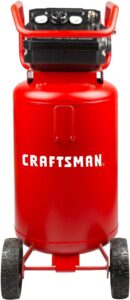
What makes this the home garage champion is the thoughtful design for non-professional users. The oil-free pump requires no maintenance schedule – just drain the tank occasionally and keep using it. The control panel features large, easy-to-read gauges and a simple regulator that’s intuitive even for first-time compressor owners. The vertical design takes up minimal floor space (about 2 square feet), leaving room for toolboxes, workbenches, and vehicle maneuvering in crowded garages.
The build quality exceeds expectations for the price point. The powder-coated tank resists rust in humid garage environments, and the belt-drive design runs cooler and quieter than direct-drive competitors. At 78 dB, it’s noticeably loud during operation but acceptable for garage use where noise tolerance is higher. The included wheels make repositioning easy, and the wraparound handle protects controls during movement. For DIYers stepping up from pancake compressors or homeowners building their first serious garage workshop, the Craftsman 20-gallon vertical delivers professional capability without professional complexity or cost.
Specs: 20 gallon, 5.5 CFM @ 90 PSI, 1.8 HP, 78 dB
Best For: Home garage, automotive work, multiple tool use
My Rating: 4.7/5 stars
Read Full Review | Check Price on Amazon →
California Air Tools CAT-10020 – Quietest Vertical
California Air Tools brings their revolutionary quiet technology to the vertical compressor category with the CAT-10020, and the result transforms garage workshops. At 70 dB, this compressor runs at normal conversation level – you can literally talk on the phone, listen to music, or have a conversation while it’s running. For anyone with an attached garage, neighbors within earshot, or family members who complain about compressor noise, this changes everything about when and how often you can use air tools.
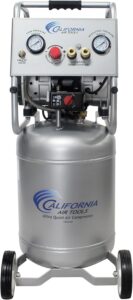
The performance matches the peaceful operation. The 10-gallon tank with 4.8 CFM at 90 PSI handles impact wrenches, air ratchets, and extended nailer use without struggle. The 2.0 HP motor provides faster recovery than you’d expect from a 10-gallon tank, and the efficient pump design means the compressor cycles less frequently than comparable models. The oil-free dual-piston pump requires zero maintenance while delivering consistent performance across thousands of cycles.
What elevates the CAT-10020 beyond just “quiet” is the overall build quality. The steel tank features a powder-coated finish that resists corrosion, and the aluminum pump head dissipates heat efficiently for extended run times. The control panel is straightforward with clear gauges and accessible regulators. At 84 pounds with integrated wheels, it’s manageable for repositioning within the shop. The compact 10-gallon vertical footprint takes up minimal floor space while the tall profile keeps controls at a convenient working height. For residential garage workshops where noise has been a limiting factor, the California Air Tools CAT-10020 removes that barrier while delivering legitimate workshop-grade performance.
Specs: 10 gallon, 4.8 CFM @ 90 PSI, 2.0 HP, 70 dB
Best For: Noise-sensitive garages, residential workshops
My Rating: 5/5 stars
Read Full Review | Check Price on Amazon →
Quincy QT-54 – Professional Grade Vertical
The Quincy QT-54 represents what happens when a company with decades of industrial compressor expertise builds a vertical unit for serious users. This is the compressor that professional mechanics, body shops, and manufacturing facilities choose when reliability and longevity matter more than initial cost. The 30-gallon tank paired with 6.5 CFM at 90 PSI provides genuine professional capacity – running multiple tools simultaneously, extended spray gun sessions, or continuous impact wrench use without performance degradation.
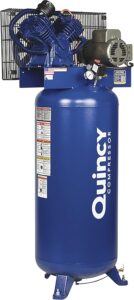
What separates the Quincy from consumer-grade compressors is immediately apparent in the construction. The oil-lubricated, cast-iron pump is built for 20-30+ years of daily use, not occasional weekend projects. The belt-drive design runs cooler and quieter than direct-drive models while enabling easier maintenance and longer component life. The 2 HP motor delivers consistent power without the surging or struggle that reveals cheaper units under load. Professional features like the aftercooler, automatic tank drain, and pressure switch designed for millions of cycles demonstrate Quincy’s industrial heritage.
The investment makes sense when calculated across the compressor’s lifespan. While the upfront cost is 2-3x a budget vertical, the Quincy typically outlasts three or four consumer compressors while providing superior performance throughout. The oil-lubricated design requires maintenance – checking oil levels, changing oil periodically – but this is standard practice in professional environments where downtime costs money. At approximately 200 pounds, it’s a permanent installation rather than a portable unit. For professional shops where the compressor runs 4-8 hours daily, restoration professionals who depend on spray guns producing flawless finishes, or serious hobbyists who want to buy once and never worry again, the Quincy QT-54 delivers industrial reliability at a semi-professional price point.
Specs: 30 gallon, 6.5 CFM @ 90 PSI, 2 HP, oil-lubricated
Best For: Professional shops, daily heavy use, longevity
My Rating: 4.8/5 stars
Read Full Review | Check Price on Amazon →
PORTABLE TIRE INFLATORS
Portable inflators and 12V compressors serve a completely different purpose than workshop compressors – they’re about convenience, emergency preparedness, and mobility rather than running pneumatic tools. These compact units excel at tire inflation, sports equipment, air mattresses, and roadside emergencies where lugging a 50-pound compressor simply isn’t practical. Modern portable inflators have evolved dramatically from the anemic 12V units of the past, now delivering legitimate performance that can inflate truck tires from flat in reasonable timeframes.
The key advantage is having inflation capability exactly when and where you need it. Cordless battery-powered models eliminate the need for vehicle power connections entirely, while 12V units connect directly to vehicle batteries for unlimited runtime. Digital pressure gauges with auto-shutoff functionality mean you set your target pressure and walk away – no more over-inflation or constant monitoring with analog gauges.
Whether you’re an off-road enthusiast who adjusts tire pressure for different terrain, an RV owner managing multiple large tires, or simply someone who values preparedness for roadside emergencies, modern portable inflators deliver performance that was impossible just a few years ago. The best models now rival gas station air compressors for speed while fitting in your glove compartment or tool bag.
Viair 400P – Best Portable for Trucks/RVs
The Viair 400P is the portable inflator that serious truck and RV owners rely on when tire pressure matters. This isn’t a toy for topping off sedan tires – the 2.3 CFM output and 150 max PSI capability handle large truck tires, dual rear wheels, and even RV tires without the interminable wait times that plague lesser inflators. The direct-drive permanent magnet motor delivers consistent power across the entire inflation cycle rather than fading as pressure builds.
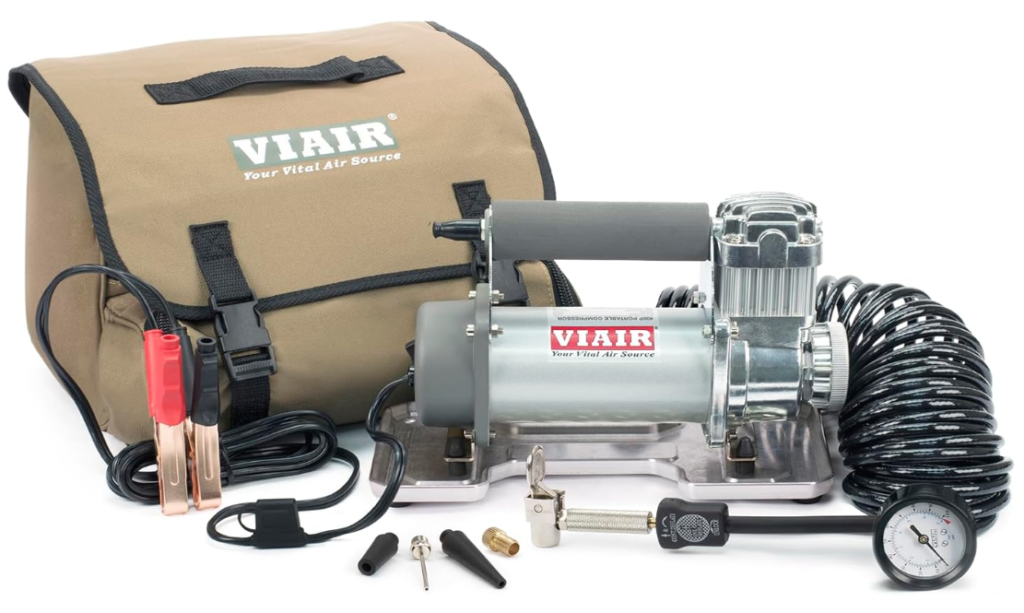
What separates the Viair from consumer-grade portable inflators is the duty cycle and build quality. This unit is designed for continuous operation on large-volume tires – the kind of inflation work that overheats and burns out cheap inflators. The heavy-duty power cord with inline 40-amp fuse connects directly to your vehicle battery for unlimited runtime, and the extended air hose reaches all wheels without repositioning. The included pressure gauge is accurate and easy to read, though it lacks the auto-shutoff convenience of digital models.
The durability becomes apparent through years of use. Off-road enthusiasts who air down for trails and air up for highway driving put these through hundreds of inflation cycles, and the Viair consistently performs without degradation. The thermal overload protection prevents damage from extended use, and the serviceable design means simple repairs rather than complete replacement. At approximately 5 pounds, it’s portable but substantial – this is a tool rather than a gadget. For truck owners, RV travelers, and off-road enthusiasts who need legitimate portable inflation capability for large tires, the Viair 400P delivers professional performance in a package that fits behind your seat.
Specs: No tank, 2.3 CFM, 12V powered, 150 max PSI
Best For: Truck tires, RV tires, off-road vehicles
My Rating: 4.4/5 stars
Read Full Review | Check Price on Amazon →
DeWalt DCC020IB – Best Cordless Inflator
The DeWalt DCC020IB transformed portable inflation by eliminating the power connection entirely. Using DeWalt’s 20V MAX battery system, this cordless inflator provides genuine freedom – no vehicle connection needed, no power outlet required, just grab and go inflation wherever you need it. The digital gauge with auto-shutoff functionality means you set your target PSI, press start, and the inflator stops automatically at the exact pressure – no more over-inflation or constant monitoring.
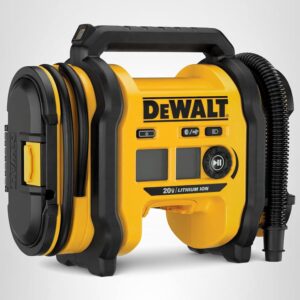
The performance surprises users who expect cordless to mean compromised capability. A single 20V 5Ah battery inflates four average car tires from 0 to 35 PSI, or tops off dozens of tires that just need a few PSI. The high-pressure inflation mode reaches 160 PSI for bike tires, while the high-volume mode handles air mattresses and sports equipment efficiently. The threaded chuck connection provides leak-free attachment, and the integrated LED work light proves invaluable for nighttime roadside use.
What makes this the cordless champion is the integration into DeWalt’s massive 20V MAX ecosystem. If you already own DeWalt cordless tools, you’ve got compatible batteries ready to go. The compact size (roughly the dimensions of a cordless drill) stores easily in trunks, tool bags, or even large glove compartments. The digital display is clear and backlit for visibility in all conditions, and the intuitive controls require no learning curve. For anyone who values cordless convenience, already invests in the DeWalt ecosystem, or simply wants the most user-friendly inflation experience, the DCC020IB delivers professional capability without wires, connections, or complexity.
Specs: Battery powered (20V), digital gauge, auto-shutoff
Best For: Cordless convenience, car tires, bike tires
My Rating: 4.7/5 stars
Read Full Review | Check Price on Amazon →
LARGE STATIONARY / TWO-STAGE COMPRESSORS
Two-stage and large stationary compressors represent the pinnacle of shop air systems – these are the units that power professional body shops, manufacturing facilities, and serious woodworking operations where air tools run continuously throughout the workday. The two-stage compression process (air is compressed twice, sequentially) delivers higher efficiency, cooler operation, and the ability to maintain pressure under constant demand that would overwhelm single-stage compressors.
These 60-80 gallon behemoths deliver 10-15+ CFM at 90 PSI, which translates to running multiple impact wrenches simultaneously, extended spray gun sessions without pressure drop, or powering entire pneumatic assembly lines. The massive tank capacity means tools draw air without triggering constant compressor cycling, and the higher horsepower motors (5-10 HP) require 220V power but provide the sustained output that professional operations demand.
The investment in a two-stage compressor is substantial – both in upfront cost and installation requirements (220V electrical, proper mounting, sometimes dedicated ventilation). But for professional shops where downtime costs money, hobbyists building serious manufacturing capability, or any operation where air tools are production equipment rather than occasional accessories, two-stage compressors deliver the reliability, capacity, and longevity that justify their professional positioning.
Ingersoll Rand SS3J5.5GH-WB – Industry Standard Two-Stage
The Ingersoll Rand SS3J5.5GH-WB has earned its reputation as the default professional shop compressor through decades of proving itself in the harshest environments. This 60-gallon two-stage unit delivers 11.5 CFM at 90 PSI with the rock-solid reliability that body shops, automotive service centers, and manufacturing facilities depend on daily. The 5.5 HP motor paired with Ingersoll Rand’s legendary two-stage pump design provides consistent performance across 8-12 hour work shifts without the thermal degradation that reveals lesser compressors.
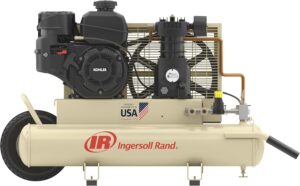
What separates Ingersoll Rand from competitors is the obsessive focus on longevity and serviceability. The cast-iron pump components are built for millions of cycles rather than thousands. The Swedish-made pump features replaceable wear components, meaning routine maintenance extends lifespan indefinitely rather than requiring complete replacement. The industrial-grade motor runs cooler and more efficiently than consumer motors, and the premium pressure switch is designed for decades of operation. Professional shops report 20-30+ years of daily use from these units with nothing more than routine oil changes and occasional valve replacements.
The build quality is immediately apparent – this is a 400+ pound permanent installation, not something you move around casually. The 60-gallon vertical tank maximizes capacity while minimizing floor space footprint. The control panel features industrial-grade gauges and a reliable pressure switch positioned for easy access during maintenance. The 175 max PSI capability provides faster recovery times and enables running high-pressure tools like sanders and die grinders at optimal performance. For professional operations where compressor failure means lost revenue, body shops where spray gun performance directly impacts finish quality, or manufacturing facilities running pneumatic tools continuously, the Ingersoll Rand SS3J5.5GH-WB represents the industry benchmark for reliability and performance.
Specs: 60 gallon, 11.5 CFM @ 90 PSI, 5.5 HP, 175 max PSI
Best For: Professional shops, body shops, manufacturing
My Rating: 4.3/5 stars
Read Full Review | Check Price on Amazon →
Quincy QT-7.5 – Heavy-Duty Professional
The Quincy QT-7.5 represents what happens when a company with over a century of industrial compressor expertise builds a unit for the most demanding applications. This 80-gallon two-stage compressor delivers 13.7 CFM at 90 PSI – enough to run multiple high-demand tools simultaneously, power entire pneumatic assembly lines, or support spray booths with the sustained airflow that professional finishing demands. The 7.5 HP motor requires 220V single-phase or three-phase power, signaling this unit’s serious professional positioning.
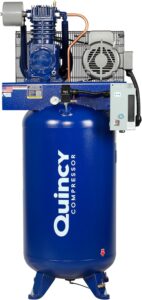
What makes Quincy compressors legendary in industrial settings is the engineering obsession with continuous duty cycles. The cast-iron, splash-lubricated pump runs cooler than competing designs, enabling truly continuous operation without thermal shutdown concerns. The oversized flywheel and counterweights eliminate vibration that causes premature wear, and the pressure-lubricated crankshaft bearings are built for decades of constant use. The two-stage compression process means the pump works less hard to achieve target pressure, resulting in cooler operation, longer component life, and higher efficiency that reduces electrical costs over the compressor’s lifespan.
The industrial features demonstrate Quincy’s professional focus. The automatic tank drain eliminates manual moisture removal, the magnetic starter protects the motor from voltage fluctuations, and the aftercooler removes heat from compressed air before it enters the tank. At approximately 600 pounds, this is a permanent installation requiring proper mounting and often professional electrical service. The maintenance requirements are straightforward but mandatory – oil changes, belt inspections, and periodic valve checks keep the compressor operating optimally. For industrial operations running multiple shifts, woodworking shops with extensive pneumatic tool collections, or any facility where air availability directly impacts production capacity, the Quincy QT-7.5 delivers industrial reliability that justifies its premium through decades of dependable service.
Specs: 80 gallon, 13.7 CFM @ 90 PSI, 7.5 HP, two-stage
Best For: Industrial use, constant duty, multiple users
My Rating: 4.9/5 stars
Read Full Review | Check Price on Amazon →
UNDERSTANDING AIR COMPRESSOR SPECIFICATIONS
Choosing the right air compressor requires understanding the specifications that actually matter. Marketing materials love to emphasize flashy numbers, but only a few specs truly determine whether a compressor will work for your applications. Here’s what you need to know to make an informed decision.
CFM (Cubic Feet per Minute) – The Most Important Specification
What it measures: CFM measures the volume of air a compressor delivers over time. Think of it as the “flow rate” – how much air moves through your tools per minute.
Why it matters more than anything else: CFM determines what tools you can actually run. A compressor with insufficient CFM will run your tool sluggishly, cycle constantly to catch up, or fail to operate the tool altogether. Tank size matters far less than CFM – a 6-gallon compressor with high CFM outperforms a 20-gallon compressor with low CFM every single time.
How much CFM you actually need:
- Brad nailer: 0.5-2 CFM – These are the least demanding pneumatic tools. Even small pancake compressors handle brad nailers easily.
- Framing nailer: 2-4 CFM – Significantly more demanding than brad nailers due to larger fasteners and higher firing frequency. Budget pancake compressors struggle here.
- Impact wrench: 3-7 CFM – The range varies dramatically based on wrench size. A 3/8″ impact needs 3-4 CFM, while a 1/2″ model demands 5-7 CFM for full performance.
- Spray gun: 10-15 CFM – This is where most home garage compressors fail. Automotive spray guns need sustained, consistent airflow. Running out of air mid-panel ruins the finish.
- Sandblaster: 15-20+ CFM – Among the most demanding tools. Sandblasting requires large stationary or two-stage compressors. Anything smaller just frustrates you.
Pro tip: Always add 50% to your calculated CFM needs. Tools rarely run at their stated CFM continuously, and having overhead prevents constant compressor cycling and extends equipment life.
PSI (Pounds per Square Inch) – Pressure Matters, But Not How You Think
What it measures: PSI measures air pressure – essentially how “compressed” the air is inside the tank and delivery system.
What most tools actually need: The vast majority of pneumatic tools are designed to operate at 90 PSI. Some require 100-110 PSI, but 90 PSI is the industry standard. Your nail gun, impact wrench, ratchet, and spray gun all expect 90 PSI at the tool.
The PSI misconception: Higher maximum PSI does NOT mean more power or better performance for your tools. A 175 max PSI compressor doesn’t make your 90 PSI impact wrench any stronger. What higher max PSI DOES provide is faster tank refill time. When the tank pressure drops to the cut-in point (typically 100-120 PSI), the compressor restarts and builds back to max PSI faster with a higher ceiling.
What to look for: Most quality compressors offer 125-175 max PSI. This range is entirely adequate for all standard pneumatic tools. Don’t pay premium prices for 200+ PSI capability unless you have specific industrial applications requiring it.
Tank Size – Capacity Versus CFM
Tank size creates the most confusion in compressor shopping because it seems important but actually plays a supporting role to CFM.
1-6 gallon tanks: Portable compressors prioritizing job site mobility. Perfect for brad nailers and finish nailers where portability matters more than sustained use. These tanks refill quickly due to small volume but can’t support high-demand tools for extended periods.
6-20 gallon tanks: The home garage sweet spot. Provides enough capacity for impact wrenches, air ratchets, and moderate nailer use without constant cycling. Large enough to be useful, small enough to fit in crowded garages. Most DIYers and weekend warriors should focus on this range.
20-60 gallon tanks: Professional and serious hobbyist territory. These capacities support running multiple tools, extended spray gun work, and higher-demand applications. The larger tank acts as a buffer, allowing tools to draw substantial air without immediately triggering compressor restart.
60+ gallon tanks: Industrial and commercial applications. These massive tanks support continuous operation, multiple users, and the most demanding tools. The huge capacity means the compressor cycles less frequently, extending motor and pump life even under constant load.
The key insight: A small tank with high CFM beats a large tank with low CFM. The tank is just storage – CFM is the delivery capability. Think of it like a water hose: tank size is your bucket, CFM is your water pressure. A small bucket with a fire hose beats a swimming pool with a garden hose.
Noise Level – Decibels Matter More Than You Think
Compressor noise isn’t just an annoyance – it’s a limiting factor in when, where, and how often you can use your tools.
40-60 dB (Quiet – California Air Tools range): Genuinely quiet operation at conversation level. You can talk normally, take phone calls, or listen to music while the compressor runs. These models cost premium prices but transform attached garage workshops and noise-sensitive environments. For residential settings, the premium pays off in usability.
60-75 dB (Moderate – conversation level): Noticeable but not oppressive. You can still communicate without raising your voice. Acceptable for most home garage situations, especially detached garages where noise doesn’t carry into living spaces. This range represents the “quiet” models from mainstream brands like Makita.
75-85 dB (Loud – standard compressors): Most budget and mid-range compressors operate here. Comparable to a vacuum cleaner or garbage disposal – loud enough to be annoying, disruptive to household peace, and problematic for extended use. Hearing protection becomes advisable for multi-hour sessions. This is the price you pay for value-priced compressors.
85+ dB (Very loud – hearing protection required): OSHA requires hearing protection at 85 dB for extended exposure. Some cheap compressors exceed 90 dB, which is genuinely unpleasant and potentially damaging. If your compressor falls in this range, invest in quality hearing protection and accept that using it will disrupt anyone within earshot.
Practical consideration: If your workshop is an attached garage, near neighbors, or used during early morning or evening hours, quiet operation (60-70 dB) is worth significant premium. The difference between a $200 loud compressor you rarely use because of noise complaints and a $400 quiet compressor you use freely is stark.
Oil-Free vs Oil-Lubricated – Maintenance Versus Longevity
The oil question creates confusion because both designs have legitimate advantages depending on your priorities.
Oil-Free Compressors:
These use permanently lubricated bearings or Teflon-coated components that require no user maintenance. The appeal is obvious – zero oil changes, no oil level checks, no mess, no maintenance schedules.
Advantages:
- Literally zero maintenance beyond tank drainage
- Lighter weight for portability
- Can be stored or operated at any angle
- Lower upfront cost in most categories
- Cleaner operation with no oil carryover risk
Lifespan reality: Quality oil-free compressors last 10-15 years with regular use. Cheap oil-free compressors might fail in 3-5 years. The key is buying quality brands (Porter-Cable, Makita, DeWalt) rather than no-name discount models.
Best for: Portable compressors, occasional use, DIYers who want simplicity, job site applications where maintenance is impractical.
Oil-Lubricated Compressors:
These feature traditional splash or pressure lubrication systems requiring regular oil changes and level monitoring. The maintenance requirement feels old-school but delivers tangible benefits.
Advantages:
- Runs cooler under sustained load
- Operates more quietly (oil dampens vibration)
- Longer component life – 20-30+ years with maintenance
- Better performance in high-duty-cycle applications
- Serviceable design enables repairs rather than replacement
Maintenance reality: Oil changes every 50-100 hours of operation, which translates to yearly for most hobbyists or quarterly for professionals. Check oil level before each use. It’s simple maintenance but must be done.
Best for: Stationary compressors, professional/daily use, serious hobbyists planning decades of ownership, high-demand applications.
The bottom line: Neither technology is inherently “better” – they serve different priorities. Choose oil-free for convenience and portability, choose oil-lubricated for longevity and continuous-duty performance. Both can serve you well if properly matched to your application and usage patterns.
Understanding these five specifications – CFM, PSI, tank size, noise level, and lubrication type – enables informed compressor selection. Focus on CFM first, choose appropriate tank size for your workspace, decide on noise tolerance based on your environment, and select oil-free or oil-lubricated based on your maintenance preferences and duty cycle requirements.
HOW TO CHOOSE THE RIGHT AIR COMPRESSOR
Selecting the right air compressor isn’t about buying the biggest tank or highest PSI rating – it’s about matching the compressor’s capabilities to your actual tools, workspace, and usage patterns. Follow this systematic approach to identify the perfect compressor for your needs.
Match Your Tools – The CFM Calculation That Actually Matters
The single most important step in compressor selection is calculating your CFM requirements. Get this right, and everything else falls into place. Get it wrong, and you’ve bought an expensive paperweight.
Step 1: List all pneumatic tools you’ll use
Be realistic here. Don’t just list every tool you might someday own – focus on what you’ll actually use regularly. Write down:
- Brad nailer
- Framing nailer
- 1/2″ impact wrench
- Air ratchet
- Die grinder
- Etc.
Step 2: Find the CFM requirement for each tool
Check your tool manual or search “[tool model] CFM requirement” online. Most manufacturers list this specification. If you can’t find exact numbers, use these typical ranges:
- Brad nailer: 0.5-2 CFM
- Finish nailer: 1-2 CFM
- Framing nailer: 2-4 CFM
- 3/8″ impact wrench: 3-4 CFM
- 1/2″ impact wrench: 5-7 CFM
- Air ratchet: 3-5 CFM
- Die grinder: 4-6 CFM
- Orbital sander: 6-9 CFM
- Spray gun (automotive): 10-15 CFM
Step 3: Add 50% buffer for efficiency and real-world conditions
This is critical. Tools rarely run at their stated CFM continuously, and compressors rarely deliver their rated CFM under actual working conditions. The 50% buffer accounts for:
- Pressure drop through hoses and fittings
- Tools drawing peak CFM during demanding operations
- Temperature and altitude effects on compressor performance
- Preventing constant compressor cycling
Example calculation:
- Your most demanding tool: 1/2″ impact wrench at 6 CFM
- Add 50% buffer: 6 CFM × 1.5 = 9 CFM
- Choose a compressor rated for at least 9 CFM at 90 PSI
Step 4: Choose compressor with appropriate CFM rating
Buy a compressor that meets or exceeds your calculated CFM requirement AT 90 PSI. Don’t be fooled by CFM ratings at 40 PSI or other non-standard pressures – your tools need 90 PSI to operate properly.
Important consideration: If you plan to run multiple tools simultaneously, ADD their CFM requirements together before applying the 50% buffer. Running two 4 CFM tools at once requires a minimum 12 CFM compressor (8 CFM × 1.5).
Consider Your Space – Matching Compressor Type to Environment
Your workspace dictates practical compressor options more than you might think.
Job Site / Mobile Work:
Space is premium, and the compressor moves frequently between locations. Prioritize:
- Pancake compressors (6 gallon maximum) for portability
- Lightweight construction – under 30 pounds preferred
- Oil-free pump to handle transport angles and vibration
- Compact footprint that fits in truck beds alongside other tools
- Noise is secondary – outdoor job sites tolerate standard noise levels
Recommended models: Porter-Cable C2002, DeWalt DWFP55126, Bostitch BTFP02012
Home Garage / Weekend Warrior:
Permanent or semi-permanent installation with occasional repositioning. Balance capacity with space efficiency:
- 6-20 gallon vertical compressors maximize capacity while minimizing floor space
- Moderate noise tolerance acceptable for detached garages; quieter models for attached
- Oil-free or oil-lubricated both work well for occasional use
- Wheels essential for moving around garage during projects
- 110V power – most home garages have standard outlets
Recommended models: Craftsman 20-gallon vertical, California Air Tools CAT-10020, Husky 20-gallon
Professional Shop / Daily Use:
Permanent installation supporting daily operations. Prioritize performance and longevity:
- 20-60 gallon capacity for sustained high-demand use
- Oil-lubricated preferred for extended lifespan and cooler operation
- 220V power – higher horsepower motors require it
- Noise level matters if customers or employees spend hours near the compressor
- Serviceability important – choose brands with available parts and service networks
Recommended models: Quincy QT-54, Ingersoll Rand SS3, Champion VR7-12
Noise-Sensitive Environments:
Attached garages, residential neighborhoods, apartment workshops, or anywhere noise creates complaints. Quiet operation becomes the priority:
- California Air Tools entire lineup (40-70 dB operation)
- Makita quiet models (60-70 dB range)
- Premium pricing justified by usability and neighbor relations
- Smaller tanks acceptable since quiet models run more frequently without annoyance
- Consider installation location – further from living spaces reduces impact
Recommended models: California Air Tools (any model), Makita MAC210Q, Makita MAC2400
Factor in Duty Cycle – How Often You Actually Use It
Duty cycle – how frequently and for how long you run the compressor – determines whether budget or premium models make financial sense.
Occasional Use (Weekends, Seasonal Projects):
You run the compressor a few hours per month for specific projects, then it sits idle for weeks. Cost-effectiveness matters more than ultimate longevity.
- Oil-free budget models are perfectly fine – they’ll outlast your needs
- Consumer-grade brands (Porter-Cable, Craftsman, Bostitch) deliver good value
- Maintenance simplicity matters more than serviceability
- Don’t overspend on features you won’t leverage
Calculated lifespan: A quality oil-free compressor lasting 10-15 years at occasional use provides thousands of hours of service – more than adequate for hobby use.
Daily Use (Professional, Serious Hobbyist):
The compressor runs several hours most days, accumulating significant annual runtime. Longevity and reliability become critical.
- Invest in quality, oil-lubricated models for extended lifespan
- Professional-grade brands (Quincy, Ingersoll Rand) justify their premium
- Maintenance becomes routine – embrace oil changes as normal practice
- Higher initial cost pays off through decades of reliable service
Cost justification: A $600 oil-lubricated compressor lasting 25 years costs $24/year. A $200 oil-free unit replaced every 8 years costs $25/year but with downtime and disposal hassle.
Continuous Use (Industrial, Production Environment):
The compressor runs 8+ hours daily, often supporting multiple users simultaneously. Downtime costs money.
- Two-stage compressors only – single-stage units fail under continuous duty
- Industrial-grade required – consumer equipment won’t survive
- Redundancy may be necessary – backup compressor prevents production stops
- Professional installation and maintenance mandatory
Reality check: If you’re running continuous duty, you’re beyond DIY compressor shopping. Consult with compressed air professionals who can design proper systems with appropriate capacity, backup, filtration, and distribution.
🔧 Pro Tips: What Experienced Users Wish They’d Known
CFM matters infinitely more than tank size. New buyers fixate on gallon capacity, but CFM determines what you can actually do. A 6-gallon compressor with 5 CFM outperforms a 20-gallon compressor with 3 CFM every single time. The tank is just storage – CFM is the delivery capability.
Add 50% to your calculated CFM needs – seriously. This isn’t conservative oversizing – it’s accounting for real-world conditions. Hoses create pressure drop. Tools surge to peak CFM during demanding operations. Temperature and altitude affect compressor performance. That 50% buffer prevents frustration and extends equipment life by reducing compressor cycling.
Oil-free is NOT inferior for home use. The oil-free versus oil-lubricated debate creates unnecessary anxiety. Modern oil-free compressors from quality brands (Porter-Cable, Makita, DeWalt, Bostitch) reliably deliver 10-15 years of service with zero maintenance. Yes, oil-lubricated compressors last longer, but “longer than you’ll own it” is long enough. Choose oil-free for convenience or oil-lubricated for maximum longevity – both work well when properly matched to usage patterns.
Quiet compressors are worth the premium in residential settings. The price difference between an 82 dB standard compressor and a 60 dB California Air Tools model seems steep until you calculate the “opportunity cost” of noise complaints. A loud compressor you can only run limited hours versus a quiet compressor you use freely makes the premium disappear. If your workshop adjoins living spaces or you have close neighbors, quiet operation removes the biggest barrier to actually using your tools.
Duty cycle matters more than you think. The difference between occasional use, daily use, and continuous duty isn’t just frequency – it’s the difference between “good enough” and “appropriate engineering.” Running an occasional-use compressor daily burns it out prematurely. Using an industrial compressor occasionally wastes money on capacity you’ll never leverage. Match the compressor’s design to your actual usage pattern for optimal cost-effectiveness and reliability.
The “buy once, cry once” philosophy applies to compressors. Undersizing to save money leads to frustration, constant cycling, and premature replacement. Buying excessive capacity wastes money on features you’ll never use. The right compressor – properly sized for your tools, matched to your workspace, and appropriate for your duty cycle – serves you reliably for years or decades. Take the time to calculate correctly rather than guessing or buying based on “bigger seems better.”
Armed with your CFM calculation, workspace assessment, and duty cycle understanding, you’re ready to choose the compressor that actually serves your needs rather than the one with the flashiest marketing or lowest price tag. The right compressor makes your tools work properly, fits your space, and lasts as long as you need it to – making the investment worthwhile every time you pull the trigger on a nail gun or impact wrench.
ESSENTIAL AIR COMPRESSOR ACCESSORIES
Your air compressor is only as effective as the delivery system connecting it to your tools. These accessories transform a basic compressor into a complete, professional-grade air system that’s easier to use, protects your investment, and delivers better results.
50ft Hybrid Air Hose – The Hose That Actually Works
Standard rubber air hoses are heavy, stiff in cold weather, and develop permanent kinks that restrict airflow. Hybrid polymer hoses changed the game by combining flexibility, durability, and weather resistance in one package.
Why hybrid matters: The polymer construction stays flexible even in freezing temperatures, making winter garage work actually practical. The lightweight design (roughly half the weight of comparable rubber hoses) reduces fatigue during extended use and makes the hose easier to maneuver around vehicles and workpieces. The material resists kinking, abrasion, and oil/chemical exposure that degrades standard hoses.
50-foot length is the sweet spot for most garages and small shops – long enough to reach any corner without constant compressor repositioning, short enough to avoid excessive coiling and storage challenges. The 1/4″ NPT standard fittings ensure compatibility with virtually all pneumatic tools and compressors.
What to look for: 300 PSI working pressure rating, reinforced construction at bend points, brass or steel fittings (avoid plastic), and bright colors for visibility (yellow or orange prevent trip hazards).
Quick-Connect Fittings Set – Stop Wrestling With Threaded Connections
If you’ve ever struggled to thread an air fitting onto a tool while maintaining air pressure, or worn out tool threads through constant connecting and disconnecting, quick-connect fittings solve these frustrations instantly.
How they work: Industrial-type quick-connects (also called quick-couplers) use a spring-loaded collar that locks onto a matching plug in one second. Push together to connect, pull the collar back to release – no threading, no cross-threading, no damaged fittings.
The complete system approach: Buy a starter set with multiple plugs and couplers. Install couplers on your hoses and compressor outlet, install plugs on all your tools. Now every tool connects in seconds, and you can dedicate specific hoses to different applications without tool-swapping delays.
Performance consideration: Quality quick-connects maintain full airflow without restriction. Cheap models create pressure drops that starve high-demand tools. Look for automotive-grade or industrial-pattern fittings from Milton, ARO, or similar quality brands.
Practical benefit: The time saved over years of tool changes is substantial, but the real win is eliminating thread wear. Threaded connections deteriorate through constant use – quick-connects protect your expensive tools and fittings from premature replacement.
Inline Filter/Regulator Combo – Clean, Controlled Air Delivery
Compressed air contains moisture (condensation is inevitable during compression) and particles that damage tools and ruin paint jobs. An inline filter/regulator addresses both problems in one compact unit.
The filter function: Removes water vapor, oil carryover (from oil-lubricated compressors), and particulates before they reach your tools. This protection extends tool life dramatically – water causes internal rust and corrosion, while particles wear seals and damage precision components. For spray guns, filtration is non-negotiable – any contamination ruins the finish.
The regulator function: Allows precise pressure control at the tool rather than relying on the compressor’s main regulator. Different tools require different pressures – brad nailers work optimally at 70-90 PSI, impact wrenches need 90-100 PSI, tire inflation requires exact pressure matching. Adjusting at the tool rather than the compressor tank means you set and forget.
Combo unit advantages: Mounting the filter and regulator together in one unit saves space, reduces connection points (fewer potential leaks), and positions controls at convenient working height rather than at floor level near the compressor.
Installation location: Mount near your primary work area or at the end of your longest hose run. Include a drain cock at the filter bowl to remove accumulated moisture – this simple maintenance task prevents water from reaching your tools.
Auto-Rewind Hose Reel – Organization That Pays For Itself
Air hoses left coiled on the floor create trip hazards, develop permanent kinks from improper coiling, and suffer damage from being run over by vehicles or carts. A quality hose reel solves all these problems while making your shop look professional.
The auto-rewind advantage: Spring-loaded retraction mechanisms eliminate manual coiling. Tug the hose to your work area, use your tools, give a quick pull to unlock, and the hose retracts smoothly onto the reel. The automatic coiling prevents the loose loops and tangles that create kinks and damage.
Mounting options transform workflow: Ceiling-mounted reels maximize floor space and enable overhead hose routing that stays out of your way. Wall-mounted reels work perfectly in space-constrained garages. Swivel mounts allow the reel to rotate, preventing hose twist that restricts airflow and damages the hose over time.
Capacity considerations: Match the reel capacity to your hose length – a 50-foot reel for a 50-foot hose. Undersized reels force awkward coiling or leave excess hose hanging. The reel should accommodate your hose diameter (typically 1/4″ or 3/8″ ID) with the appropriate spring tension for smooth operation.
Long-term value: Hoses protected by reels last 2-3 times longer than floor-stored hoses. The organizational benefit alone justifies the investment – no more untangling kinked hoses before you can work. Quality reels from Reelworks, Goodyear, or Legacy last decades with minimal maintenance.
Tire Chuck with Gauge – Accurate Inflation Prevents Problems
Incorrect tire pressure causes premature wear, reduced fuel economy, poor handling, and safety risks. A quality tire chuck with an integrated accurate gauge ensures proper inflation every time.
Why built-in gauges matter: Separate gauges require removing the chuck to check pressure, releasing air with each check. Integrated gauge designs display pressure continuously during inflation – you see exactly when you hit target pressure and stop. This prevents over-inflation (which can damage tires and wheels) and eliminates the guesswork of separate-gauge workflows.
The lock-on feature: Quality tire chucks include a locking clip or lever that maintains connection without constant hand pressure. This becomes critical when inflating large truck tires or multiple tires – your hand doesn’t fatigue from maintaining pressure on the valve stem.
Gauge accuracy and types: Analog gauges (dial-type) are durable and don’t require batteries but can lose calibration over time. Digital gauges provide precise readings and are easier to read in low light but require periodic battery replacement. Either works well if properly maintained and occasionally verified against a known-accurate reference gauge.
Dual-head options: Some advanced tire chucks include both clip-on and threaded connections in one unit. The clip-on works for quick pressure checks and standard inflation. The threaded connection locks onto the valve stem for high-pressure applications (truck tires, RV tires) or extended inflation where maintaining connection is critical.
Practical reality: A $15-25 quality tire chuck with accurate gauge eliminates tire pressure problems and pays for itself through prevented tire wear and improved fuel economy. This is one of those unglamorous accessories that proves its value through years of reliable service.
These five accessories – hybrid hose, quick-connects, filter/regulator, hose reel, and tire chuck – transform a basic air compressor into a complete, professional-grade system. The combined investment is modest compared to your compressor cost, but the improvement in usability, tool protection, and workflow efficiency is substantial. Consider these essential components of your air system rather than optional add-ons.
FREQUENTLY ASKED QUESTIONS
What size air compressor do I need for my garage?
For most home garage use, a 6-20 gallon vertical compressor with 4-6 CFM at 90 PSI handles the typical mix of tools perfectly – nail guns for trim work, impact wrenches for automotive projects, air ratchets for tight spaces, and tire inflation for vehicles and equipment.
The specific size within that range depends on your most demanding tool. If you primarily run brad nailers and finish nailers, a 6-gallon pancake with 2.6 CFM works fine. If you regularly use a 1/2″ impact wrench for automotive work, step up to a 10-20 gallon vertical with 5-6 CFM. The vertical configuration maximizes capacity while taking up minimal floor space – typically about 2 square feet of footprint.
Quick sizing guide:
- Light use (nail guns only): 6 gallon pancake, 2.6 CFM
- Medium use (nail guns + occasional impact wrench): 10 gallon vertical, 4-5 CFM
- Heavy use (frequent impact wrench, air ratchet, die grinder): 20 gallon vertical, 5-6 CFM
Remember: CFM matters more than tank size. A 6-gallon compressor with 5 CFM outperforms a 20-gallon with 3 CFM for high-demand tools.
Oil-free or oil-lubricated – which should I choose?
Oil-free compressors require literally zero maintenance beyond draining the tank occasionally. No oil changes, no oil level checks, no mess, no maintenance schedules. They’re perfect for occasional use, portable applications, and anyone who values simplicity over ultimate longevity. Quality oil-free compressors from brands like Porter-Cable, Makita, DeWalt, and Bostitch reliably deliver 10-15 years of service – more than adequate for hobby and DIY use.
Oil-lubricated compressors require regular maintenance (oil changes every 50-100 hours, level checks before use) but reward that effort with 20-30+ years of reliable service. They run quieter because the oil dampens vibration, operate cooler under sustained load, and handle continuous-duty applications better than oil-free designs. The serviceable construction means you can replace worn components rather than discarding the entire unit.
Decision framework:
- Choose oil-free if: You use the compressor weekends/occasionally, portability matters, you value zero-maintenance simplicity, or you’re a homeowner/DIYer who wants “set and forget” operation.
- Choose oil-lubricated if: You use the compressor daily, plan to own it for decades, run high-duty-cycle applications, or operate a professional shop where longevity justifies maintenance effort.
The honest truth: Both technologies work well when properly matched to usage patterns. Neither is “better” universally – they serve different priorities. Oil-free gives you convenience, oil-lubricated gives you maximum longevity. Both will serve you reliably if you buy quality brands and use them appropriately.
How loud are air compressors?
Air compressor noise varies dramatically based on design, motor quality, and whether the manufacturer prioritizes quiet operation.
Standard compressors (75-85 dB): Most budget and mid-range compressors operate in this range – roughly equivalent to a vacuum cleaner or garbage disposal running. It’s noticeably loud, disruptive to household peace, and becomes fatiguing during extended use. You can work with this noise level in a detached garage or outdoor job site, but it’s problematic for attached garages or residential neighborhoods.
Quiet models (60-70 dB): Manufacturers like California Air Tools and Makita engineer compressors specifically for reduced noise. These units operate at conversation level – you can literally talk normally, take phone calls, or listen to music while the compressor runs. The premium pricing (typically 30-50% more than standard compressors) buys usability – you can work early mornings, late evenings, or anytime without noise complaints.
Ultra-quiet models (40-60 dB): California Air Tools’ quietest models operate at library-level volume. These are transformative for apartment workshops, attached garages with bedrooms overhead, or any situation where traditional compressor noise would be completely prohibitive.
Practical consideration: If your workshop adjoins living spaces, has close neighbors, or you work outside traditional hours, the premium for quiet operation pays for itself in usability. A loud compressor you can’t use freely is effectively more expensive than a quiet compressor you use without restrictions.
Hearing protection note: OSHA requires hearing protection at 85 dB for extended exposure. If your compressor exceeds this threshold and you’re running it for hours, invest in quality hearing protection to prevent long-term hearing damage.
Can I run multiple tools at once?
You can run multiple tools simultaneously only if your compressor’s CFM rating exceeds the combined CFM requirements of all tools running at the same time – and even then, you should add a 50% safety margin for real-world conditions.
Example calculation:
- Tool 1: Brad nailer requiring 2 CFM
- Tool 2: Air ratchet requiring 3 CFM
- Combined requirement: 5 CFM
- With 50% buffer: 7.5 CFM minimum
You’d need a compressor rated for at least 8 CFM at 90 PSI to run both tools simultaneously without performance issues.
The reality most users discover: Running multiple tools sounds great in theory but rarely happens in practice. Most workflows involve one person using one tool at a time. The exception is professional shops where multiple technicians work simultaneously – these operations need large stationary or two-stage compressors with 10-15+ CFM capacity.
Tank size doesn’t enable multiple tools: A common misconception is that larger tanks allow running more tools. Tank size just provides a buffer before the compressor cycles – it doesn’t increase airflow capacity. CFM determines what you can run, the tank determines how long before the compressor needs to refill.
What actually happens with insufficient CFM: Tools run sluggishly or won’t operate at full power, the compressor cycles constantly trying to maintain pressure, and performance degrades progressively as pressure drops. It’s frustrating and damages both the compressor (excessive cycling) and tools (improper operation).
What does CFM mean and why does it matter?
CFM (Cubic Feet per Minute) measures the volume of air a compressor delivers over time – essentially the “flow rate” of compressed air. Think of it like water flow from a hose: PSI is the pressure (how hard the water comes out), CFM is the volume (how much water flows).
Why CFM is the most important specification: CFM determines what tools you can actually run and how well they perform. A nail gun needs consistent airflow to fire rapidly. An impact wrench needs sustained CFM to deliver full torque. A spray gun requires continuous airflow to maintain proper atomization. Insufficient CFM means tools work poorly or not at all, regardless of tank size or PSI rating.
CFM is more important than tank size because the tank is just storage – CFM is delivery capability. A 6-gallon compressor with 5 CFM at 90 PSI will outperform a 20-gallon compressor with 3 CFM for high-demand tools every single time. The large tank without adequate CFM just means you wait longer between disappointments.
The CFM rating that matters: Always check CFM at 90 PSI, not at 40 PSI or other non-standard pressures. Manufacturers sometimes advertise inflated CFM numbers measured at low pressures, but your tools need 90 PSI to operate properly. The CFM at 90 PSI is the only number that predicts real-world performance.
Practical guideline: Match your compressor’s CFM rating to your most demanding tool, then add 50% for real-world conditions. If your impact wrench needs 6 CFM, buy a compressor rated for at least 9 CFM at 90 PSI. This buffer accounts for pressure drops, peak demand cycles, and keeps the compressor from running constantly.
How long do air compressors last?
Compressor lifespan depends more on usage patterns and quality than the oil-free versus oil-lubricated debate.
Oil-free compressors: 10-15 years with proper use. Quality oil-free units from reputable brands (Porter-Cable, Makita, DeWalt, Bostitch, California Air Tools) routinely deliver a decade or more of reliable service when used appropriately. The key is “proper use” – occasional to moderate duty cycles rather than continuous professional operation. Cheap no-name oil-free compressors might fail in 3-5 years, but quality brands justify their premium through longevity.
Oil-lubricated compressors: 20-30+ years with maintenance. Professional-grade oil-lubricated units (Quincy, Ingersoll Rand, quality Champion models) commonly serve for decades when properly maintained. The oil changes, level checks, and periodic valve service extend component life dramatically. Body shops and professional facilities often run the same compressor for 25-30 years, only replacing it when capacity needs change rather than due to failure.
What matters more than oil type:
Duty cycle: A compressor used weekends for hobby projects lasts far longer than one running 8 hours daily in a professional shop, regardless of oil type. Match the compressor’s design to your usage intensity.
Quality tier: A $200 budget compressor typically lasts 5-8 years. A $600 professional compressor lasts 15-25 years. The cost-per-year can actually favor the expensive unit when calculated across its lifespan.
Maintenance: Oil-lubricated compressors MUST receive regular oil changes. Oil-free compressors still need tank drainage to remove moisture. Neglected maintenance destroys compressors prematurely regardless of design.
Operating conditions: Clean, temperature-controlled environments extend life. Dusty, humid, or extreme temperature conditions accelerate wear. Simple air filtration and proper storage between uses makes substantial difference.
The honest assessment: A quality compressor properly matched to your duty cycle and maintained appropriately will outlast your need for it. Focus on buying appropriate quality for your usage rather than obsessing over maximum theoretical lifespan.
What’s the difference between single-stage and two-stage compressors?
Single-stage compressors compress air in one step – the piston draws in ambient air and compresses it to final pressure (typically 125-175 PSI) in a single stroke. This design works efficiently for pressures up to 150 PSI and suits the vast majority of home garage and light professional applications. Single-stage compressors are simpler, cost less, and require less maintenance.
Two-stage compressors compress air twice in sequence. The first-stage piston compresses air to an intermediate pressure (around 50-60 PSI), then a second-stage piston compresses it further to final pressure (typically 175 PSI). The two-step process runs cooler and more efficiently, particularly at higher pressures.
When single-stage is appropriate:
- Home garage use with typical pneumatic tools
- Occasional to moderate duty cycles
- Maximum pressure requirements under 150 PSI
- Budget constraints favor simpler design
- Workshop use by one person at a time
When two-stage becomes necessary:
- Professional shops running tools 8+ hours daily
- Multiple users operating tools simultaneously
- Continuous-duty applications where compressor rarely stops
- High-volume spray painting or sandblasting
- Industrial environments where efficiency matters for operating costs
The efficiency advantage: Two-stage compression generates less heat, which improves efficiency (compressed air contains more usable volume per energy input) and reduces wear (cooler operation extends component life). The difference becomes meaningful in continuous-duty professional applications but matters little for occasional use.
Cost and complexity: Two-stage compressors cost significantly more upfront and require more maintenance (two sets of valves, more complex pump assembly). This investment makes sense when duty cycle and usage patterns justify it, but it’s overkill for typical DIY applications.
The decision framework: If you’re asking whether you need two-stage, you probably don’t. Professional operations requiring two-stage capability recognize the need through compressor runtime, multiple-user demands, or specific high-volume tools. Home garage users should focus on properly sizing a quality single-stage compressor.
Do I need a quiet compressor?
Whether quiet operation justifies premium pricing depends entirely on your workspace location and usage patterns.
You absolutely need quiet operation if:
- Your workshop is in an attached garage with bedrooms above or adjacent
- You work in an apartment or condo with shared walls
- Close neighbors can hear your garage clearly
- You work early mornings (before 8 AM) or evenings (after 8 PM)
- Local noise ordinances restrict loud equipment use
- Family members complain about compressor noise
In these situations, a quiet compressor (60-70 dB) isn’t a luxury – it’s the difference between being able to use your tools freely versus being limited to specific hours or constant complaints. The premium pricing (typically $100-200 more than equivalent standard compressors) pays for itself through usability. A cheap loud compressor you can’t use when you want to is effectively more expensive than a premium quiet compressor you use freely.
Quiet operation matters less if:
- Your garage is detached from living spaces
- You work in a commercial shop or industrial area
- Neighbors are distant or noise-tolerant
- You only work during midday hours when noise is acceptable
- You already use hearing protection for other shop equipment
The California Air Tools advantage: Their entire lineup operates at 40-70 dB – conversation level or quieter. Users consistently report the transformative effect on workshop usability. Projects that were previously “weekend afternoon only” become “anytime” activities. The ability to work when inspiration strikes rather than when noise is acceptable dramatically improves the ownership experience.
Middle-ground options: Makita’s quiet models (60-70 dB) cost less than California Air Tools while still providing substantial noise reduction versus standard compressors. The Makita MAC210Q pancake and MAC2400 hot dog deliver excellent performance with moderate noise reduction at reasonable pricing.
The bottom line: Assess your specific situation honestly. If noise has ever prevented you from using tools when you wanted to, or if you’ve received noise complaints, quiet operation is worth significant premium. If your situation tolerates standard compressor noise, save your money for capacity or accessories that provide more value for your circumstances.
Related Resources
Check out our complete reviews directory, browse free welding calculators, or read about essential metal fabrication tools.