
A young welder messaged asking how to bid his first job—welding aerospace parts in the field. He was going to charge $20 per hour. That’s employee thinking, not business owner thinking. By the time he paid for gas to drive there, wear on his equipment, and his own cost of living, he’d lose money on every hour worked.
Here’s the reality: To charge $20/hour and actually make $20/hour profit, you’d need to charge clients $60-80/hour depending on your overhead. Most welders undercharge because they don’t understand the difference between salary and charge-out rate. They calculate what they want to make per hour, then charge that—forgetting about shop rent, insurance, truck payments, consumables, and profit to reinvest in the business.
This guide breaks down exactly how to calculate your true hourly rate, bid jobs accurately whether you’re supplying materials or using client equipment, factor in consumables and profit margins, and price competitively without cutting your own throat. You’ll see real examples with actual numbers so you can adapt the formulas to your situation.
Use our Weld Cost Calculator to instantly estimate job costs including labor, materials, consumables, and profit margins.

Jump to what you need
Calculating Your True Hourly Rate: Employee vs Business Owner
The fundamental mistake new welders make: confusing salary with charge-out rate. If you need $20/hour to pay your bills, you cannot charge clients $20/hour. That $20 is your take-home pay—but running a welding business costs money beyond your personal expenses.
Employee Thinking vs Business Owner Thinking
Employee thinking: “I need $20/hour to live on, so I’ll charge $20/hour.”
Business owner thinking: “I need $20/hour salary, plus I have shop rent, truck payment, insurance, electricity, internet, equipment maintenance, and I need to put profit back into the business. My charge-out rate needs to cover ALL of that.”
This is why even solo welders charge $50-100+/hour. That rate isn’t pure profit—it’s covering business expenses and personal salary combined.
The Cost of Doing Business Formula
Before you can price a single job, you must calculate your cost of doing business. This is your baseline—the minimum you must charge per hour to keep the lights on and pay yourself.
Step 1: List All Monthly Business Expenses
These are example numbers—yours will differ. The formula is what matters.
| Expense Category | Monthly Cost |
|---|---|
| Shop Rent | $1,000 |
| Electricity | $350 |
| Internet/Phone/WiFi | $150 |
| Truck Payment (Business Vehicle) | $450 |
| Insurance (Business Liability + Vehicle) | $300 |
| Your Salary (Personal Expenses) | $3,200 |
| TOTAL Monthly Expenses | $5,450 |
Important notes on these expenses:
Shop Rent: If you’re working from home, don’t skip this. Calculate what percentage of your home is dedicated to welding and apply that percentage to your mortgage/rent. It’s a legitimate business expense.
Insurance: In many states, you need at least $1 million in general liability coverage. In Florida, this runs about $50-100/month for a solo operator. Add vehicle insurance. If you hire employees, you’ll need workers’ comp (often 10-20% of their gross wages depending on state).
Your Salary: Calculate your personal monthly expenses (mortgage/rent, personal vehicle, health insurance, food, cell phone, utilities). Divide by 160 hours (40 hours/week × 4 weeks). That’s your minimum hourly salary need. Example: $3,200/month ÷ 160 hours = $20/hour minimum.
Step 2: Calculate Your Minimum Hourly Rate
Formula: Total Monthly Expenses ÷ Minimum Hours Worked Per Month = Hourly Rate
Using the example above:
$5,450 ÷ 160 hours = $34.06/hour
This is your break-even rate. Charge less than this and you’re literally losing money. This isn’t your charge-out rate yet—this is the minimum you need just to survive and keep the business running without profit.
Why 160 hours? Welding, like construction, is feast or famine. Some months you’re slammed with 60-hour weeks. Other months you’re scraping by with 30-35 hours. Base your calculations on the minimum (40 hours/week) to ensure you can survive the slow months.
Step 3: Reality Check – Why Shop Rates Are $65-100/Hour
Now you see why professional shops charge $65-75/hour for shop work and $85-125/hour for field work. Once you add:
- Equipment maintenance and replacement
- Consumables (covered separately in bids)
- Profit margin to reinvest in business
- Tax liabilities
- Employee wages (if applicable) + payroll taxes
That $34/hour break-even rate quickly becomes $65-80/hour minimum charge-out rate for sustainable business.

Bidding Jobs: Labor Only (Client Provides Equipment & Materials)
This is the simplest scenario: You’re hired to provide your time and skill. The client provides all equipment, materials, and consumables.
Example: 100 Aerospace Parts (Labor Only)
Job details:
- 100 parts to weld
- 20 minutes per part
- Client provides all equipment, materials, consumables
- Your hourly rate: $35/hour (from cost of doing business calculation)
Calculation:
20 minutes per part = 3 parts per hour
100 parts ÷ 3 parts/hour = 33.33 hours
Round up to 34 hours (always round up for safety buffer)
34 hours × $35/hour = $1,190 total bid
Critical point: Whether you use their equipment or bring your own, the price stays the same. They’re paying for your experience and time, not your tools. If their equipment is garbage and you bring your own, that’s less wear on their stuff and more on yours—it balances out. Don’t adjust pricing based on whose equipment is used.
Should You Charge Less for Using Their Equipment?
No. You’re being paid for your skill, experience, and time—not for your tools. If you use their equipment, great—that’s less wear and tear on your gear. If their equipment is inadequate and you bring yours, you’ve already factored that into your hourly rate through cost of doing business.
Should You Charge More for Bringing Your Equipment?
No. That’s already covered in your hourly rate. The only time you charge equipment fees separately is for specialty rentals (e.g., renting a specific piece of equipment you don’t own for a one-time job—then you pass that rental cost to the client).
Bidding Jobs: Full Service (You Provide Everything)
This is where most welders get lost. You’re supplying labor, materials, consumables, equipment—everything. The formula has more components but follows the same logic.
The Complete Bidding Formula
Total Job Cost = (Labor Hours × Hourly Rate) + Materials + (Consumables % × Labor+Materials) + (Profit % × Everything)
Let’s break this down with a real example.
Example: 20 Custom Widgets (Full Service)
Job details:
- Client needs 20 custom fabricated widgets
- You supply: labor, materials, consumables, equipment
- Estimated: 10 hours of fabrication time
- Materials cost: $600 (steel, hardware, specialty components)
- 2 hours of logistics (ordering materials, coordinating delivery, prep)
Step 1: Calculate Labor Cost
10 hours fabrication + 2 hours logistics = 12 hours total
12 hours × $35/hour = $420 labor
Step 2: Add Materials
Materials: $600
Subtotal (Labor + Materials): $420 + $600 = $1,020
Step 3: Calculate Consumables (20% Rule)
Consumables include everything that gets used up during the job:
- Welding wire or electrodes
- Shielding gas (argon, CO2, mixed gas)
- Grinding discs and cutoff wheels
- Contact tips, nozzles, diffusers
- Tungsten electrodes (TIG)
- Oxy-acetylene (if used)
- Saw blades, drill bits
- Any other supplies consumed during fabrication
Rather than itemizing every single consumable (tedious and time-consuming), use the 20% rule:
Consumables = (Labor + Materials) × 0.20
Consumables = $1,020 × 0.20 = $204 consumables
New Subtotal: $1,020 + $204 = $1,224
Step 4: Add Profit Margin (10% Minimum)
This is NOT your salary—that’s already covered in your hourly rate. This is money to reinvest in your business: new equipment, replacing worn tools, marketing, building cash reserves for slow months, expanding operations.
Most new businesses don’t pay the owner much beyond bare salary for the first 1-2 years. You’re building the business, not getting rich immediately. The profit goes back into the company.
Profit = Total Cost × 0.10
Profit = $1,224 × 0.10 = $122.40 profit
Final Bid: $1,224 + $122.40 = $1,346.40
Round to $1,350 total bid
Breaking Down the Final Bid
| Cost Component | Amount |
|---|---|
| Labor (12 hours × $35) | $420 |
| Materials | $600 |
| Consumables (20%) | $204 |
| Profit (10%) | $122 |
| TOTAL BID | $1,350 |
How to Calculate Consumables Accurately
The 20% Rule: Quick and Reliable
For most welding jobs, consumables cost approximately 15-25% of combined labor and materials. The 20% rule splits the difference and provides a safe buffer.
Why 20% works:
- Simple to calculate mentally
- Covers typical consumable usage
- Provides buffer for unexpected consumption (bad welds needing rework, dropped parts requiring extra grinding)
- Scales appropriately with job size
When to Adjust the Percentage
Use 15% for:
- Simple, high-volume repetitive work
- Jobs with minimal grinding/finishing
- Clean materials requiring little prep
Use 25-30% for:
- Highly detailed work requiring extensive grinding
- Dirty/rusty materials needing aggressive prep
- Jobs with tight tolerances requiring rework
- Stainless steel (more expensive consumables)
Itemized Consumables (Advanced)
For very large jobs or when clients request itemized quotes, you can calculate consumables precisely:
Example for 10 hours of MIG welding mild steel:
- Wire: 2 lbs × $3/lb = $6
- Gas (CO2): 100 cubic feet × $0.20/cf = $20
- Contact tips: 2 × $1.50 = $3
- Nozzles: 1 × $2 = $2
- Grinding discs: 5 × $1 = $5
- Cutoff wheels: 3 × $2 = $6
- Total: $42 for 10 hours
With $350 in labor (10 hrs × $35), consumables are 12% ($42/$350). The 20% rule would give you $70—a comfortable buffer.
Adding Profit Margin: Why and How Much
Profit Isn’t Greed—It’s Business Survival
Many new welders feel guilty charging for profit. “I’m already making money from my hourly rate—why charge more?”
Because your hourly rate covers your personal bills and immediate business expenses. Profit covers:
- Equipment replacement: Your welder won’t last forever. Your grinder will die. Your table will rust. You need funds to replace them.
- Growth: Buying new equipment, upgrading to better tools, expanding your shop.
- Cash reserves: Slow months happen. Profit builds a cushion so you don’t panic when work dries up.
- Marketing: Website, business cards, advertising—all funded by profit.
- Unexpected expenses: Truck breaks down, welder needs expensive repair, insurance rates increase.
Standard Profit Margins
10% minimum: New businesses, competitive markets, high-volume work
15-20% standard: Established businesses, moderate competition, custom fabrication
25-30%+: Specialty work, rush jobs, unique skills, low competition
Don’t be afraid to charge 20-25% profit on complex custom work. If you’re the only welder in town who can TIG aluminum or do exotic alloys, your profit margin should reflect that specialized skill.
Staying Competitive Without Undercutting
Research Local Rates
Before setting your rates, find out what others charge in your area. Methods:
1. AWS Meetings: American Welding Society local chapters—network with other welders, casually ask about rates.
2. Facebook Groups: Local fabrication groups, welding communities—people often discuss pricing.
3. Direct Inquiry: Call shops as a potential customer, ask for quotes on a sample job. You’ll learn their rates.
4. RS Means: Construction cost database—subscription service that lists average rates by trade and region.
5. Small Business Development Centers: Many counties have free resources to help new businesses understand local market rates.
Typical Rates by Region (General Guidelines)
Shop Rates (Working in Your Facility):
- Rural areas, low cost of living: $45-65/hour
- Suburban, moderate cost of living: $65-85/hour
- Urban, high cost of living: $85-125/hour
Field Rates (Traveling to Client Site):
- Add $20-40/hour to shop rates
- Typical range: $85-150/hour depending on region and travel distance
Don’t Be the Cheapest—Be the Best Value
If everyone charges $75/hour and you charge $50/hour to “win” business, you’re doing three things wrong:
1. Undercutting the market: You’re making it harder for everyone (including yourself) to make a living. Clients will expect $50/hour forever.
2. Signaling low quality: “Why is this guy so much cheaper? What’s wrong with his work?”
3. Hurting yourself: You can’t sustain $50/hour long-term. You’ll burn out or go broke.
Better strategy: Charge market rate ($75) and compete on quality, reliability, and reputation. Show up on time. Do excellent work. Communicate clearly. Word of mouth will bring more business than being cheap ever will.
Field Rates vs Shop Rates: Why the Difference?
Field Work Costs More—Here’s Why
Travel time: You’re not welding while driving. That’s unpaid time unless you charge for it.
Vehicle wear: Gas, maintenance, depreciation—all costs of getting to the job site.
Unknown conditions: You don’t control the environment. Could be hot, cold, windy, dusty, cramped. You might not have power or need to run generators.
Less efficient: In your shop, everything is organized and within reach. In the field, you’re improvising with limited space and tools.
Higher liability: You’re working on someone else’s property with their employees around. More insurance risk.
Standard Markup for Field Work
Add $20-40/hour to your shop rate for field work.
Example:
- Shop rate: $65/hour
- Field rate: $85-105/hour
For long-distance travel (over 30 miles), add portal-to-portal time: charge for travel time at a reduced rate (50-75% of normal hourly rate), or add flat travel fees ($50-100 depending on distance).
5 Common Pricing Mistakes New Welders Make
1. Charging Employee Wages Instead of Business Rates
Thinking “I need $20/hour to live” and charging $20/hour. As we’ve shown, you need to charge $60-80/hour to actually net $20/hour after all expenses.
Fix: Calculate cost of doing business, then set your rate accordingly.
2. Forgetting to Include Consumables
Billing only for labor and materials, forgetting that welding wire, gas, grinding discs, and cutoff wheels cost real money.
Fix: Always add 20% for consumables on jobs where you supply them.
3. Not Adding Profit Margin
Thinking your hourly salary IS the profit. It’s not—that’s just your paycheck. Profit reinvests in the business.
Fix: Add 10-20% profit to every bid after calculating labor, materials, and consumables.
4. Underestimating Time Required
Thinking a job will take 10 hours when it really takes 15. You eat the difference and lose money.
Fix: Always add 10-20% buffer time. If you think it’s 10 hours, bid 11-12 hours. Better to finish early (client’s happy) than go over (you lose money).
5. Competing Only on Price
Racing to the bottom by being the cheapest quote. You win the job but can’t make a living.
Fix: Compete on quality, reliability, and reputation—not price. Charge market rate and deliver exceptional service.
Welding Job Estimator & Quote Calculator — $29
Want a client-ready quote instead of just the numbers? Excel + Google Sheets workbook for metal shops — cost, markup, and a clean customer quote. Job Estimator workbook on Etsy.
Frequently Asked Questions
What should I charge per hour as a mobile welder?
Field rates are typically $85-150/hour depending on your region and experience. Calculate your cost of doing business, add $20-40/hour for field work expenses (travel time, vehicle wear, less efficient working conditions), and compare to local market rates. New welders might start at $75-85/hour field rate, experienced welders $100-150/hour.
How do I calculate my hourly rate if I work from home?
Include a portion of your home expenses as business costs. If your garage is 400 square feet and your home is 2,000 square feet, 20% of your mortgage/rent, utilities, and insurance are legitimate business expenses. Add these to your cost of doing business calculation.
Should I charge for time spent estimating jobs?
For small jobs (under $500), no—estimating is part of business development. For large custom jobs requiring significant design time, material quotes, and detailed planning, yes—either charge a flat estimate fee ($50-150) that’s credited toward the job if they hire you, or include estimate time in your labor hours if you win the bid.
What if my calculated rate is higher than local competitors?
First, verify you’re calculating correctly—are you including unnecessary expenses? Second, check if competitors are undercharging (many do). Third, consider if your cost of living is higher than sustainable long-term. If your true rate is $75/hour but competitors charge $60/hour, you have three options: find ways to reduce overhead, target higher-end clients willing to pay for quality, or accept lower profit margins temporarily while building reputation.
How much should I charge for materials markup?
Some welders add 10-20% to material costs to cover procurement time and handling. This is legitimate—you’re spending time sourcing materials, coordinating delivery, and assuming liability if materials are wrong. However, it’s often cleaner to simply include your procurement time as billable labor hours (2-3 hours for material logistics) rather than marking up material cost directly.
What’s the difference between bid jobs and time-and-materials jobs?
Bid jobs (fixed price): You quote a total price upfront. You assume the risk—if it takes longer than estimated, you eat the cost. Client knows exactly what they’ll pay.
Time and materials (T&M): You charge hourly rate plus materials as you go. Client assumes the risk—if it takes longer, they pay more. Common for repair work or jobs with unknown scope.
New welders often prefer T&M to avoid estimation errors. Experienced welders prefer fixed bids because they’re better at estimating and can capture efficiency gains as profit.
Do I need to pay myself minimum wage as a business owner?
Not legally—as a sole proprietor, you can technically pay yourself nothing (though that’s not advisable). However, you should pay yourself a reasonable salary for the work you’re doing. Calculate your personal monthly expenses and divide by 160 hours. That’s your minimum salary need to avoid personal financial disaster.
How do I handle clients who say I’m too expensive?
Don’t defend or apologize. Calmly explain you charge market rates and your pricing reflects quality work, reliability, and proper insurance/licensing. Offer to show them how you calculated the bid (transparency builds trust). If they still balk, thank them and move on—clients who only care about price are usually the most difficult to work with and least profitable.
Should I offer discounts for repeat customers?
Loyalty discounts (5-10%) for established clients can make sense, but be strategic. Don’t discount so much you’re not profitable. Better approach: maintain your rates but offer priority scheduling, faster turnaround, or added value (free delivery, extra finish work) rather than cutting price.
How often should I raise my rates?
Review rates annually. If your costs increase (rent, insurance, fuel), raise rates accordingly. As you gain experience and reputation, raise rates 5-10% every 1-2 years. Inform existing clients of rate changes with 30-60 days notice, but consider grandfathering ongoing projects at old rates.
When the calculator looked profitable but actuals bled money, see Weld Cost Troubleshooting.
Choose contract shape before arguing inputs: Fixed Bid vs Time & Materials.
Related Tools & Resources
Need more welding and fabrication tools? Check out:
- What Is AWS D1.1? – When structural code compliance affects bid scope and overhead
- Weld Cost Calculator – Estimate job costs with labor, materials, and profit
- Filler Metal Weight Calculator – Calculate consumable needs
- Duty Cycle Calculator – Determine welder capacity for jobs
- Welding Calculators Hub – All welding tools in one place
- Free Calculators & Tools – Complete tool library
Cutting time is a separate bid line from weld metal: Cut-Cost & Time Estimator Guide.
Consumable underbids: Electrode & Wire Consumption Troubleshooting.
Welding
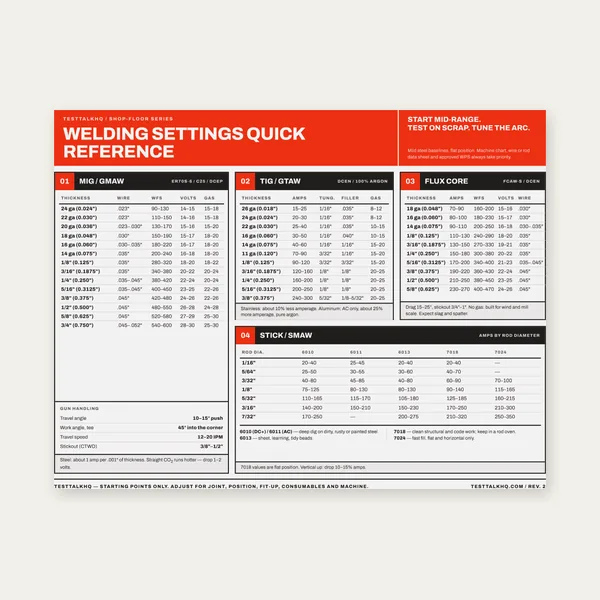
Welding Reference Card
One page. MIG, TIG, stick and flux core settings by thickness.
$3.99
Buy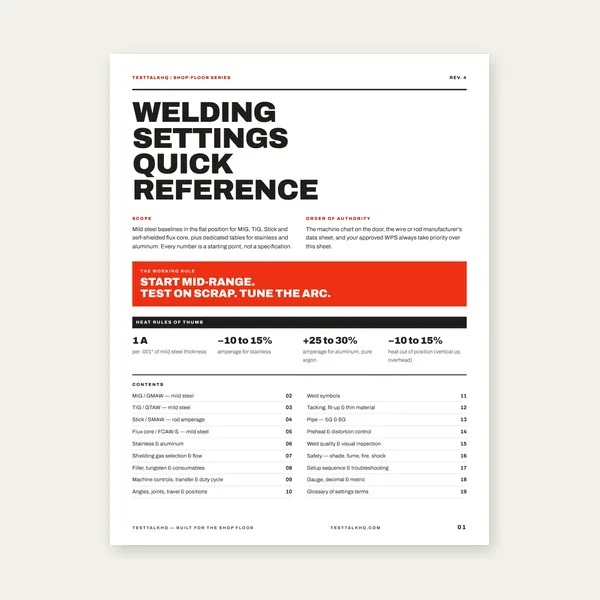
Complete Welding Settings Guide
19 pages. Four processes, stainless and aluminum, symbols and inspection.
$12.99
Buy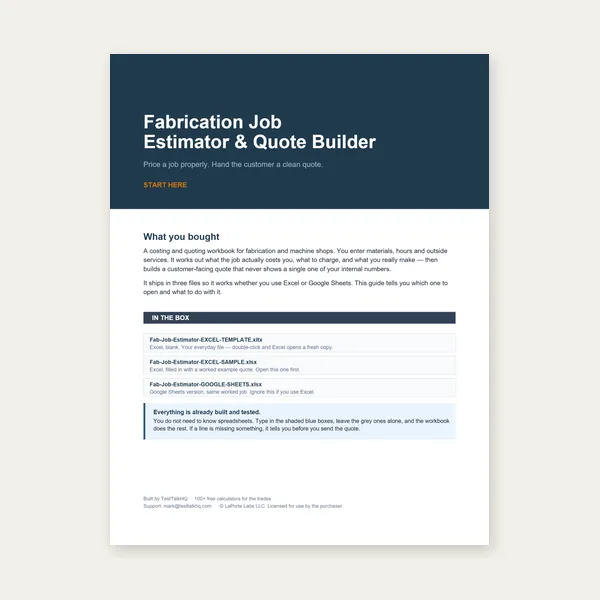
Welding Job Estimator
Price the job, then hand over a quote with no internal numbers.
Excel or Google Sheets. Best on a computer.
$29.00
Buy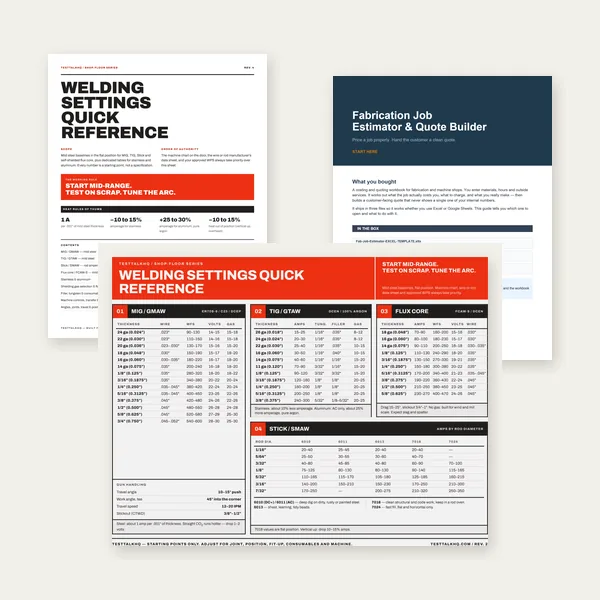
Welding Complete Bundle
Card, 19-page guide and the estimator workbook. All six files.
Excel or Google Sheets. Best on a computer.
$34.99
$45.98 if bought separately — save $10.99
BuyCheckout opens in a new tab.